
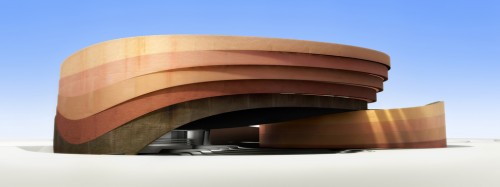

 Model of the new Design Museum Holon building, designed by Israeli-UK designer Ron Arad.
Design inspires art and craft. It can make life easier, more beautiful, sinful or divine. Design can also reflect the values of a place. It asks questions and explores cultural values. It can invite new green building materials, and make our lives more beautiful as we live in ecological harmony with our surroundings.
Currently without a home, Israeli design lovers are about to inaugurate a new museum in the city of Holon, expected to attract the highest caliber works in the field.
To be completed this winter, the Design Museum Holon was created by Israeli Ron Arad, who is considered one of the world’s top five designers. A recent retrospective of Arad’s work at the Center Pompidou in Paris and an exhibition at the MoMA in New York this past summer attracted droves of visitors.
Born in Tel Aviv, Arad has been based in England since 1973, when he moved there after graduating from Jerusalem’s Bezalel Academy of Art and Design. In 1994, he designed an auditorium at the Tel Aviv Opera House. He has designed furniture, products and structures all over the world.
When municipal representatives from Holon, south of Tel Aviv, approached Arad, they asked if he could design an iconic building that would “look good on a postage stamp.” Arad concurred and the deal has been signed, sealed and almost delivered.
This February, flanked by gravity defying red and orange steel waves, the museum will open its two large galleries to local and international exhibitors. Over the next five years, it will establish its own private collection that will be showcased but won’t be on permanent display.
Preserving by design
“We want to collect international design and Israeli design from the inception of the country to the ’70s. We know it’s being lost,” Jacob Peres, another Israeli-born designer who is currently working in the UK to promote the new museum, tells ISRAEL21c. “If nobody is collecting [this work], in 10 years’ time there won’t be anything left.”
Later this fall, Peres expects to bring a junket of UK-based and international media from glossy magazines to see the space and marvel at how so much can be built on shifting sand. Like Tel Aviv, a city that celebrates its 100-year anniversary this year, Holon was built on sand dunes. The “hol” in Holon is the Hebrew word for “sand.”
Once a relatively quiet, if not boring middle-class suburban town, Holon’s mayor Motti Sasson and his managing director, Hana Hertsman, decided to transform their city’s non-descript character. Starting 16 years ago, they earmarked municipal funds and invested heavily in the arts, culture, design, and festivals catering to specialty groups like children and women.
According to Peres, Holon’s Children’s Museum is one of the most popular in the country and “unbelievably successful.”
Top-notch international designers
The 2004 decision to erect an international-class design museum was part of a pledge to give back to the community – one that thirsts to know more about local designers and achievements, as well as what’s going on beyond Israel’s borders. And it should go some way to slaking that thirst, when it brings top-notch designers, products and installations to the Holy Land in the city of Holon. Tourists are expected to enjoy the facilities, too.
The opening exhibit in February will feature an all-star cast of four international curators – including design critic Julie Lasky from New York and Garth Walker, a prominent designer from South Africa – all of whom have been asked to select 100 objects in furniture, projects and installation work that examine eight themes in contemporary design.
Comprised of two square galleries for design and artifacts, the larger space, measuring about 5,382 square feet, will be built without columns and according to Peres will be filled with streaming natural light.
The Holon museum curators and staff – an active group of 10 -received the Innovation and Design Award for Culture from Conde Nast Traveller magazine this year. They are pledged to using the new space to seek out an enriching dialogue among designers, curators and the public.
International fashion, Japanese design…
A second exhibit later in 2010 will hinge on fashion and will include collaboration with two New York-based curators. A third exhibit, Senseware from Japan, will finish off the year, featuring Japanese textiles and technology some of which has never been showcased outside Japan.
Beyond the exhibition halls, a designer lab will provide a space where local and international designers can work in situ, as spectators watch from the sidelines.
A few Israelis have achieved great prominence in the design, architecture and fashion worlds. They include Moshe Safdie, architect and urban designer; Arik Levy, a founding partner of a multidisciplinary design studio in Paris; and Gadi Amit principal designer and founder of NewDealDesign studio in San Francisco, California. Also read Green Prophet’s Top 10 sustainable designers in Israel story.
According to Peres, Israelis like Levy and Arad are world leaders in design. “For sure,” says Peres, noting that an Arad chair can sell for thousands of dollars. “He’s up there with Starck… he’s a living artist.”
(This story first appeared on ISRAEL21c – www.israel21c.org)



RT @museummedia The Holon Museum Designs on Sand http://bit.ly/4d2tFP >>building design quite beautiful form
The Holon Museum Designs on Sand http://bit.ly/4d2tFP
Designer: The Holon Museum Designs on Sand | Green Prophet: A second exhibit later in 2010 will hinge .. http://bit.ly/lrJdd
The Holon Museum Designs on Sand | Green Prophet http://bit.ly/49Joq8
That's pretty cool RT @RachelWells The Holon Museum Designs on Sand: http://bit.ly/2Q5ql7
The Holon Museum Designs on Sand: http://bit.ly/2Q5ql7
RT @GreenProphet The Holon Museum Designs on Sand http://bit.ly/21shze
The Holon Museum Designs on Sand – Green Prophet (blog) http://bit.ly/2NlgPi
[…] Design can also reflect the values of a place. It asks questions and explores cultural values. Read More » Share and […]
.@greenprophet The Holon Museum Designs on Sand http://j.mp/3gcZ68 http://www.jewpi.com
RT @GreenProphet The Holon Museum Designs on Sand http://bit.ly/21shze