
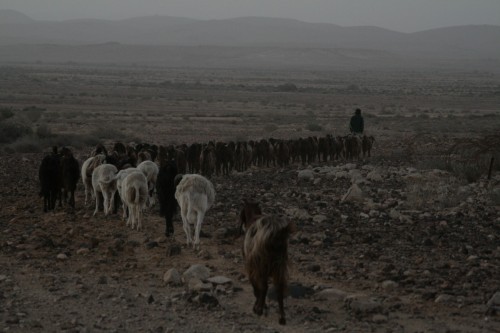


GreenProphet.com is trying out audio podcasting! Click here to listen to a morning with volunteer goat herder Robert Lavenstein. You can read along with the transcript below.
ROBERT LAVENSTEIN: That’s Shef.
DANIELLA CHESLOW: Chef?
RL: No, Shef.
DC: After graduating college, Robert Lavenstein came to Israel last summer through Worldwide Opportunities on Organic Farms. He’s from Chevy Chase, Maryland but has been goat herding at Mitzpe Ezuz, a 16-family community on the border with Egypt. The farm was founded in 1983 by Celia Friede, an immigrant from Kenya, and her husband. Robert and I went out with about 50 goats and six sheep on a December Monday, half an hour before the sun rose.
 RL: When we first came, Celia was like ‘You know, volunteers sometimes think sometimes they can go herding and they just sit there and they can bring a book and read for a few hours and it’s la-di-da-di-da.’
DC: What would happen if we sat down now and just read a book?
RL: We’d lose the herd! Just the other day, though, we were out and the herd divided. So we were leaving and all the sudden in the distance we see like just a group of them chilling, literally, eating some grass. And that’s when it gets really tricky because if one goat is missing, it’ll start crying because it knows that it needs to be with the other goats. But if the herd divides and it’s like 50 goats are together, and 50 goats are together it feels the same. So that’s when it’s really bad news.
DC: That’s when it’s time to start herding.
RL: You’ve got to pick up some stones.
DC: So you throw them in the direction you want them to go away from?
RL: Yeah, now they’ll run over there.
DC: The goats have their own internal logic.
RL: I don’t understand this. We were in a place that has plenty of food, and one of them gets a whiff of something, I don’t know, and darts, and all the goats are like ‘Oh my god, there must be something more exciting there!’ and they all start running after him. And it’s like guys, you were just at Costco, you know, why go to No Mans Land?
DC: Walking around the desert for five hours a day gives Robert a chance to get familiar with his surroundings, which remind him of a scene from one of Israeli writer David Grossman’s books.
RL: There’s a smell out here that every time I smell it its so distinct to this area, like a myrtle or rosemary melody of flavors. In the David Grossman chapter he was saying that he smells this thing and instantly this whole distinction of Israel as the homeland, or the Zionist enterprise, or Israel/Palestine, all these definitions of the land are stripped away.
DC: Sometimes he notices less pleasant things.
RL: This is where the military practices, so you’ll be walking and suddenly there’s like a huge piece of a bomb. This is a live bullet, you can see, I mean it hasn’t been shot yet.
DC: Robert said that leading goats through the empty desert can lead to some creative ways of entertaining himself.
RL: Sometimes I pretend that I am on, you know, a show, one of those nature shows. Because it gets boring out here. So you gotta occupy…
DC: How do you do the crocodile hunter?
RL: I’m slowly approaching a goat. From this distance you can see that it is pregnant, a rarity.
DC: The goats with the strongest personalities get names. Robert’s favorite is Don. 
RL: He’s a real gentleman actually. He courts the female goats. He’s kind of very cute. Just look at those teethies. And those eyes. He just reminds me of an Israeli from the seventies or something.
DC: Cuteness aside, herding the goats makes a unique bond between the herder and the animal.
RL: When you’re with a goat, and you spend the four hours or however long you graze with them, and then you feed them in the afternoon, and you go through their whole cycle and then you go through the milking at 3 or 4 in the morning, you appreciate the cheese that’s a product of that process, so much more than you do, or that I did before I did something like this.
DC: And herding in Israel has its own added meaning.
RL: I didn’t grow up in a rural area, so I never knew the rural man’s concerns, but to be here in a conflict that’s so based off of land, and then to be with people whose livelihood is based off the land, it provides a really interesting perspective to the conversations that we’ve had about policy and politics in Israel.
DC: Thanks for listening to the first podcast from GreenProphet.com. I’m Daniella Cheslow.


Assalyamu Aleykum
Dear Sirs
, I need to breed goats Damascus itself on my farm. I ask you to sell me a young goat. I am willing to pay for your goats. Send price for goats and goats Damascus breed.
What is the price for your goat?
Can you send me goats in Spain?
I am hope for your help . I am waiting for your quick reply.
With respect and best wishes,
Nail
I WOULD LIKE TO VOLUNTEER AS A GOAT HERDER. I AM IN JERUSALEM AND AM AVAILABLE ANYTIME. PLEASE CALL OR EMAIL ME WITH DETAILS. MOBILE 054-372-8467.
SHALOM, DAVID
Have you considered using dogs trained to herd and tend?
http://www.vimeo.com/2214976 – check out this goat-related video I co-produced. Well done on the podcast!
Wow! You’ve taken Green Prophet to a whole new level. Love it, Daniella.
– Karin
Daniella, you’re a natural! Next step ‘This American Life’….looking forward to listening to regular podcasts from your travels around this facinating land….