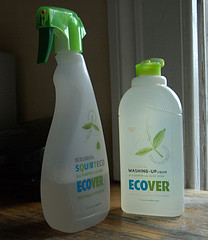
Does Dioxane Blow the Lid off Ecover’s Green Cover?

ecover bottle

Ecover is lauded by the United Nations for protecting the earth, and the company’s products scour many a lean and green TreeHugging homes — even ours.

Looking beyond the products’ labeling and phosphate-freeness, the Organic Consumer’s Association decided to do its own tests.

Among some of our favorite eco-brands emerged Ecover. The much-loved household product, it was found, tested positive for an alleged cancer-causing agent, known as 1,4-Dioxane.

Now before you jump into your nuclear-waste protection suits and dump all your Ecover products into a toxic waste site, what does this all mean?

Is dioxane something we should worry about?

According to Organic Consumers (see PDF), it is. They attempt to debunk the myth that minute amounts of dioxane are not harmful.

If you ask the late Dr. Bronner, of Dr. Bronner soaps, he would probably say that dioxanes are dangerous. But then again, Dr. Bronner’s soap tested for no detectable traces of dioxane, according to the Organic Consumer’s Association.

Ecover on the other hand, was found to have almost twice the amount of dioxane that regular off-the-shelf dish washing detergent (2.4 parts per million, versus 1.6). This is a bit worrying due to the trace amounts of soap that one ingests with every meal, and that the chemical has been linked to immune system disruption.

On the site Buygreenstandards, dioxane is also known as diethylene dioxide, diethylene ether, diethylene oxide, and it is not to be confused with dioxin, they write.

Dioxane is a solvent classified by the EPA as a probable human carcinogen, and some research suggests that it may suppress the immune system. Dioxane is listed in the 1990 Clean Air Act as a hazardous air pollutant and is on the EPA’s Community Right-to-Know list. Found in: Window cleaners.

One blogger, Allie’s Green Answers, who this TreeHugger blogged about here, was most concerned with the Ecover dioxane news, and the fact that she’s been promoting Ecover to her readers.

Ecover’s PR people responded with this:

Substantial quantities of dioxine [sic] are found in the production of synthetic fibers, such as polyester, a fabric that is worn daily by roughly 85 % of the planet’s population.

Mainly produced by two US companies, the ingredient is also used in high dosages as a solvent in mass production, including the paper and cotton industry as well as the polymer industry for the production of PET bottles.

It is therefore astonishing that the above-mentioned investigation turned a blind eye on such superabundant and well-spread sources and preferred to single out easy-to-research, mere minute traces of dioxine in detergents.

Several years ago, the European detergent industry put a limit on dioxane traces at 100 parts per million of surfactant. Ecover’s own criterion is set at half, namely 50 parts per million.

This leads to values as low as the 2,4 parts detected in the Ecover product. The threshold for reporting the presence of dioxane in tap water in The Netherlands, a country with a stringent environmental legislation, is 3 parts per million parts of water. This means that, in the unlikely event, you drank an entire bottle of pure Ecover Dishwashing liquid you still wouldn’t reach that threshold!”

We tend to be of the notion what doesn’t kill us makes us stronger, and that a little bit of dioxane, probably wouldn’t do any harm. It’s most likely that the testers are being overly-cautious, but then again, if you are paying higher “green” prices, one would expect a deluxe product.

Any dioxane/dioxin experts out there who can:

a) Tell us the difference between dioxin and dioxane?

b) Calm any unnecessary fears?

Karin Kloosterman
Karin Kloostermanhttp://www.greenprophet.com
Karin Kloosterman is an award-winning journalist, innovation strategist, and founder of Green Prophet, one of the Middle East’s pioneering sustainability platforms. She has ranked in the Top 10 of Verizon innovation competitions, participated in NASA-linked challenges, and spoken worldwide on climate, food security, and future resilience. With an IoT technology patent, features in Canada’s National Post, and leadership inside teams building next-generation agricultural and planetary systems — including Mars-farming concepts — Karin operates at the intersection of storytelling, science, and systems change. She doesn’t report on the future – she helps design it. Reach out directly to [email protected]

TRENDING

Street Vegan in Sri Thanu is a must-stop family lunch spot on Koh Phangan, Thailand

If you’re anywhere near Sri Thanu on Koh Phangan, Thailand, around the yoga centers: Zen Beach, Haad Yao, or Salad Beach—make time for Street Vegan. It's vegan and so satisfying that one meal might convince you that eating plant-based is not a compromise. I suggest for any vegan restaurant owner or chef to come to this modestly-priced venue to learn from a master.

Plants can eat dust and grow – should we stop dusting them?

Dusty plants? Let them eat their hearts out.

Paris Modest Fashion Week offers style without exposure for Muslims

France is home to around 5 to 7.5 million Muslims according to estimates, and Özlem Şahin, head of the organization behind Modest Fashion Week, has described Paris as "one of the leading modest fashion capitals in Europe".

Kids are vaping. The media shock that made them stop

On one side: aggressive anti-vaping campaigns from the FDA, Truth Initiative, and state programs, backed by over $100 million in annual spending. On the other: a public health crisis. Screenshot

Baby teeth read like tree rings paint a picture of toxins in early life

A new study from the Icahn School of Medicine at Mount Sinai in New York offers a striking insight into how the environments we are born into can quietly shape our brains years later. By analyzing naturally shed baby teeth, the ones tucked under pillows for the tooth fairy, researchers have reconstructed a detailed timeline of exposure to environmental metals during pregnancy and early infancy.

Nobul’s Regan McGee on Shareholder Value: “Complacency Is the Silent Killer” 

Why the governance framework designed to protect shareholders so...

Should You Invest in the Private Market?

startustartup Unlike public stock exchanges, which offer daily trading, strict...

How to build a 100-year-company

Kongō Gumi is a Japanese construction company, purportedly founded in 578 A.D., making it the world's oldest documented company. What can we learn about building sustainable businesses from them?

From Pilot Plant to Global Stage: How Aduro Clean Technologies’ 2026 Expansion Signals a Turning Point for Chemical Recycling Investors Like Yazan Al Homsi

The company's Next Generation Process (NGP) Pilot Plant in London, Ontario, has officially moved into initial operating campaigns, generating the kind of structured, repeatable data that separates laboratory promise from commercial viability.

How AI Helps SaaS Companies Reduce Repetitive Customer Support Work

SaaS products are designed for large numbers of users with different levels of experience, and also in renewable energy.

Pulling Water from the Air

Faced with water shortage in Amman, Laurie digs up...

Turning Your Energy Consultancy into an LLC: 4 Legal Steps for Founders in Texas

If you are starting a renewable energy business in Texas, learn how to start an LLC by the books.

Tracking the Impacts of a Hydroelectric Dam Along the Tigris River

For the next two months, I'll be taking a break from my usual Green Prophet posts to report on a transnational environmental issue: the Ilısu Dam currently under construction in Turkey, and the ways it will transform life along the Tigris River.

Related Articles

Popular Categories