


 I am not against public transportation. In fact, I am very much in favor. As a person who lives in Tel Aviv and does not own a car, I am completely dependent on my bike and the bus and train systems. What’s more, it often seems like the half a million vehicles that enter the city every day are all stuck in traffic right underneath my apartment, honking away at each other. Anything that can reduce traffic in the city has my support.
But let’s face it – Tel Aviv’s light rail is not just around the corner, and in fact it has never looked further away.
This week, the banks that were supposed to loan $1.4 billion to MTS, the consortium that won the tender for the project’s construction, announced that they cannot follow through on their commitments.
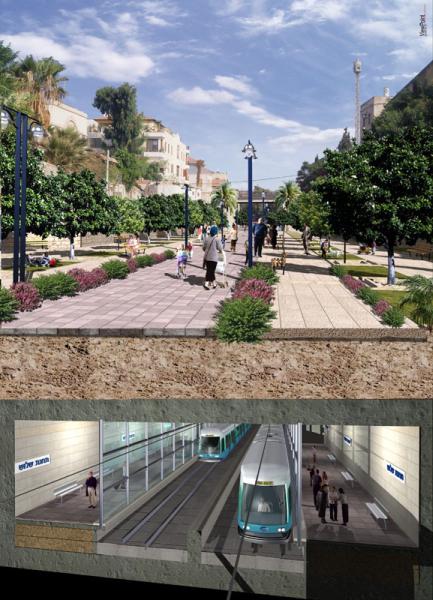
Right: A computer rendering of the underground section of Tel Aviv’s future mass transit system. (image via skyscraperlife.com)
This should not come as a huge shock. After MTS repeatedly failed to meet deadlines for securing financial backing for the project, the world financial crisis hit, taking out some of the key players: Bank of Scotland, a major lender, was nationalized, AIG, the insurer, collapsed, and the rest are now demanding fundamental changes in the tender, in light of lessons learned from Jerusalem’s light rail project. MTS will find it very difficult to make the next deadline in late January.
Tel Aviv’s light rail/subway, which has been in the planning stages since Golda Meir was in power, does not seem likely to be built in this generation. It’s time to start thinking outside the box.
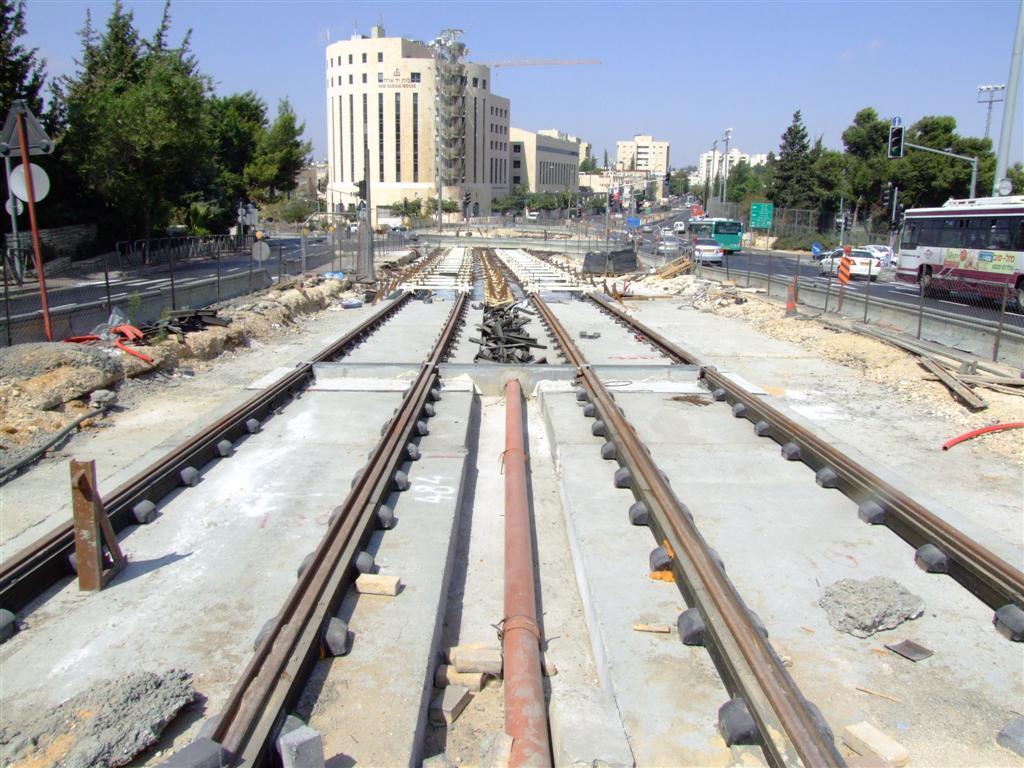
Right: Light rail tracks under construction in Jerusalem. (photo via skyscraperlife.com)
In Jerusalem, people have taken to calling the city’s light rail the “blight rail” (rakevet klala, a play on raveket kala). Meant to be up and running by 2006, the project is now on track to open in 2011.
From day one, the project was a headache for everyone involved. Engineering problems meant that tracks had to be ripped up and replaced. The company that won the tender claimed that the city wasn’t cooperative in issuing permits, sued the city, and won. Cost overruns had to be covered by taxpayers. The Calatrava bridge at the city’s entrance, planned without seeking the public’s input, ignited plenty of controversy. Jaffa Street, running through the center of downtown Jerusalem, looks like the site of an archaeological excavation. Jerusalemites are fed up of the traffic nightmare in their city. Shopowners on Jaffa Street have lost much of their business, and have started their own protest movement against the light rail. Former mayor Uri Lupolianski, who once thought he would time the opening of the light rail to occur just before the city’s elections, miscalculated and lost to Nir Barkat.
True, when the light rail finally starts running, it will be a huge benefit to the city – the air will be cleaner, it will be easier to get around, the city center might even come back to life. But the painful and incompetent process of planning and construction will likely deter other Israeli cities from building their own light rails. Haifa, for example, opted instead for a Bus Rapid Transit (BRT) system, based on extended buses in exclusive lanes. Newly elected Jerusalem mayor Nir Barkat has proposed that new lines in Jerusalem be based on this technology as well.
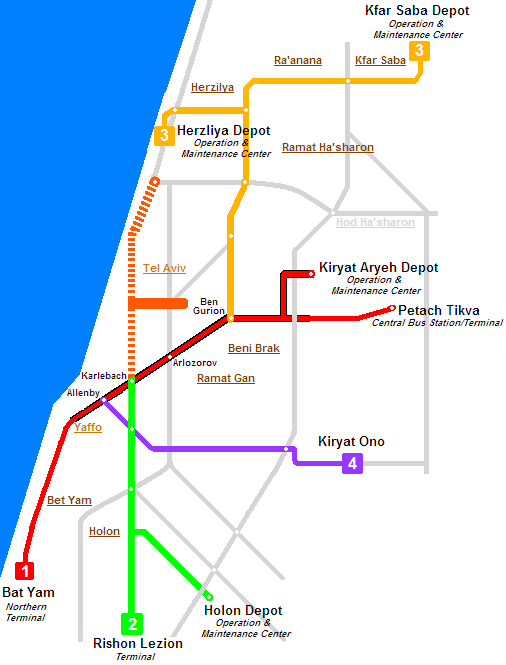 Left: Future subway and light rail lines planned for metropolitan Tel Aviv. (image via Wikipedia.com)
Meanwhile, in Tel Aviv, the city is still struggling to set up its first mass transit line. The Red Line, from Petach Tikva to Bat Yam is supposed to be part light rail, part subway.
At conference after conference, speakers harshly criticize the Tel Aviv Municipality. This is perhaps one of the only issues where the green organizations, the Treasury, the Environmental Protection Ministry, the Transportation Ministry and numerous citizens’ organizations are in absolute agreement. They all agree that Mayor Ron Huldai’s insistence on building transit lines underground inside Tel Aviv’s city limits is what is holding up the project. A subway is several times more expensive to build than a light rail, and the technical issues are infinitely more complex.
City officials counter that a subway is the only solution that satisfies technical requirements. Meanwhile, the city continues to widen roads, build new highways and dig underground parking lots for the approximately 60,000 new cars added to the road every year in metropolitan Tel Aviv.
While the discussion about mass transit in Tel Aviv continues to stagnate, circumstances have changed. The global credit crunch has made huge mega-projects unrealistic, at least for the foreseeable future. Shai Agassi’s Better Place Project, with its leased electric cars, and car-sharing programs like Car2Go are beginning to change the way people think about their relationship with the private vehicle. In response to the expected economic downturn, the Treasury is preparing plans for an economic stimulus package based on transportation and infrastructure projects (although, unlike Obama’s stimulus package, Israel’s will not contain much in the way of green thinking).
Let’s learn from Jerusalem’s mistakes. Tel Aviv doesn’t need an expensive subway and light rail system that will snarl traffic for the next decade, only to start running someone around 2020 with technologies that are already obsolete. If the city wants more breathable air, less traffic jams, less noise and traffic accidents, an immediate solution is needed. If only we had someone in City Hall capable of connecting the dots.
 A City for All’s team, now part of the City Council. (image via www.city4all.org.il)
But wait – we do. Now the largest faction on the city council, A City for All has a plan to reduce car traffic and create mass transit called “Mobility for All” (Hebrew link). Drawn up by a citizens’ forum, the plan is still being developed, but the idea will be to create immediate, comprehensive solutions to get people around the city. Despite being one of the only factions not to join Ron Huldai’s coalition, and therefore effectively the opposition, A City for All is thinking pragmatically about how to get things done based on finding common ground with coalition factions (more on this in future posts).
Faced with similar choices in the 1970’s, the city of Curitiba, Brazil used sheer ingenuity to create solutions to its transportation problems. There is absolutely no reason why Tel Aviv, which is blessed with one of the greatest concentrations of creative minds in the world, cannot come up with immediate and effective means of rescuing itself from the traffic jam it has been stuck in for over a decade.


[…] of 2011, Jerusalem finally got its much anticipated light rail (after years of construction). The light rail was intended to offer a comfortable and eco-friendly means of transportation to Jerusalem’s […]
[…] long-term plans for a light rail system in Tel Aviv fell through a few months ago, politicians have been scrambling to offer the city another efficient public […]
[…] It sometimes seems to me that there must be some kind of curse on all things transportation in Tel Aviv. The traffic jams are unbearable, the drivers obnoxious, the buses lousy and the bus station even lousier. And who even knows if the light rail/subway project will ever actually happen… […]
Toronto is absolutely right. Not investing in public transport is false economy, and you pay a higher price in terms of congestion, delays (which affects the economy) and pollution. I used to live in Athens and getting around was a nightmare. It suffocated not only the city’s air but led to a stagnant mentality and ‘can’t do’ attitude. The dramatic expansion of public transport has been of huge benefit to citizens and economic development, making access to jobs easier and hence better market attraction. The same needs to happen in Tel Aviv, overeliance on cars is simply not sustainable. In fact Tel Aviv should be planning not just light rail but a full Tube and 100% accessible bus fleet such as exists in London. Tel Aviv should aim to have a ‘London Transport’ of the Middle East.
[…] volumes about the city’s planning policy. Increasingly, the mythical light rail, which is still not even close to implementation, is looking like a smoke […]
Will the Tel Aviv Light Rail Ever Happen? Do We Want it To? http://tinyurl.com/5dx2qy
A significant issue here is the high mortality rate due to automobile accidents on the Israeli roads. Just today, the heinous deaths of these Russians on the tour bus down by Eilat! If there was a light rail, the safety would be a huge comfort to travellers.
Also I should refer you all to take a look at a very popular public transport discussion-blog here in Toronto by a fellow named Steve Munro, who has been an expert on the matter for over 30 years.
His articles are extremely insightful, and many of them have relevance outside of Toronto, and give an impression of what the issues might be in Tel Aviv in the future.
http://www.stevemunro.ca
I am a transport engineer here in Toronto, Canada, and I have a great interest in Tel Aviv’s planning/transportation problems; when I see a relatively young and growing city such as Tel Aviv, I like to compare it to our experiences here, and I sincerely hope that you can learn from some of our mistakes and successes.
To me it seems that Tel Aviv is in much the same situation that Toronto was in 50 years ago: a young, fast growing city that is trying to decide what its development and transport model will be for the next 5, 10, 25, and 50 years. Here in Toronto, we have followed two paths: on one hand, we have built a strong public transport system of buses, light rail, and subway, but on the other hand we have also built and widened many roads and highways, and allowed the city to sprawl out in an uncontrolled way. We have the second busiest public transport system in North America (behind New York), but we also have highways that have grown and grown (one of them is 18 lanes wide, and yet traffic is the worst in North America). The lesson that we have learned from all of this has been startlingly clear: every new road that we have built, and every lane that we have widened, have filled up very quickly, mostly because they encourage more and more people to move into newly served areas and use the new roads. You can never, ever catch up, and this is now well understood in transport planning here.
Meanwhile, our public transport system was for many years neglected and ignored, and yet it now serves as the most efficient way to get around. Finally, after years and years of leaving the transit system alone and investing in more and more cars and roads, we have realised it is futile.
TEL AVIV, DON’T MAKE THE SAME MISTAKE WE DID! INVEST IN HIGH-QUALITY, HIGH-CAPACITY PUBLIC TRANSPORT, EVEN IF THE COST IS VERY HIGH, BECAUSE IT WILL ALWAYS PAY OFF.
I agree with Justin. It seems a lot is “banking on” this, as there have been so many shekels invested in the Tel Aviv light rail project so far. It doesn’t sound like all hope is lost, as negotiations are still in progress. If they had failed truly, then that announcement would have been made.
An underground would be the safest in case of rocket blitzes, and surely have less traffic too – a crucial need for Tel Aviv!!! If they’re going to spend several billion shekels on the light rail, why not invest on more underground if at all possible? Why do we in Israel have to be light years behind the rest of the world? It’s time we had a solution: The light rail in Tel Aviv!
Jesse, I absolutley agree with you that perhaps we should question the validity of the proposed light rail plan
In fact yes I take it a step further – it should be scrapped, entirely – and not because its a bad plan – but because, and this is where we don’t agree – a city like Tel Aviv needs a comprehensive mass transit system that is, I’m sorry to say it, but underground.
Yes that’s right, underground. In densely populated Metropolitan Tel Avivthere is simply no room for more surface public transport -even if it was Curitiba-eqsue style system. This is a small country and the surface should be dedicated to buildings, parks and other urban activities as well as roads and paths, that, yes serve cars and busses that will compliment underground system.
If planned properly, that includes the support of the decision makers -in ensuring budgetary allocations do not promote roads and private motor vehicles (something we are yet to see), an underground system will not only be efficient, but viable and will be attractive to BOT companies.
Economic crisis or not – it will pass and ‘plonking’ more and more vehicles on the surface (cars, busses, Curitiba-style busses or light rail) is simply not the solution.
I join you in calling for the scrapping of the Light Rail – but in favour of a real subway.