A vast and largely untapped lithium reserve may be hiding beneath one of North America’s oldest landscapes, the Appalachian Mountains, offering a surprising twist in the global race for clean energy materials. According to new findings from the U.S. Geological Survey (USGS), as much as 2.5 million tons of lithium could be buried across the region, stretching from the Carolinas up through New England.
Energy equities are responding unevenly to the evolving landscape. Companies with direct exposure to UAE production growth and infrastructure are benefiting from increased activity expectations, while global oil majors face a more mixed outlook.
All air conditioners release water. That's Physics. Cities like Los Angeles pour billions of water down the drain every year. And while home owners who are savvy to water reuse are finding ways to use AC water in the garden (here are 5 ways to use air con water at home), or in art studios (it's basically free distilled water), cities could save water in meaningful ways by using creative ideas. These are solutions you can send to urban planners and those running smart city accelerator programs. Pick one of them and you might win the grant!
As tensions rise in one of the world’s most critical maritime chokepoints, the ripple effects go far beyond oil—touching food systems, climate pressures, and regional stability
Current goals are to treat neurological disease like Parkinson’s and restore autonomy to people with severe physical limitations by controlling exoskeletons and prosthetics. There’s also huge potential to improve cognitive abilities such as memory, attention, and languages.
A vast and largely untapped lithium reserve may be hiding beneath one of North America’s oldest landscapes, the Appalachian Mountains, offering a surprising twist in the global race for clean energy materials. According to new findings from the U.S. Geological Survey (USGS), as much as 2.5 million tons of lithium could be buried across the region, stretching from the Carolinas up through New England.
Energy equities are responding unevenly to the evolving landscape. Companies with direct exposure to UAE production growth and infrastructure are benefiting from increased activity expectations, while global oil majors face a more mixed outlook.
All air conditioners release water. That's Physics. Cities like Los Angeles pour billions of water down the drain every year. And while home owners who are savvy to water reuse are finding ways to use AC water in the garden (here are 5 ways to use air con water at home), or in art studios (it's basically free distilled water), cities could save water in meaningful ways by using creative ideas. These are solutions you can send to urban planners and those running smart city accelerator programs. Pick one of them and you might win the grant!
As tensions rise in one of the world’s most critical maritime chokepoints, the ripple effects go far beyond oil—touching food systems, climate pressures, and regional stability
Current goals are to treat neurological disease like Parkinson’s and restore autonomy to people with severe physical limitations by controlling exoskeletons and prosthetics. There’s also huge potential to improve cognitive abilities such as memory, attention, and languages.
A vast and largely untapped lithium reserve may be hiding beneath one of North America’s oldest landscapes, the Appalachian Mountains, offering a surprising twist in the global race for clean energy materials. According to new findings from the U.S. Geological Survey (USGS), as much as 2.5 million tons of lithium could be buried across the region, stretching from the Carolinas up through New England.
Energy equities are responding unevenly to the evolving landscape. Companies with direct exposure to UAE production growth and infrastructure are benefiting from increased activity expectations, while global oil majors face a more mixed outlook.
All air conditioners release water. That's Physics. Cities like Los Angeles pour billions of water down the drain every year. And while home owners who are savvy to water reuse are finding ways to use AC water in the garden (here are 5 ways to use air con water at home), or in art studios (it's basically free distilled water), cities could save water in meaningful ways by using creative ideas. These are solutions you can send to urban planners and those running smart city accelerator programs. Pick one of them and you might win the grant!
As tensions rise in one of the world’s most critical maritime chokepoints, the ripple effects go far beyond oil—touching food systems, climate pressures, and regional stability
Current goals are to treat neurological disease like Parkinson’s and restore autonomy to people with severe physical limitations by controlling exoskeletons and prosthetics. There’s also huge potential to improve cognitive abilities such as memory, attention, and languages.
A vast and largely untapped lithium reserve may be hiding beneath one of North America’s oldest landscapes, the Appalachian Mountains, offering a surprising twist in the global race for clean energy materials. According to new findings from the U.S. Geological Survey (USGS), as much as 2.5 million tons of lithium could be buried across the region, stretching from the Carolinas up through New England.
Energy equities are responding unevenly to the evolving landscape. Companies with direct exposure to UAE production growth and infrastructure are benefiting from increased activity expectations, while global oil majors face a more mixed outlook.
All air conditioners release water. That's Physics. Cities like Los Angeles pour billions of water down the drain every year. And while home owners who are savvy to water reuse are finding ways to use AC water in the garden (here are 5 ways to use air con water at home), or in art studios (it's basically free distilled water), cities could save water in meaningful ways by using creative ideas. These are solutions you can send to urban planners and those running smart city accelerator programs. Pick one of them and you might win the grant!
As tensions rise in one of the world’s most critical maritime chokepoints, the ripple effects go far beyond oil—touching food systems, climate pressures, and regional stability
Current goals are to treat neurological disease like Parkinson’s and restore autonomy to people with severe physical limitations by controlling exoskeletons and prosthetics. There’s also huge potential to improve cognitive abilities such as memory, attention, and languages.
A vast and largely untapped lithium reserve may be hiding beneath one of North America’s oldest landscapes, the Appalachian Mountains, offering a surprising twist in the global race for clean energy materials. According to new findings from the U.S. Geological Survey (USGS), as much as 2.5 million tons of lithium could be buried across the region, stretching from the Carolinas up through New England.
Energy equities are responding unevenly to the evolving landscape. Companies with direct exposure to UAE production growth and infrastructure are benefiting from increased activity expectations, while global oil majors face a more mixed outlook.
All air conditioners release water. That's Physics. Cities like Los Angeles pour billions of water down the drain every year. And while home owners who are savvy to water reuse are finding ways to use AC water in the garden (here are 5 ways to use air con water at home), or in art studios (it's basically free distilled water), cities could save water in meaningful ways by using creative ideas. These are solutions you can send to urban planners and those running smart city accelerator programs. Pick one of them and you might win the grant!
As tensions rise in one of the world’s most critical maritime chokepoints, the ripple effects go far beyond oil—touching food systems, climate pressures, and regional stability
Current goals are to treat neurological disease like Parkinson’s and restore autonomy to people with severe physical limitations by controlling exoskeletons and prosthetics. There’s also huge potential to improve cognitive abilities such as memory, attention, and languages.
A vast and largely untapped lithium reserve may be hiding beneath one of North America’s oldest landscapes, the Appalachian Mountains, offering a surprising twist in the global race for clean energy materials. According to new findings from the U.S. Geological Survey (USGS), as much as 2.5 million tons of lithium could be buried across the region, stretching from the Carolinas up through New England.
Energy equities are responding unevenly to the evolving landscape. Companies with direct exposure to UAE production growth and infrastructure are benefiting from increased activity expectations, while global oil majors face a more mixed outlook.
All air conditioners release water. That's Physics. Cities like Los Angeles pour billions of water down the drain every year. And while home owners who are savvy to water reuse are finding ways to use AC water in the garden (here are 5 ways to use air con water at home), or in art studios (it's basically free distilled water), cities could save water in meaningful ways by using creative ideas. These are solutions you can send to urban planners and those running smart city accelerator programs. Pick one of them and you might win the grant!
As tensions rise in one of the world’s most critical maritime chokepoints, the ripple effects go far beyond oil—touching food systems, climate pressures, and regional stability
Current goals are to treat neurological disease like Parkinson’s and restore autonomy to people with severe physical limitations by controlling exoskeletons and prosthetics. There’s also huge potential to improve cognitive abilities such as memory, attention, and languages.
A vast and largely untapped lithium reserve may be hiding beneath one of North America’s oldest landscapes, the Appalachian Mountains, offering a surprising twist in the global race for clean energy materials. According to new findings from the U.S. Geological Survey (USGS), as much as 2.5 million tons of lithium could be buried across the region, stretching from the Carolinas up through New England.
Energy equities are responding unevenly to the evolving landscape. Companies with direct exposure to UAE production growth and infrastructure are benefiting from increased activity expectations, while global oil majors face a more mixed outlook.
All air conditioners release water. That's Physics. Cities like Los Angeles pour billions of water down the drain every year. And while home owners who are savvy to water reuse are finding ways to use AC water in the garden (here are 5 ways to use air con water at home), or in art studios (it's basically free distilled water), cities could save water in meaningful ways by using creative ideas. These are solutions you can send to urban planners and those running smart city accelerator programs. Pick one of them and you might win the grant!
As tensions rise in one of the world’s most critical maritime chokepoints, the ripple effects go far beyond oil—touching food systems, climate pressures, and regional stability
Current goals are to treat neurological disease like Parkinson’s and restore autonomy to people with severe physical limitations by controlling exoskeletons and prosthetics. There’s also huge potential to improve cognitive abilities such as memory, attention, and languages.
A vast and largely untapped lithium reserve may be hiding beneath one of North America’s oldest landscapes, the Appalachian Mountains, offering a surprising twist in the global race for clean energy materials. According to new findings from the U.S. Geological Survey (USGS), as much as 2.5 million tons of lithium could be buried across the region, stretching from the Carolinas up through New England.
Energy equities are responding unevenly to the evolving landscape. Companies with direct exposure to UAE production growth and infrastructure are benefiting from increased activity expectations, while global oil majors face a more mixed outlook.
All air conditioners release water. That's Physics. Cities like Los Angeles pour billions of water down the drain every year. And while home owners who are savvy to water reuse are finding ways to use AC water in the garden (here are 5 ways to use air con water at home), or in art studios (it's basically free distilled water), cities could save water in meaningful ways by using creative ideas. These are solutions you can send to urban planners and those running smart city accelerator programs. Pick one of them and you might win the grant!
As tensions rise in one of the world’s most critical maritime chokepoints, the ripple effects go far beyond oil—touching food systems, climate pressures, and regional stability
Current goals are to treat neurological disease like Parkinson’s and restore autonomy to people with severe physical limitations by controlling exoskeletons and prosthetics. There’s also huge potential to improve cognitive abilities such as memory, attention, and languages.
Saudi Aramco discovered natural gas in the Eastern Province
Oil rich Saudi Arabia has announced discovering the lesser evil of fossil fuels, two natural gas fields in what they call the Empty Quarter, by Saudi Aramco, Saudi Arabia’s gas and oil business, the wealthiest company in the world owned by the Saudi royal family. Saudi Prince Abdulaziz bin Salman, announced the discovery yesterday.
The Al-Hiran natural gas field was discovered after natural gas flowed at a rate of 30 million standard cubic feet per day (mscf/d) from the Hanifa reservoir in the Al-Hiran-1 well, along with 1,600 barrels per day (bpd) of condensate. Natural gas also flowed at a rate of 3.1 million mscf/d from the Arab-C reservoir in the same field.
Meanwhile, natural gas flowed from the Al Mahakek-2 well at 0.85 mscf/d, resulting in the discovery of the Al Mahakek natural gas field in the Empty Quarter.
Natural gas was also discovered in five reservoirs in previously discovered fields, including the Al-Jalah reservoir in a field in the Empty Quarter, where natural gas flowed at 46 mscf/d, and an additional natural gas reservoir in the Shadoon field west of Markaz Haradh. Another exploration was made in the Unayzah-A reservoir as natural gas flowed at a rate of 15.5 mscf/d, accompanied by about 460 bpd of condensate.
In the Eastern Province, natural gas was discovered in the Unayzah B/C reservoir in the Mazalej field southwest of Dhahran, where gas flowed at 14 mscf/d, with about 4,150 bpd of condensate. Al-Sara reservoir also saw a natural gas discovery in Al-Wudhaihi field and Al-Qusaiba reservoir in Awtad field southwest of Al Hofuf, where natural gas flowed from Al-Sara reservoir at a rate of 11.7 mscf/d and from the Al-Qusaiba reservoir at a rate of 5.1 mscf/d, accompanied by about 57 bpd of condensate.
Three fish from this Tripoli market stall were analyzed to determine the ammonium content inside them. The results revealed a very high concentration of ammonium.
While Lebanon is going through an historic financial crisis, fishermen are trying to survive by fishing with dynamite. A special Green Prophet report on a social and environmental disaster:
Sitting in the courtyard of his home in a port district of Tripoli, Sayed*, a fisherman in his sixties, enjoys a coffee prepared by his wife. The crutches that have helped him since a violent car accident are lying on the ground. In his damaged mouth, where only two teeth remain, is a cigarette, which he soon lights. With it, he demonstrates the effect of fire on ammonium nitrate. From a black bag, he extracts a handful of green powder which he placed on a plate. His family witnesses the sinister scene.
“This is what I make my dynamite with,” he says with a serious face. The old man pours the nitrate into a piece of plastic which he rolls up mechanically. His wife brings him some thread to tighten it. All he needs now is the detonator to finish the homemade preparation. Sayed is a former dynamite fisherman, an illegal practice. Even if he has not forgotten anything about its manufacturing, he claims he has withdrawn from the market.
In the early hours of the morning at the port of Al-Mina, the fish markets fill up with buyers and sellers. No one knows which fish have been caught in the legal or illegal way.Sayed is a former dynamite fisherman. In this small plastic bag, he has kept some ammonium nitrate powder, the key ingredient in the fabrication of his homemade explosive.
Land of the cedar but also of the sea, Lebanon hosts 44 ports and a mostly artisanal fishing industry. Dynamite fishing has evolved throughout the tumults of history. During the civil war (1974 to 1990), sticks of dynamite were common currency. Today, it’s in Palestinian camps, such as in Nhar-al-Bared, 12 miles north of Tripoli, that you can find ready-to-use sticks. Other fishermen, like Sayed, prefer to make their own.
Also the recipes differ, they all use ammonium nitrate, a fertilizer sold in any agricultural store and the cause of the explosion at the port of Beirut in August 2020. “Homemade” dynamite also requires a detonator, banned from public sale but easily available on the black market. For the rest, everyone has their own tips. Some add sugar, others charcoal. With the crises of recent years, the techniques have been further refined.
Ammonium nitrate powder is used by dynamite fishermen on the Lebanese coast, and a spark is enough to set it on fire.
Artificial reefs made from car wrecks are created to make nurseries for fish. Others, for saving fuel, swim to sea pushing a floating tire loaded with dynamite and bombard the fishes. A 50 kg bag exploding at a depth of 60 meters has a radius of 50 meters and can harvest up to four tonnes of fish. After the explosion, the fishermen just need to wait until the dead fishes go back up to the surface.
“Fish are killed by the shock wave which causes hemorrhagic lesions of the gills,” analyzes Rami Khodr, technical director at the RBML Food Labs laboratory in Beirut. Particularly effective, dynamite fishing is well established in the poor regions of North Lebanon.
Surviving poverty
A multitude of fishing boats go out to sea in the waters near Tripoli, but it’s very difficult to get close to the illegal fishing boats, which flee as soon as they are approached by an unknown vessel.
Sitting under a sheet metal shelter with fishing companions, Amir*, 34, is waiting. Due to unstable weather, he was unable to go out to sea. The man lives in Aabdeh, in the Akkar region. The Syrian border is only 10 miles away. The surroundings are poor and abandoned, the smell of fish and diesel escapes from this small fishing port. “The fish are getting smaller and smaller and there are fewer and fewer of them, he says sadly. We sometimes have to go further to find it, but it costs a lot of diesel.”
So, for him, it is not surprising that some are turning to illegal fishing.
A two-hour drive north of Beirut, Tripoli is no longer the flourishing Phoenician city of the old days. The town was already poor before the economic crisis, but since 2019, Tripolitans have joined Syrian and Palestinian refugees in poverty. As day breaks over this desperate city, the port is bustling with activity. The fishing boats have returned from their night of hunting. On the market stalls, dozens of marine species lie in trays of ice. It’s hard to guess which ones were captured with the explosives. “Dynamite? None of that here!”, claims one of the sellers, clearly shocked by the question.
Lebanon’s shipwreck
An abandoned boat in the port of Aabdeh, in northern Lebanon, one of the poorest regions in the country.
If the pandemic followed by the explosion at the port of Beirut had already weakened the country, the economic crisis that occurred in 2019 and is still ongoing has destroyed much of the hope of the Lebanese population. The country is experiencing inflation which accelerated at the start of the year to reach 270% year-on-year in April, 2023. This crisis has plunged more than 80% of the Lebanese population into precarious living conditions, with half of them living in extreme poverty. To try to get by, people work night and day.
Thus, fishermen no longer belong only to the sea. They are also taxi drivers, café owners, bus drivers. Many had to sell their boats. “It is sad because fishing is a family tradition, a heritage,” adds Amir. Bassem is another fisherman from the port of Aabdeh. Sitting on a plastic chair in the hot sun, he relates his father’s accident in which he lost seven fingers while handling dynamite: “He was at sea. It was raining and windy. He lit a cigarette and the dynamite exploded. Since then he stopped using it.”
According to the Safadi Foundation, a structure that develops sustainable projects in Lebanon, 5% of fishermen use dynamite fishing. “In Tripoli, this technique was in decline for several years before increasing again in 2019, points out Samer Fatfat, consultant at the Safadi foundation. On the beaches of Akkar, it has remained constant.”
A failing state
The Safadi Foundation in Tripoli, a structure that develops sustainable projects in Lebanon. They study blast fishing, fish bombing, dynamite fishing or grenade fishing, a destructive fishing practice using explosives to stun or kill schools of fish for easy collection.
On 25 miles of coastline between Tripoli and Syria, the army was quickly overwhelmed. In Tripoli’s Al Mina port alone, more than 1,800 fishermen are registered. These wooden motorboats, less than seven meters long, enter and leave the port by means of a simple visual check by the army from the dyke. While the authorities clearly lack resources, not even having enough fuel to arrest illegal fishermen, they may also be in cahoots with the outlaws. In the port of Al Mina, illegal fishermen are known to everyone but the omerta, a southern Italian code of silence, hangs over anyone who dares to denounce them.
As for the president of the fishing union, crisscrossing the Corniche and the fish souks aboard his gleaming black Mercedes, he brushes the question aside: “It’s not our mission to arrest the fishermen and if they are arrested it is only for a few days in prison.”
Corruption, however, is costly to illegal fishermen. According to one of them, 40% of the revenue is intended for corruption and 60% is shared between him and his crew. However, a law governing the rules of fishing in Lebanon exists since 1929. Dynamite is strictly forbidden. But like a country that does not have a president since a year, the state is falling apart and the laws are not applied.
Some fishermen even bomb the Palm Islands Nature Reserve, in front of Tripoli, where all human activity is theoretically prohibited. Explosions not only damage the seabed but also contribute to the reduction of fish stocks without distinction between small and large fish. A toxicological analysis carried out by the RBML Food Labs laboratory, which tested three samples of fish from a market in Tripoli, demonstrated a significant quantity of ammonium inside the fish. But due to the massive use of this fertilizer in agriculture, it is difficult to know whether this pollution comes from dynamites or land runoff.
Every day, hundreds of bombs are dropped in Lebanese waters by fishermen, descendants of Phoenicians, renowned for their navigation skills. In these ravaged lands, the sea is a constant witness to tragedies. Each time a conflict has caused the closure of maritime space, fishermen have found a sea rich in fish. But the natural cycle is constantly overtaken by the death spiral. The president of the Al Mina union even dares a comparison: “It’s like Israel and Palestine, the sea is the enemy against whom the fishermen throw bombs to survive.”
Berrechid aquifer Morocco, FAO. To improve water governance, Sweden, the FAO and the Moroccan government install water meters to stop water theft by Moroccan farmers.
Over the past two decades, the plain has seen a disorderly intensification of irrigation. Between 2007 and 2017, carrot production, for instance, increased by about 500 percent. Despite the immediate economic gains, this process has been one of the causes of the over-exploitation of the Berrechid aquifer, whose more than 95 percent of pumped water goes to agriculture. The UN and partnering bodies determined in a recent study that by stopping illegal irrigation from farmers, they can slow the destruction of a life-giving aquifer. The answer: water meters.
Today, the Berrechid aquifer is one of the most depleted in Morocco. More water has been taken from the aquifer than its natural capacity to recharge. The reserve has recorded an annual deficit of 32 million cubic metres (the equivalent of 12 800 Olympic-size swimming pools) due to overuse and increasingly erratic rainfall patterns. The aquifer also suffers from increasing levels of pollution from agricultural activities. Drip irrigation, a modern method of farming developed by Israel, has increased in Morocco, making farming less of a back breaking job.
Drip irrigation, a marvel of agricultural technology, has its roots in the arid landscapes of Israel and the ancient ingenuity of desert farming. Simcha Blass, an Israeli engineer, drew inspiration from the ancient qanat system, a remarkable underground aqueduct system used by ancient civilizations, and introduced the concept of drip irrigation in the 1960s, with the pioneering support of companies like Netafim.
Rural communities and farmers in Berrechid rely on this essential aquifer to live and to grow the crops on which their household incomes and food security rely.
Though the country had established legal and institutional systems to regulate groundwater use, for several years, most wells in the area were neither declared nor monitored. Water charges were unpaid and illegal drilling accelerated the aquifer’s depletion.
“Life becomes more difficult with water shortages,” says Said Fikri, a farmer in Berrechid. “We need sustainable agriculture that does not deplete water, so our children can continue our work.”
Mounting pressure
The case in Berrechid sheds light on some of the major concerns about water management in Morocco at large. The country faces “structural water stress” due to population growth combined with climate change and growing urban and industrial demand for water.
Like in Morocco, water is incredibly precious in all of the Near East and North Africa. Freshwater availability in the region is around one-tenth of the global average, having decreased by 78 percent between 1962 and 2018, compared with a global reduction of 59 percent over the same period.
While a few decades ago, wells would pump water from 50 metres beneath the surface, now it is nearly three times deeper, compounding the difficulties in accessing water resources.
A watershed deal in a watershed plain
In 2011, the Hydraulic Basin Agency of Bouregreg and Chaouia (ABH-BC) – a governmental division overseeing the use of water in the Bouregreg and Chaouia areas, which includes the Berrechid aquifer – began negotiating a water governance arrangement to stem the groundwater deficit in Berrechid and ensure the sustainable management of these resources.
In November 2021, this process, facilitated by the Food and Agriculture Organization of the United Nations (FAO), resulted in the signing of two contracts between ABH-BC and two associations of water users, as a first step towards a broader contract that will go beyond agriculture and engage all concerned actors in the Berrechid watershed.
The contracts grant authorization and regulate the annual use of groundwater per hectare. Farmers are required to install water metres, pay fees and communicate the volumes consumed on a quarterly basis.
Funded by the Swedish International Development Cooperation Agency, FAO’s Water efficiency, productivity and sustainability in the NENA regions project supported the Moroccan government by providing scientific evidence on water availability and productivity and facilitating dialogue. FAO helped bring the different parties together to sensitize them about the gravity of the aquifer depletion, stress the importance of having a long-term agreement and facilitate their engagement.
The success of the agreement between the government and two private associations, represents a milestone for Morocco and the region at large.
“The governance process that took place over the past decade was a remarkable example of participatory process that culminated in a responsible way of looking at the aquifer, one that is conscious of future generations and reflects how different public and private actors can collaborate when they have the right motivation and conditions for it,” highlights Abdelhak Laiti, Assistant FAO Representative in Morocco.
Common ground
Throughout the years, the decreasing availability of the resource and increasing tensions and competition over groundwater have gradually given way to a spirit of cooperation between farmers and State regulators. The collection and dissemination of data on groundwater overexploitation has demonstrated that there is no time for disagreement.
This process also helped build understanding and trust between the government and the farmers. While previously farmers resisted signing an aquifer contract, today they are the ones who champion it.
To complement the governance process, FAO ran farmer field schools to support farmers in undertaking more sustainable management of natural resources.
“The project provided us with valuable information on irrigation issues and agricultural practices, allowing us to reduce quantities of water used, and therefore reduce production costs and improve our income,” says the owner of a carrot field in Jakma commune, Berrechid.
“Thanks to this, we have saved 50 percent of water compared to gravity irrigation,” exclaims Said.
Strengthening sustainable and inclusive water governance is a living process. Continued dialogue and transparency, as well as investment in accurate data, will be key to preventing any future conflicts that could arise due to lack of information or inequalities in access to water resources.
Originally from China, persimmon trees have been grown for thousands of years for their delicious fruit and beautiful wood.
In the Middle East’s November, the landscape changes from dry, brown summer to soft green. After a week of good rain, you’ll see clovers and fuzzy hints of wild grasses sprouting everywhere -between the cracks in the sidewalk, along road medians, and in gardens. This bodes well for the produce of late fall.
Fruit of November:
Olives are still on some trees, left to ripen and turn black for late harvest. If you don’t mind stooping, you can pick quite a lot from those that fell to the ground. Good olive pickings are found in national parks.
Persimmons are fat and orange, but most aren’t quite ripe. Buy, but put them aside a day or two until they soften.
Avocados are fat and green, and their price has gone down. In the shuk (market), there’s usually a stand of avocados ripe for eating, which the vendor is desperate to sell before they go too soft. Select some, but beware signs of bruising on the flesh. One way to tell if an avocado is good is to scratch the little nub of stem off the top. If the patch of flesh under it is a healthy green, buy the avocado. If it’s a sad brown, reject it.
Apples and pears are in full season. Here, the best pears are the unassuming-looking, little green ones. They feel wooden in the hand until they ripen, and then they’re far more flavorful than any imported pear.
Citrus fruit is best after the first rain, so pick up all that vitamin C in fruit shape. Oranges, clementines, lemons, yellow and red grapefruit and pomelos are sweet and juicy now. Lemons are especially suited to freezing. Just rinse and pat them dry, and stash them in the freezer, whole. They’ll be mushy when thawed out, but easy to juice.
Dragon fruit and bananas are in season. There are still plenty of pomegranates.
Pineapples of a reasonable size are available too, where once they were tiny and sort of sad-looking.
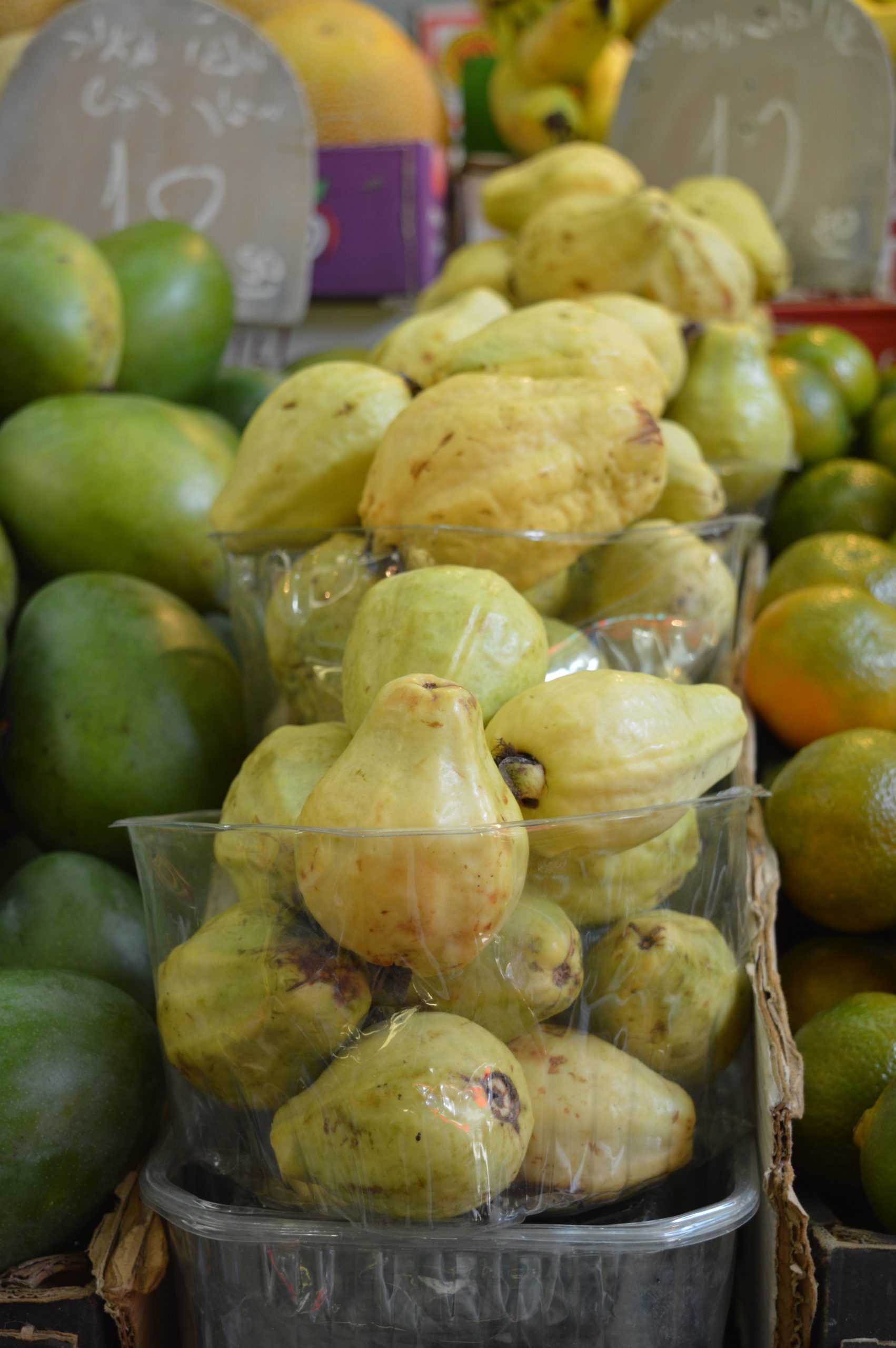
If you like guavas, now is the season. Some people can’t abide them, but I like them, and buy a couple every year just to set out on a plate and enjoy the pungent fragrance.
Vegetables in season in November
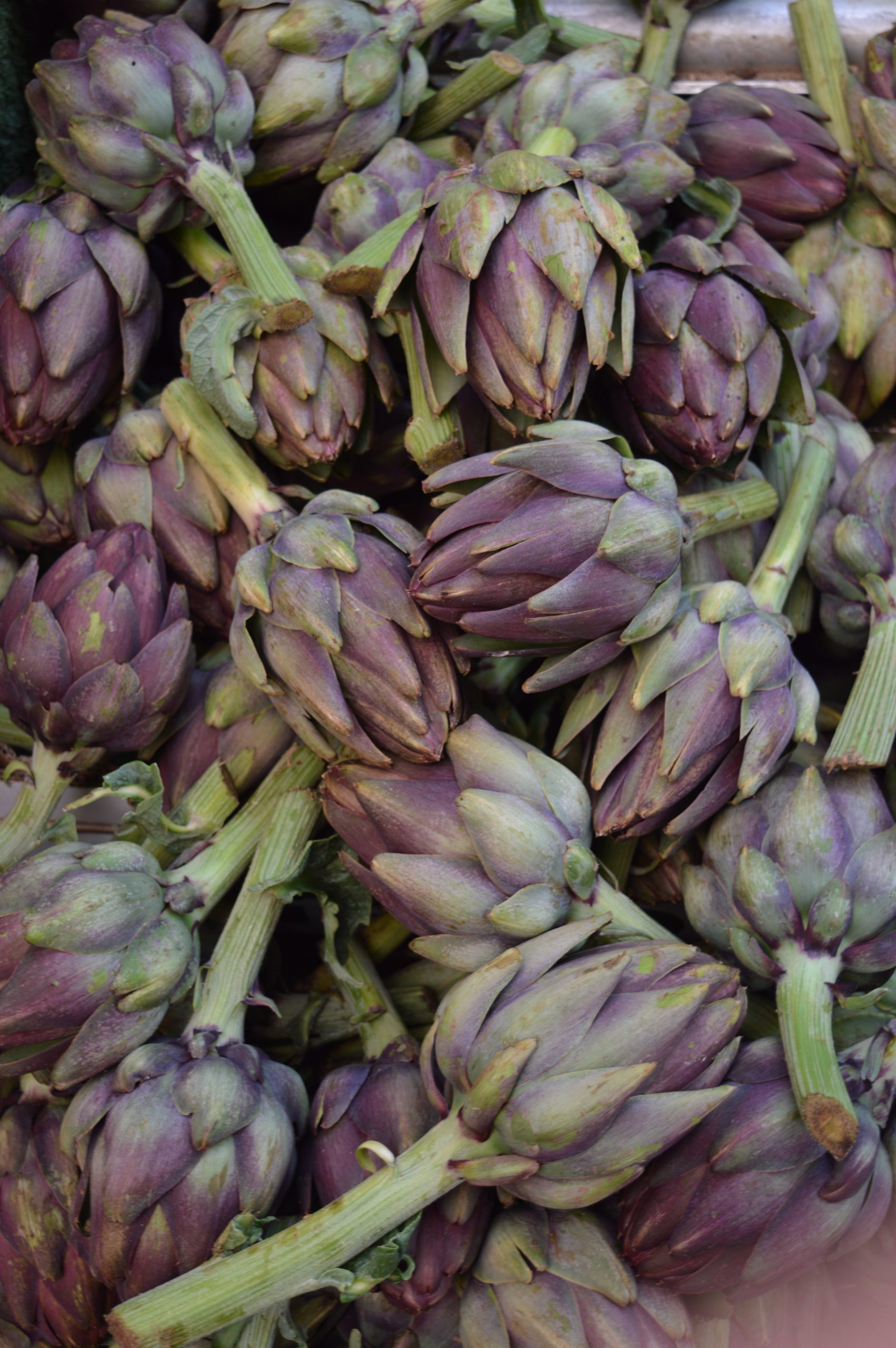
Rain brings on glorious vegetables. Leafy greens in season now are kale, Swiss chard, fat lettuces, leeks, and artichokes.
Jerusalem artichokes, kohlrabi and fennel are worth buying right now. Cucumbers, hothouse tomatoes, pumpkins, and squashes are abundant and (relatively) cheap.
Kohlrabi salad, by Ottolenghi
Beets, potato varieties, celeriac, carrots of different colors and red and purple sweet potatoes are good, although root vegetables will be even better in October and December.
Cauliflower and broccoli are recovering from summer’s heat. They were available at the beginning of the month, but not advisable; now they’re worth buying. Just turn the package around to inspect them closely, and if you can handle the vegetable itself, check for insect infestation.
Onions, which looked withered in summer, are now plump and firm. Eggplants, which shriveled with exhaustion just a month ago, have perked up with cooler weather. You can buy large baladi (heritage) eggplants with their attractive ridges and big flavor, and for a short while, baby eggplants for pickling.
Bell peppers of all colors are looking firm and good. But chili-heads beware: if you’re looking for hot peppers, hurry up and buy some now, because in winter, hot peppers aren’t very hot.
Buy sweet corn too, because the season won’t last much longer.
Mushrooms are grown in specialty farms, but somehow are more beautiful in cooler weather. Mushroom prices are reasonable, and shops offer several different varieties.
Herbs in Season in November
The herbs you love are for sale in big bunches tied with rubber bands.There’s watercress, basil, rocket, dill, tarragon, chives, thyme (good for hanging up and drying), scallions, mint, coriander leaf, parsley, and sour grass.
Writing in mid-November, I haven’t seen any great abundance of wild herbs. Nettles and chickweed are just sprouting and not noticeable unless you’re keeping an eye out for them. Look for mallows and wild beets in December.
Wildlife protection is essential to preserving biological diversity and the equilibrium of the environment. Adopting effective wildlife conservation laws is crucial to maintaining ecological health and guaranteeing the existence of animals.
The universe is an array of diversity, with beautiful scenery, unique cultural traditions, religious faith, a wealth of vegetation and animals, and much more. The chance of exploring this fascinating world is among the nicest gifts you might offer yourself.
But while on holiday, it’s important to remember that animals are not to be utilized as background images. As moral travelers, we have a responsibility to protect the welfare of our fellow human beings in order to stop injustice and cruelty. So, these are the 5 nifty steps to preserve our wildlife.
Environmentally friendly techniques for using land
Promoting responsible land-use methods can help save animals by minimizing habitat destruction and extinction. This can involve encouraging environmentally friendly practices in forestry and other sectors of the economy, cutting back on the administration of pesticides and other dangerous chemicals, and supporting environmentally friendly agriculture.
Wildfoot travel
Reputed travel companies such as Wildfoot Travel work towards minimizing the effect of human activity on the animal population. This can involve taking steps to lessen chaos, cut down on pollution, and steer clear of actions that upset the balance of ecosystems. We can contribute to lowering stress levels in wildlife populations and ensuring their continued existence by minimizing human environmental effects.
Finding and Setting Priorities for Conservation-Needed Regions
Maasai women hunters
Prioritizing locations that require urgent conservation or rehabilitation work is crucial for the successful preservation of wildlife habitats. In order to identify the best strategies for habitat conservation, this frequently entails evaluating the affected region and putting together a team.
Creating an action plan which describes the best ways to preserve each of these places after they have been recognized and assessed is the following step. The security and well-being of the habitat should be ensured by such plans, which should incorporate both short- and long-term objectives and minimize human effects.
Never feed wild animals
The chance of spreading infectious diseases between humans and animals, such as the common cold and flu, measles, TB, pneumonia, and other zoonotic illnesses, is increased when food is swapped. Overweight and poor hair conditions can also be associated with excessive human food content in primate diets. Wild creatures become reliant on people for sustenance when they are trained to anticipate it.
Humans feed and provide these monkeys in order to appease their convictions about religion, luring them out of their native environments, including langurs and rhesus macaques. This weakens their innate ability to survive and puts them at risk from things like fighting with other primates, getting electrocuted by high-voltage power lines, getting into car accidents, and even kidnapped for profit.
Evaluating Human Activity’s Effect on Wildlife Environments
Ancient man built elaborate hunting traps, and worked collaboratively.
Knowing how our actions impact ecosystems that support wildlife is essential to their conservation. Our impact on the natural world has increased along with our reach, and this effect frequently has a negative impact on the well-being of these environments. This encompasses problems like overfishing, excessive hunting, and extraction-related businesses like mining that lead to the excessive use of the earth’s resources.
In the same manner, abrupt changes in weather conditions brought about by human-caused worldwide warming have disrupted entire ecological networks and severely damaged wildlife habitats.
Furthermore, human actions like contamination, urbanization, and deforestation have all had substantial effects on wildlife habitats. Many species have lost their homes due to deforestation, and environmental dispersion brought about by civilization has made it increasingly challenging for animals to travel around and look for food.
Since pollution contaminates land, water, and the air by releasing contaminants and hazardous compounds into the surroundings, it has also had catastrophic effects on the ecology.
Awareness-raising and dissemination of knowledge
Building an ethic of appropriate and environmentally conscious conduct requires first educating the general population about the importance of animal conservation. Reaching out to the public, enlightening people, and creating consciousness about the negative effects that human behavior has on animals are some approaches to do this.
People might comprehend it properly with more perspective and by knowing more about wildlife and the world around us. People can have greater comprehension and enjoyment of the environment through discovering information about different kinds of animals and their distinctive traits. This can encourage people to take action to safeguard species and their natural environments by fostering an awareness of duty and sustainability.
Be cautious of wildlife keepsakes
You will inevitably return from a trip to a foreign nation with a few sentimental mementos; however, we implore you to consider carefully what you are purchasing. Refuse mementoes constructed from animal parts, such as shells, coral, peacock feathers, and conventional medicinal products.
The Wildlife Protection Act of 1972 in India forbids the sale or purchase of any goods that originate from animals that are regulated by law. Thus, it’s advisable to avoid buying such things! Alternatively, to promote indigenous cultures and save animals, opt to buy keepsakes made locally and sustainably.
Recycling
Camels eat plastic and then die
By reducing the amount of garbage transported to landfills and incinerators—two primary contributors to carbon emissions—recycling lowers the need for novel items, saves animal lives, and helps offset the release of carbon dioxide. By removing garbage from these locations, recycling contributes to reducing an organization’s total carbon impact. Additionally, by using reused components, the habitats are preserved for wildlife and less stress is placed on them.
Investigation and Observation
For efficient conservation leadership, tracking the condition and patterns of animal populations is crucial. Investigation can help guide governance and policy decisions as well as spot preservation possibilities. Tracking alterations in population dimensions, the condition of habitat, and other crucial markers of wildlife preservation and well-being can be part of this.
Encourage regional economies
Populations that depend on animals must also be taken care of in order to sustain them. An ideal human-animal equilibrium is necessary for the coexistence of any biosphere. Both the humans and animals who live in those areas ought to profit financially from sustainable wildlife travel. It is not advisable to provide financial support to multinational companies.
Try regional cuisine, choose lodgings that are operated regionally, and immerse yourself in the local way of life when you travel instead. The local economy is greatly impacted by tourism, and by helping the community financially, you can make sure that those who have a genuine love for the area will have the resources to preserve its treasures of nature for future generations.
There are numerous approaches to safeguarding animals. Techniques for preserving the natural world include recycling, planting trees, creating wildlife habitats, public outreach and awareness campaigns, and ecologically sound land use methods described above.
Establishing a regular sleep schedule and bedtime routine can have a significant effect on your sleep health. But did you know that your bedroom can also help you find a better night’s sleep? Recent research highlights the importance of having a comfortable and stress-free environment for adequate sleep. But how can you adjust your sleep space in an eco-friendly way? Below are some tips to help you create the ideal sleep space while still being kind to the planet.
1. Find an Eco-Friendly Mattress
Purchasing a mattress that provides adequate support is one of the best things you can do from your sleep health. However, traditional mattress production takes a large toll on the environment. When mattresses made of petroleum-based products and constructed using toxic chemicals end up in landfills, they can leech these chemicals into the ground, causing soil and water population.
Additionally, mattresses made of products produced through conventional farming methods can harm our natural resources and contributes to pollution. Lastly, conventional farming contributes significantly to air, water, and soil pollution. Statistics show that conventionally farmed cotton, which is typically used in traditional mattresses, uses 16 percent of all global insecticide use.
But all hope is not lost. There are many mattress companies making every effort to construct some of the best mattresses in the most sustainable way possible. When searching for the most eco-friendly mattress, it is helpful to consider both the materials and the construction.
Materials
Many organic mattress companies are opting to go through the strict process of obtaining organic certifications in order to show that their mattresses are made with pesticide-free fabrics. Certifications from the Global Organic Textile Standard (GOTS) and the Global Organic Latex Standard (GOLS) ensure that all materials are organic and are harvested in an environmentally and socially responsible way. Some companies are also using plant-based memory foam with emission-free production processes.
Construction
Eco-friendly mattress companies using organic materials typically use sustainable farming and manufacturing methods. Many of these methods involve the promotion of soil health, minimize water use, and lower pollution levels. According to the US National Institution of Food and Agriculture, sustainable farming works to “protect the environment, expand the earth’s natural resource base, and maintain and improve soil fertility.” These practices can also help to strengthen the local economy and increase the wellbeing and livelihood of farm families and communities. Some companies are also producing their mattresses locally to reduce their environmental footprint.
2. Cover Your Mattress is Eco-Friendly Bedding
Many bedding companies are now creating premium products that are sustainably-sourced and constructed with environmentally responsible methods. Purchasing products made of 100 percent organic natural fibers such as cotton, linen, and wool will ensure fabrics were not produced using toxic pesticides or synthetic chemicals.
GOTS and OEKO-TEXcertifications can also apply to bedding. Third-party vetting processes are a great way to verify that you are getting an eco-friendly product. Natural fibers are also ideal if you are a hot sleeper since cotton and linen are breathable and soft. Opting for bedding made of recycled materials will also guarantee that you are supporting a company with sustainable practices.
3. Look for Paint without Harsh Chemicals
Painting the walls of your bedroom in soothing sleep inducing colors can have a big impact on your ability to relax. Pale blues, greens, lavenders, yellows, and beiges, can have a calming effect on your mind and body.
Though many of us may not consider paint eco-friendly, believe it or not, there are many eco-friendly paint companies available. When shopping for eco-friendly paint, look for products that do not contain airborne chemicals or gases. These will be identified as being low in Volatile Organic Compounds (VOCs) which can create toxic emissions that leach into the air. Try ECOS it’s widely available.
4. Use only the Best Furniture
The hunt for the ultimate (and eco) bed is on!
When considering your bedroom furniture, opt for eco-furniture made from reclaimed wood, salvaged, or recycled wood or metal as these materials can be easily broken down and recycled. It is best to avoid furniture made of plastic or synthetic materials since these are non-biodegradable and are produced using toxic chemicals that end up polluting our environment.
When shopping for wood furniture, you can also rely on a third-party vetting process. A Forest Stewardship Council Certification (FSC) will verify that the product was produced in a way that protects the biological diversity of the forest. A low Volatile Organic Compounds (VOC) certification will also certify that no toxic glues, paints, or finishes were used on the product.
If you are not in a position to purchase brand new furniture, you may want to consider purchasing from a second-hand retailer. Purchasing second-hand is a great way to extend the life of a piece of furniture and keep it out of the landfill.
5. How is Your Lighting?
If the lighting in your bedroom is too harsh, it can be difficult for you to relax and fall asleep. In addition to removing all electronic lights and screens from your bedroom, consider using lower watt light bulbs which offer a more ambient and gentle light. A wattage of 45 to 50 is gentle enough to make the room feel tranquil while still providing adequate light.
Purchasing energy-efficient lights – Light Emitting Diode (LED) or Compact Fluorescent Lights (CFL) bulbs will provide a more sustainable alternative than traditional incandescent bulbs. LED bulbs use around 25-80 percent less energy than incandescent bulbs and can last up to 25 percent longer. LED bulbs also emit less heat, with only 3.4 BTUs of heat per hour while traditional bulbs produce 85 BTUs per hour. By conserving energy, you will be helping the planet, saving money, and keeping your bedroom cooler.
6. Flooring Matters!
Tiled floor for the bedroom. Maybe gently heated underneath?
A sustainably carpeted bedroom can help create a cozy, inviting atmosphere, while also reducing noise transfer. But before you re-carpet your sleep space, you will want to consider the environmental impact of traditional carpet. Traditional carpet is often produced with the use of VOCs and is toxic to us and our planet. The manufacturing methods of traditional carpet companies can also damage and pollute our natural resources.
When considering the flooring in your bedroom, you may want to consider rugs and carpeting made from all-natural materials such as wool and cotton. Because these fabrics are harvested from renewable sources, they produce less environmental impact and help to preserve our natural resources. But we have a sustainable floor guide here so you can learn about the options from cork to bamboo to ceramic tikes and upcycled wood.
Asma Al-Assad, the Syrian president’s wife, is accused of playing a major role in the crimes of her husband and his regime during Syria’s 12-year war; she’s played no small role in the country’s $57B Captagon drug trade. Image via AFP
Asma al-Assad, the wife of Syria’s dictator Bashar al-Assad grew up in London attending a private school. She went to Queen’s College and studied with people like Ringo Starr’s daughter. Asma was described by a source we spoke with as pretty normal. So how does a girl from London with a career in investment banking at JP Morgan go to running a drug ring?
After years of the world forgetting how Asma and her husband Bashar killed 230,000 Syrians, and refugee’ed almost 7 million people, the two are are back in the game, making media appearances and attending conferences in China and the UAE.
Back in 2011, Asma was dressed to kill in a Vogue article debacle entitled “A Rose in the Desert” which served as a litmus test for cynicism when considered against the backdrop of mass-murder, torture and imprisonment of tens of thousands of Syrians that had occurred since the story was first published.
Some 6.7 million Syrian refugees have since moved to Turkey, Lebanon, and Jordan and probably will never go back. Canada accepted 40,000 of them. While Vogue took down the article after the Arab Spring riots took over, we found a copy of it. Vogue article – get the PDF
The Vogue article that disappeared online
In March, 2011, the 3,200-word story on Asma al-Assad praised the “wildly democratic” family-centric couple who vacation in Europe, nurture Christianity, (ignore their country’s “missing” Jews) and leave their security guards at home when cruising around Damascus with Brad and Angelina. The article’s author Joan Buck declared that “Syria is known as the safest country in the Middle East” and described the couple’s aim was to give Syria a “brand essence.”
With catastrophic mistiming, the story was published online right before Syria’s Arab Spring erupted. It was later revealed to be the result of a coordinated public relations effort managed by Brown Lloyd James, the same firm that handled media spin for Libya’s Qaddafi regime.
Asma said in the Vogue article about her business acumen:
“What I’ve been able to take away from banking was the transferable skills—the analytical thinking, understanding the business side of running a company—to run an NGO or to try and oversee a project.”
She runs her office like a business, chairs meeting after meeting, starts work many days at six, never breaks for lunch, and runs home to her children at four.
She also made a recent appearance in China. This FT article exposes Syria’s $57B Captagon drug ring, naming Asma as playing a major role in its operation. A USA Today article suggests Captagon was found on Hamas-linked Palestinian terrorists that attacked Israel on October 7. Palestinian-Hamas terrorists crossed over and raped women, killed babies in front of their children, and blew up families hiding in their bomb shelters. Were they high on Captagon while doing it?
Captagon is called many names, writes USA Today: The jihadi drug, Captain Courage, the Poor Man’s Cocaine. But were Hamas terrorists high on the synthetic stimulant Captagon when they attacked Israel on Oct. 7, brutally killing more than 1,200 people and kidnapping at least 240 more? The Israeli government won’t say but they did find bags of pills on the bodies of terrorists.
Washington’s regional allies, particularly Jordan, have lobbied Washington to take a more active role in stopping the drug’s proliferation. The 2022 defence spending bill included the Captagon Act, requiring the US government to devise a strategy to disrupt and dismantle Syria’s narcotics networks.
“Syria has become a global leader in the production of highly addictive Captagon, much of which is trafficked through Lebanon,” said Andrea Gacki, the senior Treasury official handling sanctions.
“With our allies, we will hold accountable those who support Bashar al-Assad’s regime with illicit drug revenue and other financial means that enable the regime’s continued repression of the Syrian people,” she added.
Prof. Eyal Zisser of Tel Aviv University, who specializes in the contemporary history of Syria and Lebanon says that after the economy of the Syrian regime collapsed, the entire country became a Captagon production laboratory. He told Globes: “The product is transported by drones and UAVs across borders. Saudi Arabia is flooded with it, Jordan is flooded with it.”
Asma’s presence underscored something little understood outside Syria: how a woman initially sidelined as an obstinate young newly-wed with lofty western ideals has since risen to become one of the most powerful people in the country, at the apex of the country’s ruthless ruling family.
In public, she styles herself as the Mother of the Nation, radiating maternal care as she tends to Syria’s military families, cancer-stricken children and survivors of the February 6 earthquake. She sports delicate ribbons in her hair, her petite frame draped in dresses sewn by the widows of men martyred in her husband’s war.
But privately, Asma has manoeuvred herself into a position of remarkable power, according to interviews with 18 people familiar with the regime’s operations, including heads of business, aid workers and former government officials. She now controls some of the key levers in Syria’s battered economy, both as policymaker and profiteer, helping consolidate the family’s grip over a country in bloodied ruin.
Experts say the couple is using new illicit revenue streams for the regime to help keep it afloat: weapons, oil smuggling, alcohol (which is prohibited by Islam) and sales of the illegal amphetamine Captagon.
When I visited Syria in 1999 the people were living very poorly, kids were playing in piles of rubble and locals were plundering archeological sites. I felt that I had entered a time machine going back to the 50s. Most people got around by mini-bus and I felt safe not because there was no crime but because Basher’s father’s face was plastered everywhere. The people were living in fear of Basher’s father and in fear of each other. If you did not express your featly to the regime you could disappear. The regime hated Jews so much that even saying the word Israel was punishable. Locals said to never say the word Israel. This made me want to visit Israel even more.
Israel: codeword Disneyland
The hotels did keep guidebooks on Israel, however, covered over with the code name Disneyland. Most tourists in Syria then were headed for Jordan, Israel, then Sinai. I met a number of loving, decent Syrians when I was there. They all were afraid to mention Bashar’s father name. They were prisoners to the regime and begged that I would send them art books or any notes from the outside world as no-one in Syria was allowed to use the internet then.
We had spies following us around when we were there. We did feel very safe in Syria and slept overnight by ourselves in a Crusader Castle. We were the only guests.
People in Syria are less afraid today and social media has opened up space for critique: According to the Middle East Institute, there is a notable trend that has emerged among Alawites in Syria’s regime-held areas, including those from powerful families. They are no longer allowing themselves to be silenced.
“Writers, journalists, and rank-and-file Alawites have taken to social media platforms to express their deep frustration with the regime’s economic policies and the centralized nature of the dictatorship under President Bashar al-Assad, as well as his wife Asma al-Assad’s outsized influence and corruption linked to her secretive “economic council.””
Some activists in Syria claim the Assads have gone so far as to start forest fires.
BBC offers a must-see investigative piece on Captagon in Syria and Lebanon. Warning: the video is age-restricted.
“Living conditions are hard and the people are manipulated,” says the Jordan army who attempts to hunt down infiltrators to their border carrying Captagon. He told BBC reporters that al-Assad’s regime uses children to smuggle drugs across the border.
“In April we reported the death of a child from the Ramthan tribe. Instead of carrying his school bag he was carrying a backpack of drugs. He met his death on the Syrian-Jordanian border.”
A BBC screenshot on Captagon
The average salary for a Syrian is $15 US a month. If they smuggle Captagon they can earn $15,000 – enough for a house and to get married.
In Jordan in 2022, a border officer was killed by drug traffickers from Syria and King Abdullah of Jordan said that border police could shoot and kill anyone that attempts to cross the border. Days later 27 Syrians were shot and killed.
Syrians interviewed said that most smuggling is done by civilians living in regime-controlled areas in Syria and they have connections to the regime. The regime also enlists women and children. The drugs are then exported to Gulf States, Turkey, Europe and Africa.
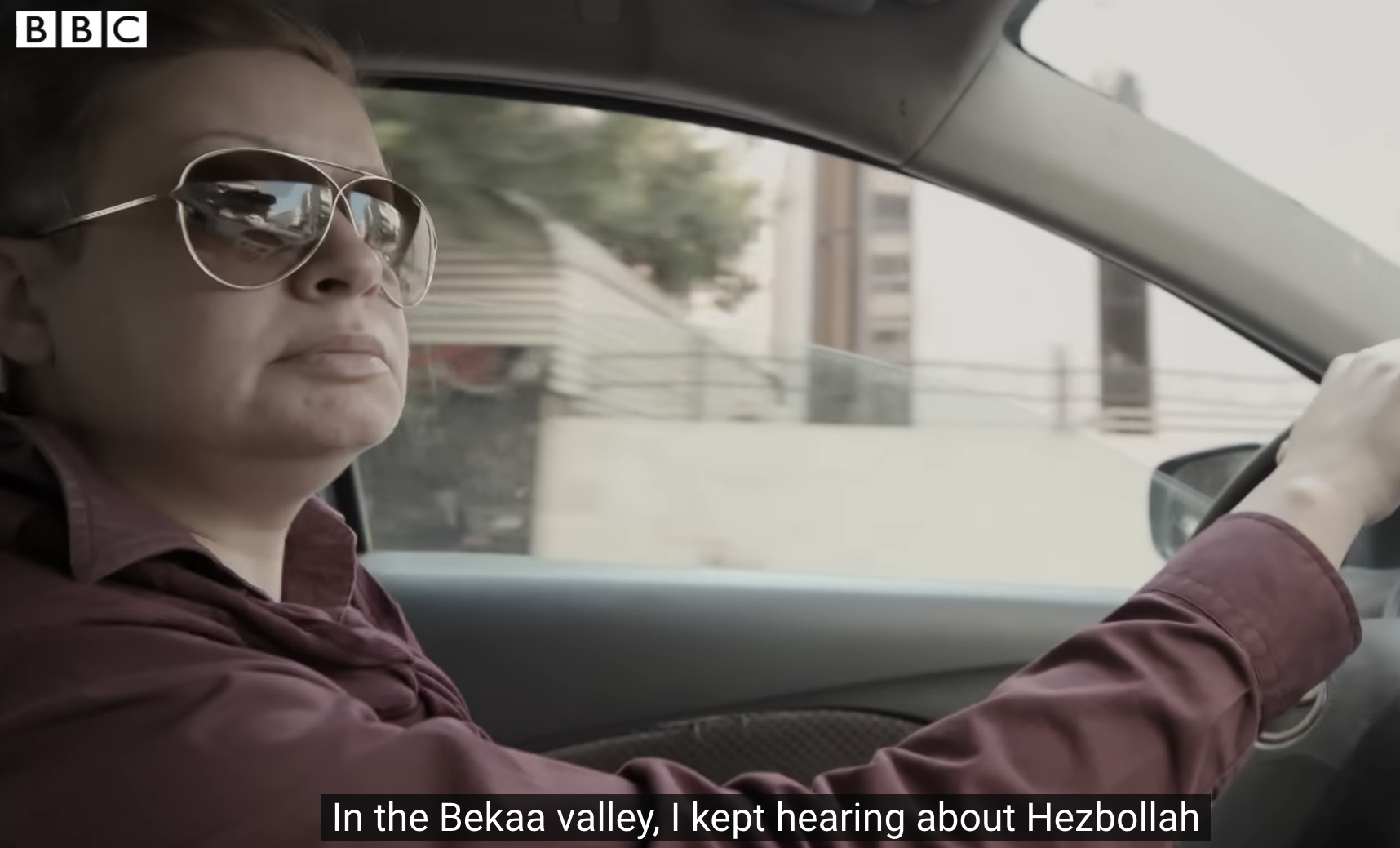
Hezbollah controls the Bekaa valley: BBC
The BBC documentary also links Captagon production and smuggling to the Hezbollah. They report that the Lebanese government has lost control of the Bekaa Valley where the production and smuggling of Captagon takes place. This is the area firing rockets into Israel currently.
Captagon: Inside Syria’s drug trafficking empire
Update May, 2024 – Asma al-Assad’s cancer diagnosis:
The traditional olive harvest in southern Lebanon is a crucial economic activity to a battered economy (Lebanon can barely keep the lights on), and it faces severe disruption now because of the Islamic jihad group, the Hezbollah. The Israeli army is firing back in response to the Hezbollah rocket attacks meant as a provocation, and olive farmer Adel Khoury from Rachaya al Foukhar, in Lebanon’s Bekaa Valley is afraid for his life, he tells The Media Line.
He is afraid that Israeli surveillance might consider their harvesting activities as part of the Hezbollah terror group, and kill him in the crossfire.
Olive harvesting
Christians from Lebanon who became refugees in Israel told me that Christians in Lebanon are not able to speak out against the Hezbollah. Sharbel Salameh was from the south Lebanese village of Klayaa, and joined about 2,500 Lebanese Christian refugees who fled to Israel while trying to fight against the Hezbollah. The story is here. I also covered this story for the Catholic News Service.
Rachaya Al Foukhar is a Lebanese village in the district of Hasbaya in the Nabatiye Governorate in southern Lebanon. It is located on the western slopes of Mount Hermon.
Hezbollah is a Shiite Muslim political party and militant group based in Lebanon, where its extensive security apparatus, political organization, and social services network fostered its reputation as “a state within a state.” Founded in the chaos of the fifteen-year Lebanese Civil War, the Iran-backed group is driven by its opposition to Israel and its resistance to Western influence in the Middle East. Western means Europe and America.
Lebanese Agriculture Minister Abbas Hajj Hassan reported that around 12,000 hectares of olive orchards have been affected by the Hezbollah-Israel strikes. Riad Harb, head of the olive oil producers syndicate in southern Lebanon, said that about 60% of farmers have been unable to harvest their crops, urging for a truce under the United Nations Interim Force in Lebanon’s supervision to allow for safe harvesting before winter.
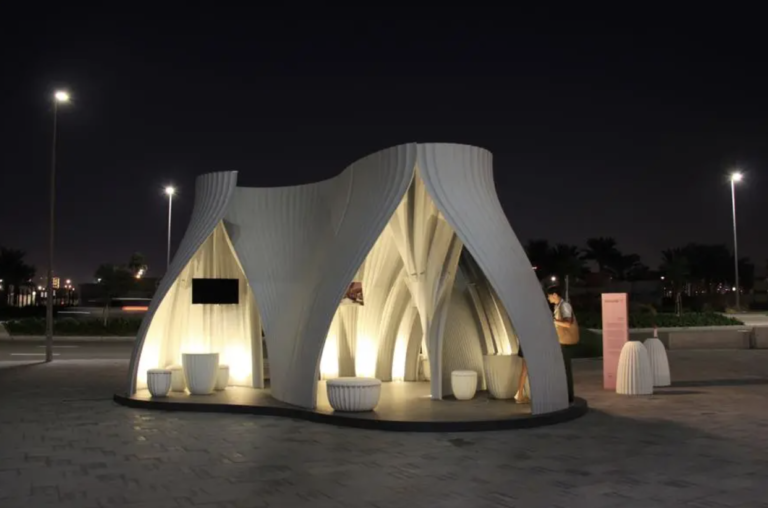
In5, part of TECOM Group, presents the region’s largest 3D printed exhibition stand, The North Star at Dubai Design Week, which opened doors at Dubai Design District on Nov. 7 and which closed on Nov 12.
Nyxo’s 3D printed pavilion
NYXO designed and built The North Star from recycled polyethylene terephthalate glycol (PETG) to showcase how recycling can be incorporated into real-world architecture.
Sheikh Mohammed bin Rashid Al Maktoum, Vice-President and Prime Minister of the UAE and Ruler of Dubai, stands in front of the the first world functional 3D printed offices during the official opening in Dubai May 23, 2016. REUTERS/Ahmed Jadallah
Spanning over 1,000 square feet The North Star represents pressing environmental challenges say its designers. An infinite loop generating four spaces and organising surfaces make up the pavilion, with the surfaces joining and folding together to create pockets that are continuously connected to signify in5’s legacy as start-up incubator.
The Tecom portfolio consists of 10 business districts catering to six vital knowledge-based economic sectors, including design, education, manufacturing, media, science, and technology. It provides a varied and tailor-made leasing portfolio – which includes offices, co-working spaces, warehouses, and land – to over 10,800 customers and more than 105,000 professionals.
Italian Designers Mirko and Michele Daneluzzo are also the founders of NYXO Visionary Design ( @nyxo_studio ), an architecture and product design studio based in Dubai. Via Nyxo Instagram.
The design house Nyxo has some other enchanting products, like Desert, a table 3D-printed to resemble the Emirati desert: “Desert is a table whose design is inspired by the fossil dunes of the Emirati desert. Printed with Foaming PLA, a lightweight, low-density material Desert is a sculptural coffee table whose organic curves are inspired by nature, in particular by the spontaneous fossil formations. Just as the layering of the sand over time created the fossils, so the layering of the 3d printing creates this table.”
Desert, a 3D printed table reminiscent of fossils in the Emirati desert
“The material has a porosity that graciously simulates the roughness of desert sand,” say the Italian designers at Nyxo, based in Dubai.
We also love Thigmo, a 3D designed porcelain cup set, “characterized by a relief surface that is inspired by the generative processes that we find in nature.”
Thigmo, 3D printed ceramic cup mold
Thigmo, 3D printed ceramic cup form
“The intricate veining surface is the result of a digital simulation of the behavior of growth of mycelium, the interweaving of filaments which constitutes the vegetative apparatus of fungi. The survey has a unique appearance and offers a tactile experience very stimulating, as well as allowing you to manipulate the cup in serenity even in the presence of a good hot coffee.”
A pasture system in Andorra, hay milk in Austria, areas growing chestnuts, white ginger and waxberries in China, flood-spreading gardens and a walnut cultivating region in Iran and an all-female fishery in the Republic of Korea –– these are all among the latest agricultural systems to be recognized by a UN group aiming to preserve and encourage traditional farming and fishing systems around the world. It’s like UNESCO but for food. The designation may help protect and fund such traditional cultures, but the UN groups have very little control in protecting systems, ecosystems and culture around the world.
We understood this when UNESCO heritage sites like Jonah’s tomb (from Jonah and the Whale in the Bible) were blown up in 2104 by the Islamic State of Iraq and Syria (ISIS). Terrorists went from town to town wiping out Jewish, Christian and other non-Sunni Muslim religious and cultural sites in 2014 and 2015, videotaping their exploits the way in a similar fashion to the Palestinians who joined the Hamas raid on October 7, did to Israelis and foreigners in kibbutzes and at the Supernova dance party. These people will never return and the heritage sites lost forever in the name of extremism.
But the UN says that by recognizing and supporting agricultural systems, this know-how can be passed down from generation to generation, alleviating poverty and giving people a better chance of avoiding a life in violence. The Slow Food movement is doing something in Europe. Read about the Slow Cheese Winners of the World.
Like UNESCO heritage sites, the UN is recognizing sites of agricultural significance. They are called Globally Important Agricultural Heritage Systems (GIAHS) – and are part of a new database created by the UN to recognize and support culturally-rich agricultural practices around the world.
The systems, formally designated during a meeting of the GIAHS Scientific Advisory Group taking place in Rome from November 7 to 10 included the first ones to be approved from Andorra and Austria. Meanwhile, additional sites in China, Iran and the Republic of Korea highlight the key role played by Asia’s traditional agricultural practices in food security and combating climate change and biodiversity loss.
Under the flagship programme of the Food and Agriculture Organization of the United Nations (FAO), the selection criteria stipulate that sites must be of global importance, have value as a public good, supporting food and livelihood security, agro-biodiversity, sustainable knowledge systems and practices, social values and culture as well as outstanding landscapes.
“Now over 20 years strong, GIAHS has proven to be a great model for showcasing longstanding practices to render agrifood systems more resilient to climate change,” said Maria Helena Semedo from the FAO.
With the newest addition to the global agricultural heritage systems list, FAO’s worldwide agricultural heritage network now consists of 86 systems in 26 countries around the globe.
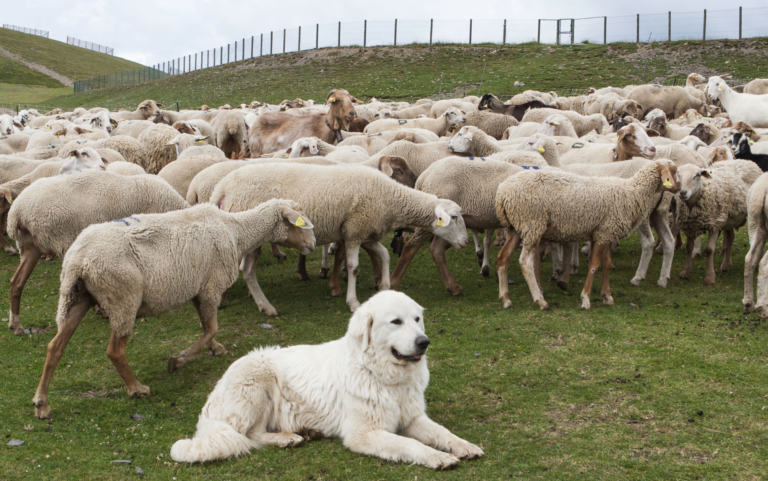
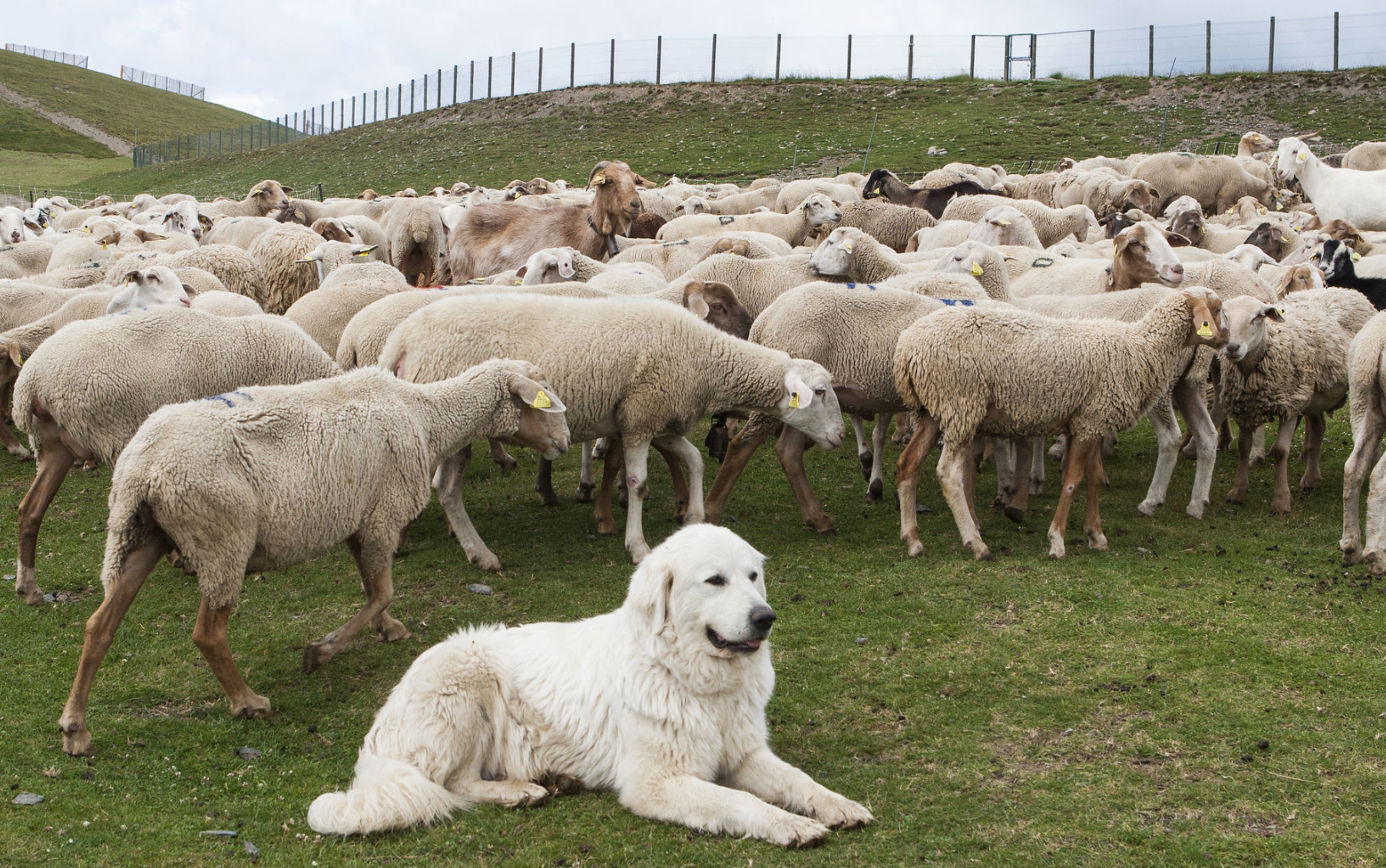
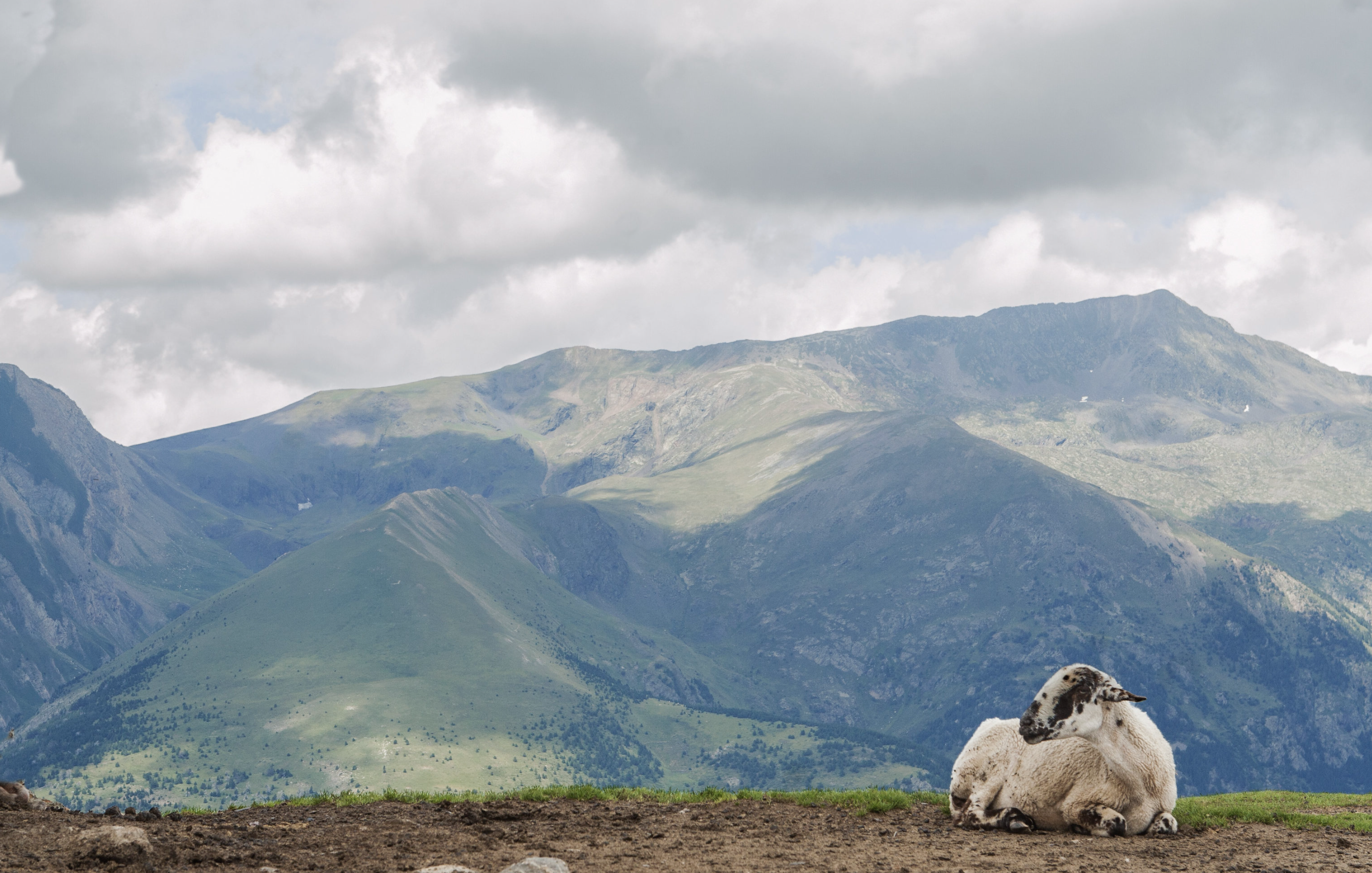
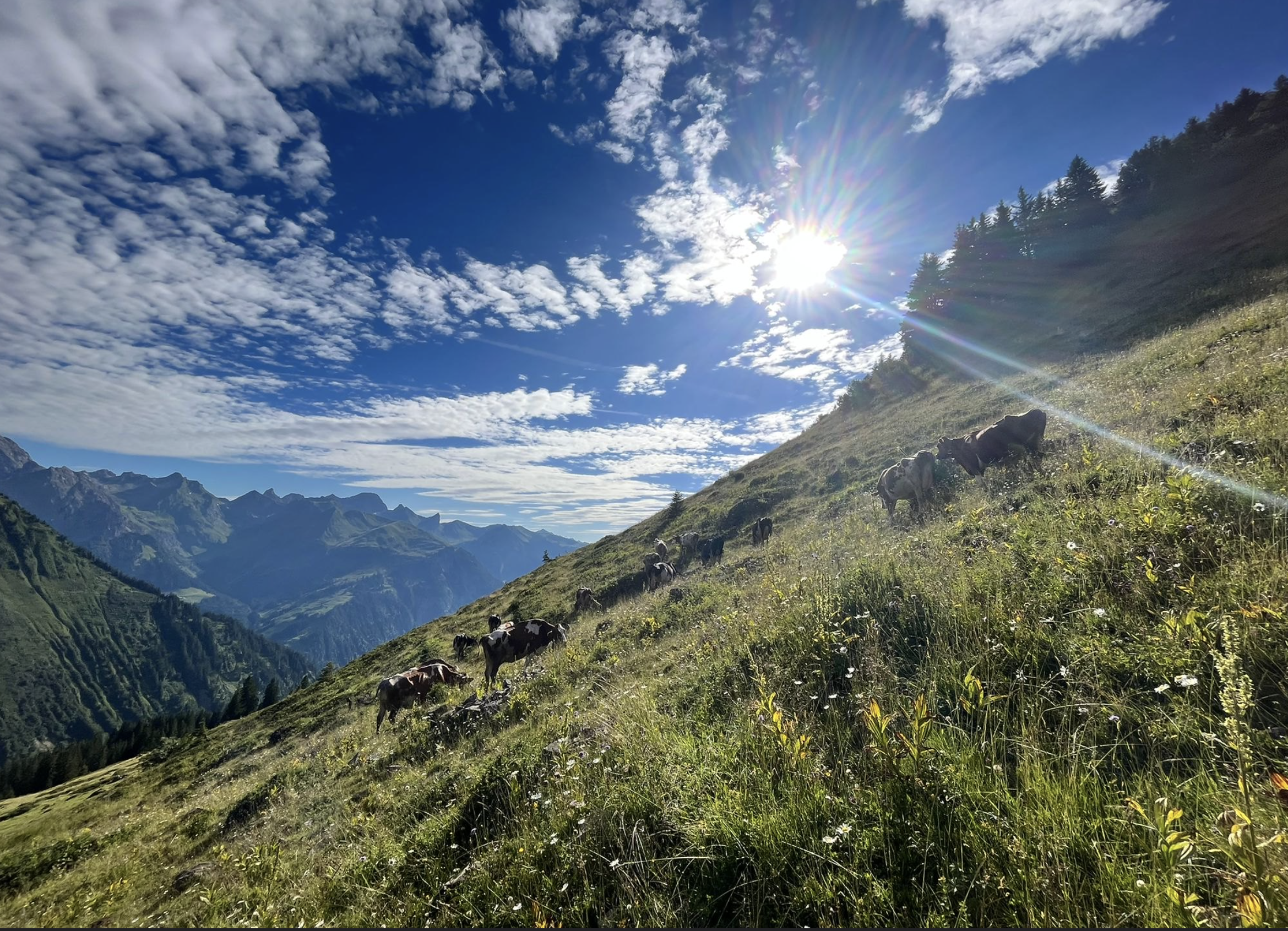
The subalpine and supraforestal pastures of Andorra reflect the longstanding agropastoral system developed in this tiny landlocked country which lies almost 2,000 metres above sea level on average in the Pyrenees mountains. The local population has combined spontaneous pastures and cultivated feeding. This supports the production of livestock, bovines, ovines, horses, on free-range and extensive grazing, which can be traded for other goods and food with the neighbouring regions.
It is based on common lands and shared pastures, with the animals’ owners paying a shepherd or taking turns to protect herds from predators, freeing the rest of the farmers for other tasks.
The production of hay milk, from cattle fed on fresh grass and hay rather than fermented fodder, is as old as the keeping of dairy animals in Europe. Using hay as a nutrient-rich winter feed helps get ruminants through the vegetation-less cold season, thus ensuring the livelihood of farming families.
Hay milk used to make up most of Austria’s milk production but now it accounts for only 15 percent. Austria’s 6,500 hay milk farmers and 60 major processors have come together in the ARGE Heumilch Österreich community. It aims to preserve hay farming and communicate the benefits of this sustainable method so that a fair milk producer price can be obtained in the marketplace.
Chestnut, White Ginger and Waxberry heartlands in China
Kuancheng Traditional Chestnut Eco-Planting System in Hebei Province, China
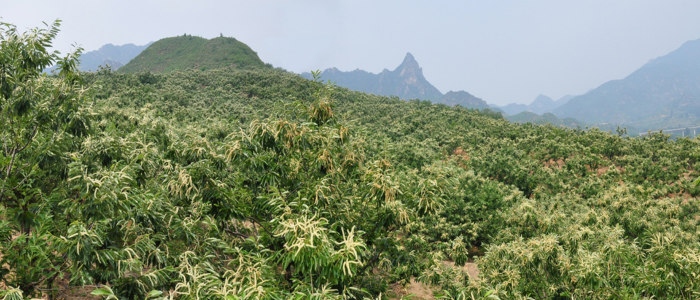
The Kuancheng Traditional Chestnut Eco-Planting System in northern China’s Hebei Province is located in one of the first and most important areas in China to cultivate chestnuts, dating back to the Han Dynasty (206 BC to 220 CE). A traditional cultivation system with chestnuts as the core together with other crops, medicinal materials, and poultry industries was gradually established.
It forms an important part of the global chestnut variety resource bank and it is rich in cultural content, respecting nature and based on a form of social organisation that promotes agricultural production.
The Tongling White Ginger Plantation System forms an important part of Southern China’s ginger planting area. There are 17 varieties of ginger in the Tongling White Ginger Plantation System, and white ginger is the main variety. Semi-late rice is the main crop for rice cultivation in Tongling, with fewer early-season and late rice varieties. There are 31 main varieties of rice.
Tongling has developed key techniques for ginger plantation including ginger pavilions for seed-preserving and germination-accelerating. There are many processing recipes dating back over nearly 1,000 years such as Salt-pickled Ginger, Sauced Ginger, Sweet-and-Sour Ginger, and Sugared Ginger.
The Xianju Ancient Chinese Waxberry Composite System in eastern China’s Zhejiang Province is in an area where the cultivation of these fruit trees dates back more than 1,600 years, with many villagers tending them in combination with tea, chickens and bees. There are 100,000 farmers in the GIAHS site, of whom 26,000 are engaged in waxberry cultivation, composite planting and breeding, and other related industries.
The site has accumulated a large number of ancient waxberry genetic resources with diverse types and rich varieties. In May 2015, China’s first county-level biodiversity conservation action plan was released by the local government of Xianju County.
Flood-spreading gardens and walnut cultivation in Iran
Gardens of Qazvin Bāghestān. The traditional Gardens of Qazvin, called locally “Bāghestān-e Sonnatī” or simply “Bāghestān” are a flood-spreading system that dates back to thousands of years ago, when the city of Qazvin developed. Copyright: Mehdi Motamed
The traditional Gardens of Qazvin, northwest of Iran’s capital Tehran, are a flood-spreading system that dates back thousands of years. Situated in the foothills of the Alborz ranges, the creation of the gardens surrounding the city has protected its inhabitants from floods adapting to and taking advantage of the watershed to produce nuts and local delicacies.
By capturing, redirecting and sharing floodwaters, local communities have been able to cultivate and grow fruits all around Qazvin. Today, the system provides food and employment opportunities for people but also cools the temperature of the city and serves to replenish groundwater tables.
Traditional Walnut Agricultural System in Tuyserkan, Hamedan Province, Islamic Republic of Iran
The Traditional Walnut Agricultural System in Tuyserkan, Iran is known not just for its walnut orchards but also for its delicacies as well as its landscapes and historical monuments. Based on family-farming, the cultivation of walnuts supports the livelihoods of a major part of the households in the area.
This cultivation is mainly developed in valleys and is irrigated using water canals designed at different levels and fed mainly by rivers and springs as well as Qanats. Among the local practices is irrigating walnut trees in the cold and frost season, which farmers believe helps to eliminate pests and diseases.
Unique all-female se women fisheries in the Republic of Korea
All female fisheries Korea
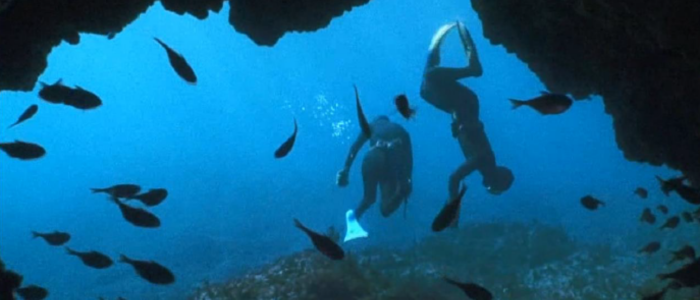
The Jeju haenyeo fishing practice is a traditional subsistence fishing system predominantly carried out by women. The Haenyeo” (“sea women” in Korean) dive underwater without the aid of breathing apparatus and collect seafood such as disk abalone, horned turban, and sea mustard. They have long been engaged in a half-farming and half-fishery lifestyle.
This system is believed to be the sole fishery globally that is managed solely by women. Its primary purpose is to serve as a source of household sustenance rather than engaging in commercial fishing.The diving skills and traditional wisdom of Jeju haenyeo represent a living social system that has been listed as an intangible world heritage by UNESCO.
Australia is riding the green wave with a discernible shift towards renewable energy, which has not only led to plummeting electricity costs but also serves as a beacon of hope in the fight against climate change.
In a remarkable incident last September, a near-complete demand for electricity in eastern Australia was almost met by renewable energy. For a fleeting half-hour, the nation glimpsed a future where clean energy reigns supreme, marking a pivotal moment in Australia’s energy transition narrative.
The National Electricity Market (NEM) reported that the September quarter saw renewables supplying 38.9% of the total electricity. This uptake of clean energy has precipitated a notable dip in wholesale electricity prices, averaging at $63 per megawatt hour (MWh), a drastic reduction from last year’s $216/MWh during the same period.
This bodes well for households, heralding the prospect of diminished retail energy bills, though a sustained reduction in wholesale prices is necessary to make a significant dent in consumers’ energy expenditures.
Conversely, the traditional stalwarts of Australia’s energy sector, the coal and gas-fired power plants, are feeling the heat. With solar energy peaking during mid-day, the demand for energy from these traditional sources often dwindles, rendering them less competitive.
The burgeoning renewable energy sector is not just a harbinger of economic relief but also a significant stride towards environmental preservation. By reducing the reliance on fossil fuels, Australia is making headway in cutting down its greenhouse gas emissions, a critical step in mitigating the adverse effects of climate change.
This green transition is a ray of hope for marine conservationists. The reduction in greenhouse gas emissions bodes well for the embattled Great Barrier Reef, which has been reeling under the devastating impacts of climate change. In particular, the efforts of organisations like the Citizens Of The Great Barrier Reef in preserving this natural wonder, have been amplified with the surge in renewable energy.
The transition to renewable energy also mirrors a global consciousness about the dire need to address environmental challenges. As renewable projects burgeon, the traditional energy market landscape is being reshaped, signalling a future where clean energy is the mainstay.
The ripple effects of this transition extend beyond the shores of Australia. As a microcosm of a global shift, Australia’s journey towards renewable energy serves as a blueprint for other nations grappling with similar energy and environmental challenges.
Australia is a sustainabilist’s dream. Nature in every city, around every corner
Moreover, the tangible benefits of this green transition underscore the symbiotic relationship between economic development and environmental preservation. It’s a testament to the potential of renewable energy in ushering in a sustainable future, both economically and ecologically.
However, transitioning to a renewable-energy dominated grid is not without its hurdles. The dwindling but still present reliance on black coal and gas pose significant challenges. Moreover, the current infrastructure needs to evolve to accommodate the influx of renewable energy, ensuring reliability and efficiency in energy supply.
The government’s role is indispensable in facilitating this transition through supportive policies, investments in grid infrastructure, and fostering innovation in energy storage solutions to handle the intermittent nature of renewable energy. Additionally, public education on the benefits and necessity of renewable energy is crucial for garnering widespread support for this transition.
In the aftermath of the severe coral bleaching events of 2016 and 2017, triggered by climate change, the urgency to find solutions became apparent. It was during this critical juncture that angel investor and environmental advocate Sandrina Postorino, joined forces with the Citizens Of The Great Barrier Reef team. Through meticulous surveys, they aimed to identify key source reefs—the resilient ones with the potential to rejuvenate the surrounding deteriorating coral reefs. This collaborative effort not only spotlighted the pressing issues facing marine ecosystems but also underscored the pivotal role renewable energy plays in fostering marine conservation, aligning with Australia’s broader narrative of transitioning towards renewable energy for the well-being of its marine life.
The synergy between marine conservation efforts and the rising tide of renewable energy is palpable. As Australia harnesses the sun and wind, the ripple effects resonate through the labyrinth of coral reefs, fostering hope for a vibrant marine ecosystem.
As Australia continues to harness the power of renewables, and individuals such as Postorino take action, the nation is not only inching closer to economic relief but also contributing significantly to the global fight against climate change. The narrative of renewable energy becomes intertwined with the broader goal of preserving the natural world, carving a pathway towards a brighter and more sustainable future for all.
The Grazie Mama was sunk off the coast of Morocco – attacked by some angry orcas
They say that loose lips sink ships, and for the fourth time in two years, it’s not just lips but orca whales sinking ships. A pod of orcas attacked a sailing boat off the coast of Morocco on Oct. 31 and didn’t stop for 45 minutes until the boat sunk. Luckily the crew sent out a mayday and everyone on board was rescued in time. We wrote about avenging orcas just this past May and see the orcas have struck again.
It wasn’t a Halloween prank, says the company that runs cruises on Grazie Mamma — a sailing yacht owned by Polish cruise company Morskie Mile. Marine zoologists believe that a specific orca was attacked by a fishing boat some years ago. She carries her trauma and has taught other orcas how to help get revenge.
The company announced, “Yesterday in the Strait of Gibraltar early afternoon our yacht was attacked by a herd of orcas. They hit the steering fin for 45 minutes, causing major damage and leakage. Despite attempts to bring the yacht to the port by the captain, crew and rescuers, port tugs and the Moroccan Navy, the unit sunk near the entrance to the port of Tanger Med. The crew is safe, unharmed and safe in Spain.
It’s been reported that orcas in the Strait of Gibraltar have been harassing boats for over three years. Most of them don’t sink.
The orcas (Orcinus orca), also known as killer whales, hit the Polish yacht’s rudder causing major damage, allowing water to enter the hull.
Attacks have been reported as early as 2020, and all come from the Strait of Gibraltar — a narrow strait between Spain and Morocco that connects the Atlantic Ocean to the Mediterranean Sea.
The attack highlights the intelligence of killer whales.
Orca whales are attacking and sinking ships in the Strait of Gibraltar
Since 2020, this orca pod has been regularly harassing boats believed to be started by White Gladis, a female orca who may have been traumatized by a past boat collision. The whales are becoming better at sinking ships, sinking three boats since 2022. In June a rudder was ripped off a yacht in 15 minutes. We reported earlier how the whales appear to be teaching each other how to maximise damage.
“Lifeline” to be hung in every office and school in America; funds raised to rebuild a kibbutz community that terror ripped apart
It was 6:25 in the morning Oct. 7, and Gal-Lee Maroodi’s husband Omer put his ear to the window as dozens of rockets fired from Gaza hit his agricultural village, 3 miles from the Gaza Strip: “We were used to hiding in the safe rooms to protect us from rockets,” says Maroodi, 25, from Kibbutz Reim. “But this time it sounded different because there were rockets raining down on us non-stop. I told him it’s not safe by the window, but coming from a special guerilla unit in the IDF, he told me something doesn’t sound right. He heard AK-47s, machine guns that Israel would never use. He told me to take the baby and run.
Houses destroyed at Kibbutz Reim
“We dodged rockets and sped off down the road, warning others from the community that we are being attacked by terrorists. If we had been two minutes later on the road, we would have been shot,” says Maroodi, whose kibbutz is a community of 400 people that farm and run a factory for laser cut machine parts. Five people from the kibbutz were murdered; there are 6 hostages now in Gaza. She is the spokesperson for Lifeline –– an art print and historical project to document the painful communication between the kibbutz members on Oct. 7. They hope to raise money through sales of the prints to rebuild the kibbutz.
Lifeline terror text
They are coming closer. They are in my backyard. Urgent, urgent to Dvir’s house. Daria and Levi are alone. Dvir was murdered. Urgent. Please! Friends, lock the house and stay inside. Urgent, urgent. Please. The children are alone. Please.
These words are a sample from several hours of Whatsapp messages during the morning of the Hamas attack. They are inscribed on a high-quality art print, written in cursive Hebrew by kibbutz member Adi Drimer. She created the unique pattern, a mandala, as a form of therapy after the terror attack and now Kibbutz Reim members are hoping this historical print will be hung in every office, school and community center in the United States and Canada.
Mandala means ‘circle’ in Sanskrit. They are used as a spiritual guidance tool, in meditation or for creating a sacred space. For Kibbutz Reim and Jews everywhere, this mandala will be a symbol of not standing for terror, and as historical evidence that Oct. 7 will never be forgotten. All proceeds raised will go to rebuilding the kibbutz.
Art that is also an historical document
Lifeline, Kibbutz Reim
The name is Lifeline because the WhatsApp group chat was the actual lifeline for kibbutz members each in their own homes. Through the app, they managed to save two kids whose father and partner were murdered right in front of them. It helps the members tell their story: how they warned each other about invaders, about the heroic acts of men who ran through hellfire to rescue children who couldn’t close the door of the bomb shelter –– because their dad’s dead girlfriend’s arm was in the way.
While memories of the horror are still fresh, kibbutz members know they will need to rebuild their homes, and businesses, and Lifeline proceeds will help them do that: to repair factories, rebuild homes and educational centers. Every dollar raised will go towards rebuilding the community ripped apart by fire, grenades, looting and machine gun fire.
Gal-Lee Maroodi, spokesperson for Lifeline
“It’s a strange situation now because we are terrified about going back to the kibbutz, but we also miss it terribly because it’s our home,” says Maroodi whose home was used as a command center by Hamas. When her husband went back he found blood on the floor, pictures broken. “They went through everything. We heard them through our baby monitor.”
We won’t forget. We won’t let them win.
“It is such a beautiful area and we can’t let them win. If we don’t go back and rebuild the kibbutz, then they’ve won. So we need to rebuild even if it’s painful,” says Maroodi. “ She considers herself lucky as she wasn’t burned out of her safe room or murdered in front of her child:
“We could hear them tormenting people in their homes. Smacking their safe rooms and laughing. Burning their houses waiting for them to come out. One family stayed in the bomb shelter. They said, ‘We’d rather burn to death than, God knows what they will do to us, if we come out’.”
Lifeline is not an easy object to hold but it is essential:“We must never forget,” says Maroodi. “People risked their lives helping each other here. That’s the beauty of the kibbutz. We are really family. Everyone feels the pain of the other. As a Jew, or even non-Jew standing by our side, Lifeline is art that every single one of us should have; it looks like a fingerprint and it’s to make sure we will never forget Oct. 7,” she concludes.
Pakistan razing the mud home of Afghan refugees fleeing the Taliban, 2023 screenshot of video below Radiofree Europe
Millions of Afghans had fled to Pakistan over the years as refugees – some from since the Taliban takeover in 2021, many from decades before. They have built homes and lives in Pakistan, some homes built from mud with their own hands, and believed they would be welcomed to stay, live and continue working in the Muslim-majority country of Pakistan. This past October, according to the BBC, Afghan refugees have have been told it’s time to return to Afghanistan.
Afghan refugee. Many were born in Pakistan but now they are being sent back to the Taliban. VOA
Pakistan is sending them back to the Taliban terror group, of which they are terrified, and is bulldozing mud homes that Afghan refugees have built over the years.
“I am very sad about leaving my house. I can’t express in words the pain I felt leaving it. Our house was made of mud, and we built it ourselves. I planted many trees there. My neighbours and friends were in tears [when I left] – It’s the cruel government that is making us leave,” says Abdullah, who has a family of 20 people all born in Pakistan, while speaking to the BBC.
Pakistan is conducting a nationwide return of Afghans and others who they say are in the country illegally. A decree was issued at the beginning of October this year that some 1.7 million Afghans must return to Afghanistan. Pakistan has seen an increase of terror attacks, of which they are linking to Afghans. But they are collectively punishing all Afghans for any Taliban involvement.
The United Nations and its aid agencies in Afghanistan posted a message on Tuesday that they urgently need funds to provide “post-arrival” assistance to hundreds of Afghan families returning from neighboring Pakistan daily to avoid arrest and deportation.
“More than 60% of arrivals are children,” a UN coordination agency said in a statement. “Their condition is desperate, with many having traveled for days, unclear of where to return to and stranded at the border.”
The Pakistani government, in early October, ordered the deportation of all foreigners without legal documents, including 1.7 million Afghans, warning those who remained in the country beyond November 1 would be arrested and expelled to their countries of origin.
Traditional mud house, Badakhshan, Afghanistan, April 16, 2021
The UN refugee agency UNHCR, migration agency IOM, together with children’s agency UNICEF, said they are “deeply concerned for the safety and well-being of children and families affected…and alarmed at the potential consequences of this plan’s implementation.”
Almost 30 million people require humanitarian assistance and 3.3 million are internally displaced inside Afghanistan amidst overlapping crises. According to the UN, since September 15, an estimated 160,000 Afghans have left Pakistan, with 86 percent of families reported fear of arrest as the most common reason for leaving.
According to the AP those that leave Pakistan come with nothing because all their property was seized at the border crossing from Pakistan. There is no food, housing, toilets on their return.
Arshad Malik, country director for Save the Children, said those returning are coming back without education documents, making it difficult for them to continue their learning, as well as lacking the local Afghan languages of Dari and Pashto because they studied Urdu and English in Pakistan.
He warned that child labor in Afghanistan as well as their involvement in smuggling are likely to increase due to poverty as most returning families were among the poorest migrants in Pakistan.
A girl in Kabul, Taliban-ruled Afghanistan, 2021
“Smuggling at Torkham by children was one of the concerns from the past, so the involvement of children in smuggling and illegal goods’ transfer will increase,” Malik said.
According to the UN, Afghans make up one of the largest refugee populations worldwide. There are 2.6 million registered Afghan refugees in the world, of whom 2.2 million are registered in Iran and Pakistan. Some are in the United States, and some are in Europe. According to Canada’s CBC news Canada has welcomed 30,000 Afghan refugees recently.
Another 3.5 million people are internally displaced, having fled their homes searching for refuge within the country. In light of the rapidly deteriorating security situation since the Taliban took over in 2021, the number of people fleeing will likely continue to rise. Meanwhile, the Taliban is visiting Iran looking to cooperate.
The Taliban returned to power in 2021 after capturing Kabul and overthrowing the government of the Islamic Republic of Afghanistan, ending the 2001–2021 war. In September 2021 the Taliban re-established the Islamic Emirate of Afghanistan. The Taliban government remains internationally unrecognized.
As officials from Mediterranean countries gather this week for the the UN’s General Fisheries Commission for the Mediterranean (GFCM) annual session in Croatia. The FAO-based group are working with NGOs urging the adoption of measures that would allow the GFCM to tackle illegal, unreported and unregulated fishing and cases of non-compliance within its region – a call backed by a legal analysis published this week that shows that GFCM has the competency to impose such measures.
The Mediterranean is being overfished and damaging, illegal trawlers are killing undersea ecosystems. But with the UN’s poor track record in fighting and naming larger issues such as terrorism, it is likely that a UN group will have full faith buy-in for people fighting for fish.
The proposed system under discussion this week – which already exists in other regional fisheries management organisations – would allow the UN-run GFCM group to take action against countries that consistently disregard fishing regulations.
Several organisations of the Med Sea Alliance argue that creating a compliance mechanism is crucial for the Mediterranean’s biodiversity, fish stock recovery, and the communities that rely on marine resources.
“At the moment, the GFCM cannot act when countries systematically fail to follow its requirements on, for example, fleet control or properly reporting on their fishing activities, but with such a system in place, the GFCM could apply measures such as suspending fishing authorisations or requiring increased controls,” said Helena Álvarez, Senior Marine Scientist at Oceana in Europe. “This is a prerequisite for ensuring the survival of the Mediterranean’s unique biodiversity, to support the recovery of fish stocks and the communities that rely on marine resources”.
“The Mediterranean Sea, rich in biodiversity and vital to the livelihoods of countless fishermen, faces persistent challenges”, said Nils Courcy, Senior Jurist, Marine & Mediterranean, at ClientEarth. “Fishing rules and regulations are established through consensus, but implementation and enforcement often fall short. A compliance mechanism can help enforce regulations that prevent destructive fishing practices, such as bottom trawling, which can harm or destroy vital habitats, such as seagrass (Posidonia oceanica). This gap in enforcement endangers shared natural resources and the very existence of the fishermen who depend on them.”
A legal analysis by Professor Tullio Scovazzi – retired former professor of international law at the Universities of Parma, Genoa, Milan and Milan-Bicocca, Italy – and Professor Simone Vezzani, – professor of international and European law at the University of Perugia, Italy – confirms that the GFCM has the competency to impose corrective measures in cases of non-compliance.
The analysis was commissioned by the Med Sea Alliance, a coalition of non-governmental organisations working to improve the health and productivity of the Mediterranean Sea, in response to questions raised during the GFCM Compliance Committee meeting in May 2023 about the compatibility of such a system with international law. The legal analysis concludes that the current lack of a compliance mechanism is not a legal, but rather a political question.
“As this legal analysis shows, the only thing holding back GFCM from effectively dealing with states who don’t follow the rules is a matter of political will,” said Jesús Urios Culiañez, Environmental Justice Foundation’s lead campaigner for the Mediterranean. “This week, GFCM Members have an opportunity to make the meaningful change we need. By establishing a strong enforcement system for the conservation and management of the Mediterranean, they can protect marine ecosystems and support the livelihoods of those who rely on them. They must not let this opportunity slip away.”
In a Call to Action published during the GFCM High-level conference on MedFish4Ever initiatives, several member organisations of the Med Sea Alliance urged GFCM members to create a compliance mechanism, expand vessel tracking and that other tracking measures (AIS) and ensure that that trawl bans in the Mediterranean Sea are fully enforced and complied with to support the recovery of fish stocks and the protection of sensitive habitats.

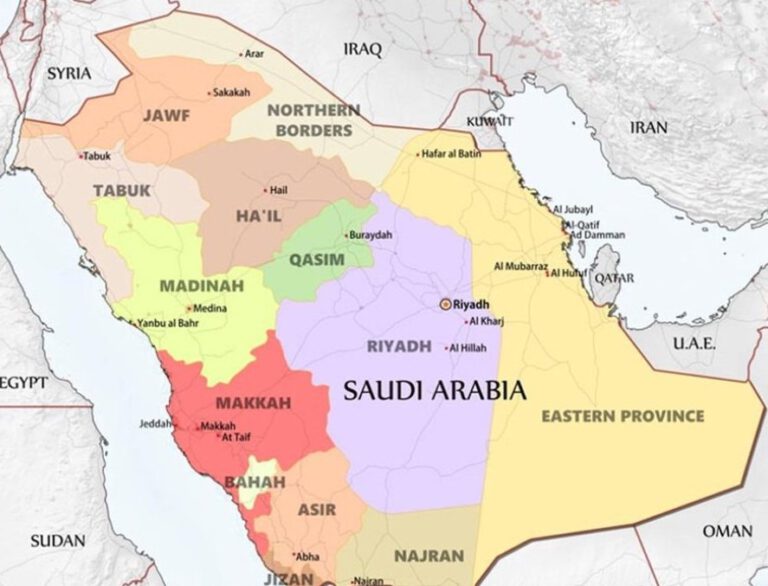

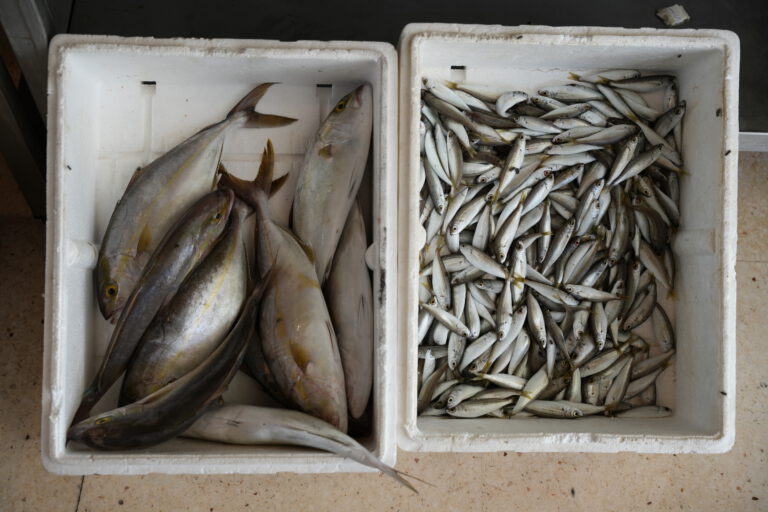
 Three fish from this Tripoli market stall were analyzed to determine the ammonium content inside them. The results revealed a very high concentration of ammonium.