

 Why do we love “makeovers”? What draws us to images of women dunked in hair dye and better lighting, or old furniture stylin’ after sanding and new hardware? The reconstruction of the Nahr el-Bared Refugee Camp in Tripoli, Lebanon is an architectural “before” and “after” with improvements far deeper than a slap-on of fresh paint. The project is a contender for a 2013 Aga Khan Award for Architecture, a $1 million award to be awarded in September.
The camp is Lebanon’s oldest and largest. Founded during the 1948 Arab-Israeli conflict, it evolved over generations from tents to permanent buildings, only to be flattened during a 2007 clash between the Lebanese army and an Islamic militant group (image above).
This project kept the essence of what was destroyed and upgraded it, opting to invest in enhanced public space and greatly improving the lives of 27,000 Palestinian refugees.
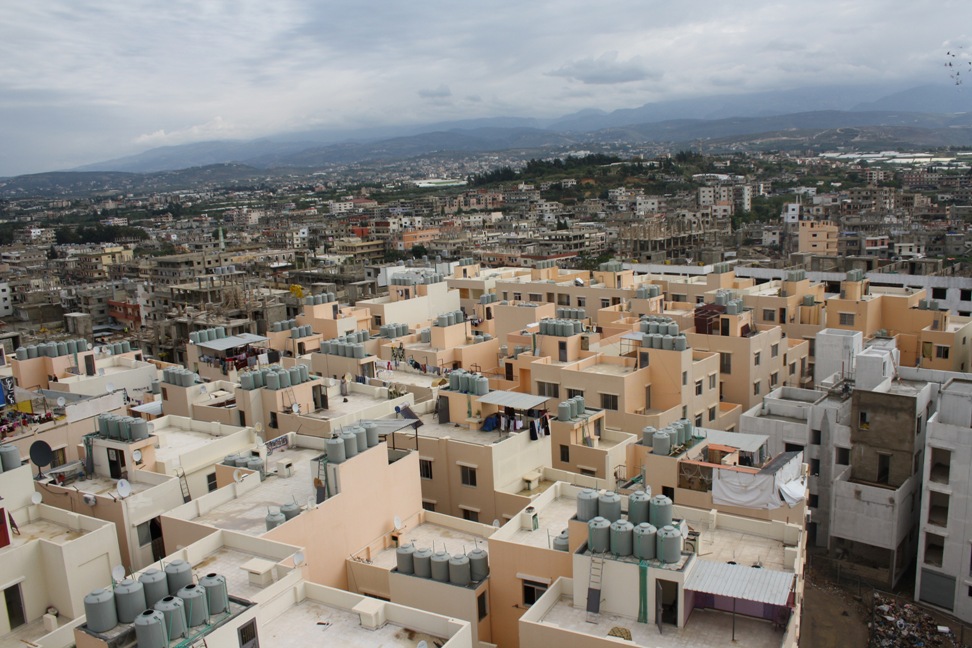 The United Nations-led planning effort involved the entire community. The idea was to rebuild something instantly recognizable to former residents. Using large scale plans, designers and residents worked to recall individual homes in correlation to their old neighbors. Camp landmarks were recorded and neighborhoods outlined, and the collective memory of the community was mapped.
The original camp followed the building typology of the refugees’ villages, which, in turn, was based on an extended-family collective. The old town road network had provided the only open space. The new town included a design goal to triple non-built areas from 11% to 35% of total landscape, achieved by giving each building an independent structural system allowing for vertical expansion up to four floors.
Former building positioning was respected, but footprints reduced to increase public space. A series of eight construction phases began in 2008, and in April 2011 residents returned to new homes, schools and shops.
The built environment influences human health as surely as diet and disease. Architecture that weaves together the physical and social fabric of a community deserves recognition. Kudos to the Aga Khan Award for Architecture for throwing light on another stellar project.
Find out more in this short video clip:
Images from the 2013 Aga Khan Award for Architecture



[…] Lebanon and Pakistan have each announced new biogas projects, tapping into a sustainable energy source that, unlike other renewable energy streams, solves two municipal problems – energy creation and waste processing. […]
Jerry – My third year living in the Middle East and I’ve made the same error regarding Tripoli. It may be this region’s answer to, say, the many “Springfield”s in America.
But – Nagib – this failure to recognize every place name is not from lack of curiosity or some deficiency unique to Americans. We all seem to focus on our own bubble of existence, it’s a matter of time and energy – not always an indication of arrogance or willful ignorance.
Forums such as Green Prophet ideally open all our minds to new and valuable information. Keep reading, and commenting!
[…] More Lebanon’s Reconstructed Refugee Camp in Tripoli Up for Aga Khan Award | Green Prophet. […]
In the video, there is a guy spraying graffiti on the newly built houses ! Looks like vandalism …
There are cities name Tripoli in more than one country as there are cities names Paris (USA) and London (Canada) in more then one country.
The problem with North American in general is that they only know what they read in their newspaper and the general knowledge of the world geography, history, cultures and civilizations is completely missing in the school curricula.
I don’t think there are 5 Americans [beside few diplomats] that know the name of the Capital of Mongolia [Ulan Bator] for example. Their attitude is “who cares?”
I don’t understand. I thought Tripoli was in Libya, not Lebanon.