
Bonn: The Latest Climate Talks and the Middle East

bonn climate talks photoAn update on the latest climate negotiations in Bonn as well as Middle Eastern countries which made the headlines during the talks

Believe it or not, the latest climate negotiations at Bonn – which discussed the future of the Kyoto Protocol which ends in 2012 as well financing adaptation – have come and gone without making much of a stir. The lack of media attention is surprising, even if we take into consideration the total failure of Copenhagen and a growing realisation that climate summits are not where we are going to find solutions for climate change.

What isn’t so surprising is apparent failure of the talks to make any real progress towards setting legally binding targets to cut emissions or finance the developing countries so that they can move towards sustainability. It seems that after two weeks of negotiations, which ended on Friday 17th June, there is very little to show for it.

Saudi Arabia, Qatar, Kuwait and Oman

Whilst Middle East and North Africa nations were fairly absent from the talks, some countries did manage to make an impact. Unsurprisingly, Saudi Arabia made the headlines (again) for their attempts to delay the progress of the talks by insisting that agreement wasn’t necessary for another 18 months.

They were also keen to revive their demand that they should receive compensation for the loss of oil revenue in a post-oil future. Kuwait, Oman and Qatar were similarly criticized for holding up talks and were awarded the ‘Fossil of the Day’ by the Climate Action Network, which is an alliance of various green NGO’s.

Saving Kyoto Protocol

The rift between developing and developed countries seemed to grow as the G77 group (which consists of developing countries) pointed out that the money promised to them 18 months ago to allow them to adjust to climate change had not been delivered. They also demanded that developed nations commit to a 50 percent cut in emission below 1990 levels by 2020 under an extended Kyoto Protocol.

Egypt, speaking for the Arab Group, called the Kyoto Protocol the most important legal instrument addressing climate change and urged Annex I countries (developed nations) to respect their legal commitment to a second commitment period.  Apart from these brief mentions, the Middle East didn’t really get much of say in the talks.

The focus seemed to be more on the EU nations as they need to be working towards a new legally binding agreement to cut their emissions as well as providing adaptation funds for developing nations who will bear the burnt of climate-change induced disasters.

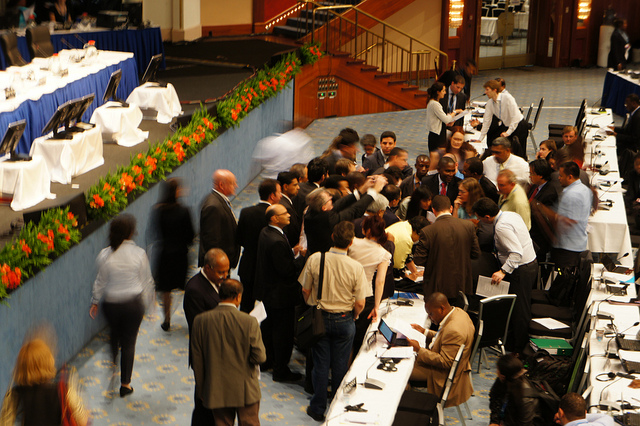
::Image via Adopt A Negotiator/flickr
Arwa Aburawa
Arwa Aburawahttp://www.greenprophet.com
Arwa is a Muslim freelance writer who is interested in everything climate change related and how Islam can inspire more people to care for their planet and take active steps to save it while we can. She is endlessly suspicious of all politicians and their ceaseless meetings, especially as they make normal people believe that they are not part of the solution when they are the ONLY solution. Her Indian auntie is her model eco-warrier, and when Arwa is not busy helping out in the neighborhood alleyway garden, swap shopping or attempting fusion vegetarian dishes- with mixed success, she’d like to add- she can be found sipping on foraged nettle tea.

Read More

LEAVE A REPLY

Please enter your comment!
Please enter your name here

TRENDING

5 projects to help kickstart your company’s sustainability journey 

True progress happens when environmental ambition meets action. Decarbonizing efficiently is possible for any business in any sector, but actually getting started can sometimes feel daunting.   The trick? It’s to start small and build momentum. Here are five potential projects to help you get started.  

Hormuz 2026 Conflict Poses an Energy and Food Security Dilemma in a Warming World

As tensions rise in one of the world’s most critical maritime chokepoints, the ripple effects go far beyond oil—touching food systems, climate pressures, and regional stability

Climate change traced in sea turtle shells

It's sea turtles which may in the end save islands in the Seychelles. They may also better help us understand climate change. Like rings on a tree, scientists have found a way to read sea turtle shells and how they are impacted by climate change tells a story. 

We’ve lived through the past 11 of the hottest years on record

Have we forgotten about global warming when the world...

Huge Fish Nursery Discovered Under Freezing Arctic Seas

In 2019, an underwater robot camera exploring the seabed...

How to quiet noise from construction in your office

Streets need to be resurfaced in New York but the humming and grinding noise is unsettling. Noise is environmental pollution. 

EarthX and a blueprint for sustainable investing

Trammell S. Crow, a Dallas-based businessman and father of four, is focusing his efforts on impact investing, and media that focuses on saving the planet through EarthX.

Mining Afghanistan’s Mineral Discoveries Similar to Avatar

Now that American forces in Afghanistan are commemorating the longest period of any war that America has been involved in, including the 1965-73 Vietnam War, the recent discoveries of large and extremely valuable mineral and metal deposits may finally bring to light a reason to continue the presence of US fighting forces in this war torn and backward country.

From Pilot Plant to Global Stage: How Aduro Clean Technologies’ 2026 Expansion Signals a Turning Point for Chemical Recycling Investors Like Yazan Al Homsi

The company's Next Generation Process (NGP) Pilot Plant in London, Ontario, has officially moved into initial operating campaigns, generating the kind of structured, repeatable data that separates laboratory promise from commercial viability.

Nobul’s Regan McGee on Shareholder Value: “Complacency Is the Silent Killer” 

Why the governance framework designed to protect shareholders so...

Should You Invest in the Private Market?

startustartup Unlike public stock exchanges, which offer daily trading, strict...

How to build a 100-year-company

Kongō Gumi is a Japanese construction company, purportedly founded in 578 A.D., making it the world's oldest documented company. What can we learn about building sustainable businesses from them?

How AI Helps SaaS Companies Reduce Repetitive Customer Support Work

SaaS products are designed for large numbers of users with different levels of experience, and also in renewable energy.

Popular Categories