
Fridge Voyeurism in Tel Aviv

fridge-voyeur-israel-photo

Are you an organic food addict? Or do you insist on eating food that grown locally, but pesticide-ridden, to spare food miles (or to serve an ideology?)

As food production is a major source of greenhouse gas pollution (Read: Global Warming), eating locally, and consuming less meat is one way we can do our part.

Following a worldwide trend, where people are opening up their fridge to show people what’s in their fridge (and on their palette) today I will expose myself and show you what’s in mine. It feels a bit like opening my underwear drawer to strangers, but here goes:

fridge-voyeur-tel-aviv-photo

CONTENTS (Door on right): Bio eggs, butter, organic strawberry jam, milk, mustard, sundried tomatoes, pomegranate concentrate, goat’s milk yogurt, V8, tehina, capers, guava juice, orange juice, batteries (not for eating!), coconut juice, goat’s yogurt, and the old Canadian maple syrup (thanks Mom!).

SOURCE: There are a number of imported items here like the V8 from North America and the juice from Egypt. The jam is from the United States. Phoeey on me, but it looked so good. And the pomegranate concentrate, I think is from Turkey, while syrup is from Canada. All the milk products are produced locally and bought at Eden Teva market or local non-organic shops. Milk costs about $1.50 a liter in Israel (non-organic), the organic yogurt about $3 a bottle.
fridge-voyear-photo

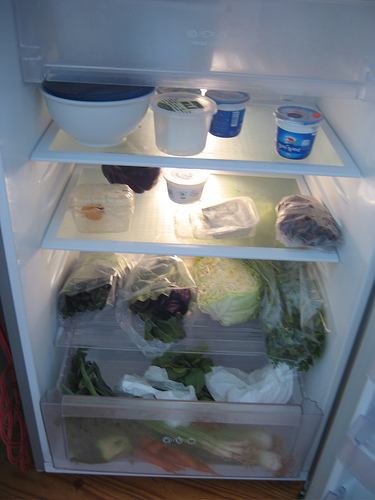
CONTENTS: (from top to bottom, left to right) organic lentil sprouts, organic goat’s cheese, chessick fruit, soft regular white cheese 5%, organic red cabbage part of a weekly CSA veggie box delivery (choose from a list of CSAs here if you live in Israel); more cheese including a Rockfort goat’s cheese, Syrian dates, spicy lettuces, cabbage, parsley, green onions, carrots, leaks, tomatoes, radishes, cucumbers, and spinach.

SOURCE: Vegetables come from an organic farm, which delivers a box of whatever’s in season, once a week. Some of the cheese is from Eden Teva market, a health food store in Bnei Brak; some cheese is from Arab supermarket on the corner nearby my house.

Reducing food miles is important to me from an environmental perspective. I try to eat locally produced food, and things which are in season.
fridge-voyeur-israel

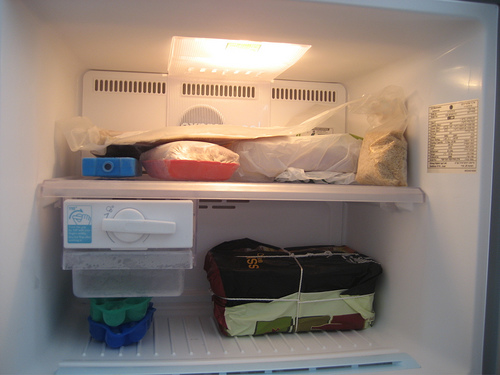
CONTENTS: It being Passover in Israel means that a lot of the bread products you might see here other times of the year have been cleaned out, eaten or burned, as per Jewish custom. Moving on, there is some sort of white fish, hamburger organic and regular, rice (stored in freezer to keep the bugs out), and a strange kind of sheep tail fat (bottom right) for making a Bukharian food known as Osh Pollo.

It is wrapped like that because someone (on their request) was supposed to “smuggle” it to the US where no such sheep tail fat can be found. It stays frozen in the meantime. (As a once a week meat-eater, Osh Pollo is very yummy and highly recommended.)

SOURCE: The frozen products come from Eden Teva Market, a health food store, a regular grocery store, and the sheep tail fat, a local market. Normally you won’t find so much meat in the freezer, as I tend to buy it when I want it. I have no idea how much meat costs per kilo, because I buy it so rarely. The organic hamburger, enough to feed 4, cost about $25 for the box, times 2 what you see above.

Want to know more about fridge voyeurism? Read this past Green Prophet post on a fridge in Jerusalem.


Karin Kloosterman
Karin Kloostermanhttp://www.greenprophet.com
Karin Kloosterman is an award-winning journalist, innovation strategist, and founder of Green Prophet, one of the Middle East’s pioneering sustainability platforms. She has ranked in the Top 10 of Verizon innovation competitions, participated in NASA-linked challenges, and spoken worldwide on climate, food security, and future resilience. With an IoT technology patent, features in Canada’s National Post, and leadership inside teams building next-generation agricultural and planetary systems — including Mars-farming concepts — Karin operates at the intersection of storytelling, science, and systems change. She doesn’t report on the future – she helps design it. Reach out directly to [email protected]
5 COMMENTS
  1. I’d be delighted to come for dinner Karin when I’m back – the contents of your fridge sound wonderful, tantalising & eco-friendly indeed! Looking fwd to that sheeps tail…..

Comments are closed.

TRENDING

Eco organization offices destroyed by Iran missile

Tel Aviv's eco organization, the Heschel Center, was impacted by an Iranian missile.

What are AWG air-water generators, and why they aren’t a golden-bullet solution (yet)

Atmospheric water generators (AWGs) sound like magic: machines that can pull drinking water out of air. The idea is mentioned in the Bible, where the elders would pray for water collected as dew on plants and the catch on turning this into a machine is in the physics. To turn invisible vapor into liquid, you must remove heat, especially the latent heat of condensation.

Jordan’s $6 Billion Aqaba–Amman Desalination Project from the Red Sea Moves Forward

In 2025, the Jordanian government signed agreements with a consortium led by Meridiam and SUEZ, alongside VINCI Construction and Orascom Construction. Under a 30-year concession agreement, the consortium will design, build, finance, operate, and maintain the system before transferring it back to the Jordanian government. The total investment is estimated at approximately $6 billion USD.

Haman’s Fingers, A Moroccan Purim Specialty

There’s feasting at home on the night and the next day, and to make sure everyone gets good things to eat, families send out packages of treats to friends and neighbors. Traditional goodies are hamentaschen, and other treats like our chocolate nut clusters .

The Saudi Startup Turning Desalination’s Toxic Waste Into Its Own Disinfectant

For millennia, the Middle East's water crisis seemed an immutable fact of geography — a region defined as much by what it lacked as by what lay beneath its sands. Today, a convergence of plummeting solar costs, advancing membrane technology, and hard-won engineering expertise is rewriting that story.

Should You Invest in the Private Market?

startustartup Unlike public stock exchanges, which offer daily trading, strict...

How to build a 100-year-company

Kongō Gumi is a Japanese construction company, purportedly founded in 578 A.D., making it the world's oldest documented company. What can we learn about building sustainable businesses from them?

From Pilot Plant to Global Stage: How Aduro Clean Technologies’ 2026 Expansion Signals a Turning Point for Chemical Recycling Investors Like Yazan Al Homsi

The company's Next Generation Process (NGP) Pilot Plant in London, Ontario, has officially moved into initial operating campaigns, generating the kind of structured, repeatable data that separates laboratory promise from commercial viability.

How AI Helps SaaS Companies Reduce Repetitive Customer Support Work

SaaS products are designed for large numbers of users with different levels of experience, and also in renewable energy.

Pulling Water from the Air

Faced with water shortage in Amman, Laurie digs up...

Turning Your Energy Consultancy into an LLC: 4 Legal Steps for Founders in Texas

If you are starting a renewable energy business in Texas, learn how to start an LLC by the books.

Tracking the Impacts of a Hydroelectric Dam Along the Tigris River

For the next two months, I'll be taking a break from my usual Green Prophet posts to report on a transnational environmental issue: the Ilısu Dam currently under construction in Turkey, and the ways it will transform life along the Tigris River.

6 Payment Processors With the Fastest Onboarding for SMBs

Get your SMB up and running fast with these 6 payment processors. Compare the quickest onboarding options to start accepting customer payments without delay.

Related Articles

Popular Categories