A classic and common piece of Americana holds links to a misunderstood culture.
I found a bag of small yarn balls. I’d left it long ago at a friend’s house in New Jersey: my Amman-bound suitcase was fatter than the airline allowed. That bag was big, but the skeins of wool no larger than my grandma’s meatballs. Name a color, it was in there. I’m incapable of tossing the leftovers from a knitting project, but what to do with the pretty dregs?
I took the bag to my mom’s knitting group, where a woman suggested something shocking: crochet the bits into an afghan. Rabid knitters rarely pick up crochet hooks: we don’t like to play for the other team.
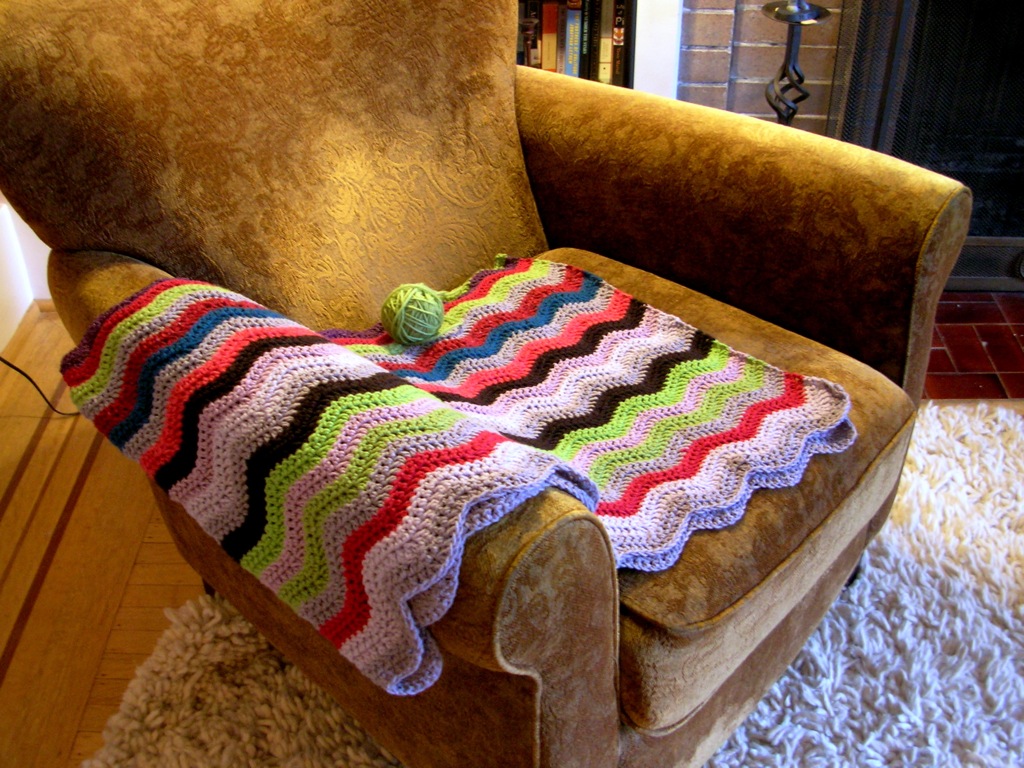
But I remembered a blanket from my childhood, thrown over the back of a rocker. It was made by my Italian grandma Rose, colorful like her name. A hundred squares bordered in black: splotches of color like stained glass windows or a new box of crayons. She could reel off memories of earlier projects embedded in each yarn. Little me lost hours looking at that thing.
I returned to those knitters, took their crash course in crochet, and with my ma’s 80-year-old girlfriends cheering me on, I was off to the races. A hundred and twelve squares were born on the flights and layovers from New York to London to Amman. That bag of wool was like an unpublished fairy tale, no matter how much I crocheted, the supply never stopped.
My London-leg seatmate nudged me and asked, “Why didn’t Homeland Security let the old lady on the plane?” Long pause arose: me sending him fierce telepathy to go back to his novel. “Because she was knitting an afghan. Get it? An AFGHAN?”
He went back to his reading and left me to my project. And I started to wonder how blankets got to be called “afghans”.
I knew from the dining hall workers in my Ohio college, old women with Kentucky and West Virginia roots, that American southerners sometimes called these blankets “Africans”.
Horrified then, we figured it was somehow linked to slavery, perhaps to the Underground Railroad that was active in those parts. But how different is that from calling them “Afghans”? Why not “Cubans” or “Lithuanians”?
The knitted or crocheted blanket we call an afghan turns out to be named for the folks in Afghanistan.
“Afghan” first appeared in English usage in the late 1700’s as a name for the Pashtuns of eastern and southern Afghanistan.
That country is known for its distinctive textiles, colorful carpets and lustrous karakul wool, so it’s sort of logical that “afghan” was picked up to refer to knitted or crocheted blankets. The word went mainstream in America in the early 1800’s, describing blankets and shawls made from multi-hued yarn.

According to a 1946 article attributed to the Oregon Worsted Company, the thrifty women of early America would carefully save oddments of yarn, left-over colors, and fiber unraveled from old sweaters and socks. As the yarn accumulated, it was crocheted into small squares; colors combined at the whim of the craftsman.
The squares were sewn together to make a blanket, a bedspread, a shawl, or a lap covering: functional for sleighing or sleeping, and decorative to boot. These “motif” afghans came to be known as “Granny Square Afghans” as grandma was commonly its maker.
Made of many colors, it resembled a particular type of colorful Colonial-era rug brought over from England, by way of the Middle East. A plausible explanation as to how a blanket became an afghan.
Knitters have popularity problems.
We’re great with other knitters, can endlessly ooh and aah over yarn choices and technique. But if you know a knitter, you can probably recall the exact moment when you hit saturation for gifts of knitted goodness. Dreading another sweater or scarf. Straining to demonstrate appropriate gratitude for the hours of labor spent on that goofy hat.
If you’re a knitter, you’ve felt the pain of handmade gifts that miss their mark. Suffered through lukewarm receptions for your latest creation; cringed through sightings of fine garments shrunk doll-size by someone ignorant in the ways of wool.
Thank God for Darwinian adaptation: knitters evolve into amped-up charity-goods machines. An ideal solution, matching knitters with people who actually want knits. Prayer shawls, preemie blankets, chemo caps, and toys for tots. Soldiers and sailors get socks and hats, amputees get stump-warmers. There’s a charity happy to receive most anything that flies off the needles. The internet is an enabler.
Afghans for Afghans is one of the most famous: a humanitarian project that sends handknit and crocheted goods to the good people of Afghanistan. Self-billed as an educational and “people-to-people” program, this grassroots effort was inspired by decades of Red Cross volunteers who made socks, slippers, and yes, afghans, for World War I and II refugees and soldiers. Volunteers like my grandma Rose.
They work with reputable relief agencies to securely transport and distribute the goods to beleaguered Afghans. Their website sells knitting patterns for Afghani-style garments; offers info on what needs to be knitted; and accepts cash donations.
So here I am making warm blankets from scraps of surplus yarn, in a style inspired by rich Eastern textiles, to be shared with the people who inspired the original. The concept’s as brilliant as the colors in an afghan.