Leap-second Bug Consumes Megawatts of Electricity

leap second clock frogWas it the leap-second bug that pushed America’s power plants beyond their capacity?

A 61 second minute was added to clocks around the world on June 30, 2012 at 23:59:60 UTC in order to compensate for slight variations in earth’s rotation speed.  This triggered a number of software bugs one of which caused a spike in data center electrical power consumption.

We won’t have to worry about a replay of Y2k until the year 10,000 but leap-year bugs reappear like clockwork every four and four hundred years.  Programmers periodically reinvent leap-year mistakes while re-implementing an algorithm first perfected by Pope Gregory XIII in 1582.  Leap second bugs are less predictable.  Leap seconds are necessary because the Earth’s rotation speeds up and slows down in
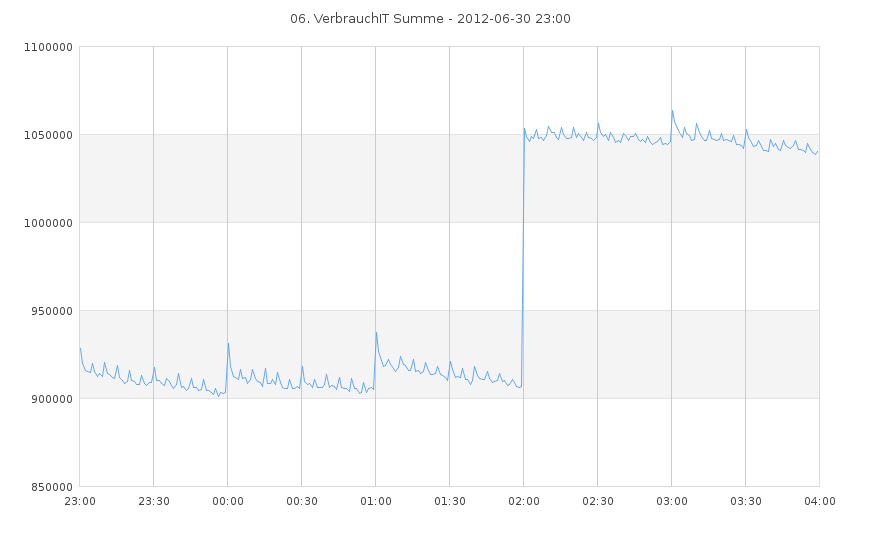
hetzer power graph

response to lunar and solar tidal forces.   Leap seconds realign astronomical time with standard earth (UTC) time.  This year’s leap second caused a number of software bugs including a Linux kernel bug which caused server power consumption to spike at web hosting companies such as OVH of France and Hetzner AG of Germany.

In a message to their customers, Hetzner AG admitted that this leap-second bug caused their electrical power consumption to increase by about a megawatt.

Even as I type this article on a Linux-powered laptop, I hear the fan speed up and slow down in response to varying CPU load.  Websites such as Facebook, online games and web advertisements cause the CPU to draw more power and run hotter so the fan speeds up.  Computer malware such as stuxmark and flame also have a significant energy cost as do the anti-virus programs which are designed to protect us from these threats.

Computers are far more efficient than they were a few decades ago.  They have grown so efficient that software developers can no longer justify spending time on optimizing algorithms or hunting down CPU performance bugs.  But because computers have become so ubiquitous, they consume an increasing fraction of our electrical power consumption and should not be ignored.

The June 30th leap second bug coincided with heat waves in parts of North America.  Air conditioning pushed some electric power utilities to the brink of their capacity.  Thunderstorms took out some redundancy and the remaining active power lines actually sagged as electrical load heated them enough to soften their copper core.

It is certainly within the realm of possibility that the power consumption spike associated with a leap-second bug could have pushed power plants beyond their capacity, leaving consumers in the dark.

Such “butterfly effect” power outages have occured in the past.  One of the most famous ones began in November 1965 when a mis-configured circuit breaker tripped and caused a cascade of overloads which left much of Northeastern US and Quebec in the dark.  So as the world moves towards a more efficient balance between electrical production and consumption, we must pay more attention to the energy consumed by inefficient computers and buggy software.

Stopwatch and frog image from Shutterstock; Leap second power spike graph via Hetzner, color fill added to improve contrast.

Brian Nitz
Brian Nitzhttp://www.greenprophet.com
Brian remembers when a single tear dredged up a nation's guilt. The tear belonged to an Italian-American actor known as Iron-Eyes Cody, the guilt was displaced from centuries of Native American mistreatment and redirected into a new environmental awareness. A 10-year-old Brian wondered, 'What are they... No, what are we doing to this country?' From a family of engineers, farmers and tinkerers Brian's father was a physics teacher. He remembers the day his father drove up to watch a coal power plant's new scrubbers turn smoke from dirty grey-back to steamy white. Surely technology would solve every problem. But then he noticed that breathing was difficult when the wind blew a certain way. While sailing, he often saw a yellow-brown line on the horizon. The stars were beginning to disappear. Gas mileage peaked when Reagan was still president. Solar panels installed in the 1970s were torn from roofs as they were no longer cost-effective to maintain. Racism, public policy and low oil prices transformed suburban life and cities began to sprawl out and absorb farmland. Brian only began to understand the root causes of "doughnut cities" when he moved to Ireland in 2001 and watched history repeat itself. Brian doesn't think environmentalism is 'rocket science', but understanding how to apply it within a society requires wisdom and education. In his travels through Europe, North America, Asia and the Middle East, Brian has learned that great ideas come from everywhere and that sharing mistakes is just as important as sharing ideas.

Hot this week

Why Health Systems Are Reaching a Turning Point

Health emerges from a continuous energy and material flow from water through food to human physiology. Technical energy systems support this cycle through water treatment, agriculture, and infrastructure.

Sustainability That Sells: How Profit and Purpose Come Together in the Hive

Whether you are a commercial grower, hobbyist beekeeper or retail equipment supplier, this system opens a new income stream with minimal environmental impact.

The Fitness App Revolution: Building the Future of Wellness Through Strategic Development

In an era where smartphones are ubiquitous and health consciousness is at an all-time high, the fitness industry has undergone a radical digital transformation. Fitness applications have moved far beyond simple pedometers, evolving into comprehensive wellness platforms that serve as personal trainers, nutritionists, and community hubs right in our pockets.

A Brief History of Basil From India to Italy

Beloved, fortunate, sweet, and royal; an herb with a long and storied history in Asia and across the world. Called by many names, basil has featured in previous Green Prophet articles, so enjoy another serving, a brief history of basil.

How Renewable Energy is Revolutionizing the Way We Power Our World

Solar has become the star of the transition thanks to modular hardware and straightforward installation. It fits dense cities and remote towns alike. Many companies are turning to rooftop arrays and carport systems - and exploring commercial solar installation as a practical way to lock in future savings.

Topics

Why Health Systems Are Reaching a Turning Point

Health emerges from a continuous energy and material flow from water through food to human physiology. Technical energy systems support this cycle through water treatment, agriculture, and infrastructure.

Sustainability That Sells: How Profit and Purpose Come Together in the Hive

Whether you are a commercial grower, hobbyist beekeeper or retail equipment supplier, this system opens a new income stream with minimal environmental impact.

The Fitness App Revolution: Building the Future of Wellness Through Strategic Development

In an era where smartphones are ubiquitous and health consciousness is at an all-time high, the fitness industry has undergone a radical digital transformation. Fitness applications have moved far beyond simple pedometers, evolving into comprehensive wellness platforms that serve as personal trainers, nutritionists, and community hubs right in our pockets.

A Brief History of Basil From India to Italy

Beloved, fortunate, sweet, and royal; an herb with a long and storied history in Asia and across the world. Called by many names, basil has featured in previous Green Prophet articles, so enjoy another serving, a brief history of basil.

How Renewable Energy is Revolutionizing the Way We Power Our World

Solar has become the star of the transition thanks to modular hardware and straightforward installation. It fits dense cities and remote towns alike. Many companies are turning to rooftop arrays and carport systems - and exploring commercial solar installation as a practical way to lock in future savings.

How does one start prepping?

Faced with an extreme winter storm this year, Americans wonder how to be prepared for catastrophe. Miriam has lived through wars in the Middle East - so she's prepared on giving you a guide to prepping.

Fishermen sue tire manufacturers on behalf of the salmon

A federal trial in San Francisco has brought US tire manufacturers, fishing groups, and environmental scientists into court over a chemical most drivers have never heard of — but which scientists say may be silently reshaping aquatic ecosystems.

Listening to Water: Tarek Atoui’s Next Work for Tate Modern

Born in Beirut, Lebanon in 1980 and now living in Paris, Atoui has spent years building instruments that don’t sit comfortably in concert halls. Many of them involve water, glass, and ceramics — materials that react to sound instead of simply producing it.

Related Articles

Popular Categories