Locavore, Shmocavore – Just Call Me an Ecotarian

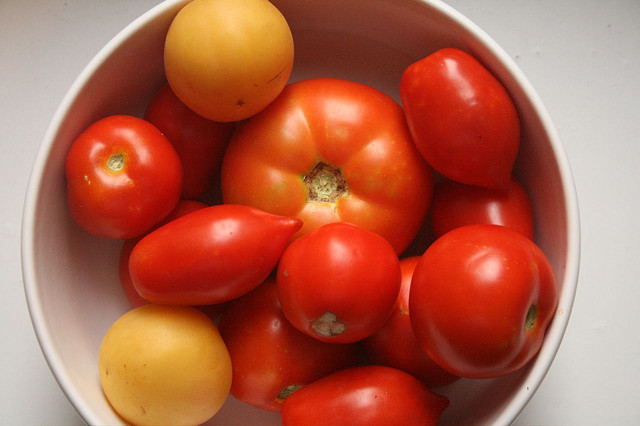
"fresh farm tomatoes"Is the eco-friendly food movement getting even more complicated, or are ecotarians simplifying matters?

The green movement is riddled with a lot of food ideologies.  When it comes to food, there are a lot of environmental issues to consider: locavores protest the pollution stemming from the transport of food from far away, vegetarians (and vegawarians) are against the high carbon footprint of the meat industry, and all-organic folks prefer their food and their soil to be pesticide, chemical and hormone free.  But just when you thought that you had all these food movements straight, another one emerges – this time, in the form of the ecotarian.

But what exactly is an ecotarian?  The name sounds simple enough – someone who eats based on ecologically sustainable principles.  Yet the definitions are fairly diverse.

The Urban Dictionary defines an ecotarian fairly concisely.  It could be someone who is “similar to a vegetarian with an emphasis on local, organic foods.”  Or it is someone who is more flexible, and “refrains from eating meat that isn’t wild game (eats deer, grouse, duck, goose, javelina, etc., but not beef, farmed pig, industrial raised chickens, etc.).”

The Ecotarian Network on Facebook is a little more informative, being written by ecotarians and for ecotarians.  The network describes itself as a group of people who

“care about where our food comes from, how it gets to us and who is affected along the way.  We like fairly traded, sustainably grown food.  Lots of us are veggies.  We like local and home grown produce too and avoid waste.  We face loads of ethical dilemmas but we love food, and we don’t think all these ethical issues should be compartmentalized.”

Under this definition, many people may be surprised to find that they could easily describe themselves as ecotarians.  It is a growing movement, one that inspires recipes and blogs just like all the other food ideologies.

Amy Martin shares some of her experiences on her blog, Confessions of an Everyday Ecotarian, where she writes about challenges and triumphs and even suggests that toddlers can be ecotarians.  “I really believe, from my own experience with my children and others, that kids are willing to eat good food,” she writes.  “A strawberry in the middle of winter shipped from thousands of miles away doesn’t taste as good as a sun-ripened local summer strawberry.  Any child will know that even if they can’t express it.”

“I really think what makes a toddler suddenly pick through something he’s been eating fine for months is a developing awareness of his food,” Martin continues.  “He wants to know what he is consuming.  Isn’t that what ecotarianism is all about?”

Read more about green food issues::
5 Vegetarian Myths to Counter Die-Hard Carnivores
NY Times Blog: Be a Part-Time Vegetarian
Interview with Locavore Expert Leda Meredith
If It’s Not Organic, It’s Not Halal (4 Ethical Zabiha Principles)

Image via: thebittenword.com

Karen Chernick
Karen Chernickhttps://www.greenprophet.com/
Much to the disappointment of her Moroccan grandmother, Karen became a vegetarian at the age of seven because of a heartfelt respect for other forms of life. She also began her journey to understand her surroundings and her impact on the environment. She even starting an elementary school Ecology Club and an environmental newsletter in the 3rd grade. (The proceeds of the newsletter went to non-profit environmental organizations, of course.) She now studies in New York. Karen can be reached at karen (at) greenprophet (dot) com.
1 COMMENT
  1. Ecotarian is a great word. People are arriving at a common place from different directions, but the result is the same. In my case, the motivation is a simpler, less corporatized life. It’s a return to the virtues of the agrarian society. So embracing the eco-system for it’s purity and health has many benefits. Bartering with one another is an individual’s expression of a free market and is the medicine of peace.

Comments are closed.

TRENDING

Farm To Table Israel Connects People To The Land

Farm To Table Israel is transforming the traditional dining experience into a hands-on journey.

Regenerative circling faming with man, AI, robots and solar power

In the next wave of regenerative agriculture, the farm is no longer a grid of efficiency but a living circle—with the human spirit at its core. Instead of replacing the farmer, AI and robotics now orbit like silent companions, extending our hands rather than erasing them. A rotating robotic arm moves through the plot not as a master, but as an assistant, guided by ecological intelligence and human intuition. This is not automation for profit—it’s a return to sacred design, where technology becomes humble, circular, and in service to the soil, the grower, and the wider web of life.

Rewilding the Suburb: Lagoon Valley’s Profound Plan for Conservation Community in California–– An Interview with Developer Curt Johansen

Lagoon Valley developers have set aside a remarkable 85% of its total land for open space, trails, and protected habitats—a rare move in an era of unchecked development. This isn’t just a nod to green space; it’s a full embrace of a conservation community model, where nature isn’t a backdrop but a partner.

These glasses see microplastics on the farm

Conventional detection methods, such as sample taken and looking under a microscope to count the bits is time-consuming, labor-intensive, and often ineffective at identifying small particles, making them impractical for large-scale monitoring. 

The Kibbutz Movement from Israel Revival

Want to learn about organic agriculture and how it's...

Should You Invest in the Private Market?

startustartup Unlike public stock exchanges, which offer daily trading, strict...

How to build a 100-year-company

Kongō Gumi is a Japanese construction company, purportedly founded in 578 A.D., making it the world's oldest documented company. What can we learn about building sustainable businesses from them?

From Pilot Plant to Global Stage: How Aduro Clean Technologies’ 2026 Expansion Signals a Turning Point for Chemical Recycling Investors Like Yazan Al Homsi

The company's Next Generation Process (NGP) Pilot Plant in London, Ontario, has officially moved into initial operating campaigns, generating the kind of structured, repeatable data that separates laboratory promise from commercial viability.

How AI Helps SaaS Companies Reduce Repetitive Customer Support Work

SaaS products are designed for large numbers of users with different levels of experience, and also in renewable energy.

Pulling Water from the Air

Faced with water shortage in Amman, Laurie digs up...

Turning Your Energy Consultancy into an LLC: 4 Legal Steps for Founders in Texas

If you are starting a renewable energy business in Texas, learn how to start an LLC by the books.

Tracking the Impacts of a Hydroelectric Dam Along the Tigris River

For the next two months, I'll be taking a break from my usual Green Prophet posts to report on a transnational environmental issue: the Ilısu Dam currently under construction in Turkey, and the ways it will transform life along the Tigris River.

6 Payment Processors With the Fastest Onboarding for SMBs

Get your SMB up and running fast with these 6 payment processors. Compare the quickest onboarding options to start accepting customer payments without delay.

Related Articles

Popular Categories