Yemen Running Dry As Water Shortage Reaches Extreme Levels in Africa and the Middle East

For years now, Green Prophet has been reporting on the growing water shortage situation in Africa and the Middle East and its economic and geopolitical implications. However, the scale of the problem and the need for urgent international coordination to secure this basic commodity is becoming more urgent today as stories and pictures from Yemen warn of an inevitable social collapse in the middle of political uncertainty.

According to a recent report from Maplecroft, the Gulf nations are among the countries with the least available water per capita. The “water stress index identifies areas of water stress by calculating the ratio of domestic, industrial and agricultural water consumption, against renewable supplies of water from precipitation, rivers and groundwater.

In a new ranking of 186 countries, the water stress index rates 17 countries as ‘extreme risk,’ with the Middle East and North African (MENA) nations of Bahrain (1), Qatar (2), Kuwait (3) Saudi Arabia (4) Libya (5), the disputed territory of Western Sahara (6), Yemen (7), Israel (8), Djibouti (9) and Jordan (10) topping the ranking.

Meanwhile, the population of the Middle East is expected to double to over 600 million in the next four decades. Add to that the changing climate change patterns expected to cause increased drought and flooding, and the water shortage situation is predicted to become more intense and permanent than past water shortages.

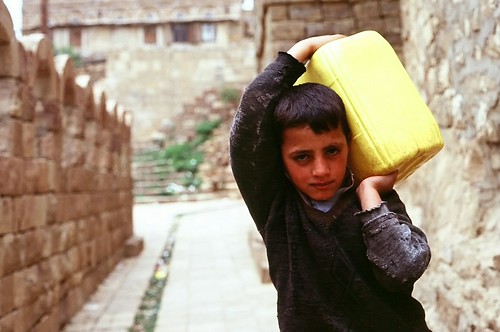
But of all counties in the region, the one coming closest to running dry is Yemen. As reported by Green Prophet recently, the food situation has been exacerbated by months of fighting to overthrow the current president Ali Abdullah Saleh. Directly linked with the food insecurity is the water shortage as agriculture is the primary use of water.  Past predictions that Yemen may be the first country to run out of water are no longer implausible. According to a report drawn up by the Washington Centre for Strategic and International Studies, within six years the city of Sana’a will have run out of water completely.

Other recent reports confirm that 19 out of the nations 21 aquifers are no longer being replenished. Consumption in the Yemeni capital exceeds by a factor of four the amount of water fed back into the underground reserves by local rainfall. Tap water is available only once every four days in Sanaa, a capital of 2 million people, while in Taiz, a southern city, tap water is available only every 20 days. Meanwhile nearly half of all Yemenis live under the poverty line set by the World Bank at $2 per day and don’t have access to proper sanitation, with more than 50 percent of children said to be malnourished.

The crisis is blamed on a number of factors, including inefficient irrigation techniques, increase in domestic consumption (the population of the region is set to double, from 24 to 48 million, over the next 17 years), corruption and poor resource management policies.

The problems created by the shortage of food and water in Yemen are exacerbated by the population’s dependence on qat, an extremely profitable crop which requires extensive irrigation and is so widespread that it takes up some 40 % of the country’s water resources.

While other “ water-deficit” counties like the UAE and Saudi Arabia can afford to invest in desalination plants, build underwater reservoirs, or buy land from other countries to secure food for their own people, in the long run these countries are as sensitive to the effects of depleting aquifers and declining home grown food production as Yemen. But time is running out faster for Yemen.


image: Flikr

Related Stories:

Syria Suffers Water Shortage- More News on Middle East Drought

In the face of “Nile-lessness” Egyptians Protest Water Shortages


Rola Tassabehji
Rola Tassabehjihttp://www.grenea.com
A global citizen, of Lebanese origin, Rola began her career in Unilever Arabia and from there moved into several roles in the marketing/communication function in Unilever, including: Brand Manager Skin Care, Unilever Arabia; Brand Development Manager, Dove, Unilever Africa, Middle East, and Turkey; and Communication Manager for Unilever North Africa and Middle East. After ten years with Unilever, she relocated to Abu Dhabi with her family and joined the team that launched INSEAD Middle East. She is currently working as Marketing Director of a new start-up, Grenea (www.grenea.com), focusing on building sustainable real estate development projects in emerging markets. After working with multi-nationals on skin care and business education, she has found a new interest in the convergence of environmental and social justice and is passionate about the possibilities that a restorative resource-based economy can bring to the people of the Middle East. Email [email protected]

Hot this week

How Renewable Energy is Revolutionizing the Way We Power Our World

Solar has become the star of the transition thanks to modular hardware and straightforward installation. It fits dense cities and remote towns alike. Many companies are turning to rooftop arrays and carport systems - and exploring commercial solar installation as a practical way to lock in future savings.

How does one start prepping?

Faced with an extreme winter storm this year, Americans wonder how to be prepared for catastrophe. Miriam has lived through wars in the Middle East - so she's prepared on giving you a guide to prepping.

Fishermen sue tire manufacturers on behalf of the salmon

A federal trial in San Francisco has brought US tire manufacturers, fishing groups, and environmental scientists into court over a chemical most drivers have never heard of — but which scientists say may be silently reshaping aquatic ecosystems.

Listening to Water: Tarek Atoui’s Next Work for Tate Modern

Born in Beirut, Lebanon in 1980 and now living in Paris, Atoui has spent years building instruments that don’t sit comfortably in concert halls. Many of them involve water, glass, and ceramics — materials that react to sound instead of simply producing it.

Leading Through a Dual-Energy Transition: Balancing Decarbonisation with Energy Security

Experience in one area of the energy industry isn't enough to guarantee readiness across all the others. That's where a structured program like an MBA in energy can come in. Today's advanced curricula explore energy economics, finance, policy, and strategic management alongside the technical subjects. And when pursuing an energy MBA online, professionals can skill up and retrain without having to step out of the labor market -- an important perk at a time when skilled professionals are already in short supply.

Topics

How Renewable Energy is Revolutionizing the Way We Power Our World

Solar has become the star of the transition thanks to modular hardware and straightforward installation. It fits dense cities and remote towns alike. Many companies are turning to rooftop arrays and carport systems - and exploring commercial solar installation as a practical way to lock in future savings.

How does one start prepping?

Faced with an extreme winter storm this year, Americans wonder how to be prepared for catastrophe. Miriam has lived through wars in the Middle East - so she's prepared on giving you a guide to prepping.

Fishermen sue tire manufacturers on behalf of the salmon

A federal trial in San Francisco has brought US tire manufacturers, fishing groups, and environmental scientists into court over a chemical most drivers have never heard of — but which scientists say may be silently reshaping aquatic ecosystems.

Listening to Water: Tarek Atoui’s Next Work for Tate Modern

Born in Beirut, Lebanon in 1980 and now living in Paris, Atoui has spent years building instruments that don’t sit comfortably in concert halls. Many of them involve water, glass, and ceramics — materials that react to sound instead of simply producing it.

Leading Through a Dual-Energy Transition: Balancing Decarbonisation with Energy Security

Experience in one area of the energy industry isn't enough to guarantee readiness across all the others. That's where a structured program like an MBA in energy can come in. Today's advanced curricula explore energy economics, finance, policy, and strategic management alongside the technical subjects. And when pursuing an energy MBA online, professionals can skill up and retrain without having to step out of the labor market -- an important perk at a time when skilled professionals are already in short supply.

From Green Energy to Healthy Societies: Why old systems thinking is becoming relevant again

Across the Middle East and North Africa, large investments are being made in green hydrogen, renewable energy, water infrastructure and sustainability. Most of these efforts are discussed in the context of climate change, decarbonization and economic diversification. That framing is important, but it may not capture their full value.

We saw peace – an interreligious encounter deep in our eyes

They came from Israel, Palestine, Jordan, Iraq, Yemen, Morocco, Tunisia, Lebanon, Egypt… There are Sunni Muslims, Shiite Muslims, Jews (Orthodox and Reform), Orthodox Christians, Coptic Christians, Protestant Christians, Druze, Baha'is, a Scientologist.

Can biochar reduce ‘Forever Chemicals’ in food if it’s used in farms?

Biochar is produced by heating organic material in a low-oxygen environment so it does not burn. This process, known as pyrolysis, transforms plant matter into a stable, carbon-rich material.

Related Articles

Popular Categories