
Israel To Fine Manufacturers $700 Per Ton Of Non-Recycled Packaging

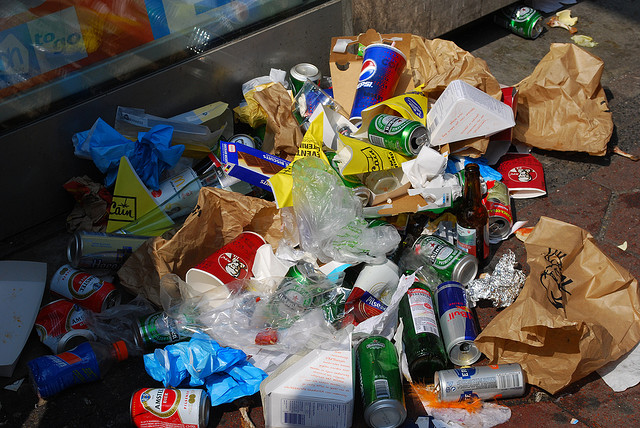
trash-pile A new law in Israel could mandate manufacturers to take ensure their packaging is recycled, or reused.

Despite its posh upcycled art installation, a quick visit to Israel’s Hiria dump demonstrates the extent to which materials that could be recycled, and should be recycled, are instead buried. There are cages available in some neighborhoods where people can stash their plastic bags and bottles, and sometimes batteries, and Koala Recycling Solutions recently started an aluminum recycling program, but mostly, Israel’s recycling system needs serious help. That could change if the Knesset approves a new law that puts the onus of recycling on the manufacturers’ shoulder.The Environment Protection Ministry will require local and international manufacturers to ensure the packaging used for their products is collected and recycled. It does not matter whether the packaging is reused, burned for energy, or recycled. It only matters that it does not land in the dump.

If passed, the law will ensure that Israel no longer wastes nearly $300 million dollars worth of raw materials each year, according to the Environmental Protection Minister Gilad Erdan.

“Instead of burying raw materials worth a billion shekels in the ground every year, the packaging will be collected from citizens’ homes and recycled. Implementing the law will add thousands of new jobs,” he told Haaretz.

Companies will be responsible for collecting and recycling paper, glass, plastic, and metal, but local citizens will have to step up to the plate as well. Even if the Environment Ministry provides the tools to sort and recycle waste, some kind of measures will be necessary to educate the public about the merits of recycling. Judging by Friday morning shopping excursions, where everyone and their grandmother troop around the souqs with armfuls of plastic bags, this will be no easy feat.

This law could also create a regulatory nightmare if local citizens don’t fulfill their end of the bargain, by sorting their waste into provided receptacles, and companies have to foot the bill for their apathy.

Still, it’s an important step, because manufacturers will be forced to become more innovative with their packaging. Perhaps biodegradable cartons will become more mainstream, or perhaps companies will use less.

To begin with, companies will have to account for 60% of the packaging they generate, and by 2020, the goal is to recycle 100% of all packaging so that literally nothing goes to waste. Failure to do so could cost nearly $700 per ton of waste.

A mighty impressive step in the right direction if it passes, and if everyone plays fair.

:: Haaretz

More on the Hadera dump and recycling in Israel:

Hiria: A Garbage Dump Turned Recycling Dream

Spend Summer Nights at Hiria, Central Israel’s Garbage Dump

Brigitte Cartier and Hiria Searching for Volunteer Upcycling Arts

image via kevingessner

Tafline Laylin
Tafline Laylinhttp://www.greenprophet.com
As a tour leader who led “eco-friendly” camping trips throughout North America, Tafline soon realized that she was instead leaving behind a trail of gas fumes, plastic bottles and Pringles. In fact, wherever she traveled – whether it was Viet Nam or South Africa or England – it became clear how inefficiently the mandate to re-think our consumer culture is reaching the general public. Born in Iran, raised in South Africa and the United States, she currently splits her time between Africa and the Middle East. Tafline can be reached at tafline (at) greenprophet (dot) com.
1 COMMENT
  1. monitoring the real Non-Recycled Packaging will be difficult. Perhaps better to change it to Non-Recyclable Packaging so its fined at source of production (even back to the raw material).
    And it would be great if there was a seriuous attempt at moving towards Recycleable Packaging here in Oman – where plastic bags rule

Comments are closed.

TRENDING

Eco organization offices destroyed by Iran missile

Tel Aviv's eco organization, the Heschel Center, was impacted by an Iranian missile.

What are AWG air-water generators, and why they aren’t a golden-bullet solution (yet)

Atmospheric water generators (AWGs) sound like magic: machines that can pull drinking water out of air. The idea is mentioned in the Bible, where the elders would pray for water collected as dew on plants and the catch on turning this into a machine is in the physics. To turn invisible vapor into liquid, you must remove heat, especially the latent heat of condensation.

Jordan’s $6 Billion Aqaba–Amman Desalination Project from the Red Sea Moves Forward

In 2025, the Jordanian government signed agreements with a consortium led by Meridiam and SUEZ, alongside VINCI Construction and Orascom Construction. Under a 30-year concession agreement, the consortium will design, build, finance, operate, and maintain the system before transferring it back to the Jordanian government. The total investment is estimated at approximately $6 billion USD.

The Saudi Startup Turning Desalination’s Toxic Waste Into Its Own Disinfectant

For millennia, the Middle East's water crisis seemed an immutable fact of geography — a region defined as much by what it lacked as by what lay beneath its sands. Today, a convergence of plummeting solar costs, advancing membrane technology, and hard-won engineering expertise is rewriting that story.

Earth building with Dead Sea salt bricks

Researchers develop a brick made largely from recycled Dead Sea salt—offering a potential alternative to carbon-intensive cement.

Should You Invest in the Private Market?

startustartup Unlike public stock exchanges, which offer daily trading, strict...

How to build a 100-year-company

Kongō Gumi is a Japanese construction company, purportedly founded in 578 A.D., making it the world's oldest documented company. What can we learn about building sustainable businesses from them?

From Pilot Plant to Global Stage: How Aduro Clean Technologies’ 2026 Expansion Signals a Turning Point for Chemical Recycling Investors Like Yazan Al Homsi

The company's Next Generation Process (NGP) Pilot Plant in London, Ontario, has officially moved into initial operating campaigns, generating the kind of structured, repeatable data that separates laboratory promise from commercial viability.

How AI Helps SaaS Companies Reduce Repetitive Customer Support Work

SaaS products are designed for large numbers of users with different levels of experience, and also in renewable energy.

Pulling Water from the Air

Faced with water shortage in Amman, Laurie digs up...

Turning Your Energy Consultancy into an LLC: 4 Legal Steps for Founders in Texas

If you are starting a renewable energy business in Texas, learn how to start an LLC by the books.

Tracking the Impacts of a Hydroelectric Dam Along the Tigris River

For the next two months, I'll be taking a break from my usual Green Prophet posts to report on a transnational environmental issue: the Ilısu Dam currently under construction in Turkey, and the ways it will transform life along the Tigris River.

6 Payment Processors With the Fastest Onboarding for SMBs

Get your SMB up and running fast with these 6 payment processors. Compare the quickest onboarding options to start accepting customer payments without delay.

Related Articles

Popular Categories