


 Treating wastewater and encouraging water efficiency balances high cost of desalination in water-scarce countries.
To some, desalination plants are the Middle East’s holy grail. Israel’s IDE launched its 3rd such plant, and Bahrain has joined the fray with theirs. However, it is no coincidence that in the last year alone Israel has also experienced a 40% hike in water prices. Energy-intensive and therefore expensive to run, desalination plants also destroy marine organisms such as phytoplankton and fish on the intake, and pump heavy concentrations of salty brine back into the water, which can be destructive to the ocean environment.
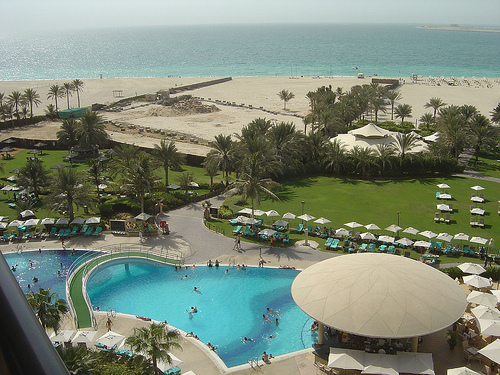 A desert wasteland astride the Arabian Gulf, the United Arab Emirates compensates for its scant freshwater resources with some of the world’s largest desalination plants. The Jebel Ali plant, the 4th largest according to Worldwater.org, has the capacity to produce 140 million gallons of distillate water every day.
But distillate water is also the most expensive source of water, reports the Pacific Institute of California, since approximately 4,000 kilowatt hours of electricity are required to produce 1 acre-foot of water. Furthermore, the price of desalinated water will rise and fall with fluctuating energy costs. The higher the cost of fuel, the higher the price of water.
Water Eats Oil
Another parched Middle Eastern country, Saudi Arabia operates the first 3 largest plants in the world. At a recent convention marking the second anniversary of the Arab Water Academy, Dr. Mohammed al Saud, deputy Minister for water said “if we continue with desalination as we do today, we will be the biggest consumer of our own oil.”
Securing an ongoing and destructive water supply to an unrealistic demand produces the risk of wasteful water practices. By contrast, insisting on better efficiency and recycling encourages communities to think more carefully about their water consumption.
Using Wastewater for Agriculture
At present, Vesela Todorova from The National claims that using treated waste water for agriculture, which combined with forestry requires 76% of the UAE’s water, is illegal in Abu Dhabi. Even so, in response to concerns about exorbitant costs the government has initiated several projects to explore safe treatment options.
The Mafraq sewage treatment plant in Abu Dhabi treats 450,000 cubic metres of waste water each day, according to Todorova. To expand that capacity, the Al Wathba Veolia Besix Waste Water consortium is constructing two more plants in Al Wathba and Allahamah, UAE, which could treat a further 430,000 cubic metres of sewage each day.
While the mere idea of using waste water to grow food can send the most intrepid environmentalist to the loo with a nervous belly, the World Health Organization has established certain guidelines for the safe execution of such an endeavor citing that current regulations might even be too stiff.
:: The National
[top image courtesy of Snap and lower image via GaryBembridge]
More Water Issues in the Middle East:
Technofarm’s Irrigation Project Aims to Boost Libya’s Self-sufficiency in Food Production
Libya’s Pivot Irrigation in the Sahara Proves Money Can Do Anything



That is probably true, though the technology definitely exists.
As with all technology, their feasibility will only be proven in the long term. It seems to me that as oil becomes more scarce, distillate water prices will soar; at this point, solar-powered desalination plants may stand a chance.
Thank you Immanuel. Yes, actually solar or wind-powered desalination plants would be much better, though it would still be necessary to ensure that unwitting creatures aren’t sucked in with the water, and that the brine is dumped far out into the ocean so that it is diluted.
I heard that solar energy could never provide enough power to fuel a plant. That it would cost more in infrastructure than it’s worth.
How about smaller solar, wind, wave and tidal powered desalination plants – all resources readily available in the above countries
How about building solar powered desalination plants?
Here in Israel, there is a campaign on that is urging the population to continue our efforts to save water for at least another three years, until the crisis is over (!), and with the desalinisation plant working at full capability, only then, according to the message, will the crisis be over. All in a snap of fingers.
The wise should know better!