The Deepwater Horizon Debacle: A Tough Lesson for Free Markets Like Israel?

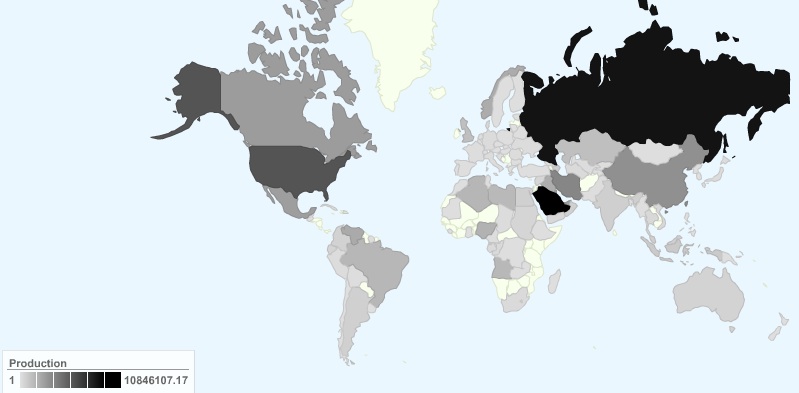
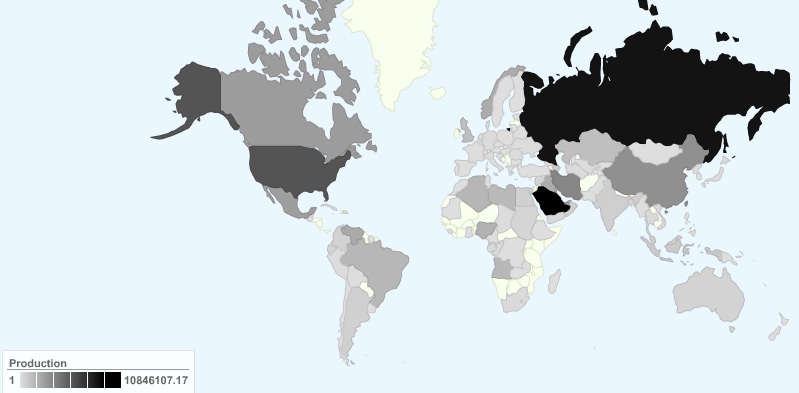
world oil production map

Dr. Gotlieb comments on the disastrous effects of the oil spill in the US Gulf of Mexico and the dangers it portends for Israel’s emerging oil industry.

In a New York Times article entitled Our Fix-It Faith and the Oil Spill published this week, Elisabeth Rosenthal writes that “Americans have long had an unswerving belief that technology will save us — it is the cavalry coming over the hill, just as we are about to lose the battle. And yet, as Americans watched scientists struggle to plug the undersea well over the past month, it became apparent that our great belief in technology was perhaps misplaced.”

Ms. Rosenthal’s comment concerning the hemorrhaging of crude oil from the Deepwater Horizon oil rig in the Gulf of Mexico cuts to the bone with respect to the harm entailed by the blind use of technology. For Israel, where tycoon Yitzhak Tshuva’s Delek Group is drilling in the Tamar oil fields off our coast and other entrepreneurs are racing for a piece of the action, there is a burning question: Can we afford the sort of catastrophe that is already wreaking untold environmental disaster on the Louisiana coast? Are our coastlines so long and robust that they can withstand the kind of onslaught that the southeast United States is facing?

In the context of the Deepwater Horizon debacle, the effects could be devastating.

The Times  reports on a “serious setback” in the attempts by British Petroleum (BP) to stanch the oil leak. The “top kill” technique which company officials said would stop the leakage did not succeed and other efforts are underway. This is the fourth technique to be applied by the company in tying to control what had already become the largest oil spill in US history, twenty years after the Exxon Valdez disaster in Alaska.

The leak began on April 20th when Deepwater Horizon exploded, killing eleven workers. According to the Times, 18-40 million gallons of oil has flowed into the Gulf of Mexico with an estimated 12-19,000 barrels leaking into the sea each day.

Despite attempts to keep the oil slick from reaching the fragile ecosystems of the Louisiana coast, oil has already washed ashore. The US National Oceanographic and Atmospheric Administration (NOAA) has already banned commercial fishing in the affected southeast coastal area.

The fishing communities of the Louisiana coast are reeling from the economic and social effects of the disaster, which threatens their way of life: They are mindful that the coastal communities of Alaska have still not recovered from the Valdez disaster. Marine animals and birds are also among the victims of the disaster. Ecosystems are endangered.

It is now believed that only the drilling of two relief wells, which will not be completed until August can provide effective relief. What the environmental toll of this human-made disaster will be by then is immeasurable at this time.

An example for the Middle East?

Recent reports show that Israel has among the lowest royalty rates of any country with respect to how much oil companies pay the state for extracting mineral stocks. The Netanyahu government, with its free market advocacy, has not taken steps to change this situation: The government has left the business environment very conducive for the extraction of fossil fuels off our coast, a gift for big business.

In terms of Middle East history, it is insightful to ask whose interests are truly served by such the petroleum industry and its associated adventures. Much of  the political discord in the region stems from the gerrymandering of the area in a  manner that postcolonial states and the elites that govern them would further the strategic affairs of the European powers and the corporate interests of the oil industry. The strategy has left a state system in the region based on economies that fuel climate change while filling the corporate coffers of the Seven Sisters (of which BP is one), the major oil conglomerates that have dominated the energy industry for nearly a century.  

The failure of  technology at Deepwater Horizon and its inability to remediate the consequences are indicative of the dangers inherent to blind faith in technological fixes for environmental problems.  The implications for Israelis and others  interested in preserving a future for our progeny should be clear: Placing the fate of the commons in the hands of private economic interests is ridden with risk. 

Read more on oil spills and the Middle East:
Method To Seal Kuwait Spill Could Work on Gulf Oil Spill
Will Gulf Of Mexico Oil Spill Open Pandora’s Box on Oil Sands Drilling?
Kuwait Still Cleaning up After Saddam’s Mess
Russian Vessel Fined for Dumping Oil Bilge into Red Sea

Above image: see what nations of the world are producing the most oil. Via Digital_Dreams

Dr. Yosef Gotlieb
Dr. Yosef Gotlieb
Dr. Yosef (Yossi) Gotlieb is a geographer specializing in society-nature relations, international development and global change. He was born in Costa Rica and raised in the United States. During service as a planner in an Israeli international development cooperation program in Nepal in 1987, Yosef observed the systematic destruction of the environment in that resource-rich country, whose population was being made poorer by expatriate concerns in the name of “modernization.” During his doctoral studies, he proposed that development be directed toward geo-ethnic regions rather than in the confines of the post-colonial state. Kurdistan was his case study. Among Dr. Gotlieb’s writings are Self-Determination in the Middle East (NY: Praeger, 1982) and Development, Environment and Global Dysfunction (Delray Beach, FL: St Lucie Press, 1996). He currently directs text and publishing studies at David Yellin College of Education, Beit HaKerem, Jerusalem. Yosef Gotlieb is a writer of prose and poetry and paints. He practices tai chi and is a passionate listener of classic and progressive rock and blues. He lives with his family outside of Jerusalem, having made his home in Israel since 1984. You can reach him at yossi (at) greenprophet.com.

LEAVE A REPLY

Please enter your comment!
Please enter your name here

TRENDING

Earth building with Dead Sea salt bricks

Researchers develop a brick made largely from recycled Dead Sea salt—offering a potential alternative to carbon-intensive cement.

Farm To Table Israel Connects People To The Land

Farm To Table Israel is transforming the traditional dining experience into a hands-on journey.

Remilk makes cloned milk so cows don’t need to suffer and it’s hormone-free

This week, Israel’s precision-fermentation milk from Remilk is finally appearing on supermarket shelves. Staff members have been posting photos in Hebrew, smiling, tasting, and clearly enjoying the moment — not because it’s science fiction, but because it tastes like the real thing.

An Army of Healers Wins the 2025 IIE Goldberg Prize for Peace in the Middle East

In a region more accustomed to headlines of loss than of listening, the Institute of International Education (IIE) has chosen to honor something quietly radical: healing. The 2025 Victor J. Goldberg Prize for Peace in the Middle East has been awarded to Nitsan Joy Gordon and Jawdat Lajon Kasab, the co-founders of the Army of Healers, for building spaces where Israelis and Palestinians — Jews, Muslims, Christians, Druze, and Bedouins — can grieve, speak, and rebuild trust together.

The US leaves 66 United Nations organizations to “put America first”

The world needs a reset and to restart well intentioned cooperation projects from start. Because right now the UN and EU projects look like software built on code from the 80s, rickety, patched, slow to adapt, and prone to crashing under the weight of outdated assumptions.

Qatar’s climate hypocrisy rides the London Underground

Qatar remains a master of doublethink—burning gas by the megaton while selling “sustainability” to a world desperate for clean air. Wake up from your slumber people.

How Quality of Hire Shapes Modern Recruitment

A 2024 survey by Deloitte found that 76% of talent leaders now consider long-term retention and workforce contribution among their most important hiring success metrics—far surpassing time-to-fill or cost-per-hire. As the expectations for new hires deepen, companies must also confront the inherent challenges in redefining and accurately measuring hiring quality.

8 Team-Building Exercises to Start the Week Off 

Team building to change the world! The best renewable energy companies are ones that function.

Thank you, LinkedIn — and what your Jobs on the Rise report means for sustainable careers

While “green jobs” aren’t always labeled as such, many of the fastest-growing roles are directly enabling the energy transition, climate resilience, and lower-carbon systems: Number one on their list is Artificial Intelligence engineers. But what does that mean? Vibe coding Claude? 

Somali pirates steal oil tankers

The pirates often stage their heists out of Somalia, a lawless country, with a weak central government that is grappling with a violent Islamist insurgency. Using speedboats that swarm the targets, the machine-gun-toting pirates take control of merchant ships and then hold the vessels, crew and cargo for ransom.

Leopoldo Alejandro Betancourt López Turned Ocean Plastic Into Profitable Sunglasses

Few fashion accessories carry the environmental burden of sunglasses. Most frames are constructed from petroleum-based plastics and acrylic polymers that linger in landfills for centuries, shedding microplastics into soil and waterways long after they've been discarded. Leopoldo Alejandro Betancourt López, president of the Spanish eyewear brand Hawkers, saw this problem differently than most industry executives.

Why Dr. Tony Jacob Sees Texas Business Egos as Warning Signs

Everything's bigger in Texas. Except business egos.  Dr. Tony Jacob figured...

Israel and America Sign Renewable Energy Cooperation Deal

Other announcements made at the conference include the Timna Renewable Energy Park, which will be a center for R&D, and the AORA Solar Thermal Module at Kibbutz Samar, the world's first commercial hybrid solar gas-turbine power plant that is already nearing completion. Solel Solar Systems announced it was beginning construction of a 50 MW solar field in Lebrija, Spain, and Brightsource Energy made a pre-conference announcement that it had inked the world's largest solar deal to date with Southern California Edison (SCE).

Related Articles

Popular Categories