
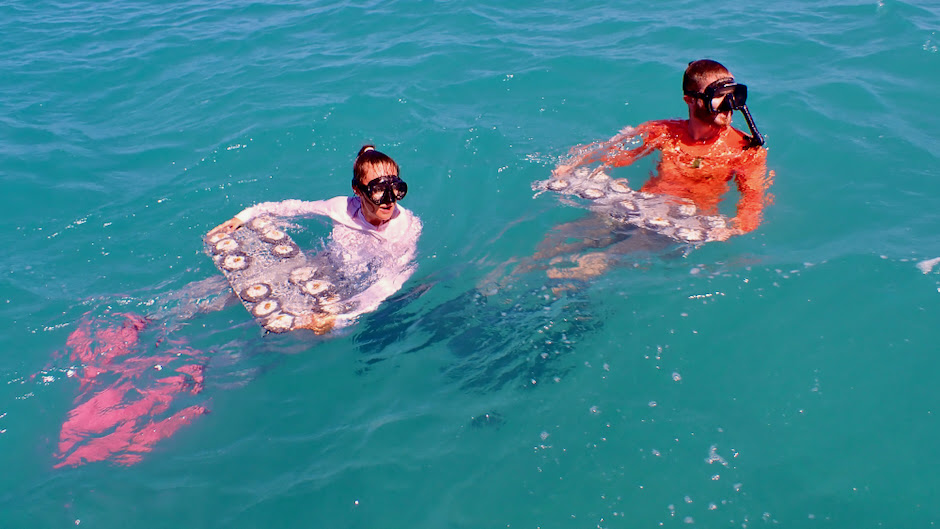
In early April, a collaborative team of scientists and divers from the University of Miami Rosenstiel School of Marine, Atmospheric, and Earth Science, the U.S. Geological Survey’s St. Petersburg Coastal and Marine Science Center, and the National Park Service outplanted almost three dozen two-year old elkhorn corals (Acropora palmata) to three reef sites in Dry Tortugas National Park.
This initiative is the next phase of a project aimed at directly comparing the performance, under natural reef conditions, of new genetic diversity introduced from outside Florida, this time inside a National Park that may be key to the recovery of this species in Florida.
The project centers on “Flonduran” corals, which are offspring of Florida elkhorn corals bred with elkhorn corals from Honduras. These new corals are being evaluated alongside Florida elkhorn corals of the same age that are outplanted side by side in natural reef habitats to assess whether the new genetic diversity can enhance coral resilience and reduce coral bleaching during Florida’s warm summers. The team will return every six months to monitor growth, survivorship, and overall health.
The “Flonduran” corals are the result of a first-of-its-kind international effort to enhance reef resilience by crossbreeding Florida elkhorn corals with colonies from Tela Bay, Honduras, which have adapted to warmer, more nutrient-rich waters. In 2024, scientists from Rosenstiel School and Tela Marine studied these robust Honduran populations, collected and exported parent colonies, and together with scientists from The Florida Aquarium, bred them with Florida corals in the laboratory. In addition to adding new genetic diversity to Florida’s depleted elkhorn population, the new offspring are intended to increase heat tolerance, helping to boost the capacity of corals to survive marine heatwaves.
“This is a critical step in field-testing measures to help reefs adapt to increased ocean temperatures,” said Andrew Baker, Ph.D., professor in the Department of Marine Biology and Ecology at the Rosenstiel School. “By testing these Flonduran and Floridian corals side-by-side on different reefs, we can begin to identify suitable source populations for future breeding efforts.”
“Elkhorn coral has suffered tremendous losses,” said Bailey Marquardt a doctoral student in the Department of Marine Biology and Ecology and the project lead. “But projects like this give us renewed hope. By introducing new genetic diversity and testing it directly on the reef, we’re giving these corals a better chance to adapt and giving Florida’s reefs a fighting chance for the future.”
This project aims to generate data on how new genetic backgrounds affect elkhorn coral survival in the wild and inform restoration strategies. The trial in Dry Tortugas National Park is part of a broader, ongoing effort to identify solutions that could improve the long-term survival prospects for Florida’s Coral Reef. “We are optimistic the Flonduran corals will thrive in Dry Tortugas National Park, offering the new elkhorn corals there much-needed genetic variation, and thus, resilience,” said Ilsa Kuffner, USGS research biologist. “It is hard to overstate the importance of this coral species. The elkhorn coral builds the reef crest, the shallowest part of the reef, that dampens wave energy and protects the shorelines of coastal communities throughout Florida and the Caribbean. Our collaborative research is providing science to guide restoration strategies for this critical natural infrastructure-providing coral.”
Elkhorn coral was once a dominant reef-building species in the Caribbean and has declined by more than 95% across the Florida Keys. A recent study by scientists at NOAA’s Coral Reef Watch, the Rosenstiel School, and other institutions throughout Florida found the 2023 marine heatwave caused catastrophic losses, leaving Florida elkhorn and staghorn corals functionally extinct.
This work builds on decades of research on coral bleaching and heat tolerance at the University of Miami’s Coral Reef Futures Lab, in partnership with federal, state, and park scientists. The research is jointly supported by the USGS Coastal Marine Hazards and Resources Program, the National Park Service, NOAA’s Office of Habitat Restoration, Tela Marine in Honduras, and the University of Miami Rosenstiel School of Marine, Atmospheric and Earth Science.