Solar and wind were once framed as intermittent, unreliable, and dependent on fossil fuels to fill the gaps. That argument is fading fast.
A new report from the International Renewable Energy Agency based in Abu Dhabi makes something clear that many in the industry already suspected. When solar and wind are paired with battery storage, they can deliver reliable, round the clock electricity at costs that compete with, and often beat, fossil fuels.
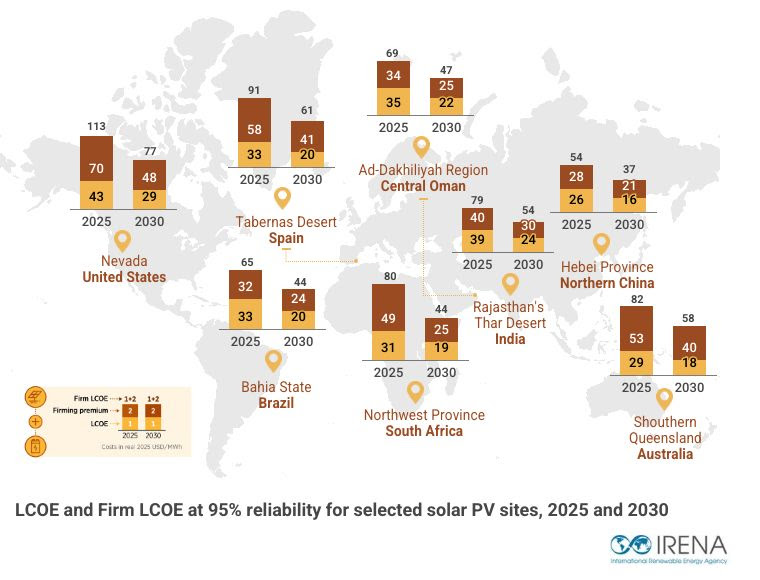
In the best solar and wind regions, these hybrid systems are already delivering what used to be considered impossible. Continuous power. Stable pricing. Lower costs. The numbers tell the story. Solar paired with storage is now delivering electricity at roughly 54 to 82 dollars per megawatt hour in high quality regions. That is already below or competitive with new coal plants in China and significantly cheaper than new gas plants globally.
Costs have not just dropped. They have collapsed. Since 2010, solar installation costs have fallen by about 87 percent. Wind is down by more than half. Battery storage has dropped by over 90 percent. That last number matters most because storage is what turns intermittent energy into firm power.
This changes everything, especially for artificial intelligence.
AI systems and data centers are among the most energy hungry infrastructures ever built. They do not tolerate downtime. They do not accept fluctuations. They need constant, predictable electricity. Until recently, that meant fossil fuels or nuclear.
Hybrid renewable systems are being designed specifically to meet these demands. Solar generates during the day. Wind often peaks at night. Batteries fill in the gaps, shifting energy into the hours when it is needed most. The result is a system that can run continuously, without burning fuel.
In places like the United Arab Emirates, large scale solar plus battery installations are delivering gigawatt level power at around 70 dollars per megawatt hour. Wind plus storage is also becoming competitive, with costs expected to drop further over the next decade.
Projects that combine solar, wind, and storage can now be built in one to two years once permits are secured. That is faster than most new gas plants. Faster than nuclear by an order of magnitude. Speed matters when demand is rising as quickly as it is now.
Every new model, every data center, every layer of digital infrastructure increases the pressure on energy systems. AI companies are now quietly becoming energy companies, signing long term deals and building their own power strategies. They are not looking for green energy as a branding exercise. They are looking for reliability and price stability.
There is also a geopolitical layer. Fossil fuel markets remain exposed to disruption, whether through conflict, shipping chokepoints, or price volatility. Renewable systems, once built, draw on local resources. Sun and wind are not shipped through straits or pipelines. They do not spike in price because of a crisis.
When solar, wind, and batteries are combined, they do more than reduce emissions. They stabilize economies. They reduce exposure to global shocks. They give countries and companies more control over their energy future.
The next phase is optimization, and this is where AI comes back into the picture.
AI is not just a consumer of energy. It is becoming the system that manages it. Energy companies are increasingly using AI powered energy management platforms, predictive analytics software, and grid optimization SaaS tools to balance supply and demand in real time. These software as a service platforms allow utilities and developers to forecast solar output, predict wind patterns, and decide when to store or release energy from batteries.
AI driven demand response systems are already helping large users, including data centers, adjust consumption dynamically. Smart grid software, cloud based energy platforms, and machine learning models are optimizing when electricity is used, where it is sent, and how it is priced. These tools reduce waste, improve efficiency, and increase the value of every kilowatt generated.
For AI companies themselves, this creates a feedback loop. The same artificial intelligence systems that require massive amounts of energy are now being used to make renewable energy systems more efficient and more reliable. Energy optimization software, battery management systems, and renewable forecasting tools are becoming essential infrastructure.
Solar and wind with storage provide the physical layer. AI provides the intelligence layer. Together, they create an energy system that is not only cleaner, but smarter.
As costs continue to fall, with projections suggesting another 30 percent drop by 2030 and up to 40 percent by 2035, the combination of renewable generation, battery storage, and AI optimization will become the default model rather than the alternative.