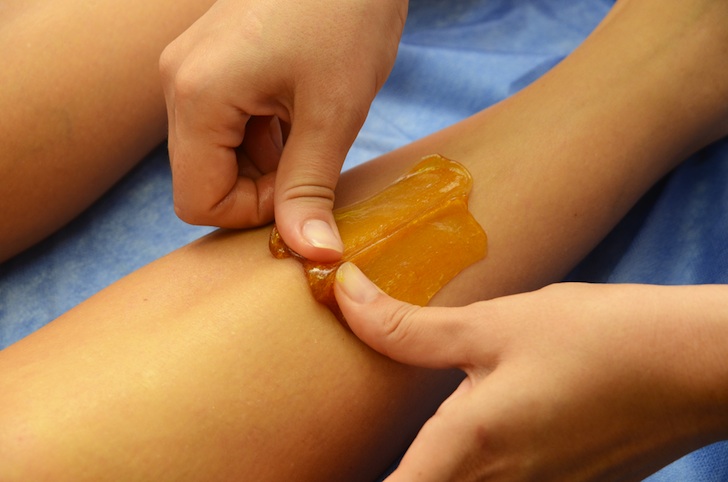
Green Prophet readers know we write a lot about hair. We have covered the halal and the haram sides of hair removal for Muslims. We have written about sugar waxing, Persian sugaring, threading, and the beauty secrets that came out of the Middle East long before salons started calling them trends. Our articles on sugar wax broke the internet a few times.
We have also written about people who would rather grow it all out. For them there is Januhairy, where body hair becomes a statement rather than a problem. We have written about Persian women with mustaches, once considered beautiful in Tehran. We have even looked at natural ways to lighten darkened knees for women whose prayer practice leaves a mark on the body.
 Hair is never just hair. It is religion, culture, modesty, rebellion, fashion, hygiene, sexuality, and sometimes just one more thing we are tired of managing.
(If you have come looking for a hair transplant, you’ve come to the wrong place, but we did see tens of people in the airport of Istanbul with new plugs in their scalp – so that’s probably the place).
Today we are talking about lasers.
Once a woman or man reaches an age where laser hair removal is appropriate, it may be one of the more ecological choices for people who already remove hair regularly. That part matters. If you love your hair, keep it. If you remove it for religious, cultural, personal, or practical reasons, then it is worth asking how much waste your routine creates.
Razors, plastic cartridges, shaving cream bottles, wax strips, applicators, salon paper, depilatory creams, packaging, and water use all add up. Waxing every month or shaving every few days is not just a beauty routine. It is a supply chain.
I have spoken with women and men who have used laser treatment to remove hair on different parts of the body. Most say the same thing. After years of waxing or shaving, five, six, or seven laser sessions made the whole business easier. Not always perfect. Not always permanent forever. But enough to remove much of the hassle.
For many Muslims, hair removal is recommended within a forty day rhythm, depending on practice and interpretation. For traditional Jewish women, preparation before the mikveh can include careful grooming and cleansing before immersion after menstruation. How much hair is removed is personal, but the body, water, and ritual all come into the conversation.
Laser treatment enters that space in a practical way.

There are different kinds of machines, and this is where things get real. Not all laser treatments are equal. Some of the newer machines have better cooling systems, skin sensors, and settings for different skin tones. Someone in my family uses a more expensive machine and is told to stay out of the sun for about three days after treatment. That is manageable.
Other clinics are far more restrictive. We tried one while on holiday in Canada and were told to stay out of the sun for two weeks. Two weeks in summer is not a small ask. That is not sustainable unless you are planning your life around your legs.
The common machine types include Alexandrite, Diode, and Nd:YAG lasers, along with IPL, which stands for intense pulsed light and is not technically a laser. Alexandrite lasers are often used for lighter skin with darker hair.
Diode lasers are common and can work across a broader range of skin tones.
Nd:YAG lasers go deeper and are often considered safer for darker skin tones when used by experienced professionals.
IPL is usually cheaper and more available, including in some home devices, but it is less targeted and may require more sessions. People can buy them online and teenagers use them often, but the efficiency is almost not worth it.

This is why you should ask questions before booking. Ask what machine they use. Ask whether it is a true laser or IPL. Ask if the operator has experience with your skin tone. Ask how many days you need to avoid sun before and after treatment. Ask what cooling system they use. Ask if maintenance sessions are likely later. And how many? Laser treatments aren’t recommended for teenagers before they hit peak puberty. Chances are the overdrive hormones will not have any effect on rampant hair growth.
The American Academy of Dermatology warns that laser hair removal can cause burns, scars, or permanent changes in skin color when done badly, especially in inexperienced hands. Cleveland Clinic says tanned skin can make the procedure less effective and increase side effects. Mayo Clinic also advises avoiding sun exposure and tanning beds before treatment, using sunscreen, avoiding sunless tanning products, and stopping waxing or plucking before sessions.
That may sound like a lot, but it is better to know before you pay. The machine matters. The person using it matters more.
When in doubt ask a friend of yours with smooth arms if they have ever been hairy. If yes, ask them about laser treatments.

From an ecological perspective, the logic is simple. Fewer treatments over time can mean less reliance on disposable products, less plastic, less packaging, less chemical runoff, and less repetition. It is not perfect. It is still a treatment. It still uses energy. It still costs money. But compared to a lifetime of razors, wax strips, creams, and salon waste, laser hair removal starts to look like a reduction model rather than a consumption model.
It is also not for everyone. Light hair, red hair, grey hair, hormonal conditions, darker skin tones treated with the wrong machine, pregnancy, medications, and recent sun exposure can all complicate results. A good clinic will tell you that. A bad clinic will sell you a package before asking enough questions. We actually had a clinic near Toronto turn us away because it was summer and the lasers might do damage if we came into contact with the sun.
So maybe the question is not whether you remove hair or leave it alone. That is personal. It can be cultural. It can be religious. It can be nobody’s business. The better question is how you do it.
Good luck and enjoy your summer. We love you.