Jordan’s $6 Billion Aqaba–Amman Desalination Project from the Red Sea Moves Forward

Jordan needs $6 billion USD to built a desalination plant on the Red Sea

Jordan, which has long received a lion’s share of USAID for survival, and which receives $1.5 billion USD every year to help with water and basic needs, is one of the poorest countries and most water-scarce countries on Earth. In parts of Amman, the most unwalkable city on the planet, households still receive municipal water only once a week. You order a truck and a you pay $50 or so for the company to fill up your water tank. If you are lucky, you build 2 or 3 tanks so you can be sure about your next shower.

National renewable freshwater availability stands at well under 100 cubic meters per person annually, which is far below the international benchmark for “absolute scarcity.” And Jordan has started building itself as a greenhouse and agriculture center of the region.

hydroponics jordan, USAID
Hydroponics farming is a good solution for growing food in countries where water is scarce. A USAID program gives training to local Muslim farmers so they can grow their own food and livelihood.

Now Jordan is advancing one of the the largest infrastructure project in its history: the Aqaba–Amman Water Desalination and Conveyance Project. The plan links a massive Red Sea desalination plant to a 450-kilometer pipeline that will transport water north to the capital. An original plan over the years was the Red Dead Canal, a partnership with Israel. But after decades of inaction from both sides, they want to do it alone if they can pull off the billions in financing needed.

In 2025, the Jordanian government signed agreements with a consortium led by Meridiam and SUEZ, alongside VINCI Construction and Orascom Construction. Under a 30-year concession agreement, the consortium will design, build, finance, operate, and maintain the system before transferring it back to the Jordanian government. The total investment is estimated at approximately $6 billion USD.

What the Desalination Project Will Deliver
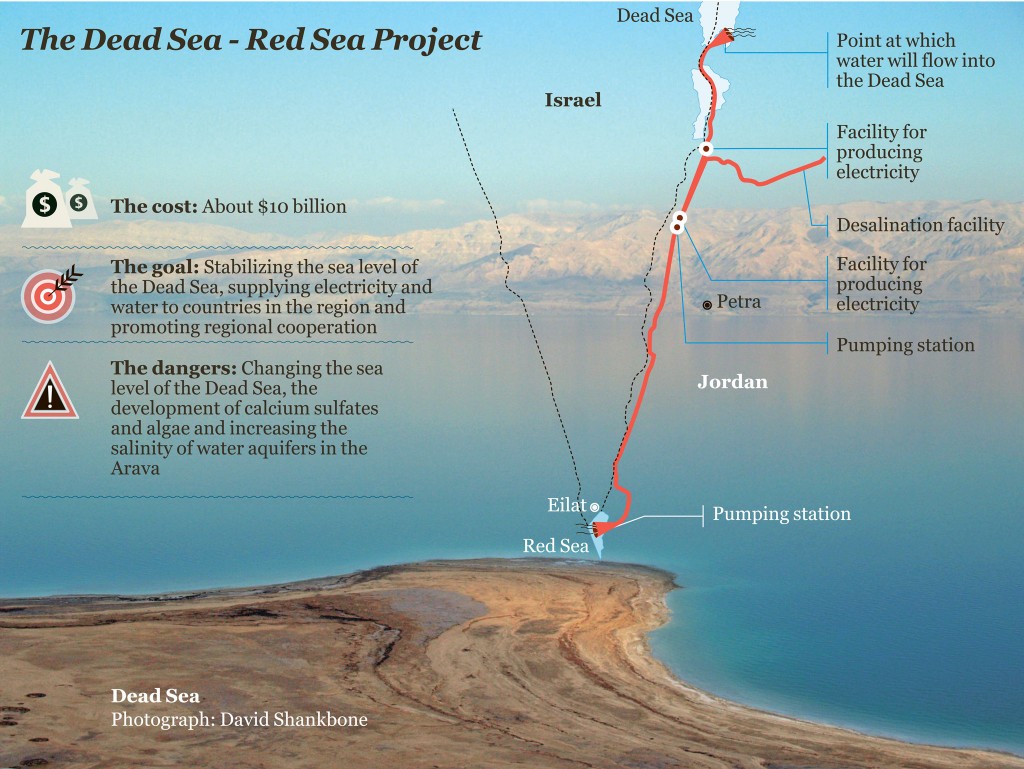
red dead canal conduit
A dead idea: The Red-Dead, a proposed desalination project between Jordan and Israel to revive the Dead Sea and bring water to Amman.

At full capacity, the system is expected to supply 300 million cubic meters of desalinated water per year, covering roughly one-third to 40% of Jordan’s drinking water demand.

The system includes:

  • A large reverse osmosis desalination plant near Aqaba on the Red Sea
  • A 300-mile conveyance pipeline to Amman
  • High-capacity pumping stations lifting water more than 1,000 meters in elevation
  • Expanded storage infrastructure in the Amman region

The plant’s projected output — about 800,000 to 850,000 cubic meters per day — would make it one of the largest seawater reverse osmosis facilities in the world. Saudi Arabia, which borders Jordan, currently runs the largest desalination plant in the world, a title taken from Israel not long ago. Israel has long been a pioneer of membrane technology, which is the technology needed to separate salt and brine from the water.

According to SUEZ, the project “will significantly strengthen Jordan’s long-term water security while integrating environmental best practices in desalination.”

Who Will Profit from Jordan’s Water?

Prince Hassan Bin Talal Jordan, meets Green Prophet founder Karin Kloosterman
Karin Kloosterman, Green Prophet founder was invited to a Middle East water event in Switzerland where she met Prince Hassan of Jordan.

The financing structure is a public-private partnership. The consortium will raise a significant portion of the capital through a mix of private equity and project debt. Multilateral development banks are expected to participate, including institutions such as the European Bank for Reconstruction and Development and the International Finance Corporation, alongside export credit agencies and commercial lenders.

Jordan’s government will ultimately purchase the water under long-term offtake agreements, creating predictable revenue streams for the concession holders over three decades.

That means: Infrastructure investors like Meridiam earn a stable, long-term return. SUEZ generates operating revenue from managing one of the region’s most strategic water assets. Construction giants VINCI Construction and Orascom Construction secure multi-billion-dollar engineering contracts. Lenders collect interest over the concession period. Jordan gains water security.
Sustainable hotel in the Dana Bioreserve, Jordan

The question now is whether the financial model keeps water affordable for citizens while delivering returns to international investors? Locals I have spoke with found the cost of water to be negligible in their montly expenses, but will the costs increase going forward? In some countries the cost of water is free, and in others water is difficult to obtain, like on islands in Thailand where you can’t think of drinking tap water. Desalinated water is drinkable, as long as added minerals are put in place. Can Jordan do this?

Another option is for Jordan to strengthen trade with Saudi Arabia, which operates extensive desalination infrastructure along the Red Sea, producing over 3 billion cubic meters of water daily and accounting for nearly 50% of global desalination capacity. If the Vision 2030 ever comes to be, this is probably what will happen in reality.


Karin Kloosterman
Karin Kloostermanhttp://www.greenprophet.com
Karin Kloosterman is an award-winning journalist, innovation strategist, and founder of Green Prophet, one of the Middle East’s pioneering sustainability platforms. She has ranked in the Top 10 of Verizon innovation competitions, participated in NASA-linked challenges, and spoken worldwide on climate, food security, and future resilience. With an IoT technology patent, features in Canada’s National Post, and leadership inside teams building next-generation agricultural and planetary systems — including Mars-farming concepts — Karin operates at the intersection of storytelling, science, and systems change. She doesn’t report on the future – she helps design it. Reach out directly to [email protected]

LEAVE A REPLY

Please enter your comment!
Please enter your name here

TRENDING

Saudi Arabia cancels the Asian games at Neom’s Trojena

Neom, a bombastic collection of futuristic cities and resorts, has flopped as Saudi oil prices roll back reality. The Saudi plan of hosting the 2029 Asian games to be held at Trojena, a ski report in the desert, has been cancelled. 

Xcimer is the Denver-based startup that could put Saudi Arabia out of business

An American company can collapse OPEC if they can prove their approach to unlimited energy works.

The Saudi Startup Turning Desalination’s Toxic Waste Into Its Own Disinfectant

For millennia, the Middle East's water crisis seemed an immutable fact of geography — a region defined as much by what it lacked as by what lay beneath its sands. Today, a convergence of plummeting solar costs, advancing membrane technology, and hard-won engineering expertise is rewriting that story.

Australian camels fly on a plane to Saudi Arabia

Australia has the largest population of feral camels in the world. Some get repatriated to Saudi Arabia.

Earth building with Dead Sea salt bricks

Researchers develop a brick made largely from recycled Dead Sea salt—offering a potential alternative to carbon-intensive cement.

Turning Your Energy Consultancy into an LLC: 4 Legal Steps for Founders in Texas

If you are starting a renewable energy business in Texas, learn how to start an LLC by the books.

Tracking the Impacts of a Hydroelectric Dam Along the Tigris River

For the next two months, I'll be taking a break from my usual Green Prophet posts to report on a transnational environmental issue: the Ilısu Dam currently under construction in Turkey, and the ways it will transform life along the Tigris River.

6 Payment Processors With the Fastest Onboarding for SMBs

Get your SMB up and running fast with these 6 payment processors. Compare the quickest onboarding options to start accepting customer payments without delay.

Qatar’s climate hypocrisy rides the London Underground

Qatar remains a master of doublethink—burning gas by the megaton while selling “sustainability” to a world desperate for clean air. Wake up from your slumber people.

How Quality of Hire Shapes Modern Recruitment

A 2024 survey by Deloitte found that 76% of talent leaders now consider long-term retention and workforce contribution among their most important hiring success metrics—far surpassing time-to-fill or cost-per-hire. As the expectations for new hires deepen, companies must also confront the inherent challenges in redefining and accurately measuring hiring quality.

8 Team-Building Exercises to Start the Week Off 

Team building to change the world! The best renewable energy companies are ones that function.

Thank you, LinkedIn — and what your Jobs on the Rise report means for sustainable careers

While “green jobs” aren’t always labeled as such, many of the fastest-growing roles are directly enabling the energy transition, climate resilience, and lower-carbon systems: Number one on their list is Artificial Intelligence engineers. But what does that mean? Vibe coding Claude? 

Somali pirates steal oil tankers

The pirates often stage their heists out of Somalia, a lawless country, with a weak central government that is grappling with a violent Islamist insurgency. Using speedboats that swarm the targets, the machine-gun-toting pirates take control of merchant ships and then hold the vessels, crew and cargo for ransom.

Related Articles

Popular Categories