
New lab reactor uses water instead of toxic solvents

ying chen
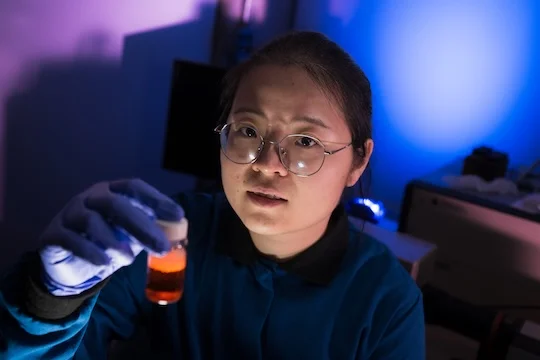
Ying Chen is the first author of this study and a doctoral student in chemistry at Rice. Photo by Jeff Fitlow/Rice University.

Researchers at Rice University in Houston, Texas, have developed a new method for performing chemical reactions using water instead of toxic solvents.They call it green chemistry. We wrote about the potential of water over toxic solvents way back in 2008. The idea is now coming to fruition. Baby steps in science.

The scientists created microscopic reactors capable of driving light-powered chemical processes by designing metal complex surfactants (MeCSs) that self-assemble into nanoscale spheres called micelles. This innovation could drastically reduce pollution in industries including pharmaceuticals and materials science, where harmful organic solvents are often necessary.

The new micellar technology represents a step forward in sustainable chemistry. These self-assembled micelles form in water, where their hydrophobic cores provide a unique environment for reactions, even with materials that are typically insoluble in water.

The research team led by Angel Martí, professor and chair of chemistry at Rice, demonstrated that this system can efficiently perform photocatalytic reactions while eliminating the need for hazardous substances. The study was published in Chemical Science Feb. 10.

“Our findings show how powerful molecular design can be in tackling chemical sustainability challenges while maintaining high chemical performance,” Martí said. “We’ve created a tool that could transform how chemical reactions are performed, reducing environmental harm while increasing efficiency.”

How the discovery works

Surfactants are molecules with a dual nature: One part is attracted to water, while the other repels it. When added to water, they naturally form micelles or tiny spheres where the water-avoiding parts gather in the center, creating a small reaction space. The scientists modified these surfactants by adding a light-sensitive metal complex to their structure, making the MeCSs.

The researchers tested different versions of the MeCSs by altering the length of their hydrophobic, or water-repelling, tails. They found that these molecules could form micelles as small as 5-6 nanometers, much smaller than those in similar systems. The team used these micelles to perform a photocatalytic reaction, achieving high yields without needing harmful solvents.

marti
The new micellar technology represents a step forward in sustainable chemistry. Photo by Jeff Fitlow/Rice University.

“These micelles act like tiny reaction vessels,” said Ying Chen, first author of this study and a doctoral student in chemistry at Rice. “They enable chemical transformations that wouldn’t normally work in water while being more sustainable than traditional methods.”

Why this matters

Many chemical processes in manufacturing and research rely on organic solvents, which are harmful to the environment and expensive to handle safely. The development of photoactive water-based micelles capable of driving chemical reactions offers a safer, greener alternative. Additionally, the system can be reused, improving its cost-effectiveness and environmental footprint.

In 2008 we reported on the groundbreaking work, thanks to a groundbreaking discovery at Tel Aviv University. Prof. Arkadi Vigalok from the School of Chemistry has discovered a way to use water to make certain steps of a complicated chain of chemical reactions more environmentally-friendly.

Prof. Vigalok’s solution replaces chemical solvents, which can pollute the environment, with water. Though chemists have long thought it possible, Prof. Vigalok’s approach has only rarely been even attempted. His discovery was reported in the journal Angewandte Chemie, International Edition. Once ideas are published in the scientific community they become open-source questions and challenges for the science community around the world to solve.


Karin Kloosterman
Karin Kloostermanhttp://www.greenprophet.com
Karin Kloosterman is an award-winning journalist, innovation strategist, and founder of Green Prophet, one of the Middle East’s pioneering sustainability platforms. She has ranked in the Top 10 of Verizon innovation competitions, participated in NASA-linked challenges, and spoken worldwide on climate, food security, and future resilience. With an IoT technology patent, features in Canada’s National Post, and leadership inside teams building next-generation agricultural and planetary systems — including Mars-farming concepts — Karin operates at the intersection of storytelling, science, and systems change. She doesn’t report on the future – she helps design it. Reach out directly to [email protected]

Hot this week

How Renewable Energy is Revolutionizing the Way We Power Our World

Solar has become the star of the transition thanks to modular hardware and straightforward installation. It fits dense cities and remote towns alike. Many companies are turning to rooftop arrays and carport systems - and exploring commercial solar installation as a practical way to lock in future savings.

How does one start prepping?

Faced with an extreme winter storm this year, Americans wonder how to be prepared for catastrophe. Miriam has lived through wars in the Middle East - so she's prepared on giving you a guide to prepping.

Fishermen sue tire manufacturers on behalf of the salmon

A federal trial in San Francisco has brought US tire manufacturers, fishing groups, and environmental scientists into court over a chemical most drivers have never heard of — but which scientists say may be silently reshaping aquatic ecosystems.

Listening to Water: Tarek Atoui’s Next Work for Tate Modern

Born in Beirut, Lebanon in 1980 and now living in Paris, Atoui has spent years building instruments that don’t sit comfortably in concert halls. Many of them involve water, glass, and ceramics — materials that react to sound instead of simply producing it.

Leading Through a Dual-Energy Transition: Balancing Decarbonisation with Energy Security

Experience in one area of the energy industry isn't enough to guarantee readiness across all the others. That's where a structured program like an MBA in energy can come in. Today's advanced curricula explore energy economics, finance, policy, and strategic management alongside the technical subjects. And when pursuing an energy MBA online, professionals can skill up and retrain without having to step out of the labor market -- an important perk at a time when skilled professionals are already in short supply.

Topics

How Renewable Energy is Revolutionizing the Way We Power Our World

Solar has become the star of the transition thanks to modular hardware and straightforward installation. It fits dense cities and remote towns alike. Many companies are turning to rooftop arrays and carport systems - and exploring commercial solar installation as a practical way to lock in future savings.

How does one start prepping?

Faced with an extreme winter storm this year, Americans wonder how to be prepared for catastrophe. Miriam has lived through wars in the Middle East - so she's prepared on giving you a guide to prepping.

Fishermen sue tire manufacturers on behalf of the salmon

A federal trial in San Francisco has brought US tire manufacturers, fishing groups, and environmental scientists into court over a chemical most drivers have never heard of — but which scientists say may be silently reshaping aquatic ecosystems.

Listening to Water: Tarek Atoui’s Next Work for Tate Modern

Born in Beirut, Lebanon in 1980 and now living in Paris, Atoui has spent years building instruments that don’t sit comfortably in concert halls. Many of them involve water, glass, and ceramics — materials that react to sound instead of simply producing it.

Leading Through a Dual-Energy Transition: Balancing Decarbonisation with Energy Security

Experience in one area of the energy industry isn't enough to guarantee readiness across all the others. That's where a structured program like an MBA in energy can come in. Today's advanced curricula explore energy economics, finance, policy, and strategic management alongside the technical subjects. And when pursuing an energy MBA online, professionals can skill up and retrain without having to step out of the labor market -- an important perk at a time when skilled professionals are already in short supply.

From Green Energy to Healthy Societies: Why old systems thinking is becoming relevant again

Across the Middle East and North Africa, large investments are being made in green hydrogen, renewable energy, water infrastructure and sustainability. Most of these efforts are discussed in the context of climate change, decarbonization and economic diversification. That framing is important, but it may not capture their full value.

We saw peace – an interreligious encounter deep in our eyes

They came from Israel, Palestine, Jordan, Iraq, Yemen, Morocco, Tunisia, Lebanon, Egypt… There are Sunni Muslims, Shiite Muslims, Jews (Orthodox and Reform), Orthodox Christians, Coptic Christians, Protestant Christians, Druze, Baha'is, a Scientologist.

Can biochar reduce ‘Forever Chemicals’ in food if it’s used in farms?

Biochar is produced by heating organic material in a low-oxygen environment so it does not burn. This process, known as pyrolysis, transforms plant matter into a stable, carbon-rich material.

Related Articles

Popular Categories