Humans have wiped out about 20% of all bird species

ambelopoulia songbirds cyprus
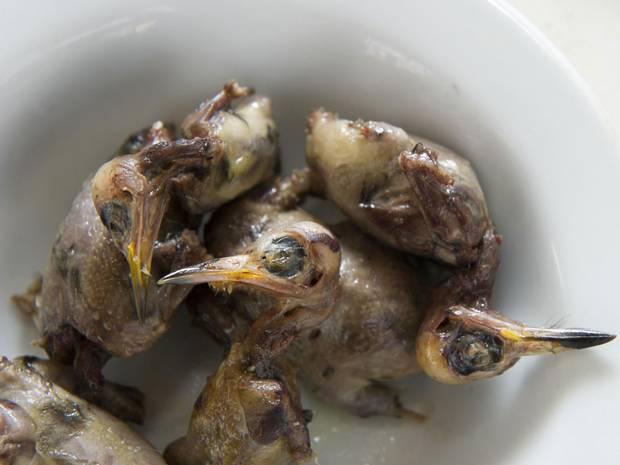
Some 20% of all species of birds have become extinct because of us. Image above of Cypriots killing migrating songbirds for pickling. Once caught and killed, the birds are then sold to restaurants in the Republic of Cyprus, which serve ambelopoulia, a traditional Cypriot dish

A new study reveals that over the last 20,000-50,000 years birds have undergone a major extinction event, inflicted chiefly by humans, which caused the disappearance of about 10%-20% of all avian species. 

According to the researchers, the vast majority of the extinct species shared several features: they were large, they lived on islands, and many of them were flightless.

The study was led by Prof. Shai Meiri of the School of Zoology

and Amir Fromm of the Weizmann Institute of Science. The paper was published in the Journal of Biogeography.

Prof. Meiri: “We conducted a comprehensive review of scientific literature, and for the first time collected quantitative data on the numbers and traits of extinct species of birds worldwide. Those that became extinct in the last 300 years or so are relatively well known, while earlier species are known to science from remains found in archaeological and paleontological sites worldwide. Altogether we were able to list 469 avian species that became extinct over the last 50,000 years, but we believe that the real number is much higher.”

The researchers think that the vast extinction was caused primarily by humans, who hunted the birds for food, or by animals brought to islands by humans – that fed on the birds and/or their eggs. This assumption is based mainly on two facts: First, the greater part of bird remains were found on human sites, apparently belonging to birds consumed by the inhabitants.  Second, in most cases the extinctions occurred a short time after the arrival of humans.

The researchers also found that extinction was not random, as most extinct species shared three major features:

  • About 90% of them lived on islands. When humans arrived on the island, the birds were hunted by them, or fell victim to other animals introduced by humans, such as pigs, rats, monkeys, and cats.
  • Most extinct bird species were large, some very large. Consequently, since each bird provided humans with a great quantity of food, they were a preferred target for hunters. In fact, the body mass of the extinct species was found to be up to 10 times as large as that of surviving species. Previous studies have found a similar phenomenon among mammals and reptiles, especially lizards and turtles that lived on islands: the larger ones were hunted by humans and became extinct.
  • A large portion of the extinct bird species were flightless, and often unable to escape their pursuers. The study found that the number of flightless bird species that became extinct is double the number of flightless species still existing today; all in all, 68% of the flightless bird species known to science became extinct. One of the better-known examples is the moa bird in New Zealand: 11 species of moa became extinct within 300 hundred years, due to hunting by humans

How you can help?

  • Join a bird conservation organization.
  • Sponsor a land trust (email me about one we are building in Nipissing, Ont – [email protected].) so nature and man can live in harmony
  • Support organizations that catch animal traffickers, like what Ofir Drori is doing in Africa
  • Educate your fellow people in the Middle East that killing owls is a dumb superstition
  • Share the message that real men don’t hunt rare birds


Karin Kloosterman
Karin Kloostermanhttp://www.greenprophet.com
Karin Kloosterman is an award-winning journalist, innovation strategist, and founder of Green Prophet, one of the Middle East’s pioneering sustainability platforms. She has ranked in the Top 10 of Verizon innovation competitions, participated in NASA-linked challenges, and spoken worldwide on climate, food security, and future resilience. With an IoT technology patent, features in Canada’s National Post, and leadership inside teams building next-generation agricultural and planetary systems — including Mars-farming concepts — Karin operates at the intersection of storytelling, science, and systems change. She doesn’t report on the future – she helps design it. Reach out directly to [email protected]

Read More

TRENDING

Hydrophilis rebreather, an interview with Oliver Isler

A retired Swiss biology teacher has built one of...

A Quantum Kaddish? What fungal networks teach us about grief, God and death

Can Zar speak with her recently departed mother into...

Econcrete makes built coastlines richer in marine life with new investment

    A decade ago, we met Shimrit Perkol-Finkel in a...

Desalination experts debunk Aqua Solaire, the floating desalination barge

AI makes it easy to dream, develop, and create images of what could be world-changing ideas, until the reality sets in. A new project making the rounds is Aqua Solaire, an allged French concept for a solar-powered desalination vessel designed to bring drinking water to coastal communities facing drought, storms, and infrastructure failures.

Exploring Bangkok by electric bike with teenagers

With two teenagers in tow and four nights to spare, we decided to give Thailand’s capital the attention it deserved. My son had one request: he wanted to rent electric bikes. A friend of his had explored Japan this way, and he was convinced Bangkok would be just as exciting.

How to quiet noise from construction in your office

Streets need to be resurfaced in New York but the humming and grinding noise is unsettling. Noise is environmental pollution. 

EarthX and a blueprint for sustainable investing

Trammell S. Crow, a Dallas-based businessman and father of four, is focusing his efforts on impact investing, and media that focuses on saving the planet through EarthX.

Mining Afghanistan’s Mineral Discoveries Similar to Avatar

Now that American forces in Afghanistan are commemorating the longest period of any war that America has been involved in, including the 1965-73 Vietnam War, the recent discoveries of large and extremely valuable mineral and metal deposits may finally bring to light a reason to continue the presence of US fighting forces in this war torn and backward country.

From Pilot Plant to Global Stage: How Aduro Clean Technologies’ 2026 Expansion Signals a Turning Point for Chemical Recycling Investors Like Yazan Al Homsi

The company's Next Generation Process (NGP) Pilot Plant in London, Ontario, has officially moved into initial operating campaigns, generating the kind of structured, repeatable data that separates laboratory promise from commercial viability.

Nobul’s Regan McGee on Shareholder Value: “Complacency Is the Silent Killer” 

Why the governance framework designed to protect shareholders so...

Should You Invest in the Private Market?

startustartup Unlike public stock exchanges, which offer daily trading, strict...

How to build a 100-year-company

Kongō Gumi is a Japanese construction company, purportedly founded in 578 A.D., making it the world's oldest documented company. What can we learn about building sustainable businesses from them?

How AI Helps SaaS Companies Reduce Repetitive Customer Support Work

SaaS products are designed for large numbers of users with different levels of experience, and also in renewable energy.

Popular Categories