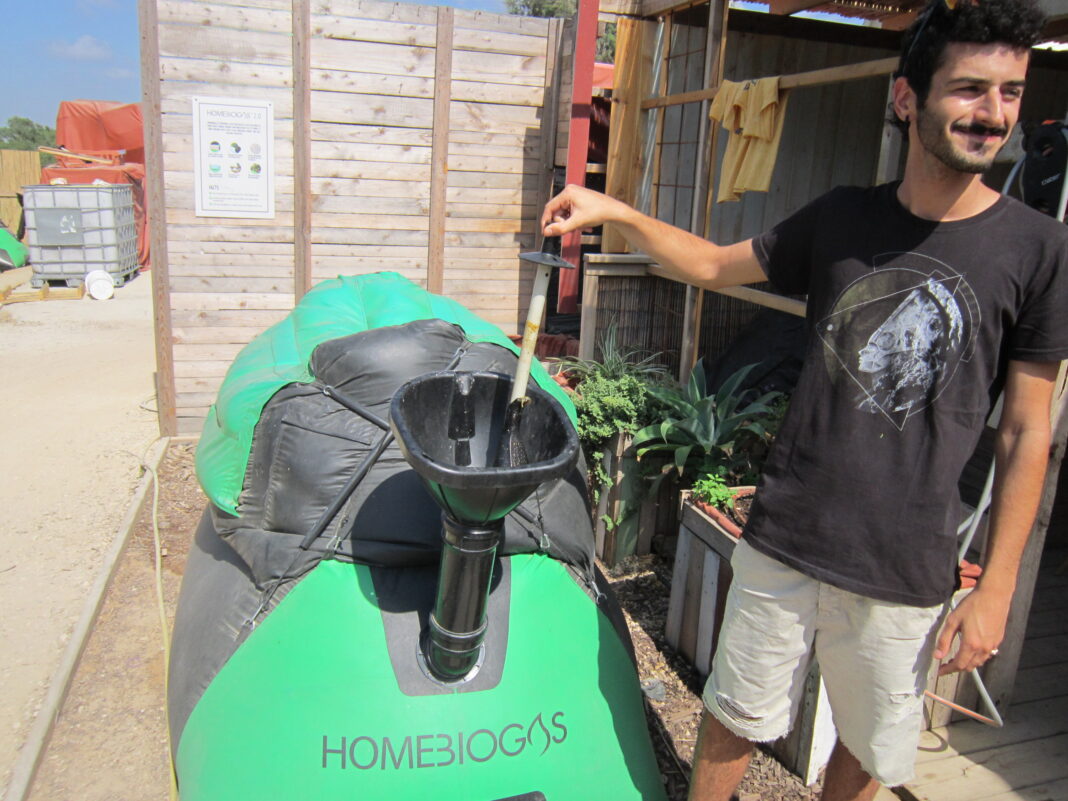
Homebiogas appliance processes compost and home food waste into bio-gas

bio gas from methane at home deviceMaking bio-gas at home from food scraps is now becoming an easily affordable reality. After
seeing a model of the Homebiogas device on display at the June 26-27 Cleantech Israel 2018 conference and exposition in Tel Aviv, I paid a July 10 visit to the company’s headquarters in Beit Yanai Israel, to inspect a working model of the appliance that makes usable methane based bio-gas in one’s own backyard using a combination of manure, food scraps and other organic material.

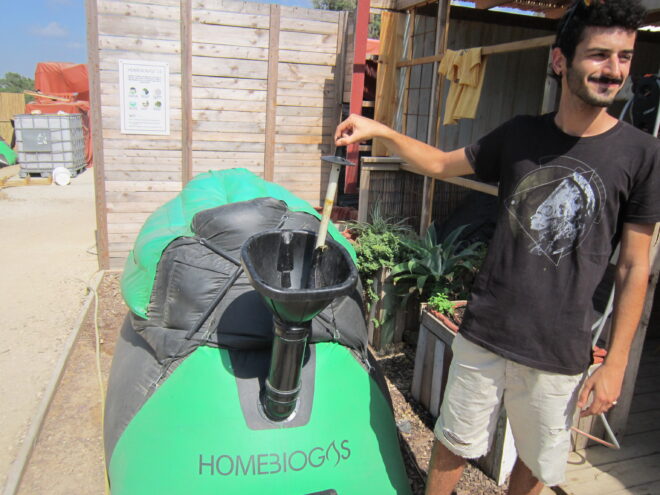
Roy Barzam, Homebiogas’ US sales manager (photo), took me on a tour of their facilities, at which several bio-gas appliances were in various stages of bio waste processing and operation. “The process of converting organic wastes into bio-gas is known as anaerobic digestion  
in which bacteria and other micro-organisms breakdown the organic material without being exposed to air. This is different from composting, in which the organic material
is exposed to air” he said. This anaerobic breakdown process is what produces the mostly methane bio-gas that is then stored in the appliance for later home use.

The Homebiogas appliance, made almost entirely of PVC and polyprophane plastic materials, weighs only 23 KG “in the box” when delivered with a set of assembly and operation instructions. When completely ‘charged up’ with horse or cow manure (the best fertilizer for producing suitable bacteria for the breakdown process), water and food scraps, the appliance weighs as much as 1.5 tons. The entire bio-gas production process takes several weeks, Roy added, pointing to an appliance still in the  bio-gas production process (photo).
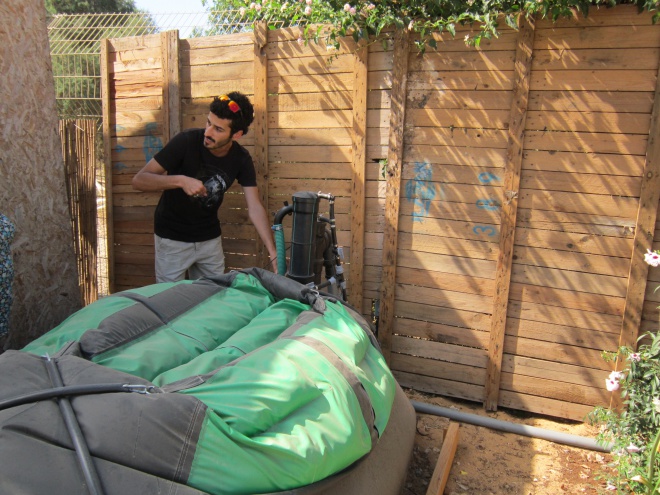
Once the Homebiogas appliance is delivered to a customer, the set-up and preperation process is as follows:

After unpacking assembling on a dry, flat surface, around 100 KG of horse or cow manure is fed into the appliance’s intake inlet to create the needed bacteria. After a 3-4 week time period, organic waste such as vegetable and fruit, meat and dairy scraps (including bones) are fed into it. Up to 12 liters of “kitchen wastes” per day can be added via the intake “feeding tube”. Water is also added along with food wastes (up to 1200 liters).This is done until the water volume and food waste volumes are more or less equal.

“The manure does it all to create the bacteria for breaking down the food wastes”, Roy says. He also pointed out a capped outlet pipe from which filtered liquid fertilizer, a byproduct of
the biogas production process, is removed. What remains from this process is a sludge that accumulates at the bottom of the appliance and is eventually removed.
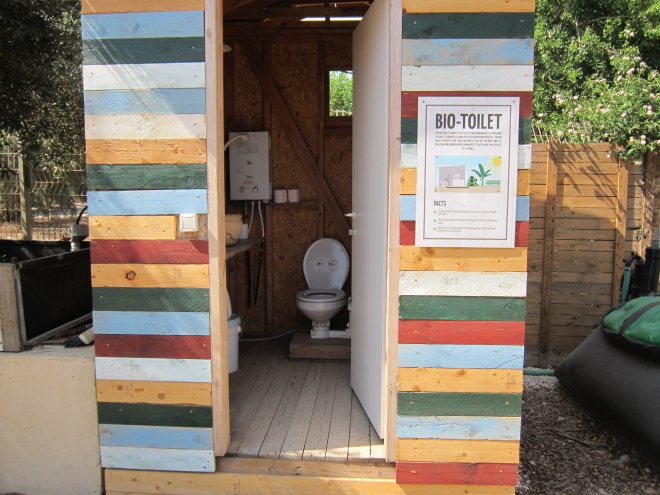
Roy also showed a “bio-toilet” in operation ( above photo)in which human wastes are fed directly into a Homebiogas unit. The resulting fertilizer would not be suitable for fertilizing food crops, but can be used for fertilizing trees flowers, grass, etc. “Bio-toilets, which are like those used in boats and campers save water, due to their unique pumping systems” Roy adds.

Since Homebiogas was founded in 2012, some 3000 biogas appliances have been sold to customers in more than 90 countries. “We advise using our appliance in warmer climates where temperatures are at least 20 degrees Celsius during the daytime. Otherwise, a heating device must be used to keep the processing bacteria alive and functioning properly” , Roy said.

Due to the much lower gas pressure for the created bio-gas in its 700 liter storage compartment, the Homebiogas appliance is much safer to use than conventional LP gas; and has been certified safe to use by Israeli governmental authorities. The amount of daily bio-gas produced is enough to power a one burner gas unit for up to two hours. One of these gas burners is included with each  appliance.

As to the future: “We are developing larger models for use in schools and other facilities. They will be much larger than the standard home model – as much as 5 times larger”, Roy said.

More about biogas from biomass and food scraps:

Make bio-gas in your back yard from food and poop

Israel’s 4MW Biogas Plant to Clean up After 14,000 Cows

5 Brilliant Projects That Turn Poop into Power

Maurice Picow
Maurice Picowhttps://www.greenprophet.com/
Maurice Picow grew up in Oklahoma City, U.S.A., where he received a B.S. Degree in Business Administration. Following graduation, Maurice embarked on a career as a real estate broker before making the decision to move to Israel. After arriving in Israel, he came involved in the insurance agency business and later in the moving and international relocation fields. Maurice became interested in writing news and commentary articles in the late 1990’s, and now writes feature articles for the The Jerusalem Post as well as being a regular contributor to Green Prophet. He has also written a non-fiction study on Islam, a two volume adventure novel, and is completing a romance novel about a forbidden love affair. Writing topics of particular interest for Green Prophet are those dealing with global warming and climate change, as well as clean technology - particularly electric cars.

Hot this week

How Renewable Energy is Revolutionizing the Way We Power Our World

Solar has become the star of the transition thanks to modular hardware and straightforward installation. It fits dense cities and remote towns alike. Many companies are turning to rooftop arrays and carport systems - and exploring commercial solar installation as a practical way to lock in future savings.

How does one start prepping?

Faced with an extreme winter storm this year, Americans wonder how to be prepared for catastrophe. Miriam has lived through wars in the Middle East - so she's prepared on giving you a guide to prepping.

Fishermen sue tire manufacturers on behalf of the salmon

A federal trial in San Francisco has brought US tire manufacturers, fishing groups, and environmental scientists into court over a chemical most drivers have never heard of — but which scientists say may be silently reshaping aquatic ecosystems.

Listening to Water: Tarek Atoui’s Next Work for Tate Modern

Born in Beirut, Lebanon in 1980 and now living in Paris, Atoui has spent years building instruments that don’t sit comfortably in concert halls. Many of them involve water, glass, and ceramics — materials that react to sound instead of simply producing it.

Leading Through a Dual-Energy Transition: Balancing Decarbonisation with Energy Security

Experience in one area of the energy industry isn't enough to guarantee readiness across all the others. That's where a structured program like an MBA in energy can come in. Today's advanced curricula explore energy economics, finance, policy, and strategic management alongside the technical subjects. And when pursuing an energy MBA online, professionals can skill up and retrain without having to step out of the labor market -- an important perk at a time when skilled professionals are already in short supply.

Topics

How Renewable Energy is Revolutionizing the Way We Power Our World

Solar has become the star of the transition thanks to modular hardware and straightforward installation. It fits dense cities and remote towns alike. Many companies are turning to rooftop arrays and carport systems - and exploring commercial solar installation as a practical way to lock in future savings.

How does one start prepping?

Faced with an extreme winter storm this year, Americans wonder how to be prepared for catastrophe. Miriam has lived through wars in the Middle East - so she's prepared on giving you a guide to prepping.

Fishermen sue tire manufacturers on behalf of the salmon

A federal trial in San Francisco has brought US tire manufacturers, fishing groups, and environmental scientists into court over a chemical most drivers have never heard of — but which scientists say may be silently reshaping aquatic ecosystems.

Listening to Water: Tarek Atoui’s Next Work for Tate Modern

Born in Beirut, Lebanon in 1980 and now living in Paris, Atoui has spent years building instruments that don’t sit comfortably in concert halls. Many of them involve water, glass, and ceramics — materials that react to sound instead of simply producing it.

Leading Through a Dual-Energy Transition: Balancing Decarbonisation with Energy Security

Experience in one area of the energy industry isn't enough to guarantee readiness across all the others. That's where a structured program like an MBA in energy can come in. Today's advanced curricula explore energy economics, finance, policy, and strategic management alongside the technical subjects. And when pursuing an energy MBA online, professionals can skill up and retrain without having to step out of the labor market -- an important perk at a time when skilled professionals are already in short supply.

From Green Energy to Healthy Societies: Why old systems thinking is becoming relevant again

Across the Middle East and North Africa, large investments are being made in green hydrogen, renewable energy, water infrastructure and sustainability. Most of these efforts are discussed in the context of climate change, decarbonization and economic diversification. That framing is important, but it may not capture their full value.

We saw peace – an interreligious encounter deep in our eyes

They came from Israel, Palestine, Jordan, Iraq, Yemen, Morocco, Tunisia, Lebanon, Egypt… There are Sunni Muslims, Shiite Muslims, Jews (Orthodox and Reform), Orthodox Christians, Coptic Christians, Protestant Christians, Druze, Baha'is, a Scientologist.

Can biochar reduce ‘Forever Chemicals’ in food if it’s used in farms?

Biochar is produced by heating organic material in a low-oxygen environment so it does not burn. This process, known as pyrolysis, transforms plant matter into a stable, carbon-rich material.

Related Articles

Popular Categories