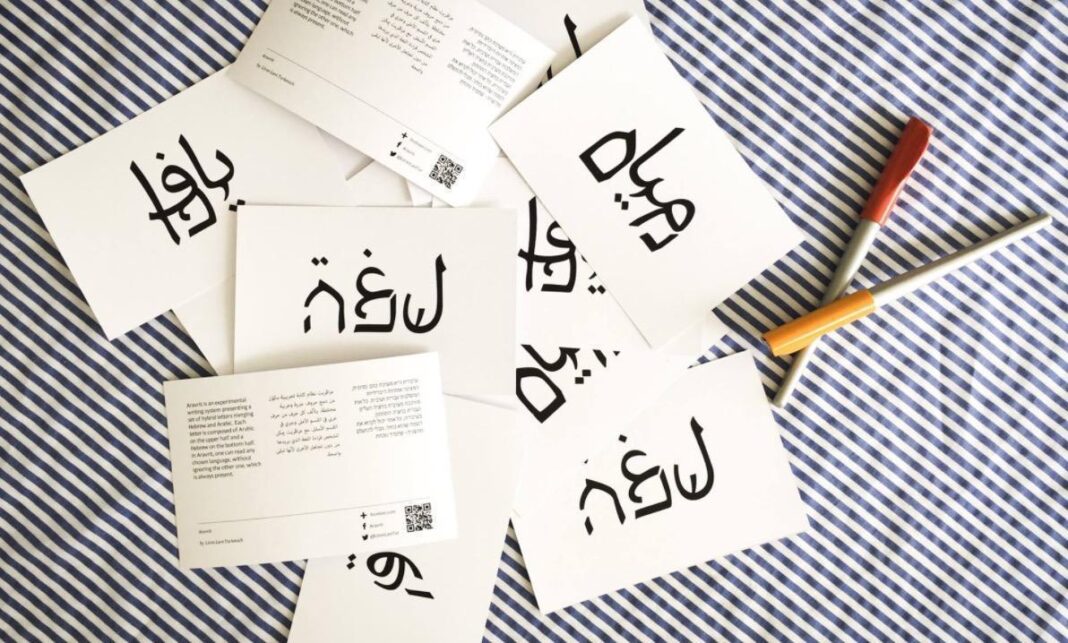

 An Israeli designer with roots in Haifa has developed a new script that bridges a basic cultural divide between Israeli Jews and Arabs.
Liron Lavi Turkenich (pictured below), instructor of graphic design from Jerusalem’s Bezalel Academy of Art, was raised in a Haifa, a city with a blended ethnic population where Hebrew and Arabic are spoken. A Hebrew speaker, it occured to her several years ago that she had never paid attention to the Arabic letters on bilingual road signs. Instead, she was “just looking at Arabic as decorations and not letters with content – and in fact, kind of ignoring the Arabic,” Turkenich told NoCamels. (Green Prophet has written about the hypnotic visual affect of Arab calligraphy on non-Arabic readers, as example in this story about Tunisian-French artist eL Seed.)
 Turkenich calls her new typeface “Aravrit” (which fuses the Hebrew words for “Arabic” and “Hebrew”). Arabic and Hebrew are both Semitic languages. They share the same vocabulary structure and have some similar pronunciations, and they are both read right to left.
She fused the 22 Hebrew letters with the 29 Arabic ones, resulting in a script that Arabic readers can understand by reading the top half of any word string, while Hebrew readers can understand the bottom half. (See how Hebrew influenced English, in this story from our archives.)
The designer was challenged by the fact that – in Arabic – each letter takes on four unique forms depending on whether the letter is at the start, middle, end, or completely separate from a word. She currently has 638 letters based on the separate form, and, in future, will expand the alphabet to include the connected forms of the Arabic letters. Follow her developments on her Facebook page – link here.
With these 638 letters, Turkenich is able to write a word in Aravrit in a way that incorporates both the Arabic and Hebrew words. For example, ‘peace’ in Aravrit would say ‘salaam’ on the top half and ‘shalom’ on the bottom half (see below). (See how Arabic influenced English, in this story from our archives.)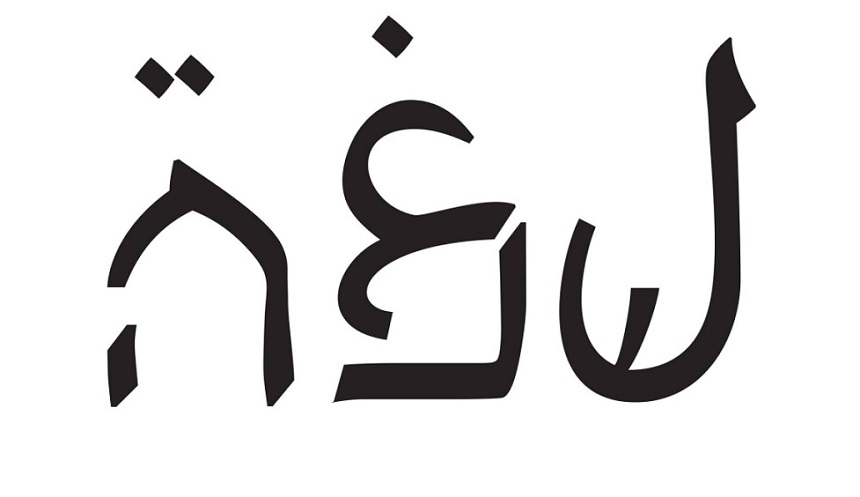 “The first thing is just to bring up the discussion – people start to talk about this, and the presence of Arabic in our surroundings,” said Turkenich. “I think this is the power of language, the fact that it is so daily.”
The script is proving popular, and is sparking discussion. It holds potential to transcend Israel’s linguistic barriers, and Turkenich says she has received positive responses from other nations with Arabic speakers, such as Yemen and Saudi Arabia.
“They really loved it because they were able to read their own script and they still got this message of life together,” adding, “I think people really like it because they feel like they’ve solved a riddle,” says Turkenich.
Arabic and Hebrew are the official languages in Israel, with roughly 20 percent of the population speaking Arabic (worldwide, more than 290 million people speak Arabic).
Images from Liron Erel