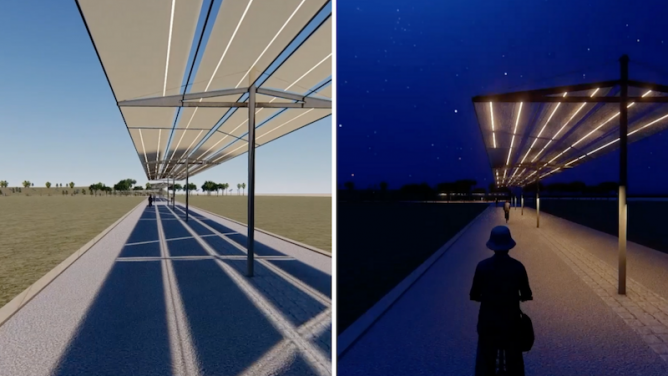
The city of Tel Aviv has installed a pilot of LumiWeave, a flexible and lightweight solar energy shade and energy system in Atidim Park in Tel Aviv to provide shade during the day and illuminate your path at night.
Initiated by Anai Green, an industrial designer, the idea is the winning project in the international technology competition of Women for Climate launched by the C40 organization. Sadly, women still need their own competitions to get noticed in clean tech and design.
At the heart of the development is a solar sheet that combines energy harvesting and lighting. The sheet is lightweight and flexible and allows immediate installation anywhere without the need to connect to main power outlets. The LumiWeave has no need for electrical infrastructure and allows the customer (in this case the city) to control the time and intensity of lighting and thanks to its simplicity (unlike let’s say the Solar Tree which isn’t at costs $100,000 per unit) the LumiWeave system saves at least 50% of the installation costs of standard lighting infrastructure and 100% of the electricity costs, according to Green’s estimates.
The system meets all safety standards, withstands all weather conditions and continues to provide lighting even after 3 days without sun.
The Lumiweave project is a unique project, as it combines addressing climate change and the growing challenge of shading in urban areas, with a technological solution that operates based on renewable and clean energy, and enables the supply of lighting that without the polluting fuels. Of course trees are the best solution for shade but in hot dry Middle East countries maintenance of trees comes with their own cost. Lighting is an issue in many desert communities only partially connected to the grid, or in Syria, where rolling blackouts have made solar panel energy the only mode of reliable energy for home owners and vendors.
Anai Green grew up in Israel, attended the Bezalel Academy of Art, and Worked in Japan before opening her independent design studio in Israel. Over the past decade, Anai’s interests have extended her work on lighting and furniture to the design of spatial objects and the relationship between materials, form and technologies to bring her designs to impact every day life in urban settings.
In 2010 She participated as a collaborator in Megama – a strategic design office – on an entry for the Landscape Urbanism Biennale called “32N Urban Shade” that focused on the significance of natural and built shade in the city of Bat Yam, Israel.
Creating public shade maps and shade walls, the installation offered respite from the sun in the industrial zone, as part of the event. Lumiweave and the preoccupation with climate and well tempered environments emerged from this early exploration. Lumiweave combines Anai’s unique interests in emerging LED lighting technologies, flexible PV cells, with the potential of textiles in outdoor uses to address the problem of rising temperatures in urban environments.
Following the win at the international competition, the Tel Aviv-Yafo Municipality is assisting and enabling the project to undergo a practical experiment, in collaboration with Atidim Park Tel Aviv and the Cityzone Innovation Laboratory, in which the experiment is currently being conducted. The venture is operated through LumiWeave and is overseen by designer and entrepreneur Anai Green, its founder, and Tal Perens, a serial high-tech entrepreneur.
The Tel Aviv-Yafo Municipality is a member of the international city organization C40, a network of major cities in the world committed to urgent action to combat the climate crisis. Within this context, the municipality initiates many actions including the municipal climate plan, a municipal plan for climate change assessments and reducing greenhouse gas emissions, a plan for massive tree planting, expansion of green areas, a program to remove polluting vehicles and ongoing educational efforts in schools and the public spaces regarding the consequences of climate change.
A press release issued by the city of Tel Aviv of course quotes its mayor Ron Huldai who will use any opportunity to tout his “green” projects to the international media while encouraging the endless building of mega towers in Tel Aviv. These commercial building products to create condos can forcibly remove residents who do not agree to sell their apartments in exchange for a unit in the newly constructed towers that can start at 30 floors.
Elderly suffer because they don’t want to leave their only homes and wait 4 years for a new tower to be built and usually have no interest in changing a small garden-facing apartment for one of hundreds of apartments in a new tower often just used as a second home or for AirBNB rental income.
Huldai has also made personal efforts to stop the funding of anthroposophical education in Tel Aviv, namely Beit Hinuch Aviv, a unique, wholistic method of teaching deep ecological values in children, citing that the system is encouraging segregation despite the students being from all faiths and socio-economic backgrounds. The school has started a program to teach Arab women how to become Waldorf teachers.
Huldai took the school to the Supreme Court in Israel so it would not receive municipal support. Meanwhile schools in Tel Aviv- Jaffa are segregated by Muslim-Jew, religious and non-religious.
Tel Aviv makes small steps in “green” progress only because Huldai wants to win favors in the international community.