Solar energy plants in the desert – a planning guide

solar power plant aora energy israel
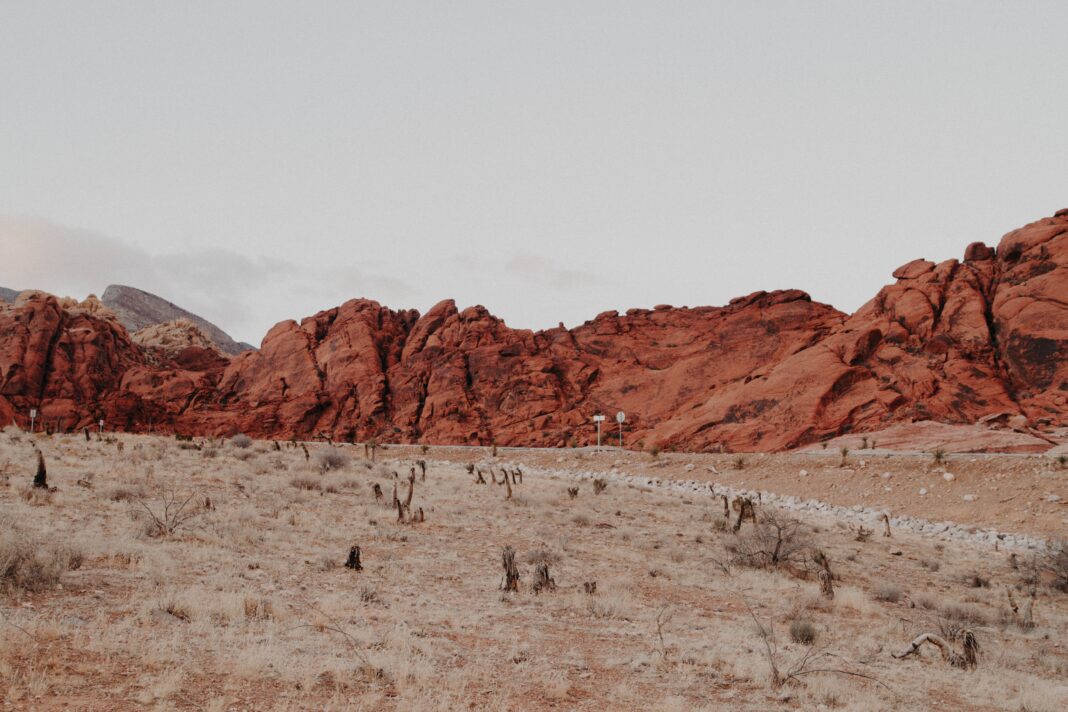
Solar power plants in the desert make use of wasted land, right? Think again. The desert soil has a complex network of pores in its unique soil. This takes hundreds, maybe thousands of years to create. Disturbing the desert may have implications on desertification, flash floods and who knows what else.

While it might look like deserts don’t have soil, they do. It’s just very different from those kinds of soil found anywhere else. Extreme temperatures, very little water and limited plant matter to degrade on the surface make an unusual environment. With little dead plant material to decompose and create a rich layer of organic matter, desert soils are unique. And they need to be protected, finds new research. This is especially important for renewable energy installations being built in the desert, like solar power plants or military installations. For almost ever, people believed that deserts don’t harbor soil or life, but they really do.

It’s just different than what we know and the answers to keep deserts alive are in the pores of the desert soil.
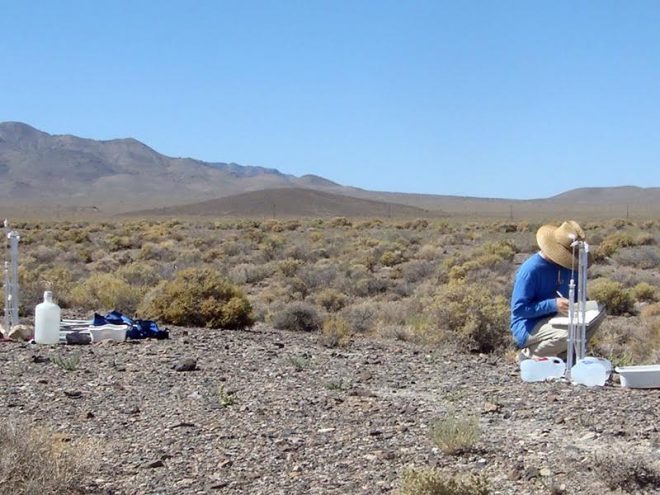
Judith Turk researching fragile desert soil
It takes thousands of years to create and can be wiped out by one dump-truck. Desert soils are fragile eco-systems. Look to the soil. Researchers measure soil infiltration in desert soils near Alkali Lake, NV. Credit: Judith Turk

Judith Turk, an assistant professor at the University of Nebraska-Lincoln in the United States, studies the top layer of desert soils, called the vesicular horizon. This surface layer of the soil is common in deserts and contains pores – or tiny holes – of different shapes, called vesicles and vughs.

“These horizons are important because of their role in many processes,” Turk says. “Vesicular horizons determine how much water soaks into the soil and how much runs off. Since they occur in deserts, they control the distribution of the most limiting resource, which is water.”

Vesicular pores are spherical, look a bit like bubbles, and are not connected to each other. Vughs are similar but more irregular in shape, almost like a clump of bubbles that have not fully separated from each other.

Predict impact on floodwater runoff, flash floods

Turk wanted to learn how these horizons form across different desert soils. In their most recent experiment, they chose small plots of the soils and took samples. They then crushed the soil so the formation of pores would have to start from scratch. They checked the porosity of the soils over the course of a year to compare.

“First, we found that infiltration rates were lowered as a result of disturbance,” Turk explains. “This would normally not be surprising, since disturbance compacts the soil, reducing porosity, and breaking up the pore networks that water flows through.

“However, the pores in V horizons are different,” she says. “Most of the pores are not connected with each other and therefore contribute little to permeability of the soil. So, we weren’t sure how disturbance would affect these horizons.”

She adds that what did surprise them was how a soil’s texture determined how well its porosity in this soil layer came back. They assumed that a soil with more silt would be better for vesicle formation but found vesicles formed more rapidly in relatively sandy soils.

“The capacity for vesicular pores to reform within a year after the V horizon is disturbed is something that is interesting,” Turk says. “The post-disturbance V horizons being thinner with smaller pores tells us that what we observed in the undisturbed soils takes time to form.”

It is important to study these soils because semi-arid lands cover about one third of the planet’s land area. Soils with V horizons are often disturbed because populations of cities in arid environments are growing. There is construction of solar and wind farms, and these areas are popular for military exercises.
oman desert
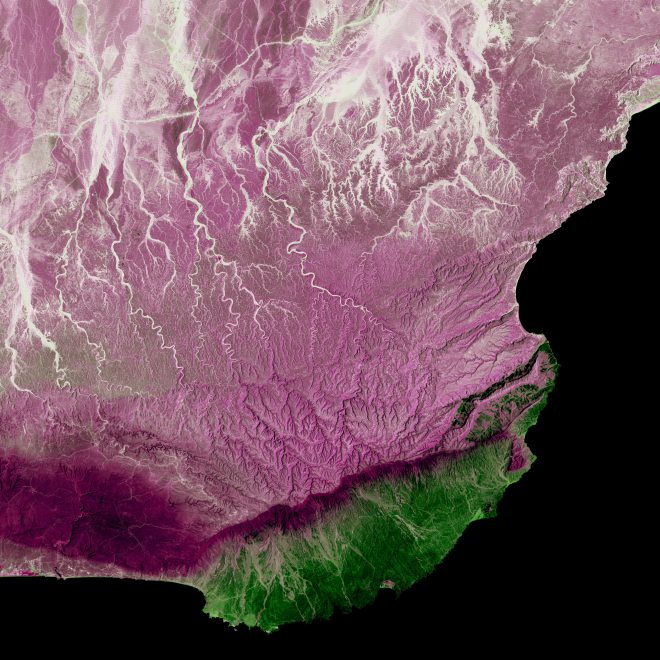
Much of Oman is desert, but the Arabian Sea coast in the Dhofar region represents a startling difference in climate. This coastal region catches the monsoon rains, or khareef, during the summer months. Drenching rains fall primarily on the mountainous ridge that separates the lush, fertile areas along the coast from the arid interior, recharging streams, waterfalls, and springs that provide plentiful water supplies in the fertile lowlands for the remainder of the year.

It’s vital to take the researchers’ findings into account when planning to disturb the soil.

“Many people are surprised to learn that there are interesting soils in the desert,” she says. “When I moved to California for graduate school, I fell in love with the desert lands of the western US. In the desert you can see the land surface and it’s easy to imagine the processes that have built the soil landscapes that we see today.”


Karin Kloosterman
Karin Kloostermanhttp://www.greenprophet.com
Karin Kloosterman is an award-winning journalist, innovation strategist, and founder of Green Prophet, one of the Middle East’s pioneering sustainability platforms. She has ranked in the Top 10 of Verizon innovation competitions, participated in NASA-linked challenges, and spoken worldwide on climate, food security, and future resilience. With an IoT technology patent, features in Canada’s National Post, and leadership inside teams building next-generation agricultural and planetary systems — including Mars-farming concepts — Karin operates at the intersection of storytelling, science, and systems change. She doesn’t report on the future – she helps design it. Reach out directly to [email protected]

Read More

LEAVE A REPLY

Please enter your comment!
Please enter your name here

TRENDING

AI data centers are triggering panic, instead of cleantech opportunities

AI may unintentionally become the economic engine that finally modernizes America’s aging grid. California is experiencing a massive AI data center boom, ranking 3rd in the U.S. with 227 operating centers and 54 more in development as of April 2026, according to Stanford.

24 7 renewable energy: how solar, wind, batteries and AI SaaS replace fossil fuels

A new report from the International Renewable Energy Agency based in Abu Dhabi makes something clear that many in the industry already suspected. When solar and wind are paired with battery storage, they can deliver reliable, round the clock electricity at costs that compete with, and often beat, fossil fuels.

Abortion Pills, Plan B and Mifepristone and what the new US mail ban means

Abortion pills, often confused with Plan B (the morning-after pill), and historically referred to as RU486 (mifepristone), are part of a broader category of reproductive health medications that women have been using for decades. But they are not the same thing.

Japan wants to build a solar panel ring around the moon

Unlike solar power on Earth, which is limited by night cycles, weather, and seasons, the Moon offers something close to uninterrupted exposure to the Sun. By placing solar infrastructure in orbit or along the lunar surface, engineers could generate continuous clean energy at a scale that may exceed global electricity demand,  the Japanese scientists say.

Art from Oman at the Venice Biennale

Oman is returning to the Venice Biennale with Zīnah, an immersive installation by artist and curator Haitham Al Busafi that transforms a traditional form of horse adornment into a large-scale sensory experience.

How to quiet noise from construction in your office

Streets need to be resurfaced in New York but the humming and grinding noise is unsettling. Noise is environmental pollution. 

EarthX and a blueprint for sustainable investing

Trammell S. Crow, a Dallas-based businessman and father of four, is focusing his efforts on impact investing, and media that focuses on saving the planet through EarthX.

Mining Afghanistan’s Mineral Discoveries Similar to Avatar

Now that American forces in Afghanistan are commemorating the longest period of any war that America has been involved in, including the 1965-73 Vietnam War, the recent discoveries of large and extremely valuable mineral and metal deposits may finally bring to light a reason to continue the presence of US fighting forces in this war torn and backward country.

From Pilot Plant to Global Stage: How Aduro Clean Technologies’ 2026 Expansion Signals a Turning Point for Chemical Recycling Investors Like Yazan Al Homsi

The company's Next Generation Process (NGP) Pilot Plant in London, Ontario, has officially moved into initial operating campaigns, generating the kind of structured, repeatable data that separates laboratory promise from commercial viability.

Nobul’s Regan McGee on Shareholder Value: “Complacency Is the Silent Killer” 

Why the governance framework designed to protect shareholders so...

Should You Invest in the Private Market?

startustartup Unlike public stock exchanges, which offer daily trading, strict...

How to build a 100-year-company

Kongō Gumi is a Japanese construction company, purportedly founded in 578 A.D., making it the world's oldest documented company. What can we learn about building sustainable businesses from them?

How AI Helps SaaS Companies Reduce Repetitive Customer Support Work

SaaS products are designed for large numbers of users with different levels of experience, and also in renewable energy.

Popular Categories