

Sending the kids to school in India

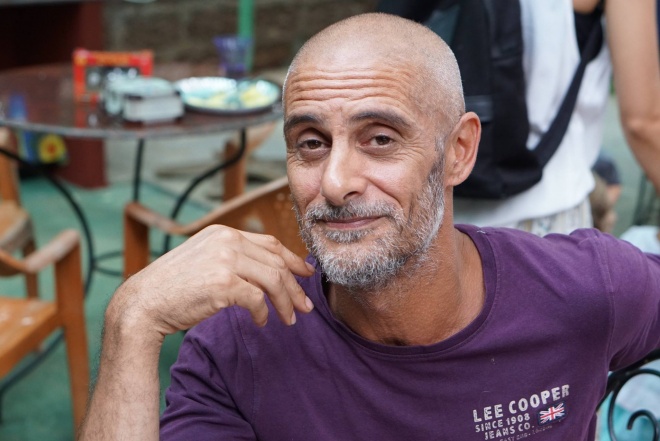
Picking up kids at the Yellow School in India. Would you carpool with Mad Max?

It’s a parent’s fantasy to get away for the winter, no? But not just for a week on a Disney cruise. That kind of holiday actually frightens me. Perhaps because I am a child of the 70s now with children of my own, I was seeking a holiday where I could enjoy myself, and my kids could too. I have a theory that when I am happy, my kids are happy. We all found the answer to our family needs in Goa, India. We decided to stay in a village called Anjuna, because a friend of mine Didi, said it’s the best.

Yes, I know, India has a wildness to it. It’s one of those places where you need vaccination shots, and you need to wash your hands and you can’t drink water from the tap, and yes, the roads are nuts. But think of Goa as “India light”. It’s a great place to enter the eastern wildness and awareness that India offers, but it’s a relatively safe place for children and women alike to settle in for a month or two or more. 

After I heard about the beautiful community in a small beach village called Anjuna, what made the whole trip for 6 weeks irresistible is that my children would be able to go to school there. Some established hippies, then with kids of their own, set up a school in Anjuna, which starts young at pre-school ages, up until Grade 6. It’s called the Holistic Yellow. Taught in English by local Indian and international teachers, you as the parent can have your days free to explore Goa, do yoga, work remotely, sunbathe, or sleep, while your kids enter a small paradise of freedom and fun.

My daughter and her new bestie

The Holistic Yellow School, was founded by Karl John Shenton, a father of 2 boys – now both at the school. He’s studied and learned from many pedagogical systems over the years and has built his own style, where a kind of freedom and wildness prevails. While my 5 and 7 year olds were there for 5 weeks they met friends from all over the world, some speaking 5 languages; they got to swim, go to water parks, discos, played endlessly with glitter and crafts, planned a large dance festival, and most importantly were hugged and loved by the warm staff.
When we entered the children to the school, we told them that they don’t need to learn anything. I’d been homeschooling English, and they go to a slower-paced school in Israel where one of them is just starting to read and do math. We were under no stress for them to learn anything and the Holistic Yellow staff were gracious about that.

The kids felt at home from the first day and couldn’t wait to go to school the next day. While it’s hard to get my boy dressed in the morning in Israel, where we live, in India he was motivated to put on his clothes and his shoes well before the time.
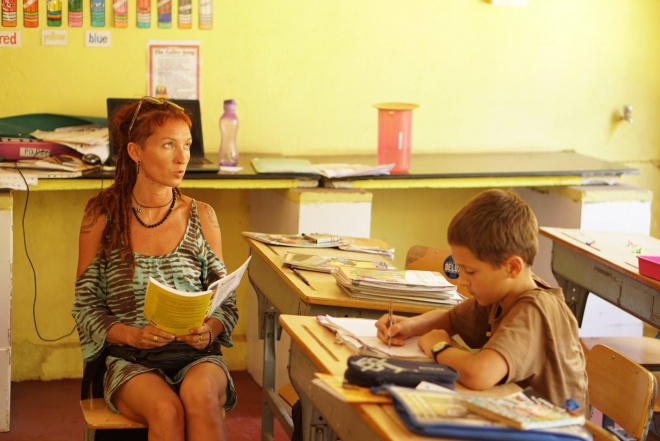
goa,anjuna, yellow school

Another great thing about the school is that there are vegetarian options for my kids who keep a kosher diet. For others, as vegans or vegetarians there is a strong awareness in Goa to other’s eating habits thanks to Hindu influences and a very multi-national community, many of whom are vegetarian.
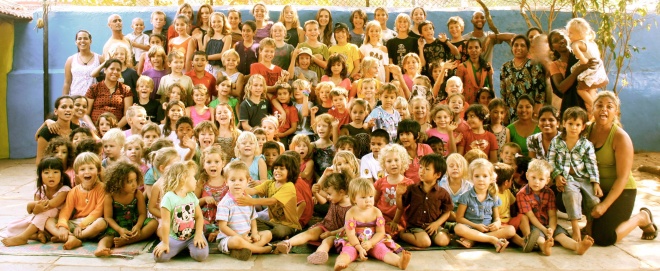
The Holistic Yellow School won’t break your bank either. It cost us a modest 14,000 rupees a month, about $240 USD per child, making it a great alternative for parents and people who want a real holiday of a month or more to get into the vibe of India. They accept drop ins and cater to the travelling community.

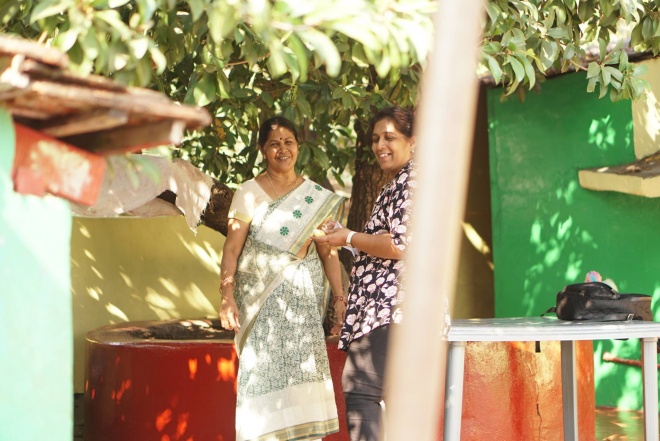
Yellow School parents

Consider that what makes the school so charming and the kids so great is that they are the offspring of the Goa hippies, many from the trance scene that started in the 80s. The kids are world-travelled, balanced, fair and open-minded. Once you experience the Yellow School and visit there you will know exactly what I mean.

danice yellow school anjuna

If you are lucky your children will connect to the others and you will have an instant community where you will meet other parents full of positivity. Not a “normal” one in the crowd. We were invited to birthday parties, disco parties, and unusually good dinner buffets with our new friends.

An after-school playdate. The kids are cooking in their restaurant.

There is no simple way to sum up what the Goa experience is. It’s not Pura Vida like Costa Rica. It’s not Same Same, But Different like Thailand. It’s just amazing for the spirit. Because going to Goa is mostly like going to visit yourself, the version of you that you like in your dreams.

While I love my kids, I also love being my own person and the Holistic Yellow gave me the chance to be that too, on holiday.

New friends that I got to meet because of the Yellow School – my kids were on a playdate at this home in Anjuna.

For more information about the Yellow School in Anjuna, Goa, see their Facebook page. Or talk to Karl here. Check out Sam Rao for homestays in the Anjuna area


Karin Kloosterman
Karin Kloostermanhttp://www.greenprophet.com
Karin Kloosterman is an award-winning journalist, innovation strategist, and founder of Green Prophet, one of the Middle East’s pioneering sustainability platforms. She has ranked in the Top 10 of Verizon innovation competitions, participated in NASA-linked challenges, and spoken worldwide on climate, food security, and future resilience. With an IoT technology patent, features in Canada’s National Post, and leadership inside teams building next-generation agricultural and planetary systems — including Mars-farming concepts — Karin operates at the intersection of storytelling, science, and systems change. She doesn’t report on the future – she helps design it. Reach out directly to [email protected]

Read More

TRENDING

A Brief History of Basil From India to Italy

Beloved, fortunate, sweet, and royal; an herb with a long and storied history in Asia and across the world. Called by many names, basil has featured in previous Green Prophet articles, so enjoy another serving, a brief history of basil.

This furniture isn’t built, it grows from mushrooms

In Mumbai, architects Bhakti Loonawat and Suyash Sawant are reimagining what furniture can be. Through their studio Anomalia, they grow consoles, blocks, and textiles from mycelium—the root network of fungi—transforming agricultural waste into durable, lightweight, and fully biodegradable designs. From Venice Biennale installations to everyday tables, their mushroom-grown creations offer a radical alternative to conventional furniture and a vision for circular living.

5 Brilliant eco-architect alternatives to Foster + Partners

In the world of architecture and design, there’s a growing movement towards exploring new, uncharted territories. While renowned firms like Foster + Partners and Zaha Hadid have undeniably shaped the skyline of modern architecture, there’s a wealth of untapped potential in emerging voices that can offer bold, innovative, and sustainable alternatives. These next five studios are pushing the boundaries of creativity, blending technology with art, and designing spaces that respond to the future needs of communities and the planet. Let’s take a closer look at these pioneers who are crafting tomorrow’s architectural landscape today.

Can neem and tulsi purify water?

All four medicinal plants used in the study demonstrated a notable transformation in turning contaminated water into drinkable water. More than any other plant, neem has proven to be effective at cleaning contaminated wate, the researchers note. Along with a value closer to that of neem, tulsi also possesses the ability to filter contaminated water.

The vernacular architecture book

Can architects, and students of architecture do better for planet and people? Yes, the answers are in the bible of vernacular architecture called Habitat: Vernacular Architecture for a Changing World, edited by architect Sandra Piesik with contributions from about 100 architects who specialise in geographic regions and materials. 

Yerukim Forms a New Green Economy Where the Money is Really Green

The Yerukim members who pick up the recyclables get to keep the monetary reward, the public earns "green" bills that can be used in shops, and business owners get to be associated with environmentalism.

Choosing Riyadh over Dubai? What Investors Should Know

Saudi Arabia is deploying capital at unmatched scale to catalyze tourism and advanced industry while rewiring its power-and-water backbone. The investable frontier is widening—especially in renewables, grid storage, water efficiency/desal retrofits, and hospitality operating platforms. Prudent investors will insist on phased delivery, enforceable KPIs (energy, water, biodiversity), and RHQ/zone compliance—while pricing political-economy and reputational risks alongside growth upside.

Sell your cooking oil for biodiesel money

Want to make money on old french fry oil? Sell it.

Qatar Alternative Energy Summit Pairs Investors And Innovators

Alternative energy investors and innovators can meet n' greet in Doha, Qatar March 16 and 17.

Here’s How To Implement The Four Pillars Of Employee Engagement

If you throw a party for your work team and they are vegans, don't make it a barbecue. Know the sustainability values of your team to boost moral and retain good people.

Locals From Rishon Fight IKEA

Big Box stores are a pretty new concept in Israel, and thank God that not every Israeli city wants them in their backyard. A word from someone who has see the beautiful farmland around her hometown Newmarket, Ontario stripped and converted into vulgar strip malls of big box shops: they have no place in a healthy and sustainable town or city.

The Jewish National Fund Meets An Inconvenient Truth

According to the JNF, it has transformed thousands of acres of barren land into green forests in Israel. They state that each person emits about 23 tons of carbon per year, estimating that each tree planted can absorb one ton of carbon in its lifetime. That's a whole lot of trees you'd need to be planting. Could so many fit in Israel?

How to quiet noise from construction in your office

Streets need to be resurfaced in New York but the humming and grinding noise is unsettling. Noise is environmental pollution. 

Popular Categories