


 Morocco has activated the Noor I concentrated solar power (CSP) plant, the first part of a three-phase development in the Sahara Desert intended to supply more than a million homes with electricity by 2018. The 500,000 crescent-shaped solar mirrors of Noor I, which sits on thousands of acres of desert terrain near Ouarzazate, will generate up to 160 MW of power. It’s the largest CSP plant to come online in the Middle East and North Africa region, and the African continent. When the full fit-out is complete, the 350 MW plant will be the single largest solar power production facility in the world.
When Morocco’s King Mohammed VI inaugurated the facility, he also officially launched Noor II and Noor III. According to Climate Investment Funds (CIF), the Noor I project cost nearly US$1 billion, exceeding an original estimate of US$820 million. Financing came from CIF, The World Bank, and the African Development Bank, and was also backed by Moroccan government guarantees. Undisclosed energy subsidies from the king will keep costs from being transferred to energy consumers.
“The returns on investment will be significant for the country and its people, by enhancing energy security, creating a cleaner environment, and encouraging new industries,” World Bank Country Director for the Maghreb, Marie Francoise Marie-Nelly said in a press release.
 The World Bank predicts that the plant will bring down the industry-wide CSP costs, but the future of the technology is uncertain given rapid price decline in solar photovoltaics (PV). The plant’s cost is around US$6 per watt, whereas utility-scale solar PV projects are coming in below US$2 per watt. The recent bankruptcy of the largest global CSP developer, Spain’s Abengoa, has further undermined interest in future CSP investments. That said, the technology is well-suited for harnessing the desert’s solar energy.
The Guardian wrote about the project last October, stating,””The potential for solar power from the desert has been known for decades. In the days after the Chernobyl nuclear accident in 1986 the German particle physicist Gerhard Knies, calculated that the world’s deserts receive enough energy in a few hours to provide for humanity’s power needs for a whole year. The challenge though, has been capturing that energy and transporting it to the population centers where it is required.”
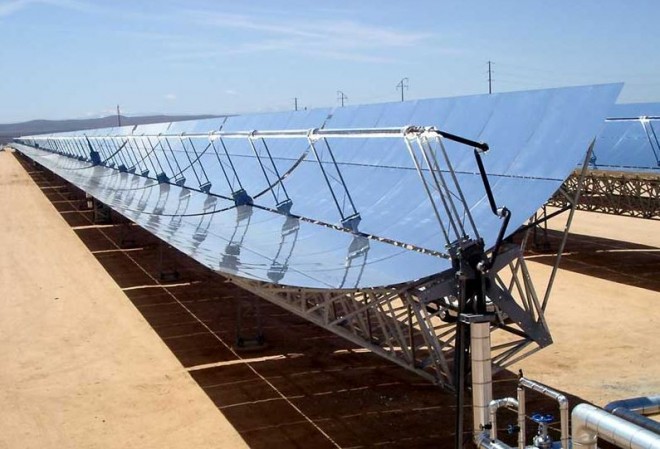 Unlike PV systems, CSP output doesn’t dip when skies are momentarily overcast, and they do not need battery back-up to store energy for nighttime use. The technology works like this: concentrated sunlight hits the mirrors, which heat fluids in a system-wide pipeline, which create steam that, in turn, drives turbines which produce electricity. The Ouarzazate system uses 39-foot-tall parabolic mirrors to focus energy on that pipeline causing fluids to reach temperatures of 739 degrees Fahrenheit. Surplus heat can be stored in a tank of molten salts for use during nighttime or on overcast days; Noor 1 is designed to keep three hours worth of such storage, which presently is a lower cost alternative to battery storage.
Morocco – similar to Jordan – is not an oil producer, and imports about 97 percent of its energy consumption, according to the World Bank. Investment in renewables reduces reliance on foreign suppliers, secures the nation’s long-term energy supply and reduces the nation’s long-term carbon emissions by millions of tons.
The project spearheads Morocco’s ambition to tap its expansive deserts to become a solar superpower, ultimately aiming to offer energy to the Mediterranean Basic and Europe. Solar energy will make up a thirty-three percent of Morocco’s renewable energy supply by 2020, with hydropower and wind power each providing similar shares.
Morocco’s environment minister, Hakima el-Haite, believes that solar energy could have the same impact on the region this century that oil production had in the last.



[…] Source: https://www.greenprophet.com/2016/02/worlds-largest-solar-power-plant-goes-live-in-morocco/ […]
[…] [7] http://www.greenprophet.com/2016/02/worlds-largest-solar-power-plant-goes-live-in-morocco/ […]