Istanbul Municipality Forces Neighborhood To Make Way For Planned Gentrification

tarlabasi

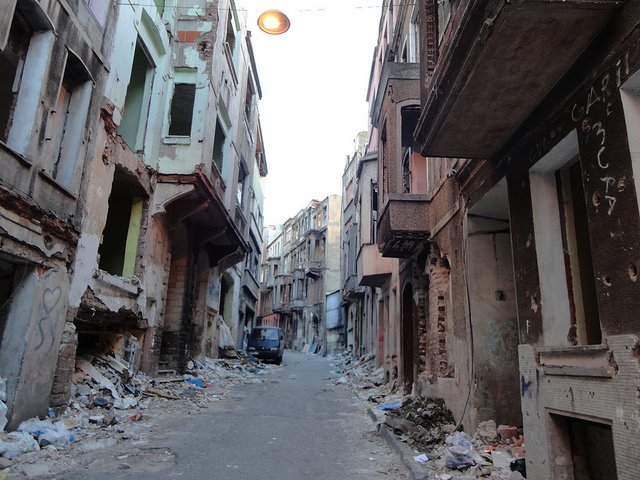
Until a recent urban renewal project that forced most residents out, the neighborhood of Tarlabaşı was home to a diverse array of Istanbul’s minority populations.

In the early 20th century, Tarlabaşı’s winding streets and colorful buildings were home to many of the city’s Greek residents. After violence against the Greek population their mass emigration from Turkey, Roma and Kurdish families moved in. But today, a municipal plan to turn the area into a wealthier, more mainstream neighborhood has forced out most families — and is making life miserable for the residents who refuse to leave, reports independent media agency Bianet.

Forced to collect rainwater for drinking

The Ber family profiled by three Bianet reporters are, like many modern residents of the neighborhood, recent immigrants to Istanbul from Turkey’s eastern regions.

Their house is certified as cultural heritage by the Istanbul municipality. But because it stands in the way of the urban renewal plans, they were offered approximately 35,000 Euros two years ago to leave and move to a different part of the city. For a family of ten, it will be impossible to find a suitable house for that amount on today’s market, so they refused the offer and stayed.

Other Tarlabaşı residents who demanded more money for their houses were personally threatened, so most of them caved in, took the money, and left, says Ali Ber.

The city is already sending the Bers threatening messages. Recently, their water was cut, forcing the family to collect rainwater for drinking. When Ali Ber asked the municipality why, he was simply informed that the family “could have already been evicted.”

More information about the ongoing gentrification of Tarlabaşı can be found at Tarlabaşı Istanbul.

A recurring problem

“Urban renewal” projects in Istanbul rarely renew their target areas.

The neighborhood of Sulukule was also predominantly inhabited by Roma until the city evicted most residents to make way for planned gentrification. By the time an Istanbul court annulled the project last year, saying it violated the area’s heritage protections and the residents’ rights, most houses had already been destroyed and hundreds of new villas were under construction.

In the city’s main square, Taksim, a more high-profile controversial renovation has begun. The Taksim Project, as it’s known, will replace the square’s adjacent park with a reproduction of old military barracks and a shopping mall, and will isolate the square from surrounding neighborhoods by transforming streets into highways.

Construction on the Taksim Project is now underway, despite the protests of many urban planners, environmentalists, and citizens, none of whom were consulted on the project.

:: Bianet

Read more about controversial urban planning in Istanbul:

Controversial Renovation of Istanbul’s Taksim Square Has Begun

Istanbul’s Main Square To Become Lifeless and Isolated In New Urban Plan, Opponents Warn

Istanbul Court Annuls Almost-Finished Roma Neighborhood Project

Image via m-lodious

Julia Harte
Julia Hartehttp://www.greenprophet.com
Julia spent her childhood summers in a remote research station in the Rocky Mountains of Colorado, helping her father with a 25-year-old experiment in which he simulated global warming over a patch of alpine meadow. When not measuring plant species diversity or carbon flux in the soil, she could be found scampering around the forests and finding snowbanks to slide down. Now she is a freelance journalist living in Istanbul, where her passion for the environment intersects with her interest in Turkish politics and grassroots culture. She also writes about Turkish climate and energy policy for Solve Climate News.

Read More

TRENDING

Jordan’s Abdali Souk revives in new setting

Second (and third!) - hand marketplaces offer some of...

Qatari coastal city to double in size but won’t kill the mangroves (photos)

Qatar is spending billions of dollars to prepare for...

Abu Dhabi energy pylons confuse perceptions of “land” use

An awe-inspiring sight, as one departs Abu Dhabi towards...

Taksim Redux? Lebanese Protest Over Loss of Beirut’s Ancient Jesuit Garden Park

In a Middle Eastern city with paltry green space,...

One Dies in Istanbul as Thousands Protest for Turkish Nature Preservation

The social protests currently sweeping through Turkey started with...

Yerukim Forms a New Green Economy Where the Money is Really Green

The Yerukim members who pick up the recyclables get to keep the monetary reward, the public earns "green" bills that can be used in shops, and business owners get to be associated with environmentalism.

Choosing Riyadh over Dubai? What Investors Should Know

Saudi Arabia is deploying capital at unmatched scale to catalyze tourism and advanced industry while rewiring its power-and-water backbone. The investable frontier is widening—especially in renewables, grid storage, water efficiency/desal retrofits, and hospitality operating platforms. Prudent investors will insist on phased delivery, enforceable KPIs (energy, water, biodiversity), and RHQ/zone compliance—while pricing political-economy and reputational risks alongside growth upside.

Sell your cooking oil for biodiesel money

Want to make money on old french fry oil? Sell it.

Qatar Alternative Energy Summit Pairs Investors And Innovators

Alternative energy investors and innovators can meet n' greet in Doha, Qatar March 16 and 17.

Here’s How To Implement The Four Pillars Of Employee Engagement

If you throw a party for your work team and they are vegans, don't make it a barbecue. Know the sustainability values of your team to boost moral and retain good people.

Locals From Rishon Fight IKEA

Big Box stores are a pretty new concept in Israel, and thank God that not every Israeli city wants them in their backyard. A word from someone who has see the beautiful farmland around her hometown Newmarket, Ontario stripped and converted into vulgar strip malls of big box shops: they have no place in a healthy and sustainable town or city.

The Jewish National Fund Meets An Inconvenient Truth

According to the JNF, it has transformed thousands of acres of barren land into green forests in Israel. They state that each person emits about 23 tons of carbon per year, estimating that each tree planted can absorb one ton of carbon in its lifetime. That's a whole lot of trees you'd need to be planting. Could so many fit in Israel?

How to quiet noise from construction in your office

Streets need to be resurfaced in New York but the humming and grinding noise is unsettling. Noise is environmental pollution. 

Popular Categories