The Qatar climate conference this year could very well mark the end of the Kyoto protocol.
Qatar has one of the highest per capita CO2 emission rates in the world, but it will host The United Nations Framework Convention on Climate Change (UNFCCC)’s climate change conference this year – shortly before the Kyoto protocol’s first emission targets expire at the end of this year. Will the Kyoto agreement die? Will it hobble along on a skeleton crew of signatories or will be be reborn in Qatar as the inclusive greenhouse gas reduction agreement first envisioned in Kyoto 15 years ago?
The UNFCCC Conference of the Parties (COP 18) conference will take place between November 26 and December 7th 2012 in Doha, Qatar. The Kyoto agreement is facing even more challenges than it did during the 2011 climate conference in Durban. But there is some hope that the Qatar climate conference will spark off the second phase of the Kyoto protocol agreement even as Kyoto’s 2012 deadline approaches.
A Brief History of the Kyoto Agreement
The Kyoto protocol agreement was first signed on December 11, 1997. One hundred and ninety one countries went on to ratify the agreement and committed themselves to various greenhouse gas emission targets. The targets were to be measured in comparison to a baseline year, usually 1990, and varied according to circumstances of individual countries including industrial development and wealth. So-called Annex I countries committed to a target which would be measured at the end of 2012 in preparation for the next phase of the agreement. As this deadline approaches, the International Energy Agency (IEA) has made a pre-release version of CO2 Emissions from Fuel Combustion 2012 – Highlights available. This annual publication contains estimates of CO2 emissions by country, region and sector from 1971 to 2010.
Now for the Complicated Part
Anthropogenic greenhouse warming is controversial, but at least this debate breaks down to a simple yes or no answer. The question of whether a nation is making progress towards its Kyoto protocol greenhouse gas (GHG) emission target is somewhat more complicated. Some countries such as the United Kingdom were committed to GHG reductions from a baseline year (typically 1990.) Others committed to a reduction in the increase of greenhouse gasses from a baseline year. Other countries (e.g. China) were not required to commit to a greenhouse gas emission target at all over this first measurement period.
To complicate matters further, the Clinton administration signed the agreement after the US senate had unanimously voted for the Byrd-Hagel resolution which rendered this signature meaningless. This resolution said that the Senate would not support any climate ratification that excluded the developing world or that could harm the US economy. President George W. Bush clarified this position with a terse withdrawal from the Kyoto protocol in the spring of 2001.
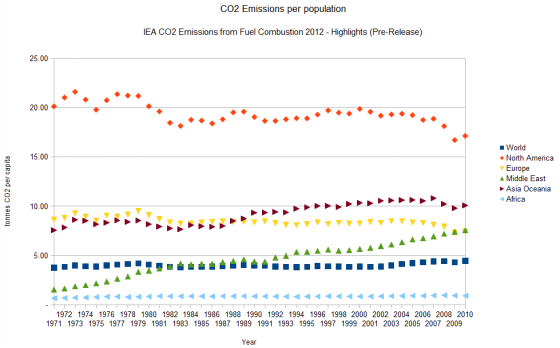
CO2 Emissions per capita show a drop in the high baseline of North America. Per capita carbon dioxide emission in the Middle East and Asia/Oceania has surpassed the global average as well as the European average.
Others Threaten to Drop out of the Game
Canada, Russia and Japan announced their intention to withdraw from the Kyoto agreement. Russian Prime Minister Dmitry Medvedev explained that Russia had received no benefit from the Kyoto protocol. And Japan, the birthplace of the Kyoto agreement, has had to adjust its priorities as 48 of its 50 nuclear reactors were shut down after the March 2011 tsunami and Fukushima meltdown. Even New Zealand, a progressive country with enormous potential for geothermal and hydro-power, is considering dropping the Kyoto agreement as the carbon credits it had hoped to benefit from have been devalued by the Kyoto exodus.
The Silver Lining Behind Kyoto’s Cloudy History
While the best hopes of the Kyoto agreement seem to be fading, there is a silver lining behind the cloud that hangs over this historic agreement. The European Union met its reduction target and went on to reduce its carbon emissions by an additional 8.8%. After carbon trading adjustments by Spain, Luxemburg, Italy and seven other EU nations, only Italy is expected to fall short of its target. Germany, Denmark, Sweden and the UK performed especially well proving that GHG reduction is possible and that it is compatible with the strongest economies in Europe. It must have come as a terrible embarrassment that after years of political wrangling, excuses and gnashing of teeth over the Kyoto agreement that the US came nearer to its unratified Kyoto target than some signatories.
The Qatar Climate Conference: The End or a Turning Point?
The Qatar conference comes at a critical time in the Kyoto agreement. EU members have proven that GHG reduction and prosperity can go together. The 700% rise in oil prices since 1997 means GHG is no longer the only compelling reason for weaning ourselves from fossil fuels. Technology and climate science have come a long way since 1997. China developed rapidly since 1997 and its GHG emissions rose as much as 10% annually during parts of the last decade.
China now leads the world in carbon emissions so its carbon footprint can no longer be written off as inconsequential. The United States has seen that without its participation and leadership, Kyoto did not follow the same highly successful trajectory as the Montreal protocol on CFC emissions did.
The Qatar climate conference could very well mark the end of the Kyoto protocol. It could be the beginning of Kyoto 2.0. But it could also be the beginning of something so innovative and progressive that it deserves a new name. How many nations will fully participate in the Doha Qatar Protocol?
Graphs by Brian Nitz for Green Prophet using data from the International Energy Agency (IEA) pre-release version of CO2 Emissions from Fuel Combustion 2012 – Highlights