

 Investing in African Agriculture
This past April, MASHAV, Israel’s agency for international development cooperation, signed a memorandum of understanding with the United States Agency for International Development (USAID). The memorandum is aimed at addressing food security through partnerships with farmers in Uganda, Tanzania, Ethiopia and Rwanda. Israel will contribute expertise in irrigation, water technologies, agricultural production and climate change.
Israeli experts have experience with desertification and hostile, dry environments. The Negev Desert makes up around 60 percent of Israel’s total landmass. Yet, since its establishment in 1948, Israel has managed to create a thriving agricultural economy. This experience could be particularly valuable in African countries with scarce water resources.
 According to reports by Agri-pulse Communications, an American industry media group, Israel’s agricultural sector annually contributes $5 billion to the nation’s GDP and exports over $2 billion worth of fresh and processed products. The Israeli Ministry of Foreign Affairs estimates that Israel produces 93 percent of its domestic food requirements.
“We were a developing country and now we are a developed country,” said Daniel Carmon, head of MASHAV. “We know how to do it.”
Technological Innovation for Poverty Alleviation (TIPA) is one of MASHAV’s primary programs in Africa. It helps small-scale farmers install water-saving irrigation systems. While MASHAV has similar programs in Benin, Kenya, Ethiopia and Niger, TIPA is devoted primarily to farmers in Senegal, where 75 percent of the population is involved with farming.
“We especially want to devote resources to women,” said Carmon. In Sub-Saharan Africa women make up an estimated 70 to 80 percent of small-holder farmers. MASHAV is also implementing major, joint agricultural projects dealing with citrus in Ghana.
Over the past five years, MASHAV experienced what Carmon called a revolutionary change. “We used to have a menu of activities and trainings to choose from. Now we have demand-driven activity,” said Carmon. “We shouldn’t tell the developing world what they need. We need to listen. Now we ask what is needed first.”
But MASHAV represents only a tiny fraction of Israel’s annual $14 million foreign assistance budget. Carmon stressed MASHAV’s emphasis on developing Africa’s human capacity.
“We don’t bring money to the table. We don’t bring high-tech where high-tech is not needed,” he said. “Israelis share their experience, roll up their sleeves and work alongside the people on the ground.” Over 100,000 African professionals have participated in MASHAV’s training activities. In addition, private Israeli businessmen, such as Gilad Millo in Kenya, are spearheading entrepreneurial ventures in African agriculture and education.
Corporate Interests
Many skeptics believe that Israel’s recent surge of diplomatic attention devoted to Africa has self-serving motivations. Among them is President of the New Israel Fund and former Deputy Speaker of the Knesset, Naomi Chazan. She also formerly served as a visiting scholar and lecturer for both the University of Ife in Nigeria and the University of Ghana.
Chazan described the recent developments as a mild shift. “The shift began when Avigdor Lieberman [Israel’s Foreign Minister] visited Africa,” she said. In 2010 and 2011 Israel enjoyed the fastest economic growth in the developed world. African markets were only marginally affected by the crisis in the west. Lucrative African markets have gained obvious appeal.
Chazan has been highly critical of private Israeli businesses operating in Africa, especially those involved in the purchasing and managing of natural resources, warning against the privatization of Israeli involvement in the region. Her writings also denounce the Ministry of Foreign Affairs, arguing that its Africa division is woefully understaffed. For example, the Embassy of Israel to Cote d’Ivoire is also responsible for relations with Liberia, Togo, Burkina Faso and Benin.
In 2011, Global Witness, an international NGO established to publicize links between natural resource exploitation, conflict, poverty and corruption, alleged that Zimbabwe’s secret police, the Central Intelligence Organization (CIO), received clandestine financing from individuals linked to corporations owned by Israeli business moguls, including Lev Leviev, his brother, Moshe Hallak, and Eliezer Nefussy, an Israeli living in Namibia. Global Witness reports denounced recent purchases of vast natural resources, predominately diamonds and oil, in both Zimbabwe and the Democratic Republic of Congo.
National Interests
Israel’s economic future depends on stability in Africa. The Horn of Africa – including Ethiopia, Kenya, both North and South Sudan – influences the shipping lanes to Eilat in southern Israel. Israel is the only country in the world land-linked to the African continent. “Events in North Africa obviously affect Israel,” said Granot. In Febuary 2012, pollution from North Africa drifted towards the Jewish state and shut down Israeli airports for two weeks.
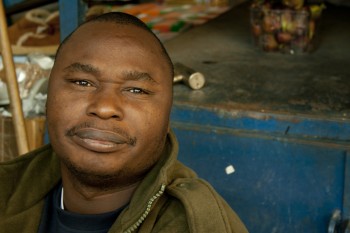
Africans are now also part of Israel’s human landscape. Over the past two decades, Israel has absorbed over 120,000 immigrants from Ethiopia and at least 60,000 asylum-seekers, predominately from North Sudan and Eritrea.
“African crises are no longer happening far away,” said Schler. “Israel can’t afford to ignore problems in Africa.”
According to Granot, both Mubarak and Gaddafi were obstacles to establishing deeper connections in Africa. Recent revolutions have created new opportunities. “We hope to reestablish those ties between Israel and African nations,” said Granot.
There are currently over 1,000 university students in Israel taking courses in African studies, what Schler referred to as a revival.
“I’m also interested in what role Africa will play in Israel’s future,” said Schler.
“What can we learn from Africa?”
Images from Tel Aviv via Idit Keren, image of African farmer via Shutterstock
For more on Israel’s increasing influence throughout Africa read:
Israel Strengthens Environmental Ties to Africa: Part 1




This is reminiscent of western interest in Africa, whereby they nudge farmers to grow biofuel crops and export them to the west. Isn’t Israel simply sourcing some of its commercial food production to Africa, and taking advantage of cheap labor there? As a Lebanese college student I had some African professors, and like Lebanese professors they insisted that useful solutions are always produced locally, by the locals. There is also no free lunch, there are no favors. A favor from another country requires you serving their profits in return, at your own country’s expense. African agri-engineers, inventors and the such can advance their own agriculture once Israel, the west and the Saudis stopped backing Bana Republics in Africa. These corrupt regimes sabotage all progress.