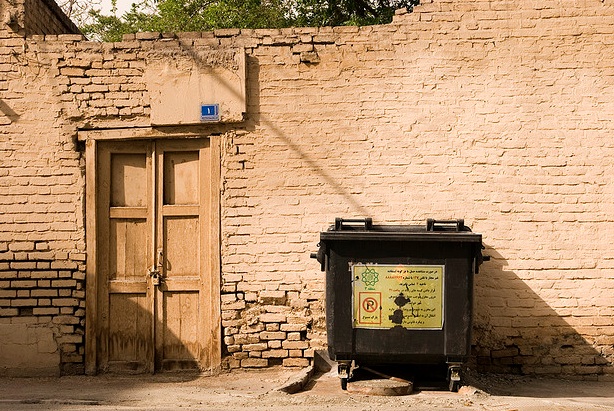
High Waste Generation and Low Level Recycling in Iran

Iranians throw our about a half kilo of trash, per person, per day. That’s high for a developing country.

There is a growing rate of waste generation in Iranian cities. According to the R&D Deputy of the Environment and Sustainable Development Committee of Municipality of Tehran, every resident of Tehran produces 320 kilograms of solid waste per year. In other words, every person produces 6 times more trash than his/her own body weight. This amount has had a growth of 1.1 percent between the year 2001 and 2006. Also the average waste generation in Esfahan, the third biggest city of Iran, is between 0.55 to 0.6 kilogram of trash per person, per day.

Although this statistic sounds worrying, there is still a huge difference between waste production in Iran and in the more developed and western countries. In America it’s about twice the amount of Iran. In 2000, the record in municipal waste generation in the US was 760 Kgs per person per year; Australia  was 690 Kgs, the United Kingdom was 560 Kgs and for comparison Japan was 410 Kgs. But while the waste generation (Kg/capita/day) is estimated to be 0.4 to 0.9 Kg/per capita/per day in low-income countries, 0.5 to 1.1 in medium-income countries, and 1.1 to 5 for high-income countries, the figure is 0.66 for Iran. Quite high. Of course the statistics seems reasonable but using recycling methods and the percent of recycled waste in countries like Germany and Japan is quite different than in low waste generating countries. Strategies like paying for transferring the trash in Japan pushes people to recycle the trash on their own. Not the case in Iran.

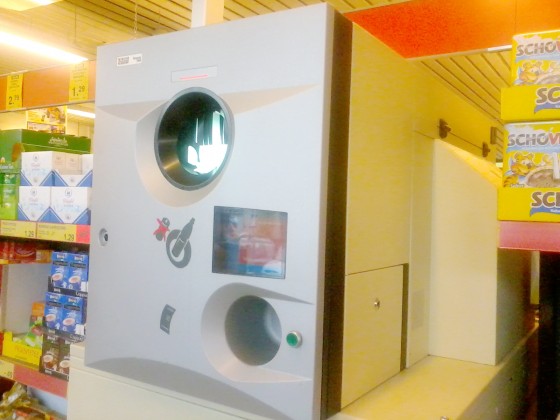
Measures are done to recycle the urban waste of Tehran in a sustainable way. Yet, 90% of the waste is buried and only 2% is recycled. There is still a long way to reach the percentage of recycling in countries like Austria with about 60% and United Kingdom with 17.7%. Countries like Iran need more solutions for recycling urban waste like the bottle recycler I’ve pictured below.
Read more on recycling in the Middle East:

Canadian Man Revolutionizes Sharjah, UAE With Recycling

Lebanon Launches New Recycling Campaign, “Think Before You Throw”

Above image via parapet

Mehrdad Parsipour
Mehrdad Parsipourhttp://www.greenprophet.com
Mehrdad Parsipour is an urban researcher who is based in Germany. He is originally from Iran and is interested in the traditional urbanism and architecture of Iran and Middle East. Mehrdad’s other research interests are western traditional urban development trends, Islamic cities, and sustainable urban forms, and finally the environment. Since 1997 he has been working in the field of civil engineering, and also urban and regional planning.

Read More

2 COMMENTS

TRENDING

Weston Higginbotham found dead in a Kyoto forest: is climate anxiety part of the story?

In some ways, Weston has become a symbol of a generation wrestling with environmental and technological anxiety. Friends and family described him as deeply concerned about environmental issues. Reports also noted that he questioned the growing role of artificial intelligence in daily life, even reportedly disagreeing with his mother about her use of AI.

Can Scientists Predict Coral Bleaching Before It Happens?

Now researchers at the Woods Hole Oceanographic Institution (WHOI) in the US say they have developed a way to predict coral bleaching five to six months before it occurs, potentially giving reef managers enough time to intervene and save vulnerable corals.

Japan’s packaging turns black and white from Iran oil shortage

Japan is a country that builds 100-year companies; while...

Make paper mache with flowers to create stunning vase

There’s something quietly beautiful about what Rebloom Studio is doing, and it starts with waste. At wholesale flower markets, mountains of unsold blooms are tossed out at the end of each cycle. Perfect flowers, just not sold in time. Most of them are burned or dumped. Rebloom takes that moment and turns it into something else.

Japan wants to build a solar panel ring around the moon

Unlike solar power on Earth, which is limited by night cycles, weather, and seasons, the Moon offers something close to uninterrupted exposure to the Sun. By placing solar infrastructure in orbit or along the lunar surface, engineers could generate continuous clean energy at a scale that may exceed global electricity demand,  the Japanese scientists say.

Locals From Rishon Fight IKEA

Big Box stores are a pretty new concept in Israel, and thank God that not every Israeli city wants them in their backyard. A word from someone who has see the beautiful farmland around her hometown Newmarket, Ontario stripped and converted into vulgar strip malls of big box shops: they have no place in a healthy and sustainable town or city.

The Jewish National Fund Meets An Inconvenient Truth

According to the JNF, it has transformed thousands of acres of barren land into green forests in Israel. They state that each person emits about 23 tons of carbon per year, estimating that each tree planted can absorb one ton of carbon in its lifetime. That's a whole lot of trees you'd need to be planting. Could so many fit in Israel?

How to quiet noise from construction in your office

Streets need to be resurfaced in New York but the humming and grinding noise is unsettling. Noise is environmental pollution. 

EarthX and a blueprint for sustainable investing

Trammell S. Crow, a Dallas-based businessman and father of four, is focusing his efforts on impact investing, and media that focuses on saving the planet through EarthX.

Mining Afghanistan’s Mineral Discoveries Similar to Avatar

Now that American forces in Afghanistan are commemorating the longest period of any war that America has been involved in, including the 1965-73 Vietnam War, the recent discoveries of large and extremely valuable mineral and metal deposits may finally bring to light a reason to continue the presence of US fighting forces in this war torn and backward country.

From Pilot Plant to Global Stage: How Aduro Clean Technologies’ 2026 Expansion Signals a Turning Point for Chemical Recycling Investors Like Yazan Al Homsi

The company's Next Generation Process (NGP) Pilot Plant in London, Ontario, has officially moved into initial operating campaigns, generating the kind of structured, repeatable data that separates laboratory promise from commercial viability.

Nobul’s Regan McGee on Shareholder Value: “Complacency Is the Silent Killer” 

Why the governance framework designed to protect shareholders so...

Should You Invest in the Private Market?

startustartup Unlike public stock exchanges, which offer daily trading, strict...

Popular Categories