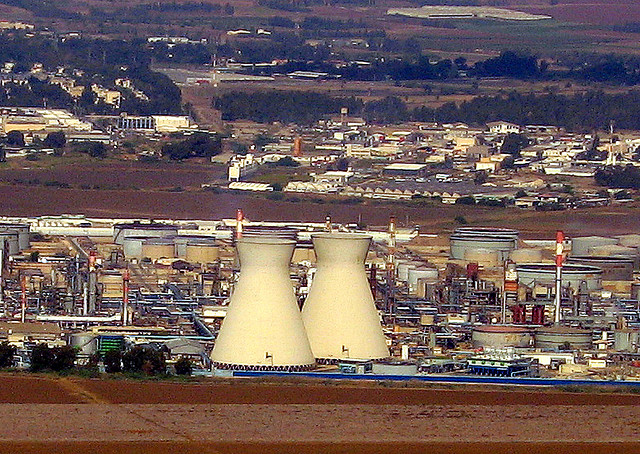

Three Employees Killed In Haifa Oil Refinery Gas Leak

haifa-oil-refineriesThree Oil Refineries Ltd. employees killed as a result of “negligence?”

An explosion at Israel’s largest oil refinery resulted in a gas leak that killed three people last week. Located in the bay area of Haifa, Oil Refineries Ltd. (ORL) has an annual capacity of 9.8million tons of crude oil and a daily maximum capacity of 196,000 barrels. Though its facilities are considered to be “state-of-the-art” last week Tuesday something went terribly wrong, resulting in the death of three people under thirty-five including two cousins. An environment ministry official told Haaretz that he has no doubt that the accident was caused by negligence.

When the Israeli paramedics arrived at the scene of the accident last Tuesday evening, four people lay unconscious, according to Haaretz. Two were brought down from an elevated installation. Two of the victims died that evening, while the third died in the hospital the following day.

ORL’s owner released the following statement:

“Refinery installations have been shut down over the last month for scheduled work. As part of this, a number of workers approached an installations containing gas, wearing full protective gear, including masks. For a reason that is not yet clear, they were affected by the flow of gas.”

But Shlomo Katz, Haifa’s district manager of the Ministry of Environment was less equivocal. He explained that the event had to have been caused by negligence and that the employees were not working according to protocol. The accident could have been avoided if the employees had worked with a closed security system, he told Haaretz.

ORL had been closed for a month prior to the explosion.

The gases leaked as a result of the explosion included Hydrogen sulfide (H2S).

:: Haaretz

More oil news from Israel:
NGO Takes IEI/Genie Oil Shale Plan To Israel’s High Court

Israeli Citizen Group “Save Adullam” To Fight Oil Shale Plans

Tafline Laylin
Tafline Laylinhttp://www.greenprophet.com
As a tour leader who led “eco-friendly” camping trips throughout North America, Tafline soon realized that she was instead leaving behind a trail of gas fumes, plastic bottles and Pringles. In fact, wherever she traveled – whether it was Viet Nam or South Africa or England – it became clear how inefficiently the mandate to re-think our consumer culture is reaching the general public. Born in Iran, raised in South Africa and the United States, she currently splits her time between Africa and the Middle East. Tafline can be reached at tafline (at) greenprophet (dot) com.

Read More

TRENDING

Russia’s Arctic superdeep oil drill revives debunked ‘infinite oil’ theory

Russia is reviving the controversial abiotic oil theory with plans to drill superdeep holes in the Arctic. While small amounts of abiotic methane exist deep within the Earth, most geologists reject the idea that commercial oil reserves originate from non-biological processes, raising questions about the environmental cost and scientific value of the project.

Tigris River oil spill highlights Iraq’s environmental oversight and our addiction to oil

A fresh oil spill in the Tigris River, filmed by an Iraqi university student, has reignited concern over Iraq's polluted waterways. From ancient Mesopotamia to modern Basra, the country's dependence on oil has come at a steep environmental and human cost, with activists warning that unchecked contamination is putting ecosystems and public health at risk.

The fossil fuel problem hiding in your wardrobe

The fuel pumps don't lie. When oil prices spike,...

Japan’s packaging turns black and white from Iran oil shortage

Japan is a country that builds 100-year companies; while...

Oil pollution in Basrah’s soil is 1,200% higher than it should be

Soil pollution levels in parts of Basra are 1,200% to 3,300% higher than those typically measured in cities like Toronto or New York, according to new comparative soil data. It's getting into water.

The Essential Guide To Sustainability in Project Management

Sustainability is an approach where businesses and individuals balance the environmental, social, and economic aspects of a project such that current and future stakeholders are not overburdened with the impacts of the project in future.

Yerukim Forms a New Green Economy Where the Money is Really Green

The Yerukim members who pick up the recyclables get to keep the monetary reward, the public earns "green" bills that can be used in shops, and business owners get to be associated with environmentalism.

Choosing Riyadh over Dubai? What Investors Should Know

Saudi Arabia is deploying capital at unmatched scale to catalyze tourism and advanced industry while rewiring its power-and-water backbone. The investable frontier is widening—especially in renewables, grid storage, water efficiency/desal retrofits, and hospitality operating platforms. Prudent investors will insist on phased delivery, enforceable KPIs (energy, water, biodiversity), and RHQ/zone compliance—while pricing political-economy and reputational risks alongside growth upside.

Sell your cooking oil for biodiesel money

Want to make money on old french fry oil? Sell it.

Qatar Alternative Energy Summit Pairs Investors And Innovators

Alternative energy investors and innovators can meet n' greet in Doha, Qatar March 16 and 17.

Here’s How To Implement The Four Pillars Of Employee Engagement

If you throw a party for your work team and they are vegans, don't make it a barbecue. Know the sustainability values of your team to boost moral and retain good people.

Locals From Rishon Fight IKEA

Big Box stores are a pretty new concept in Israel, and thank God that not every Israeli city wants them in their backyard. A word from someone who has see the beautiful farmland around her hometown Newmarket, Ontario stripped and converted into vulgar strip malls of big box shops: they have no place in a healthy and sustainable town or city.

The Jewish National Fund Meets An Inconvenient Truth

According to the JNF, it has transformed thousands of acres of barren land into green forests in Israel. They state that each person emits about 23 tons of carbon per year, estimating that each tree planted can absorb one ton of carbon in its lifetime. That's a whole lot of trees you'd need to be planting. Could so many fit in Israel?

Popular Categories