Surprise ! Grand Opening of First Masdar City Building

The carbon-neutral Masdar City seems to have been a concept for forever, it seems. In my mind, it has long been filed under “noble theory.” So I was surprised to get an email from Foster+Partners today.

The Architects responsible for the Masdar Institute matter-of-factly announced the opening of the first building in the visionary city-to-be this morning.  Yet, as one of the first town-sized developments in the world to attempt real carbon neutrality – Masdar City has long come up against all the problems inherent in undertaking such an ambitious plan.

The first building houses the Masdar Institute: the post-grad students will be the city’s first resident community.

Foster + Partners’ Masdar Institute returns to the ancient lessons of passive solar design that has evolved over centuries of traditional Arabian architecture, invents some completely new ones, and then adds renewables for a three-pronged carbon footprint reduction.

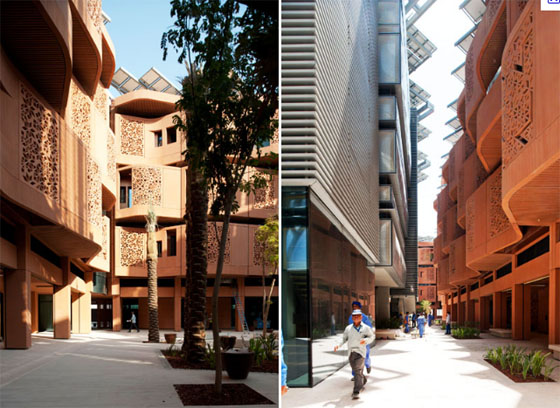
The completely novel passive solar aspects are brilliant, if a little strange looking, at first sight. The skyscrapers are built uncomfortably close to each other. For someone used to seeing skyscrapers at least a city-street-apart from each other, as in most major cities, these two pictured above, for example, are built jarringly close to each other. But notice how this same proximity creates a wind-cooled canyon.

Walking here would be like walking through a canyon. It will only get direct sun for perhaps an hour while the sun is directly overhead. The wind-tunnel effect common to canyons will add even more passive cooling. Bliss. This is lesson one in how to build a city to withstand the even more catastrophic heat that the Middle East is due to get, with climate change.

Reverting to the traditional city building in the region, which is much more eco friendly than the new oil-fueled fantasies springing up in much of the Arab world, it is designed to be a walkable city, along the lines of the traditional Casbar.

Windows in the residential buildings are protected by a contemporary reinterpretation of mashrabiya, a type of latticed projecting oriel window, with patterns of light and shade perforations based on traditional Islamic architecture. Horizontal and vertical fins and brise soleil shade the laboratories of the institute.

The unique material Foster + Partners uses in their signature wavy shape is a sustainably developed, glass-reinforced concrete that is colored red by the use of local sand,  giving it a clay-like appearance. The local sand in the concrete mix integrates it with its desert context and minimizes maintenance: no painting.

A 5,000 square meter roof-mounted photovoltaic array will provide 30% of the sprawling four story Masdar Institute’s electricity. Solar hot water receptors will provide 75% of the hot water needs of the building. Altogether, though, a 10 megawatt solar field within the total site will provide 60% more energy than is consumed by the Masdar Institute, with the remaining energy  fed back to the Abu Dhabi grid.

::Foster + Partners

More Masdar Stories:

GE Ecomagination Centre in Masdar City

Studied Impact’s Power Plant Fit For Living

Masdar Awards $600 Million Contract for ‘World’s Largest’ Thermal Solar Plant in UAE

Read More

TRENDING

AI data centers are triggering panic, instead of cleantech opportunities

AI may unintentionally become the economic engine that finally modernizes America’s aging grid. California is experiencing a massive AI data center boom, ranking 3rd in the U.S. with 227 operating centers and 54 more in development as of April 2026, according to Stanford.

Make paper mache with flowers to create stunning vase

There’s something quietly beautiful about what Rebloom Studio is doing, and it starts with waste. At wholesale flower markets, mountains of unsold blooms are tossed out at the end of each cycle. Perfect flowers, just not sold in time. Most of them are burned or dumped. Rebloom takes that moment and turns it into something else.

Korean researchers create battery from greenhouse gases

Professor Ji-Soo Jang, in collaboration with Professor Taekwang Yoon of Ajou University and Professor Hansel Kim of Chungbuk National University, has developed a novel energy device that generates electricity during the process of capturing greenhouse gases.

Should You Invest in the Private Market?

startustartup Unlike public stock exchanges, which offer daily trading, strict...

EU startup aiming to generate energy on moon villages

Stepping up to democratize the moon is an EU-funded company, Deep Space Energy, which has just raised more than $1 million USD as a seed fund to help it create energy generators on the moon.

How to quiet noise from construction in your office

Streets need to be resurfaced in New York but the humming and grinding noise is unsettling. Noise is environmental pollution. 

EarthX and a blueprint for sustainable investing

Trammell S. Crow, a Dallas-based businessman and father of four, is focusing his efforts on impact investing, and media that focuses on saving the planet through EarthX.

Mining Afghanistan’s Mineral Discoveries Similar to Avatar

Now that American forces in Afghanistan are commemorating the longest period of any war that America has been involved in, including the 1965-73 Vietnam War, the recent discoveries of large and extremely valuable mineral and metal deposits may finally bring to light a reason to continue the presence of US fighting forces in this war torn and backward country.

From Pilot Plant to Global Stage: How Aduro Clean Technologies’ 2026 Expansion Signals a Turning Point for Chemical Recycling Investors Like Yazan Al Homsi

The company's Next Generation Process (NGP) Pilot Plant in London, Ontario, has officially moved into initial operating campaigns, generating the kind of structured, repeatable data that separates laboratory promise from commercial viability.

Nobul’s Regan McGee on Shareholder Value: “Complacency Is the Silent Killer” 

Why the governance framework designed to protect shareholders so...

Should You Invest in the Private Market?

startustartup Unlike public stock exchanges, which offer daily trading, strict...

How to build a 100-year-company

Kongō Gumi is a Japanese construction company, purportedly founded in 578 A.D., making it the world's oldest documented company. What can we learn about building sustainable businesses from them?

How AI Helps SaaS Companies Reduce Repetitive Customer Support Work

SaaS products are designed for large numbers of users with different levels of experience, and also in renewable energy.

Popular Categories