Arab World and Med Region More Vulnerable to Climate Change

climate change arab worldIf Egypt’s Nile Delta is flooded by rising seas, half of its population will be at risk.

We’ve written about the topics dealing with the effects of climate change in the Middle East before on Green Prophet, and will undoubtedly write about it again. The sad truth is that the Middle East and much of the Mediterranean region, is becoming more vulnerable to the effects of climate change. Whether this involves severe water problems, often caused by government apathy; wheat and other grains dying from rising temperatures and less rainfall, or an increase in bed bug biting in  the UAE. The Arab World is becoming more vulnerable to the effects of climate change.

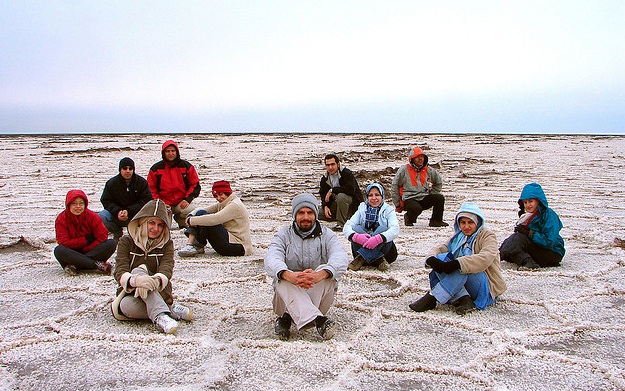
Dry lake bed in southern Cyprus

The seriousness of climate change in the Arab World was pointed out recently in an article in the news site ArabBusiness.com, in which it was noted that powerful dust storms in Iraq, freak floods wreaking havoc in Saudi Arabia and Yemen, and rising sea levels eroding Egypt’s coast are all sure signs that countries in the Middle East are some of the most vulnerable to the effects of climate change.

This is certainly nothing new as the Middle East has never been an area that has received ample rainfall. With one of the fastest growing populations in the world, especially in countries like Egypt, people living in the Arab World by the year 2015 will have to survive on less than 500 cubic meters of water a year each, against a world average exceeding 6,000 cubic meters per head, according to Mohamed El-Ashry, former head of the Global Environment Facility.

Five hundred cubic meters of water per person per annum is barely enough to survive on, much less maintain a decent quality of life. Although desalination is now widely used in Saudi Arabia, and in the Gulf States, especially in Dubai and Abu Dhabi, strict measures of water conservation and recycling, such as those now being considered in Abu Dhabi will now have to become the norm.

After all, if a small country like Israel, with a population of 7.5 million can reclaim 75% of its sewage waste water then why can’t Arab countries do the same? The ravages of climate change will not go away soon; and the sooner that Arab countries take more measures to conserve water, the better off they will be.

According to a UN Development Program (UNDP) research paper, as quoted in Arabianbusiness.com:

“For a region that is already vulnerable to many non-climate stresses, climate change and its potential physical and socio-economic impacts are likely to exacerbate this vulnerability, leading to large-scale instability.”

Hotter, drier weather already worsens water scarcity in the Middle East. And unless more effort is made by countries in this region, increased political instability and mass population migrations will soon become the norm in the Arab World.

::Almasryalyoum

Read more on Climate Change affecting the Middle East:

12 Million Egyptians to be affected by climate Change

Climate Change Killing the First Crops in the Cradle of Civilization

Is Middle East Taking Climate Change Seriously?

Arab World in Water Crises Reports Jordanian Journalist


Maurice Picow
Maurice Picowhttps://www.greenprophet.com/
Maurice Picow grew up in Oklahoma City, U.S.A., where he received a B.S. Degree in Business Administration. Following graduation, Maurice embarked on a career as a real estate broker before making the decision to move to Israel. After arriving in Israel, he came involved in the insurance agency business and later in the moving and international relocation fields. Maurice became interested in writing news and commentary articles in the late 1990’s, and now writes feature articles for the The Jerusalem Post as well as being a regular contributor to Green Prophet. He has also written a non-fiction study on Islam, a two volume adventure novel, and is completing a romance novel about a forbidden love affair. Writing topics of particular interest for Green Prophet are those dealing with global warming and climate change, as well as clean technology - particularly electric cars.

Read More

TRENDING

Understanding Food Production: Karl Studer on the Urban-Rural Knowledge Gap

Karl Studer occupies an unusual position in American business. As President of Quanta Services, he oversees electrical infrastructure operations across the United States, Canada, and Australia, managing thousands of employees and multibillion-dollar projects.

Wave wind energy for Nvidia’s next AI energy boom?

As AI factories consume unprecedented amounts of electricity, NVIDIA is looking beyond chips and data centers to the ocean. The company recently spotlighted Israel's Eco Wave Power and its wave energy projects in Jaffa and Los Angeles, highlighting how AI, digital twins and renewable energy can work together to meet future power demands. The collaboration reflects a growing realization that the future of artificial intelligence may depend as much on clean energy infrastructure as it does on computing power.

Weston Higginbotham found dead in a Kyoto forest: is climate anxiety part of the story?

In some ways, Weston has become a symbol of a generation wrestling with environmental and technological anxiety. Friends and family described him as deeply concerned about environmental issues. Reports also noted that he questioned the growing role of artificial intelligence in daily life, even reportedly disagreeing with his mother about her use of AI.

Billie Eilish’s Mom Takes the Stage at Hollywood Climate Summit — But Does Hollywood Still Care About Climate Change?

Hollywood once promised to help save the planet. Leonardo DiCaprio warned of climate catastrophe from awards stages. Celebrities flew to climate conferences. Studios pledged greener productions. Streaming platforms rushed to commission environmental documentaries. But in 2026, with the aftermath of wildfires, heatwaves and floods becoming routine, a question lingers: Does Hollywood still care about climate change?

Can Scientists Predict Coral Bleaching Before It Happens?

Now researchers at the Woods Hole Oceanographic Institution (WHOI) in the US say they have developed a way to predict coral bleaching five to six months before it occurs, potentially giving reef managers enough time to intervene and save vulnerable corals.

Yerukim Forms a New Green Economy Where the Money is Really Green

The Yerukim members who pick up the recyclables get to keep the monetary reward, the public earns "green" bills that can be used in shops, and business owners get to be associated with environmentalism.

Choosing Riyadh over Dubai? What Investors Should Know

Saudi Arabia is deploying capital at unmatched scale to catalyze tourism and advanced industry while rewiring its power-and-water backbone. The investable frontier is widening—especially in renewables, grid storage, water efficiency/desal retrofits, and hospitality operating platforms. Prudent investors will insist on phased delivery, enforceable KPIs (energy, water, biodiversity), and RHQ/zone compliance—while pricing political-economy and reputational risks alongside growth upside.

Sell your cooking oil for biodiesel money

Want to make money on old french fry oil? Sell it.

Qatar Alternative Energy Summit Pairs Investors And Innovators

Alternative energy investors and innovators can meet n' greet in Doha, Qatar March 16 and 17.

Here’s How To Implement The Four Pillars Of Employee Engagement

If you throw a party for your work team and they are vegans, don't make it a barbecue. Know the sustainability values of your team to boost moral and retain good people.

Locals From Rishon Fight IKEA

Big Box stores are a pretty new concept in Israel, and thank God that not every Israeli city wants them in their backyard. A word from someone who has see the beautiful farmland around her hometown Newmarket, Ontario stripped and converted into vulgar strip malls of big box shops: they have no place in a healthy and sustainable town or city.

The Jewish National Fund Meets An Inconvenient Truth

According to the JNF, it has transformed thousands of acres of barren land into green forests in Israel. They state that each person emits about 23 tons of carbon per year, estimating that each tree planted can absorb one ton of carbon in its lifetime. That's a whole lot of trees you'd need to be planting. Could so many fit in Israel?

How to quiet noise from construction in your office

Streets need to be resurfaced in New York but the humming and grinding noise is unsettling. Noise is environmental pollution. 

Popular Categories