

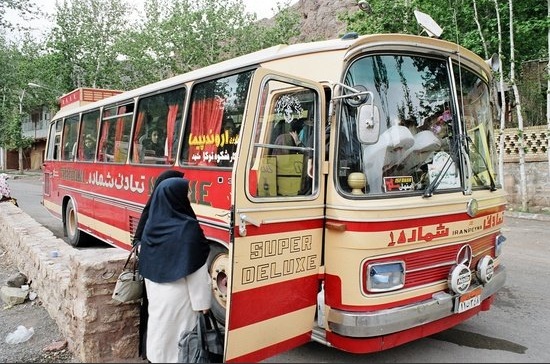
 A look at the air pollution in Esfahan, Iran. Cars and the clay brick industry are some of the biggest problems. The solution? Take the bus.
In 2005 it was announced for the first time that the air pollution of Esfahan, the third big city of Iran, was in an emergency situation. Since then Esfahan has experienced a quick increase in air pollution. Today this city is the most polluted Iranian city after Tehran. The number of the “clean air” days in Esfahan was only 11 days last year.
Where is the pollution coming from? Seventy to 75 percent of this pollution is caused by automobiles. So this has caused more strict control over emissions of the vehicle motors. Yearly checking of the car engines are done by special centers. This has recently been compulsory for car owners.
Apart from the automobiles, another reason of the air pollution of the city is the industry. While the industrial centers should be located outside a 50-kilometers radius of the city, still many centers are active inside the illegal zone.
According to Elaheh Mousavi, an environmental journalist in Iran, 70 percent of the clay bricks that are used in construction of the country are produced in Esfahan. These bricks are produced in kilns that use surface mud and lime as raw materials. Baking these materials in a 25 kilometers distance from the city, sends a daily amount of 1.5 to 2 tons of pollutant to the air of the city.
Elaheh also mentions the high percentage of sulfur in the automobile fuels as a main source of pollution. This amount of sulfur is 50 times more than the world standards.
It is likely that a traffic plan like Tehran’s be carried out in Esfahan in the near future. Such ideas can be heard from time to time from the transportation authorities. One of them is the Mostafa Nourian from the Municipality of Esfahan who believes that the central streets of Esfahan should be closed to the personal cars, and the only automobiles that can pass through them should be the public ones like buses and taxis.
This is similar to the traffic plan of Tehran, which has been executed in different levels since 1979 over the city center of Tehran. One of the reasons for executing such a plan in Tehran was the air pollution of the city less extreme then than now.
The difficulty in such problems is that usually the people have low levels of participation. The citizens of Iranian cities have seen inactivity from the governmental sections so they are discouraged and often do not take the first steps in using public transport facilities or by walking more.
However we should know that by using less cars and more sustainable ways of transportation like taking public transit is one of the most effective strategies for reducing air pollution in Iran or anywhere.
The people of Esfahan have traditionally been bicycle riders. This is what normally the elder people can remember. Of course the old monuments of Esfahan will be more tourist-friendly with cleaner air. We can hope.
More green articles on Esfahan and Tehran:
Problems With Rehabilitating the Historical Grand Bazaar of Tehran
The Difficulties of Developing Cycling Routes in Iranian Cities
Traffic Accident Fatalities in Iran: the Statistics and Causes
Image via travelpod



Today there are many companies which claim to offer the
reliable background check services but their authenticity can be judged through background
on myself check. With the aid of the internet you can easily come to know how to get the background check
quite efficiently. Most individuals now gather this
type of account for employment purposes.
Je narrive pas a trouver le flim le rock des cendrillons qui connect lhistoire de
je crois bien 5 ou 6 jeune filles dans un orphelinat adopter par un mansieur
je croi que cet un flim des annee 90 merci de me repondre.
Bien joue les gars!
my web blog: watch Lucy 2014 free onlineRegardez Des Films En ligne gratuitement