Home Blog Page 726

Dubai First Gulf State to Allow Fully Electric Reva Cars on the Road

3

India’s REVA cars  – which Green Prophet previously reported may soon be available for sale in Israel –  are the first all-electric cars on the Persian Gulf.

United Arab Emirate’s ruler Mohammed Bin Rashid Al Maktoum’s dream to turn Dubai into an environmentally friendly city is taking shape not only through participation in Earth Hour and the construction of a rotating wind powered tower, but now Dubai is the first Gulf city to license electric cars for road use.

Last month the SS Lootah Company added two of the Bangalore-made REVAs for use in its fleet of company cars.

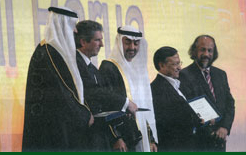
The developments in the United Arab Emirates come after Dubai-based conglomerate SS Lootah (which deals in an array of industries, including construction, health care and education) launched a ‘Green Car Program’ for its own fleet of corporate vehicles. In the three years since introducing the program, the company has purchased compressed natural gas (CNG) and hybrid cars for its employees use. SS Lootah director, Nasser Lootah (pictured next to one of his company’s new REVAs above) says: “The Green Car program has seen a great progress.”

Lootah says that while the REVA normally has a maximum range of 160 kilometers per charge, conditions in UAE will limit the practical expecations to 70 kilometers of driving on a full battery. But, he notes that with zero point emmisions and a much greater energy efficiency, his company is glad to welcome the REVAs to its corporate fleet as part of their drive for minimal environmental impact.

One thing that has Lootah really excited is the ease of recharing the car. “No sophisticated infrastructure is needed for recharing the car,” he says. “The car’s battery can be recharged in a simple electric socket.”

Ward Off Evil Eyes With Handmade Israeli Jewelry and Jewish Gifts From Israel

4

jewish jewelry handmade israeli jewelry photo‘Tis the season to be jolly, if you are a Christian. But a number of holidays for people of all faiths intersect around this time. It’s more noticeable if you live in the Middle East. Over here in Jaffa a couple of weeks ago, Muslims everywhere were celebrating Eid al-Adha; and Jewish people start lighting candles and gorging on jelly-filled doughnuts for Hanukah starting next week.

But whatever the season, or holiday, unique gift-giving is always something on our minds. When it comes to choosing gifts that are “green” the options are limited even more. One nice way to “say I love you” to someone in a way that is soft on the environment, is to give something handmade. Trendy, with no official religious affiliation is the good old hamsa, one of our faves, which means “five” in Arabic.

According to Wikipedia, an alternative Islamic name for this charm is the Hand of Fatima or Eye of Fatima, in reference to Fatima Zahra, the daughter of Muhammad. An alternative Jewish name is the Hand of Miriam, in reference to Miriam, the sister of Moses and Aaron. It is a kind of “protecting hand” or “hand of God.”

Some associate the significance of the five fingers to the five books of the Torah for Jews, the Five Pillars of Islam for Sunnis, or the five People of the Cloak for Shi’ites.

In recent years some activists for Middle East peace have chosen to wear the hamsa as a symbol of the similarities of origins and tradition between the Islamic and Jewish faiths. The fingers can point up or down.

Among Jews in Israel, it’s considered a Jewish gift, but one appropriate for Muslims, Christians, pagans and the unaffiliated. When I went to see my Catholic cousins in Scotland last year, it was hamsas for everyone.

While the gifts might not be certified green, there are some wonderful gift items in stock on MostOriginal.com, an online jewelry and gifts store that sells handmade artwork by Israeli artists.

Selling Israeli jewelry and Jewish gifts, their hamsas (like Laly Cohen’s Hamsa Hands pictured above), or Kabbalah bracelets, would satisfy even the choosiest friend.

Green Prophet's Jesse Fox is Gleaning Feeding on Fugee Fridays

1

fugee friday tel aviv jesse fox photo
(Jesse Fox and a Fugee Friday volunteer, in Tel Aviv, loading some food into a car. Israeli volunteers are gleaning vegetables and fruit from the nearby Carmel Market and are delivering it to hungry African refugees from Sudan and Eritrea living in south Tel Aviv. PHOTO CREDIT: Daniel Cherrin.)

Turns out some Green Prophet writers are doing more than ranting and raving about the environment in the Middle East. Our very own Jesse Fox, who started blogging here about produce waste at Tel Aviv’s food market (click here to see some shocking pictures) ––– has decided to put the waste to a good purpose. Several months ago, Daniella Cheslow reported on Jesse’s “gleaning” project, and this week I gave a recap for the non-profit news service ISRAEL21c. Here it is:

When Jesse Fox, an urban planning student from Tel Aviv decided to find a way to combine social justice with his passion for the environment, it was, he says: “Just connecting the dots.” Today Fox is one of four founders of a young grassroots project called Fugee Fridays.

The group’s mission is to distribute the surplus of Tel Aviv’s Friday Carmel food market — which would otherwise go to waste — to hungry African refugees who fled to Israel on foot to escape persecution. In recent years, there have been literally thousands of African refugees who have come to Israel from countries such as Sudan and Eritrea.

In an attempt to rebuild their lives, they eventually come to a Tel Aviv refugee shelter, and without any government aid, local heroes like Fox and other volunteer organizations step up to the “plate” to help.

Five Times Cleaner at the December Cleantech Startup Showcase in Israel

clean technology israel photo
(Photo from recent CleanIsrael meetup).

Last Monday evening, the Arison Lobby at the IDC in Herzliya was full with founders of clean technology startups, VCs , investors, researchers and other cleantech professionals who gathered for the first Cleantech Startup Showcase, organized by CleanIsrael in conjunction with the new Institute for Renewable Energy Policy and Applied Research (IDC IREP). The event was sponsored by Amit, Pollak, Matalon & Co.

The showcase featured presentations by 5 Israeli startups from the areas of energy, water and green technology sectors: Agam Energy, Emefcy, High Check Control, Phoebus Energy, and SOVNA.

“We chose these five companies from the dozens that applied because we wanted companies across a diverse set of sectors and stages of financing,” explains Gene Dolgin, the co-founder of CleanIsrael Network: “Agam develops novel turbine engines, Emefcy produces electricity from wastewater, High-Check builds real-time water contamination detection systems, while Sovna develops urban wind projects; and Phoebus – hybrid heating units.

“Of course, these are all also serious companies that interest both fellow entrepreneurs and investors.”

This was a first-of-its-kind event, and part of CleanIsrael’s goal is to create a vibrant and unified cleantech community in Israel. In past events, the group has hosted speakers from Better Place, Cleantech Group, Israel Cleantech Ventures, and Sindicatum Carbon Capital as well as entrepreneurs from EnStorage and SolarPower Israel.

RADVISION's Sagee Ben-Zedeff on Video-Conferencing To Save the Environment

videoconferencing green technology Al Gore Cisco image

Coincidentally, Green Prophet spoke earlier today with Zohar Zisapel, a founder of RAD, the company that owns RADVISION, a NASDAQ-traded company. Zisapel, who says he’s looking to solar and green tech, will appear soon in a story we’re writing for ISRAEL21c. Today we have a guest post from RADVISION’s Sagee Ben-Zedeff, on the greenness of video-conferencing technology:

Earlier this year, former US Vice President and Nobel laureate Al Gore spoke on a virtual panel that discussed the role of enterprise technologies in environmental matters, most notably climate change. Gore said that climate change is an “urgent crisis,” in which “scientists are practically screaming” at governments and citizens to take action.

It seems that there is a great deal of pressure, mainly in Europe and the US, to make an effort and reduce the carbon footprint. Climate change, global warming, pollution – all are threatening our lives, all are most probably our fault.

It wasn’t a coincidence that Gore called for action in a VoiceCon, a convention about enterprise communication, and that he chose to do so in a virtual panel. Communication and collaboration technologies, such as video conferencing, have long been considered “green,” and are now mature enough to play a key role in the enterprise “green” initiatives.

green technology Al Gore Cisco image

A proper disclosure – the event was organized by Cisco, the networking giant, to showcase its video conferencing technologies as a “green” solution. While the conference was held in Orlando, Gore spoke from a location near his home in Tennessee, his host, Cisco CEO John Chambers, was located in San Jose, and the moderator spoke from outside London. The panel included audiences in Orlando, London, Warsaw, Dubai and Paris. All were using Cisco’s Telepresence technology.

The fact that most of the people involved in the panel did not have to leave their homes or offices and fly in order to participate in this event may seem trivial, but even in 2008 video conferencing and other collaboration technologies are still considered “nice to have” by most enterprises, a fact that is quite alarming in light of the environmental crisis we are all facing.

Hebrew University Launches One Million Dollar Program in Support of Cleantech Development

Hebrew University Yissum Ormat cleantech green technology image

Yissum, the Technology Transfer Company of the Hebrew University of Jerusalem, is launching a 1 million U.S. dollar program to support the development of outstanding cleantech inventions by scientists at the Hebrew University of Jerusalem. The launch will take place on December 25th at the Givat Ram campus of Hebrew University and feature a keynote address from Yehuda Bronicki, Chairman and CTO of Ormat.

Yissum’s business partners include companies such as Novartis, Microsoft, Johnson & Johnson, Merck, Intel, Teva and many more. “We are pleased to launch Yissum’s Cleantech Programme, in response to the growing need for alternative energy solutions, novel technologies to combat water shortage and cleaner technologies to protect the environment,” said Nava Swersky Sofer, President and CEO of Yissum.

“We hope that this initiative will assist in bridging the gap between the Hebrew University’s cutting-edge research in these fields and the product-based industry, leading eventually to the commercialization of new “green” technologies for the benefit of us all.”

Initially, five novel technologies were chosen, three of which aim to reduce the polluting effects of toxic substances and create alternative, clean, energy sources. These inventions involve the generation of clean fuel, detoxification of gasses emitted by burning fossil fuels and detecting toxic chemicals.

Burning fossil fuels for the generation of energy is the major cause of air pollution and global warming. The consumption rate of oil, gas and coal is estimated as the equivalent of 200 million barrels of oil per day, and approximately one million people die annually due to air pollution resulting from fossil fuel burning. Furthermore, fossil fuels are a diminishing energy source and their limited supply has a far-reaching political and social impact.

Eco Rabbi: Parshat Vayeshev – Love the Land and it Will Love You Back

0

judean hills

Traveling through the mountains of Judea I am always struck by the stark contrast between the mountainous areas where there are villages and where there are not. The differences can be as sharp as night and day. There are even places where people are living but the land seems barren and there are other places where people are living and the area around it seems to be overflowing with greenery. It is clear who is taking care of the areas around their homes and who is not. But it often seems to expand far beyond what you would have thought.

Shai Agassi's Project Better Place to Seal a Deal with Japan?

1

Shai Agassi Project Better Place Japan image

Following the ongoing saga of Project Better Place‘s steady process of world domination, we can now add a new country to the list: Japan.

The news just in is that the Japanese Environment Ministry is inviting Better Place to take part in their feasibility project for building a network of charging stations in Japan. Better Place is the only foreign company that was invited to participate in the project, which will begin in January in the port city of Yokohama and last for three to six months.

Better Place has already signed on to implement its project in places as diverse as Hawaii, Israel, California, Denmark and Australia.

Founder and chief executive of Better Place Shai Agassi commented, “Better Place is honored to participate in this groundbreaking program in a country with so much auto-manufacturing expertise and history.”

::International Herald Tribune


Read more at Green Prophet about the growing phenomenon of Project Better Place:

REVA Electric Cars May Soon Be For Sale in Israel
Project Better Place Unveils Prototype of Electric Car Recharging Station
Israel’s Electric Car Guru Shai Agassi Gets Wired

Image credit: jorgeml

Earth Hour 2009 Sweeps Across the Middle East

6

[youtube]http://www.youtube.com/watch?v=BjWD8pbK5t8[/youtube]

It was almost exactly a year ago that we enthusiastically wrote about Tel Aviv’s upcoming participation in Earth Hour 2008, as the only Middle Eastern city to join the worldwide campaign.  We are now pleased to announce that although Tel Aviv (and other Israeli cities) will not be formally participating in Earth Hour 2009, the trend has spread widely across the Middle East.

This year will see the participation of Amman (Jordan), Istanbul (Turkey), Abu Dhabi (UAE), Dubai (UAE), Fujairah (UAE), and Sharjah (UAE).  Out of a total of 74 participating cities, 6 are from our small, humble region – not bad.

What is Earth Hour?

"Greenchange" – A new Israeli social network

0

green-changeIn an overwhelming world of  online social networks a new Israeli/Environmental network has emerged called “GreenChange using the Ning.com platform.

The organization behind GreenChange is the “Heschel Center for Environmental learning and leadership“, which celebrates it’s 10th anniversary today.

Its goal is to create an online environment where environmentalists can meet, share ideas and information as well as promote aspects of a sustainable society.

Like other networks, Greenchange offers groups, forums, blogs, applications, video/images sharing, events, news, green tips, and much more.

Among the different groups you can find: Eco-design, Eco-tourism, Environment and Judaism, Consuming culture, Local economy and many more.

If you’re looking for a Face-to-Face network you might want to check out the Green Drinks get together meetings.

Please feel free to contact me for more information.

From a Deserts & Drylands Conference in Sde Boker (part 2)

drylands israel conference photoEvents and frenetic discussion, both academic and activist in nature, have continued apace here at the 2nd Drylands and Desertification Conference here in Sde Boker, and I’ve taken an afternoon off to process the previous days proceedings. (You can see yesterday’s recap of the conference here.)

The theme of day 2 was titled ‘the role of vegetation in sustainable living within drylands,’ though this was a very loose umbrella for the variety of papers presented.

A critical theme emerging from this Internationally significant congregation of experts and interested parties is the effect of the creeping deserts upon human society – encompassing both desert dwellers and urban conorbations.

I was surprized to meet an Italian group here, but they tell me their government takes the increasing aridity of the south of the country, in Sicily, seriously. Some of the other participants have travelled from Ireland, Chad, Togo, Spain and Botswana to be here. A strand of today was the Jeffrey Cook Workshop in Desert Architecture and Urban Planning, which pulled together presentations from the Auroville Community in India, by S. Ayer-Guigan, an architect who works there; to research into microclimatic issues in the planning of a modern city, using examples as diverse as Phoenix, Arizona, Marrakech, and Beersheva.

BGU’s own Eyatar Erell (microclimatic issues) and Yodan Rofe (urban sustainability in deserts) presented these papers. It was particularly illuminating to hear new terms like ‘frontal density’ (what the wind would see and experience as it approaches buildings within a city) and ‘anthropogenic heat’ – the energy we consume and emit in our daily lives, through travel, house heating etc.

Comparing the maps and models of the traditional desert cities with planning for new cities or new suburbs through the prism of this kind of terminology and research is fascinating.

Youth Clean Energy Movement Event in Jerusalem

0

Awakening dreamer symposium imageDear Green Prophet folks,

Hello! My name is Zohar Tobi — I’m an organizer for the US Youth Clean Energy Movement, and I’m writing to invite you to an event I’m facilitating in Jerusalem called the Awakening the Dreamer Symposium. Here are the basic details:

WHAT: The Awakening the Dreamer Symposium
WHEN: Wednesday, December 24th, 7-10:30pm – optional potluck at 6pm!
WHERE: Merkaz Hamagshimim, 7a Dor Dor VeDorshav St. in Jerusalem
RSVP (not required, but helpful).

The Awakening the Dreamer Symposium is “an experience made of dynamic group interactions, leading edge information, and inspiring multimedia, in which participants become inspired to reconnect with their deep concern for our world, and are empowered to make a difference.” The Pachamama Alliance created it in 2005, and has been training facilitators left and right to present it – there are now over 1100 facilitators in 20 countries.

You can view the trailer here.

Studying the worldwide effects of desertification in Sde Boker

0

Negev Desert, Israel

Israel’s pioneering Desert University, Ben-Gurion University of the Negev (BGU), is currently hosting the 2nd biannual Drylands, Deserts and Desertification conference at their deep desert outpost at the Sde Boker Campus. Day 1 has focussed upon Life and Soil Degredation in the Drylands, and has seen a wide range of experts presenting fieldwork and research from Somaliland, Nairobi, Australia, Bosnia and Herzgovina, the Mongolian Steppe, Kazakhstan, and a host of other arid and humid lands as well as Israel.

In all there are 55 countries represented, with somewhere between 320 and 350 delegates. One hundred of these are from the African continent alone.

Some of these participants have been on an Israeli Government/MASHAV programme studying agriculture and drip irrigation methods here in the desert. Their trip will end on Thursday with a large tree planting event nearby on Thursday.

The conference has been initiated and organised by Green Prophet hero Professor Alon Tal, who was recently honoured by the State on its 60th birthday for his contribution to Israel’s environmental protection, and is no. 2 on the Green Party’s list in the forthcoming elections.

Keynote speaker today was professor James Reynolds, of Duke University in the US, who addressed the issue of viewing the problem of desertification through the newer framework of the DDP (the Drylands development paradigm).

A fascinating story of field research Reynolds shared with the audience was that quinoa, the ‘super food from the Andes’ which is the health food of the age (and I must admit to having half a sack load of at home) is causing economic strife amongst farmers in Bolivia.

The huge demand for quinoa is causing other crops to be neglected, and the sudden income shift creates new dietary conditions, and paradoxically a lack of healthcare facilities.

This migration from the land is one of the key threads of the entire conference. Professor Aref Abu Rabia from BGU addressed potential eco tourism opportunuities through sustainable agriculture and carbon offsetting (any green investors out there?) for the Negev Bedouin community in his morning paper.

Other notable presenters today included Max Rietkerk from the Netherlands, Prof. Alan Grainger from Leeds University (UK) advocating the development of an International Forestry Commission, which would oversee all forestation/reforestation issues worldwide, and Ofer Dahan(also of BGU and its Sde Boker home, the Jacob Blaustein Institute) who has been recently profiled here on Green Prophet.

All in all, a packed day. And that’s only a quarter of the academic events! Other social events included a moonlight walk through a nearby Wadi, various fieldtrips, and the general sociability that comes from bringing so many environmentally-focussed folk together.

More news from the desert soon!
– James

Heschel Center Celebrates its 10th Anniversary with a Conference on Sustainability this Week

0

Green events are filling our social calendars this week – first there’s the Green Drinks event in Tel Aviv tonight (at 8pm at Gilda Bar on Achad Ha’am in Tel Aviv), and on Wednesday, the Heschel Center is celebrating its 10th anniversary with a sustainability conference held in the Tel Aviv Port.  Don’t worry, they’re on different days so you can squeeze them both in.

We already know how much fun the Green Drinks event is going to be, but what about the sustainability conference?

The conference program, which will run from 9am to approximately 7pm on December 17, consists of three parts.  During the first part of the conference, Professor David Orr (who is one of the leading international researchers in the field of environmental education and ecological design) from Oberlin College will talk about an optimistic prognosis for the future of the environment.  His talk will be followed by short discussions about cultural, social, and economic agendas for the next ten years.

Arab Climate Alliance Perspective on Poznan Climate Talks

0

saudi arabia solar energy sun masdar

This past Friday we saw the conclusion of the United Nations Climate Change Conference in Poznan, Poland.  This two-week long conference brought together representatives from 189 countries for talks to lay the groundwork for Copenhagen in 2009, where the convention signatories have agreed to finalize a global treaty for the post-2012 period (2012 is when the Kyoto Protocol, the currently operating climate change treaty, is set to expire).

While the Middle East has not been a major actor in the unfolding drama of global climate change and its politics, their role is still significant, according to Wael Hmaidan, who represented the Arab Climate Alliance in Poznan.  Hmaidan says that, as countries with both a lot of fossil fuels and a great capacity for solar energy production, Arab countries are both part of the problem and part of the solution to climate change.