PEOPLE Festival returns to Berlin’s Funkhaus this October, bringing 180 musicians together for a week of collaboration, improvisation and more than 200 one-off performances.
Teletherapy can make mental health care easier to access by reducing travel, scheduling and location barriers. Here are six ways virtual therapy can help people connect with professional support more easily.
A coworking space within walking distance can cut commuting time and give you a reliable place to work, but distance alone does not make it useful. Test the internet, noise, privacy, desk setup, environmental claims and real cost before committing to a membership.
Yazan Al Homsi looks at two very different bets — Aduro Clean Technologies and Rocket Doctor — to show what investors should watch as small-cap companies attempt to move from promising technology to commercial scale.
PEOPLE Festival returns to Berlin’s Funkhaus this October, bringing 180 musicians together for a week of collaboration, improvisation and more than 200 one-off performances.
Teletherapy can make mental health care easier to access by reducing travel, scheduling and location barriers. Here are six ways virtual therapy can help people connect with professional support more easily.
A coworking space within walking distance can cut commuting time and give you a reliable place to work, but distance alone does not make it useful. Test the internet, noise, privacy, desk setup, environmental claims and real cost before committing to a membership.
Yazan Al Homsi looks at two very different bets — Aduro Clean Technologies and Rocket Doctor — to show what investors should watch as small-cap companies attempt to move from promising technology to commercial scale.
PEOPLE Festival returns to Berlin’s Funkhaus this October, bringing 180 musicians together for a week of collaboration, improvisation and more than 200 one-off performances.
Teletherapy can make mental health care easier to access by reducing travel, scheduling and location barriers. Here are six ways virtual therapy can help people connect with professional support more easily.
A coworking space within walking distance can cut commuting time and give you a reliable place to work, but distance alone does not make it useful. Test the internet, noise, privacy, desk setup, environmental claims and real cost before committing to a membership.
Yazan Al Homsi looks at two very different bets — Aduro Clean Technologies and Rocket Doctor — to show what investors should watch as small-cap companies attempt to move from promising technology to commercial scale.
PEOPLE Festival returns to Berlin’s Funkhaus this October, bringing 180 musicians together for a week of collaboration, improvisation and more than 200 one-off performances.
Teletherapy can make mental health care easier to access by reducing travel, scheduling and location barriers. Here are six ways virtual therapy can help people connect with professional support more easily.
A coworking space within walking distance can cut commuting time and give you a reliable place to work, but distance alone does not make it useful. Test the internet, noise, privacy, desk setup, environmental claims and real cost before committing to a membership.
Yazan Al Homsi looks at two very different bets — Aduro Clean Technologies and Rocket Doctor — to show what investors should watch as small-cap companies attempt to move from promising technology to commercial scale.
PEOPLE Festival returns to Berlin’s Funkhaus this October, bringing 180 musicians together for a week of collaboration, improvisation and more than 200 one-off performances.
Teletherapy can make mental health care easier to access by reducing travel, scheduling and location barriers. Here are six ways virtual therapy can help people connect with professional support more easily.
A coworking space within walking distance can cut commuting time and give you a reliable place to work, but distance alone does not make it useful. Test the internet, noise, privacy, desk setup, environmental claims and real cost before committing to a membership.
Yazan Al Homsi looks at two very different bets — Aduro Clean Technologies and Rocket Doctor — to show what investors should watch as small-cap companies attempt to move from promising technology to commercial scale.
PEOPLE Festival returns to Berlin’s Funkhaus this October, bringing 180 musicians together for a week of collaboration, improvisation and more than 200 one-off performances.
Teletherapy can make mental health care easier to access by reducing travel, scheduling and location barriers. Here are six ways virtual therapy can help people connect with professional support more easily.
A coworking space within walking distance can cut commuting time and give you a reliable place to work, but distance alone does not make it useful. Test the internet, noise, privacy, desk setup, environmental claims and real cost before committing to a membership.
Yazan Al Homsi looks at two very different bets — Aduro Clean Technologies and Rocket Doctor — to show what investors should watch as small-cap companies attempt to move from promising technology to commercial scale.
PEOPLE Festival returns to Berlin’s Funkhaus this October, bringing 180 musicians together for a week of collaboration, improvisation and more than 200 one-off performances.
Teletherapy can make mental health care easier to access by reducing travel, scheduling and location barriers. Here are six ways virtual therapy can help people connect with professional support more easily.
A coworking space within walking distance can cut commuting time and give you a reliable place to work, but distance alone does not make it useful. Test the internet, noise, privacy, desk setup, environmental claims and real cost before committing to a membership.
Yazan Al Homsi looks at two very different bets — Aduro Clean Technologies and Rocket Doctor — to show what investors should watch as small-cap companies attempt to move from promising technology to commercial scale.
PEOPLE Festival returns to Berlin’s Funkhaus this October, bringing 180 musicians together for a week of collaboration, improvisation and more than 200 one-off performances.
Teletherapy can make mental health care easier to access by reducing travel, scheduling and location barriers. Here are six ways virtual therapy can help people connect with professional support more easily.
A coworking space within walking distance can cut commuting time and give you a reliable place to work, but distance alone does not make it useful. Test the internet, noise, privacy, desk setup, environmental claims and real cost before committing to a membership.
Yazan Al Homsi looks at two very different bets — Aduro Clean Technologies and Rocket Doctor — to show what investors should watch as small-cap companies attempt to move from promising technology to commercial scale.
Last month I wrote about Etihad Airways offering free travel insurance, another move by the airline and Abu Dhabi to make the United Arab Emirates an easier, more attractive place for tourists to visit. Then this came across my feed.
Etihad and sexism against female doctors?
Dr. Gretchen Winter, a physician who describes herself as quadruple board certified, says she tried to help a passenger during a medical emergency aboard Etihad flight EY16 on August 27. She says the male cabin manager wouldn’t let her.
He sent her back to her seat. What caught my attention wasn’t only that a doctor says she was prevented from helping. Winter says there were two female physicians on the plane willing to step in. According to her account, both were turned away while the passenger remained on the floor of the aircraft.
“Your cabin manager on EY16 put a passenger’s life at risk today,” Winter wrote on X, in a thread that quickly attracted hundreds of thousands of views. Winter says the emergency happened close to where she was sitting. She saw the commotion and went over.
“I identified myself and asked for the medical bag,” she wrote.
According to Winter, the cabin manager “brusquely” told her to return to her seat because he was first-aid trained and didn’t need her. She says he instructed people to give the passenger oxygen, which she believed wasn’t what the patient needed.
Winter identified herself again and explained what she needed to do. Again, she says, she was told to sit down. Then comes a detail I find hard to shake. As Winter walked back to her seat, she says surrounding passengers grabbed her several times by the arm and asked her to stay and help. She couldn’t.
Two women doctors, one passenger on the floor
Etihad is offering free travel insurance for every visitor to the UAE for 2 weeks.
Ten or 15 minutes later, according to Winter, the passenger was still lying in another aisle.
“I was not allowed to do so and had to watch him mismanage the situation from my seat,” she wrote.
A flight attendant eventually apologized to her, Winter says, and explained that the cabin manager was simply “following protocol.” But what protocol?
“As I write this note they are still lying in the aisle and myself and another female physician have both been turned away,” Winter wrote while apparently still aboard EY16.
She couldn’t understand why the cabin manager couldn’t complete whatever documentation Etihad required while allowing a physician to assess the passenger. About an hour later, she says, the cabin manager came to speak with her. He explained that he had been following protocol and would have “called” her if she were needed.
Winter told him that, in her medical opinion, he had triaged the passenger incorrectly and had also been disrespectful toward her. She says he doubled down.
“I don’t know if this is just sexism or stupidity,” Winter wrote, “but your cabin manager is a liability.”
That is Winter’s question, not yet an established explanation for what happened. Nothing in the posts I’ve seen shows the cabin manager explicitly saying, “You cannot help because you are a woman.” But I think it’s a fair question to ask.
One female doctor being brushed aside could be an arrogant cabin manager, a misunderstanding or some obscure airline procedure. Two female physicians being turned away during the same emergency starts to look stranger. Especially on an airline based in the United Arab Emirates.
Is this Etihad protocol? The UAE wants the world to see something very different from the old stereotypes of the Gulf. Dubai and Abu Dhabi sell themselves as global cities. Women fly in for conferences, holidays, investment meetings and stopovers. They put women on stage, give them roles of “power” or is it all smoke and mirrors?
Etihad is one of the country’s most visible international faces. And Etihad itself employs women across aviation, medicine and management. Dr. Nadia Bastaki, its Chief People and Corporate Affairs Officer, is herself a physician and a prominent figure in aviation medicine.
So I don’t think it’s reasonable to take the actions of one cabin manager and declare that we’ve discovered what an entire country thinks about women. But I also don’t think Etihad gets to hide behind the word “protocol.” If this really was protocol, what was it?
Does Etihad instruct cabin managers to refuse help from doctors unless the crew decides it is required? Was Winter’s medical training verified or even considered? Why was a second physician reportedly turned away? And when a passenger has been lying on the floor for 10 or 15 minutes, at what point does a first-aid-trained cabin manager call upon the doctors sitting a few metres away?
Etihad Help did respond publicly to Winter after her posts began circulating. “Hey Gretchen, we’re concerned to see this,” the airline wrote, asking her to send more details by direct message. Companies in the Gulf region are often handled by British PR firms who understand sexism and its consequences.
There may be another side to this story. I would like to hear it. For now, what we have is the account of a doctor who says she watched a medical emergency unfold from her seat because the person running the cabin wouldn’t allow her to help.
Etihad has spent a great deal of money convincing travelers that Abu Dhabi and the UAE are open, modern and ready for the world. What happened aboard EY16 deserves an explanation, because if preventing two female doctors from helping really is Etihad “protocol,” travelers deserve to know that too.
Green Prophet has asked Etihad Airways for clarification about its medical emergency procedures and what happened aboard flight EY16. We will update this story if the airline responds.
It’s one of the most common conversations that happens a few months after a heat pump installation: the homeowner opens their first winter electricity bill, sees a number that’s higher than last year, and wonders if something went wrong with the system.
Usually, nothing went wrong with the system. What happened is a combination of three things: the rate plan wasn’t adjusted for higher electricity usage, the thermostat wasn’t configured to avoid peak hours, and the comparison is being made against a year when gas handled most of the heating load.
This article explains what’s actually on your PG&E bill after a heat pump installation, why the first year often looks worse than it will be long-term, and the specific adjustments that move the economics in your favor.
Why the First Bill Is Often Misleading
When you replace a gas furnace with a heat pump, you’ve made a major shift in how your home uses energy. Before: heating loads ran on gas, electricity ran lighting, appliances, and whatever cooling you had. After: heating and cooling both run on electricity. Your electricity consumption goes up meaningfully. Your gas consumption drops — or, if you’ve eliminated all gas appliances, your gas bill disappears entirely.
The first-year comparison is usually apples to oranges. You’re looking at an electricity bill that’s now carrying the full heating load that gas used to carry, and comparing it to a prior year where electricity only covered part of the picture. The honest comparison is total energy spend — electricity plus gas together — not electricity alone.
Quick check: Add your current monthly electricity bill to your current monthly gas bill. Compare that total to what you paid for electricity plus gas in the same month last year. If the combined number is flat or lower, the system is performing correctly.
The Rate Plan Problem Most Homeowners Miss
PG&E has a default residential rate plan — currently E-TOU-C — that most customers land on unless they actively choose something different. It’s a time-of-use plan designed for households with moderate electricity consumption that can shift some usage away from peak hours.
The issue: a heat pump significantly increases your electricity consumption. E-TOU-C was built for lower-usage customers. When you become a higher-usage customer, you may be on the wrong plan — and the wrong plan can cost you several hundred dollars per year more than the right one.
Here’s how the main PG&E residential plans compare for heat pump households:
Rate plan
Peak window
Best for
E-TOU-C (default)
4–9 PM daily
Moderate usage; can shift some load away from evenings
E-TOU-D
5–8 PM weekdays only
Households with more weekend usage; shorter peak window
EV2-A
4–9 PM daily
Homes with EV + heat pump; can charge EV overnight at lowest rates
E-ELEC
4–9 PM daily
NEM 3.0 solar customers; lower off-peak rates, optimized for battery storage
The right plan depends on your usage pattern, whether you have solar, and whether you have an EV. PG&E’s Rate Analysis tool at pge.com compares each plan against your actual last-12-months usage and tells you which one would have cost least. It uses your real data — not hypotheticals. Run it before the second heating season.
The all-electric baseline allowance
PG&E also offers an all-electric baseline for space heating — a higher baseline quantity for customers who install a permanent heat pump heating system. More of your usage falls into the lowest rate tier. This requires a phone call to PG&E (1-800-743-5000) to request. Most homeowners don’t know it exists and never ask for it.
Peak Hours Are Where Heat Pump Costs Concentrate
On any TOU plan, the electricity you use between 4 and 9 PM costs significantly more than electricity used outside that window. On E-TOU-C in 2026, the difference between peak and off-peak rates is substantial — running your heat pump during peak hours in summer can cost 50% more per kWh than running it at noon or after 9 PM.
A heat pump that’s heating or cooling your home aggressively during the 4–9 PM window is doing so at the highest possible rate. The fix is a thermostat strategy called pre-conditioning — getting the house to your target temperature before peak hours start, then letting the thermal mass of the home coast through the expensive window.
Pre-cooling in summer
Set your thermostat to reach your target temperature by 3:30–4 PM. Run the system hard during the afternoon when rates are lower. Then raise the setpoint slightly during peak hours (4–9 PM) and let the house drift — most well-insulated Bay Area homes lose only 1–2 degrees per hour passively. The system runs less during the expensive window.
Pre-heating in winter
Same logic applies to heating. Warm the house to your target temperature before 4 PM. Set the thermostat back slightly during the 4–9 PM peak window. A house that started warm holds temperature for several hours without significant system run time.
A smart thermostat handles this automatically. Nest, Ecobee, and equivalent models can be programmed with TOU-aware schedules that shift the heavy lifting to off-peak hours without you managing it manually. The payback on a smart thermostat in a TOU-heavy environment is typically under two years.
The March 2026 PG&E Rate Restructure
In March 2026, PG&E restructured its residential billing to add a fixed Income-Graduated Fixed Charge (IGFC) of approximately $24/month for most non-low-income customers. This charge appears on every bill regardless of how much electricity you use — conservation or solar production don’t reduce it.
In exchange, per-kWh rates were reduced. For heat pump households that use more electricity than average, the net effect of the restructure is generally neutral to slightly favorable — the lower per-kWh rates on higher usage tend to offset the new fixed charge. For very low-usage households, the fixed charge represents a larger proportional increase.
The practical implication: if your bill jumped in March 2026 and you’re trying to isolate whether it’s the heat pump or a rate change, check whether the IGFC appeared as a new line item. That’s $24/month that has nothing to do with your system’s performance.
What ‘Normal’ Looks Like After the First Year
The first year with a heat pump has a learning curve that most contractors don’t explain:
Rate plan optimization usually happens after the first winter bill — most homeowners don’t think about it until they see the number
Thermostat scheduling takes a few weeks to dial in — the pre-conditioning strategy works better once you understand your home’s thermal behavior
Gas bill elimination (if applicable) takes a full billing cycle to register — the savings on the gas side don’t always feel real until the account closes
By the second heating season, a household that has switched to the right rate plan, set up pre-conditioning schedules, and requested the all-electric baseline allowance typically sees a materially different picture than year one. The system hasn’t changed. The optimization around it has.
A Checklist for the First 90 Days
Step 1: Get your electricity bill and add back your gas bill (or note that gas is now zero). Compare the combined total to the same month last year — not electricity alone.
Step 2: Log into pge.com and run Rate Analysis. It models E-TOU-C, E-TOU-D, EV2-A, and other plans against your actual usage. Switch if another plan is cheaper. You can switch once every 12 months at no cost.
Step 3: Call PG&E at 1-800-743-5000 and request the all-electric baseline for space heating. It increases the amount of electricity billed at the lowest rate tier. Takes one phone call.
Step 4: Program your thermostat with a pre-conditioning schedule. Target temperature reached by 3:30–4 PM in summer; slight setback from 4–9 PM. In winter, same logic for heating.
Step 5: Check your heat pump’s operating mode settings. Most systems have an efficiency mode and a comfort mode. Efficiency mode prioritizes lower energy use; comfort mode prioritizes reaching setpoint quickly. Running in efficiency mode outside of extreme temperature events is almost always the right default.
The Long View
Heat pump economics improve with optimization. The system that seemed to push your bill up in the first winter is the same system that, with the right rate plan and thermostat strategy, can reduce your total energy spend year over year — particularly as California gas prices continue to be volatile and as the electrical grid becomes increasingly renewable. The first year is when the optimization happens. The savings show up starting in year two.
Aerial panoramic view of Hobart, Tasmania’s capital, spread along the wide Derwent River
Hobart, Tasmania’s capital, is the kind of city that makes you regret not having come sooner. Mount Wellington/kunanyi that shapes the skyline, Bruny Island’s dolphins, Port Arthur’s convict ruins and Salamanca’s Saturday market are all close enough to fit into the same week. Located in southeastern Tasmania, Hobart sits along the River Derwent, right next to Mount Wellington. The whole place is walkable. And nearly everything worth doing can be reached by ferry or a bus.
Tasmania’s capital is small enough to walk and big enough to keep you busy for a week. If this is your first visit and you’re wondering how to divide your days, here are some of the best things to do in Hobart. This is the best of Hobart in a week: three ways to spend your energy, three places that stay with you, and two flavours you’ll want to bring home
Experiences to Have
Hobart’s geography does most of the work for you and that’s what makes the city’s Hobart experiences so easy to string together. The river, mountain and an old railway line each pull you out from the comfort of your hotel room in a different way, and the hard part of the journey thus becomes the confusion of which one to start with instead of what to do.
Cruising the Derwent & Beyond
The Derwent River is the first thing you should see and the last thing you will forget. It’s wide and clear, with Oak valleys adding to the charm. The good thing about experiencing it on the Hobart cruisesis that you can choose how much river you want according to your schedule. Short Derwent River sightseeing cruises take you to iconic tourist attractions like the Hobart skyline, Tasman Bridge, Battery Point, Sandy Bay and more depending on your package. If you’d rather eat while you’re at it, lunch and dinner cruises do the same stretch of water with a table and a plate of fresh Tasmanian seafood, and you can enjoy the calm afternoon or have a relaxed stargazing experience.
Tasman Bridge stretching across the Derwent River
Then there are the ones that leave the river altogether. Tasman Island cruises head down to the Tasman Peninsula and explore the Tasmanian Devil Unzoo, Port Arthur Historic Site, Cape Raoul and more. Bruny Island cruises go south to a different island and a different mood: sea caves, blowholes, a coastline that feels a long way from anywhere.
Hiking Mount Wellington
kunanyi / Mount Wellington is 1,271 metres tall and sits about 21 kilometres from the city centre, roughly a 30-minute drive. You can go straight to the summit by car or on the Explorer Bus, and on a clear day the view runs down to the Tasman Peninsula and west into the Southwest wilderness. It’s cold up there, even in summer, so pack more layers than you think you’ll need.
Walking tracks also lead to the summit, starting at The Springs, a picnic ground roughly halfway up the mountain. The standout is the Organ Pipes track, which runs beneath dolerite columns that look like a pipe organ someone left out in the weather for a few million years. It’s a couple of hours return on decent shoes. Climbers hang off the rock above you. The tougher option is the Zig Zag track up to the summit from the same start point, and that one earns its name.
Hiker at the rocky summit of kunanyi / Mount Wellington
Check whether Pinnacle Road, the main access route for hikers, is open before you leave your accommodation. It closes in snow and ice, and it does snow up there in the middle of the year.Cycling the Intercity Cycleway
Not every Hobart experience needs a booking. The Intercity Cycleway is roughly 16 kilometres of flat, sealed path along an old railway line, running from near the Regatta Grounds by the waterfront out to Claremont in the northern suburbs. It follows the river Derwent for the first stretch, ducks under the Tasman Bridge, skirts the edge of the Royal Tasmanian Botanical Gardens, and moves towards the Cornelian Bay.
Ride far enough north, and you’re a couple of kilometres from MONA, which is where a lot of people finish before catching the ferry back to town. Bikes and e-bikes are easy to hire in the city, and shared e-scooters are available, if pedalling isn’t your thing.
Places to Visit
If you’re deciding on the best places to visit in Hobart, start with the ones that carry the most history and the best views.
Battery Point & Salamanca Place
Salamanca Place is a row of Georgian sandstone warehouses from the 1830s that now hold galleries, cafes and bars. That’s the weekday version. On Saturday morning it turns into Salamanca Market, which has run every week since 1972 and now stretches to more than 300 stalls of produce, timber work, cheese, bread and hot food, from 8.30 in the morning until 3. Get there before 10 if crowds bother you.
From the market, walk up Kelly’s Steps. They were cut in 1839 and still do the same job, which is, get you from the docks to Battery Point without going the long way round. Battery Point is Hobart’s oldest suburb, named for the guns installed on the point in 1818 to guard the port and protect early Hobart Town from perceived maritime threats. It has narrow lanes, colonial cottages, local bakeries and pubs, and stunning views with the river peeking through at the ends of streets.
MONA
The Museum of Old and New Art opened in January 2011 and has been dividing opinion since. It belongs to a professional gambler named David Walsh, sits about 11 kilometres north of the city at Berriedale, and is dug into a sandstone headland on the western bank of the river. There’s no natural light inside. No wall labels either. You get an app instead to read about and rate the artworks.
The way to arrive is by ferry from Brooke Street Pier, which takes 25 to 30 minutes and drops you at the bottom of 99 steps. An accessible tunnel and lift are available if you cannot use the stairs. Some visitors love it. Some hate it. Almost nobody is bored. There’s a winery, Moorilla, on the grounds if the art gets too much. It’s usually closed on Tuesdays and Wednesdays, so check the days before you plan around it, and adult entry is somewhere in the mid-$30s.
Port Arthur Historic Site
Port Arthur is 90 minutes’ drive southeast of Hobart on the Tasman Peninsula and it takes you back to the darker days in history. It was a penal settlement from the 1830s until 1877, and in 2010 it was inscribed on the World Heritage list as part of a group of Australian convict sites. There are more than 30 buildings and ruins spread over 100-odd acres, so give it three or four hours at least. Your ticket is valid for two consecutive days and includes a short harbour cruise around the Isle of the Dead.
The Penitentiary at Port Arthur Historic Site, the former convict settlement
The site is quiet in a way that catches you off guard. The lawns are green, and the water is still, contrasting with its history, which is far from gentle. Go with a full tank and a plan to stop somewhere on the Arthur Highway on the way home.
Flavours to Try
Hobart’s food scene punches above its size, and no visit is complete without sampling the best of Hobart food — from farmhouse cheese to award-winning whisky.
Tasmanian Cheese & Local Produce
Tasmania’s food reputation is real, thanks to the cool climate, rich soil and small local producers who aren’t in a hurry to scale up. Salamanca Market on Saturday is the shortcut to experience the local produce in one stop: honey, sourdough, smoked fish, artisan cheeses, wines and meat from a handful of small-scale makers whose whole output would fit in a van.
The one most people go looking for is Bruny Island Cheese Co., started by Nick Haddow in 2003 after a decade learning from cheesemakers overseas. Their cellar door is on Bruny Island itself, and they added a brewery behind the cheesery in 2016, so you can pair a washed rind with a farmhouse ale on the same picnic table. If you can’t make it to the island, ask around Salamanca. Their cheese turns up in the city too.
Whisky Trails
Want to know an interesting Whisky tale? Distilling was effectively banned in Tasmania for the better part of 150 years, starting from 1893, until a man named Bill Lark challenged it in the early 1990s and got a license. Lark’s first barrel was distilled in 1992. Sullivans Cove followed in 1994. Twenty years later, Sullivans Cove won world’s best single malt at the 2014 World Whiskies Awards, and Tasmanian whisky stopped being a curiosity.
There are now more than 30 distilleries across Tasmania. In and around Hobart, Lark has a cellar door and whisky bar down on the waterfront, and Sullivans Cove runs tours and tastings in Cambridge, a small town near Hobart Airport, about 15 minutes from the city centre. Both are walk-in friendly. Neither is cheap. Buy a bottle anyway.
Wrapping Up
Hobart rewards people who slow down. You could rush the mountain, the market and a museum into a single day, and you’d have a fine time. But the city works better in layers. Water one day. Rock and ruins the next. Cheese and whisky in the gaps. Give it four days if you can find them, and you’ll leave planning the return.
Sensitive ecosystems can be damaged when visitor numbers, infrastructure, and human activity grow. Soil erosion, wildlife disturbance, waste, water demand, and habitat loss are among the pressures tourism can create when access is poorly managed.
Well-designed visitor policies can reduce those impacts while also generating money for conservation. Permit systems, biosecurity rules, visitor limits, tourism concessions, and conservation fees give protected-area managers tools to control access and raise revenue for management. The International Union for Conservation of Nature (IUCN) and the Convention on Biological Diversity both identify carefully managed tourism as a potential source of protected-area funding, provided environmental limits and local governance are in place.
The examples in this article show how regulated access can support habitat protection when tourism is treated as part of a wider conservation strategy.
Why Small-Ship Expeditions Are Reshaping Remote Wilderness Travel
All aboard a small ship sailing to a port with you at the helm
High-latitude marine environments require careful visitor management to reduce disturbance at sensitive landing sites. In Antarctica, International Association of Antarctica Tour Operators (IAATO) member vessels carrying more than 500 passengers operate as cruise-only ships and do not make landings. Where landings are permitted, no more than 100 passengers can be ashore at a site at one time, helping limit the physical footprint of individual visits.
Remote islands also use strict biosecurity controls. On a South Georgia expedition cruise, visitors must follow the Government of South Georgia and the South Sandwich Islands procedures designed to prevent non-native species and disease from reaching the territory. Clothing, footwear, bags, and field equipment are checked and cleaned to remove mud, seeds, invertebrates, and other material before and between landings.
Travel by train in Norway to remote places
Smaller expedition vessels allow operators to work within passenger limits at landing sites and divide visitors into manageable groups. Ship size alone, however, does not determine environmental impact. Underwater noise can also depend on propeller design, machinery, hull characteristics, speed, and operating practices. Together, passenger limits, controlled landing schedules, and biosecurity requirements provide a clearer framework for reducing visitor pressure in remote polar environments.
What Overtourism Has Already Cost Fragile Ecosystems
High visitor pressure can cause measurable damage to sensitive ecosystems when access and infrastructure are poorly managed. Heavy foot traffic can wear away vegetation and accelerate soil erosion, while recreational boating and concentrated snorkelling or diving can damage shallow coral reefs through anchors, vessel groundings, and direct contact.
You can slow travel around Thailand in a wooden boat. Photo by Karin Kloosterman for Green Prophet
Maya Bay in Thailand shows how quickly visitor pressure can overwhelm a small marine environment. At its peak, the bay received nearly 5,000 visitors a day, and authorities reported serious damage to coral and other marine life before introducing strict access controls in 2018. Iceland’s Fjaðrárgljúfur canyon faced a different problem: high foot traffic, combined with wet and thawing conditions, damaged walking trails and surrounding vegetation. Authorities responded with access management, trail improvements, and measures designed to keep visitors on designated paths.
A dog shelter on Koh Phanghan in Thailand offers more than a Maya Bay photo op. Meet tourists that change the lives of stray pets.
Tourism can also put pressure on wastewater systems. Where infrastructure cannot keep pace with visitor numbers, sewage and runoff can add excess nutrients and pathogens to coastal waters. Nitrogen and phosphorus pollution can fuel algal blooms and reduce oxygen levels, damaging aquatic ecosystems. These examples show why sensitive destinations need visitor limits, suitable infrastructure, and active monitoring instead of unrestricted access.
The Rise of Private, Low-Volume Charters in Protected Waters
Charter a Slow Boat cruise
Tourism in the Galápagos operates within a tightly managed network of protected visitor sites. The Galápagos National Park Directorate currently oversees 176 authorised marine and terrestrial sites, with permitted activities defined for each location. Tourism vessels also operate under authorisations that specify where they can visit, their schedules, and passenger numbers.
These controls matter for travellers booking a private Galapagos cruise, since vessels follow approved itineraries instead of choosing landing sites freely. Park rangers monitor tourism operations to check that vessels comply with authorised sites, schedules, passenger numbers, and guiding requirements. The park also monitors how visitor groups are distributed across sites as part of its wider conservation management.
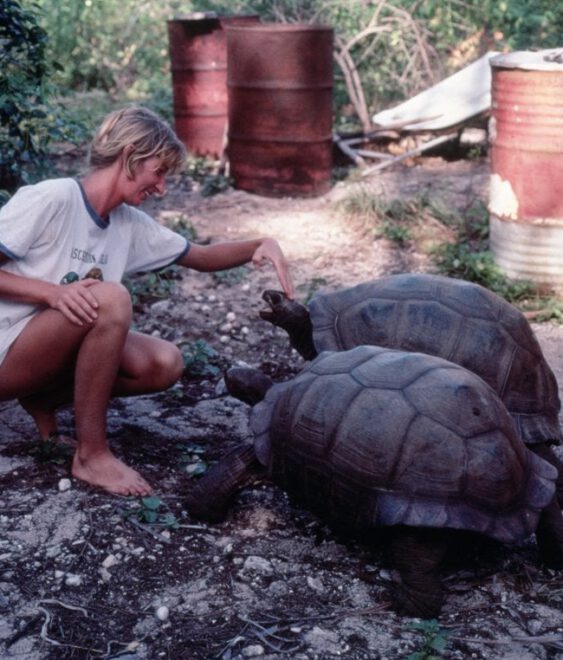
Jeanne Mortimer in her early days with the tortoises and turtles in wild places
Private and small-vessel tourism still creates environmental pressures, so vessel size alone should not be treated as proof of low impact. What matters is how the operation fits within park rules governing access, visitor numbers, authorised activities, and site management. This regulated system gives conservation authorities greater control over where and when tourism takes place within protected areas.
How Capping Visitor Numbers Can Fund Local Conservation
Direct access fees paid by visitors can provide important funding for protected-area management. Park authorities can use entry fees to finance environmental monitoring, conservation programs, and visitor infrastructure. When paired with carefully managed visitor numbers, these fees can generate revenue while helping reduce pressure on sensitive ecosystems.
Swimming in the Galapagos. Sunscreen is polluting the delicate balance
The Galápagos National Park Directorate strengthened this funding model in August 2024 by increasing the standard entry fee for foreign visitors aged 12 and over from $100 to $200 per person. Revenue from the fee is distributed among the National Park Directorate, the Galápagos biosecurity agency, local governments, and other public institutions, with half allocated to the management and conservation of protected areas. Tourism fees in South Georgia also support environmental protection, including scientific monitoring, habitat restoration, and measures to prevent the return of invasive species.
Targeted fee structures can also direct tourism revenue toward local communities. In the Galápagos, part of the entry-fee revenue distributed to local authorities supports services including health, education, sanitation, and environmental management. Linking tourism income with conservation and community needs gives protected areas another financial tool for managing visitor pressure over the long term.
Why Traveller Behaviour Now Shapes Wildlife Protection Policy
Conservation policies increasingly regulate individual behaviour within protected natural areas. Wildlife managers use minimum-distance rules and other visitor guidelines to reduce disturbance around native species. These measures are especially important at breeding, nesting, and feeding sites, where repeated human intrusion can disrupt normal wildlife behaviour.
Required distances vary by species and location. In Antarctica, International Association of Antarctica Tour Operators (IAATO) protocols require visitors to remain at least five metres from wildlife and avoid blocking animal pathways or disturbing breeding areas.
Other jurisdictions set their own rules. In the United States, for example, NOAA recommends staying at least 100 yards from large whales, with stricter legal limits applying to some species and regions.
Individual biosecurity compliance also helps protect isolated wildlife populations from introduced organisms and pathogens. Boot cleaning, clothing inspections, and equipment disinfection are used in Antarctica and South Georgia to reduce the risk of carrying seeds, invertebrates, or disease between sites. As environmental authorities refine these standards, visitor behaviour remains an important part of reducing human pressure on vulnerable species.
Can smarter travel choices save wild places?
Unchecked human access can damage fragile ecosystems, but total isolation is not practical for many protected areas. Capping visitor numbers, enforcing strict biosecurity protocols, and managing how people move through sensitive environments can reduce visitor pressure while generating revenue for conservation. Evidence from regulated destinations shows that structured management can support habitat protection while providing funding for park oversight.
In places where tourism is permitted, wilderness protection will require carefully managed access alongside broader conservation policies. Visitor limits, conservation fees, monitoring, and clear enforcement can help vulnerable marine and terrestrial areas manage tourism while directing revenue toward environmental protection and restoration.
Modern transport has made it possible to cross countries and regions quickly, but packed itineraries can leave little time to understand the places between major stops. Slow travel takes a different approach, with longer stays, overland journeys, regional transport, and fewer destinations built into a single trip.
Travelling to Kerala, India, offers so much in adventure and slow travel options. How about knitting a sweater for an elephant?
The environmental impact depends on how people travel, but choosing trains, buses, ferries, or other lower-impact options in place of frequent flights can reduce transport emissions. Spending more time in one area can also mean fewer transfers and more opportunities to explore local neighbourhoods, landscapes, food traditions, and public transport. In this way, getting from one place to another becomes part of the trip instead of something to rush through.
England’s West Country Reveals Itself Slowly by Train
The rail line running from London Paddington into England’s West Country offers a clear alternative to navigating narrow rural roads by car. Great Western Railway services continue through Devon and Cornwall, with the route along the sea wall at Dawlish treating passengers to direct coastal views before trains continue toward Torbay and the southwest.
Trains in England host bands to perform on cultural train trips along the countryside.
From Exeter, regional lines extend into coastal areas, including services toward Paignton, while Cornwall’s branch lines include the scenic St Ives Bay Line. Taking the train can reduce the need for a rental car and may also lower transport emissions, depending on the journey. Rail works well for those planning tours to Devon and Cornwall, especially when the aim is to visit several towns without congesting local roads with another car.
Stations such as Totnes and Truro also provide access to town centers and onward local transport, making it easier to explore without relying on a car for every leg of the trip.
Slovenia Built Its Tourism Model Around Staying Longer
Slovenia has made sustainability a central part of its tourism strategy through the Green Scheme of Slovenian Tourism. The national certification program assesses destinations across areas including environmental management, nature protection, culture, and tourism development, while encouraging destinations and tourism businesses to improve their performance over time.
Slow Food cows make high fat milk using regenerative agriculture. You can enjoy workaways in Slovenia and learn how to raise dairy cattle and make cheese.
Bohinj is one practical example. Parking around Lake Bohinj is regulated, while visitors are encouraged to use buses, bicycles, and seasonal shuttle services to reach popular trailheads and attractions. The destination also asks guests staying locally to leave their cars at their accommodation where possible and use public transport during their stay.
Long-distance routes are another reason to spend more time in the region. The 270-kilometre Juliana Trail follows 16 stages around the Julian Alps and Triglav National Park, passing through towns and villages where walkers can stop between sections of the route. Visitors staying at least two nights with participating Bohinj accommodation providers are also eligible for the Julian Alps: Bohinj Card, which includes public-transport benefits and encourages car-free travel around the area.
Ireland’s Wild Atlantic Way Favours a Slower Pace
Travel by boat around Europe in the Neptun of Marstal
Spanning around 2,500 kilometres from the Inishowen Peninsula in the north to Kinsale in the south, Ireland’s Wild Atlantic Way follows the country’s western coastline through nine counties. Covering the entire route in one trip can mean long stretches of driving, while focusing on individual regions such as the Burren or Connemara leaves more time for walking, trying out local food, and discovering smaller coastal towns.
Using shared transport can also reduce the number of individual cars on narrow rural roads. Joining sought-after small group tours of Ireland can be one option for reaching coastal areas without relying on a single-occupancy rental car for every part of the journey.
Staying in one area for several days also creates more opportunities to explore on foot. In Burren National Park, marked trails cross the region’s limestone pavement and are managed to guide visitors away from more sensitive habitats. Longer stays can also mean more time spent in local cafés, shops, and villages instead of moving on after a brief stop.
Kerala’s Backwaters Are Best Explored by Houseboat
Inside a cabin on a river boat
The backwaters of Kerala form a network of interconnected canals, lakes, rivers, and lagoons stretching for more than 900 kilometres along the state’s coast. Traditional wooden vessels known as kettuvallams, originally used to transport rice and spices, have been adapted into houseboats that now carry passengers through areas such as Vembanad Lake and Alappuzha.
Wild places face pressure from resource extraction, habitat conversion, and poorly managed human activity. Responsible adventure travel can create an economic incentive to keep ecosystems intact when tourism is carefully managed, and local communities share in the benefits. Visitor fees, tourism concessions, community-run accommodation, and local guiding can all direct money toward conservation while creating income linked to protected landscapes.
Booking an all inclusive holiday in Costa Rica? look out for sloths falling from power lines
In some regions, that income can support alternatives to activities such as logging, land conversion, or wildlife exploitation while helping fund protected-area management. The effect depends on how tourism is structured, where the money goes, and how visitor impacts are controlled. Done well, adventure travel can support both conservation and local livelihoods across mountain, savanna, forest, and marine environments.
Trekking Fees in Nepal Fund the Villages You Pass
Many of Nepal’s major trekking regions require protected-area permits or local tourism fees that contribute to conservation and community development. In the Annapurna region, trekkers pay an entry fee to the Annapurna Conservation Area Project (ACAP), Nepal’s only self-financing conservation area. ACAP uses an integrated conservation model that supports community infrastructure, alternative energy, local livelihoods, and natural resource management alongside tourism.
A similar link between tourism revenue and local communities exists around national parks. Nepal’s protected-area system allocates 30 to 50 per cent of park revenue to buffer-zone communities, where funds can support conservation, income-generating projects, and community development. Sagarmatha National Park also has a designated buffer zone, and Nepal’s park authority credits tourism with contributing to the economic development of communities in the Everest region.
Operator choices matter too. For anyone weighing up trekking in Nepal, knowing how an agency pays, insures, and equips guides and porters can help direct more of the trip’s economic benefit toward the people working along the route. Together, permit revenue and local employment show how trekking can contribute to the communities and landscapes that make these mountain routes possible.
Kenya’s Wildlife Corridors Depend on Careful Route Planning
In Kenya’s Maasai Mara ecosystem, community conservancies have developed a landscape-level conservation model built around controlled tourism and land-use planning. At Mara Naboisho Conservancy, more than 700 Maasai landowners lease their land for conservation while retaining ownership and receiving monthly lease payments. Cattle grazing continues through designated zones and rotational use, helping reduce pressure on the landscape while keeping important wildlife corridors open.
A cave restaurant in Kenya. The country isn’y only about safaris.
Tourism numbers are also deliberately limited as a method for preserving wildlife through tourism. Naboisho currently has eight tourism camps and a maximum of 150 beds, while visitor numbers and activities are managed under conservation guidelines. This lower-density model reduces pressure on grasslands while maintaining connected habitat for elephants, lions, wildebeest, and other species moving through the Greater Mara.
Keeping these corridors open also helps connect the Maasai Mara National Reserve with surrounding conservancies and community lands. Ranger teams patrol the landscape, while ecological monitoring records wildlife movement, vegetation cover, and other changes that inform conservation decisions.
Chile Limits Daily Hikers on the W Trek
Chile’s Corporación Nacional Forestal (CONAF) manages visitor access to Torres del Paine National Park through advance ticketing and mandatory accommodation reservations for multi-day hikers on the W Trek. Anyone completing the mountain route must reserve approved refugios or campsites before entering the mountain area, helping prevent unauthorised camping and concentrate overnight stays in designated sites.
A geothermal power plant in Chile
Accommodation capacity at refugios and campsites also places a practical limit on the number of people staying along the route each night. Hikers are required to remain on authorised trails, as leaving marked routes can cause erosion and damage vegetation. For those researching Patagonia W trek tours, an accredited operator can simplify accommodation, transport, and park-entry arrangements and help keep the itinerary aligned with current park requirements.
The reservation system also gives park managers greater oversight of visitor movement and improves traceability in case of emergencies or changing trail conditions. CONAF says its ticketing structure is intended to strengthen visitor control, safety, and conservation inside the park.
Costa Rica Pays Landowners to Keep Forests Standing
Costa Rica’s National Fund for Forest Financing (FONAFIFO) manages the Pagos por Servicios Ambientales (PSA) program, which provides financial payments to forest owners for environmental services such as biodiversity protection, carbon storage, water protection, and scenic value. The program supports forest protection as well as regeneration, reforestation, and agroforestry.
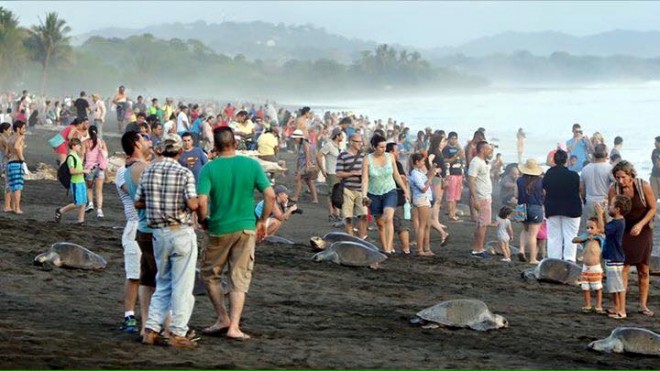
Turtle nesting sites over-run by curious tourists. When you visit, make sure to tred lightly.
A major share of PSA funding comes from Costa Rica’s fuel tax and water-use charges, alongside other public and private contributions. These payments give landowners a financial reason to retain or restore forest instead of converting it to other uses. Costa Rica’s wider conservation strategy also includes biological corridors designed to maintain connectivity between protected areas and surrounding habitats.
Costa Rica’s forest cover has recovered dramatically, rising from about 26 percent in 1983 to more than half of the country’s land area. That recovery reflects several decades of forest policy, protected-area management, and conservation incentives, with the PSA program playing an important role in reducing deforestation and supporting forest restoration.
Coffee Lands at San Isidiro, Costa Rica. Photo by Green Prophet.
The Norwegian archipelago of Svalbard enforces strict wilderness regulations through the office of the Governor (Sysselmesteren) to protect both visitors and Arctic wildlife. Anyone travelling outside the settlements must carry suitable equipment for scaring off polar bears, while the governor also recommends additional protection appropriate for polar bear encounters. Visitors must keep at least 300 metres from polar bears, increasing to 500 metres between March 1 and June 30.
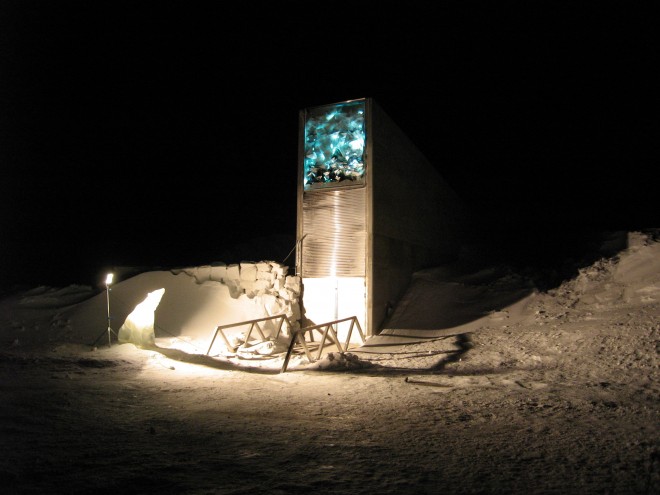
The seed vault in Svalbard.
Environmental rules also limit disturbance to other wildlife. Boats must remain at least 150 metres from walrus haul-out sites, with a five-knot speed limit when travelling within 300 meters. Seasonal five-knot limits also apply near designated bird cliffs. In protected areas covered by the landing regulations, tourist landings are restricted to approved sites, helping concentrate visitor activity in places where access can be managed.
Guide requirements are becoming stricter as well. From July 1, 2027, approved Svalbard guides will be required for tourist and field activities outside inhabited areas. Guides are trained to manage safety, changing weather, and wildlife encounters while following the archipelago’s environmental regulations.
What does responsible adventure travel protect?
Polar bear crossing in Norway
Responsible adventure travel can support both conservation and the communities living near protected landscapes. Reservation systems in Patagonia, conservation lease payments in Kenya, and tighter visitor regulations in Svalbard show how tourism can reduce pressure on sensitive environments while directing income toward local communities and protected-area management.
That approach works best when clear regulations, community involvement, and responsible operators are all part of the system. Trips that respect visitor limits, designated trails, wildlife regulations, and local employment practices can contribute to habitat protection while helping destinations manage tourism more carefully over the long term.
Europe has spent years trying to reduce its dependence on Russian energy, both to cut fossil fuel emissions and to limit the flow of European money into Russia following its invasion of Ukraine. Yet billions of euros are still moving in the opposite direction. New shipping data shows just how large that trade remains — and how European companies continue to play a crucial role in keeping Russia’s Arctic gas industry connected to international markets.
Oil from Europe is being bought by Europeans
Greek-linked shipping vessels transported an estimated €2.35 billion worth of Russian Arctic liquefied natural gas to European ports during the first seven months of 2026, according to new analysis from Urgewald, a Germany-based environmental and human rights organization that investigates the financial institutions and companies supporting fossil fuel and other environmentally damaging industries.
The organization analyzed cargo-level data from commodities intelligence company Kpler to track shipments from Russia’s massive Yamal LNG project.
Why does this matter? Russia’s ability to sell oil and gas remains an important source of export revenue, while the EU is simultaneously trying to use sanctions and energy policy to reduce its economic relationship with Moscow. The new figures expose a striking contradiction: EU ports received more than 92 percent of all LNG exported from Yamal during the first seven months of 2026, with Urgewald estimating that European countries paid €6.64 billion for those shipments. EU-bound Yamal volumes were not falling — they increased 13.9 percent compared with the same period in 2025.
At the center of that supply chain is Greek shipowner Dynagas. Vessels attributed to the company transported 57 cargoes, or 4.14 million tonnes of LNG, from Yamal between January and July — approximately 35 percent of everything exported by the Russian Arctic project during the period, according to Urgewald and data they sent to Green Prophet.
In July alone, Dynagas-linked vessels delivered six cargoes and 413,924 tonnes to EU ports, with an indicative gross value of €306 million.
Across all destinations in July, Dynagas-linked vessels carried eight of Yamal’s 22 cargoes, totalling 557,302 tonnes.
EU countriespaid an estimated €6.64 billion for 10.89 million tonnes of Yamal LNG between January and July, including around €681 million in July.
Dynagas volumesrose by 5.0 per cent from the same period in 2025, while total Yamal LNG volumes were broadly flat.
Of those shipments, 53 cargoes carrying 3.86 million tonnes were delivered to EU ports, with an estimated gross value of €2.35 billion.
The timing is particularly significant because Greece recently delayed agreement on the EU’s 21st sanctions package while seeking an exemption protecting qualifying European companies transporting Russian LNG under contracts signed before Russia’s full-scale invasion of Ukraine.
The eventual sanctions package included such an exemption, raising questions about how Europe can simultaneously tighten restrictions on Russian energy while maintaining parts of the infrastructure that allow the trade to continue.
An ancient Jewish holiday once used to count livestock for tithing is being revived this August as a worldwide call for compassion toward animals, sustainable food systems and an end to unnecessary animal suffering.
Jewish Vegan Life has launched a global campaign celebrating the New Year for Animals, with synchronized events in Washington, D.C., Los Angeles, Pittsburgh, Montreal and Jerusalem, alongside an international livestream on August 9 featuring partners including Mercy for Animals, The Good Food Institute and Freedom Farm Animal Sanctuary.
The organization is reinterpreting the little-known holiday through the Jewish principle of Tza’ar Ba’alei Chaim—the prohibition against causing unnecessary suffering to animals—arguing that modern factory farming challenges Jews to reconsider how ancient values apply to today’s food system.
“Judaism contains a profound blueprint for animal stewardship,” said Michael Gribov, Head of Movement Building for Jewish Vegan Life. “The New Year for Animals is a call to step away from factory farming, aligning our modern food choices with our deepest spiritual values.”
Events will include vegan seder meals, community dinners, educational discussions and plant-based potlucks designed to connect Jewish tradition with environmental stewardship and animal welfare.
Among the featured speakers is Rabbi David Rosen, who said the Torah established protections for animals long before modern animal welfare organizations existed. “There is special value in identifying a day in the year for particular attention to our obligations towards animal life,” he said.
Jewish educator Dr. Richard H. Schwartz, who has long advocated reviving the holiday, called the initiative “a necessity to heal our world” amid climate change and industrial animal agriculture.
The campaign culminates in local gatherings on August 13 in Los Angeles, Pittsburgh and Jerusalem, where participants will explore Jewish teachings on stewardship through food, discussion and community.
Jewish Vegan Life says the initiative aims to reconnect Jewish identity with values of compassion, environmental responsibility and respect for all living beings while inviting people of all backgrounds to participate.
More information and event registration are available at Jewish Vegan Life
Although California won’t be in the path of totality for the August 12, 2026 total solar eclipse, the SETI Institute—best known for its search for extraterrestrial intelligence and life beyond Earth—and the California Academy of Sciences are giving Bay Area audiences a front-row seat through a celebration combining astronomy, music, and public science.
Make sure you view the eclipse safely
The event will livestream eclipse views from Iceland and northern Spain, where the eclipse will be total, while the 35-member International Space Orchestra, made up of astronauts, scientists, engineers, and researchers—performs a new orchestral interpretation of Voyager by PJ Harvey.
The International Space Orchestra
Visitors will also hear from SETI scientists about how eclipses have advanced our understanding of the Sun and other stars, with opportunities to ask questions during live discussions. While SETI is famous for searching for signs of intelligent life beyond Earth, its scientists also study planets, stars, astrobiology, and the technologies that help humanity understand our place in the universe.
“Even though the Moon’s shadow won’t reach San Francisco, technology allows us to bring the eclipse to everyone,” said Dr. Franck Marchis, Senior Planetary Astronomer at the SETI Institute. “By connecting live to observers across Europe, we’re turning a local astronomical event into a global shared experience where the public can witness the eclipse in real time, interact with scientists, and celebrate our common curiosity about the cosmos.”
The International Space Orchestra in 2012
Dr. Shannon Bennett, Chief Science Officer at the California Academy of Sciences, said the collaboration reflects the museum’s mission to inspire wonder. “Experiencing live views of the eclipse alongside a performance by the International Space Orchestra will create an unforgettable celebration that deepens our connection to the natural world and to one another.”
The event begins at 10:30 a.m. PDT on August 12 at the California Academy of Sciences in San Francisco and is included with regular museum admission.
As governments race to adopt AI, the biggest lesson from Canada’s healthcare transformation may have little to do with technology—and everything to do with people.
Can artificial intelligence save public healthcare?
It is one of the defining questions facing governments today. From Canada and the United States to the Netherlands, Switzerland and the Gulf states, healthcare systems are confronting the same uncomfortable reality: people are living longer, clinicians are burning out, costs continue to climb, and patients expect faster access to care than ever before.
Technology companies promise AI-powered solutions for everything from physician note-taking to cancer detection. Governments are investing billions into electronic health records, predictive analytics and virtual care. The UAE alone has made artificial intelligence a national priority, hoping to build one of the world’s most digitally advanced healthcare systems.
Yet after more than three decades working inside healthcare transformation, Alison MacDonald, Senior Vice President and European Lead at Nordic Global, offers a surprisingly restrained perspective: “AI isn’t a silver bullet,” she tells Green Prophet.
Alison MacDonald of Nordic says artificial intelligence will transform healthcare only if it supports clinicians, streamlines workflows and keeps patients at the center of digital transformation.
It’s an observation that may sound almost old-fashioned amid today’s excitement surrounding generative AI, but it reflects one of the most important lessons emerging from Canada’s digital healthcare journey: technology succeeds only when it supports clinicians rather than attempting to replace them.
That philosophy has guided Healthtech, the Canadian healthcare consultancy acquired by Nordic in 2019 after nearly forty years helping hospitals modernize their digital infrastructure. Since then, Nordic has expanded that expertise internationally, adding operations in the Netherlands and growing across Switzerland, Ireland and the United Kingdom while helping healthcare organizations navigate one of the most significant technological transitions in modern medicine.
Canada’s greatest healthcare export may be experience
Canada is rarely held up as a model of healthcare efficiency today. Long waits for specialists, shortages of family physicians and fragmented provincial systems have become common topics of political debate and complaints by Canadians who can’t find family physicians to take them on. But MacDonald believes those very challenges have transformed Canada into something unexpected: one of the world’s largest living laboratories for healthcare modernization.
Every publicly funded healthcare system is wrestling with remarkably similar problems, she says. “Our challenges aren’t unique,” she says. “When I moved to Ireland, I experienced many of the same issues Canadians talk about every day, such as difficulty in finding a family doctor, pressure on hospitals and long waits for care.”
Across Europe, governments are experimenting with new ways to stretch limited healthcare resources.
The Netherlands has embraced telehealth and digital-first primary care for many routine consultations. AI-powered chatbots increasingly help direct patients to appropriate services before they enter already crowded waiting rooms. Nurse practitioners are assuming greater responsibility for routine care that once required physicians.
Rather than viewing these innovations as threats to traditional medicine, MacDonald sees them as practical responses to changing demographics: “The question isn’t whether technology replaces healthcare professionals,” she says. “It’s how technology helps patients reach the right healthcare professional at the right time,” she says.
That distinction matters because healthcare isn’t manufacturing, where automation often replaces repetitive labour. Medicine remains deeply human and relies on clinical judgment, empathy and trust which can never be automated.
Instead, digital transformation succeeds when it removes friction from the system, allowing clinicians to spend more time treating patients and less time navigating administrative complexity.
The Alberta experiment
Few Canadian healthcare projects have attracted as much international attention as Alberta’s province-wide implementation of Epic, one of the world’s leading electronic health record platforms.
Unlike many jurisdictions where hospitals adopted different systems over time, Alberta pursued a single integrated electronic record spanning acute care, correctional facilities and much of primary care. The result was something healthcare leaders have pursued for decades: a patient record capable of following people throughout much of their healthcare journey.
The project has also been associated with measurable improvements, including reductions in medication-related safety incidents and unnecessary duplicate testing, demonstrating that digital transformation can improve both patient safety and operational efficiency when implemented thoughtfully.
Ontario chose a different path, where hospitals were allowed greater flexibility in selecting electronic health record systems, creating a more fragmented digital landscape. Considerable effort has since focused on connecting those systems through interoperability initiatives and regional health information exchanges.
Neither model is presented as universally right or wrong but instead, they offer valuable lessons for governments everywhere now investing heavily in digital healthcare infrastructure.
“The important thing,” says MacDonald, “is remembering that technology alone doesn’t solve fragmentation. You have to redesign workflows, engage clinicians and think about the patient journey from beginning to end.”
Why Nordic approaches healthcare differently
Many of the world’s largest consulting firms have built substantial healthcare consulting practices, says MacDonald who worked as a nurse before joining Nordic 12 years ago.
Nordic takes a different approach. She says its expertise didn’t grow out of finance, audit or general management consulting, it grew out of hospitals.
Across Nordic’s Canadian and international teams are physicians, nurses, radiologists, laboratory technologists, clinical informaticists, project leaders and healthcare operations specialists who have spent much of their careers inside healthcare organizations rather than studying them from the outside and that difference shapes how projects begin.
Rather than asking which technology should be implemented first, Nordic starts with a more fundamental question:mHow do clinicians actually deliver care today?
One principle guides nearly every engagement.
“It has to be clinically led and operationally delivered,” MacDonald explains. The technology comes later.
Healthcare organizations often focus on purchasing software before understanding how doctors, nurses and patients actually interact. Nordic reverses that process, bringing frontline clinicians into system design from the earliest stages. That emphasis on change management may be one of the least glamorous, and most important, aspects of successful digital transformation.
Many failed healthcare IT projects were not technological failures at all, they were people failures, she says.
Hospitals introduced new systems without giving clinicians enough ownership over how those systems would fit into everyday practice. MacDonald believes the balance must always remain between people, process and technology. If one of those three pillars is missing, even sophisticated software can struggle to deliver meaningful improvements.
Sustainable healthcare isn’t just about greener hospitals. It’s about building resilient systems that reduce waste, improve access, make better use of scarce clinical resources, and continue delivering quality care for decades. That’s where digital transformation and AI can make their greatest impact. We spoke with Nordic’s Alison MacDonald about how the company is helping healthcare systems in Canada and Europe modernize while keeping patients, and clinicians, at the center of the transformation.
Q&A: Alison MacDonald on AI, digital transformation and the future of healthcare
Green Prophet: Artificial intelligence is dominating healthcare conversations. Where do you see the biggest opportunities—and where is the hype getting ahead of reality?
Alison MacDonald: AI is incredibly exciting, but it isn’t a silver bullet. Healthcare is far more complex than many other industries because every decision ultimately affects a person’s wellbeing. The biggest opportunities today are reducing administrative burden, supporting clinicians and improving workflows. AI can help physicians with documentation, assist radiologists in identifying areas that need closer review, and help patients navigate the healthcare system more efficiently. But I don’t see AI replacing clinicians. It should help healthcare professionals spend more time caring for patients, not less.
Green Prophet: Canada has become something of a test case for digital healthcare. What lessons are other countries beginning to notice?
MacDonald: Every public healthcare system is facing similar pressures, aging populations, workforce shortages, increasing demand and rising costs. Canada isn’t unique in that respect. What’s valuable is the experience we’ve accumulated implementing digital transformation at scale. Every country can learn from what has worked, and what hasn’t.
One of the biggest lessons is that technology alone doesn’t solve problems. Successful transformation requires balancing people, processes and technology. If clinicians aren’t involved from the beginning, adoption becomes much more difficult.
Green Prophet: Nordic competes with firms like Deloitte, EY and other global consultancies. What makes your approach different?
MacDonald: Our roots are different. Many consulting firms built healthcare practices after developing expertise in finance, audit or management consulting.
Healthcare is all we do. Our teams include nurses, physicians, radiologists, laboratory specialists, clinical informaticists and people who have spent their careers inside hospitals. I’m a nurse myself. We understand the realities clinicians face because many of us have lived them.
One principle we’ve followed throughout my career is that projects must be clinically led and operationally delivered. Technology should support care—not dictate it.
Green Prophet: Governments have invested billions in electronic health records. What’s next?
MacDonald: The next phase is optimization. Most organizations already have significant technology investments. Now they’re asking, “How do we get greater value from what we’ve already built?” That’s where we’re seeing opportunities around digital front doors (which may be run by AI), patient engagement, workflow redesign, AI-assisted scheduling, reducing duplicate testing and making existing systems work together more effectively.
Green Prophet: Countries like the UAE are investing heavily in AI and digital health. Can they leapfrog some of the mistakes made elsewhere?
MacDonald: Absolutely. Emerging healthcare systems have an opportunity to learn from decades of experience in Canada, Europe and the United States. Technology continues to evolve, but the fundamentals don’t change. Keep patients at the centre, involve clinicians early, and remember that transformation is as much about people as it is about software.
Healthcare sustainability means building systems that last
Green Prophet often writes about sustainability through the lens of climate, cities and infrastructure, but healthcare deserves to be part of that conversation. But a sustainable healthcare system isn’t simply one that consumes fewer resources, it is one that continues delivering quality care despite growing demand.
Digital transformation can contribute in surprisingly practical ways: Telehealth reduces unnecessary travel for routine appointments. Better-connected health records reduce duplicate laboratory tests and medical imaging. AI-assisted documentation such as note-taking, allows clinicians to spend more time with patients instead of keyboards. Smarter scheduling and digital patient intake reduce bottlenecks before they become costly delays.
Every unnecessary appointment avoided, every duplicated test eliminated and every hour returned to frontline clinicians makes healthcare systems more resilient.
For Nordic, these are not futuristic ambitions. They are measurable improvements that build on decades of practical implementation across Canadian healthcare organizations while increasingly informing projects throughout Europe.
As governments invest billions in artificial intelligence and healthcare modernization, the lesson from Canada is surprisingly simple. After forty years helping Canadian healthcare organizations navigate digital transformation, and now bringing those lessons to Europe and beyond, Nordic believes the future of healthcare won’t be defined by artificial intelligence alone. It will be shaped by how thoughtfully people, technology and clinical experience come together to deliver better care.
“I don’t think AI will eliminate healthcare jobs,” says MacDonald, who sees a bright future for young people in healthtech: “If anything, it will open new career paths for young people who want to combine healthcare with technology and innovation.”
The future of healthcare will be built not only by governments and hospitals, but also by entrepreneurs, researchers and technology companies developing the next generation of digital health tools. After helping modernize some of Canada’s largest public healthcare systems, Nordic is now looking to work with innovators of every size, providing the clinical know-how, technical expertise and implementation experience to help turn bold ideas into technologies that improve patient care around the world.
For generations, when Jews found doors closed to them, they built new ones—not only for themselves, but for everyone.
It happened in New York when Jewish doctors were excluded from many hospitals and Jewish patients sometimes couldn’t receive care. In 1852, philanthropist Samuel Samson and other benefactors founded The Jews’ Hospital, which would eventually become Mount Sinai Hospital, now one of the world’s leading medical centers serving people of every background.
It also happened in Toronto, where members of the Jewish community founded Mount Sinai Hospital in 1923 after Jewish physicians faced barriers to hospital appointments and privileges. Today it is one of Canada’s premier teaching hospitals, caring for patients of every background.
The Jewish Green Business Network
That history is being invoked today as a new generation of Jewish professionals responds to another challenge, this time within parts of the climate movement.
The Jewish Climate Trust says it has seen increasing numbers of Jewish climate professionals report feeling unwelcome in environmental spaces following the October 7, 2023, terrorism attacks. Members of the LGBTQ+ community have reported similar experiences of exclusion in other settings. Israelis and Jews have also reported being barred from Pride parades and other public spaces.
Even within climate journalism, it is worth remembering that Pulitzer Prize-winning outlet Inside Climate News was founded by Jewish journalists David Sassoon and Stacy Feldman. Originally launched as SolveClimate News, Feldman lived in Tel Aviv during part of the outlet’s early years.
Rather than retreating from climate work, the Jewish Climate Trust has backed a new initiative designed to strengthen both climate action and Jewish community.
More than a year ago, the Trust funded Adamah to launch the Jewish Green Business Network (JGBN), connecting climate entrepreneurs, investors, scientists and professionals through networking events, mentorship, a job board and an active online community. Its mission is straightforward: accelerate climate solutions while strengthening Jewish peoplehood.
JGBN executive Or Katzman jokingly describes the initiative as “the Green Chabad of LinkedIn,” a place where Jewish professionals can “bring their full selves.”
That sense of belonging has become increasingly important.
As Talya Herring explains: “Representing JGBN at climate conferences, I’ve become aware of the tension many Jewish climate professionals are carrying. Conversations about Israel often happen in polarizing ways, leaving many people feeling isolated. JGBN creates a space where you don’t have to check part of your identity at the door.”
One climate investor quoted by the Trust asked: “Why are we discriminating against a whole people, not allowing them to participate in climate solutions? Why would that help anyone when the world needs these solutions now?”
Building solutions has long been a Jewish response
Jewish history is filled with examples of adversity becoming an opportunity to contribute to society.
Mount Sinai Hospital is only one example. Jewish scientists, including Albert Einstein, helped transform modern physics. Jonas Salk’s work led to one of history’s most important vaccines. Rosalind Franklin’s research transformed genetics. Israel pioneered drip irrigation, helping farmers grow more food with less water, while Israeli Jewish innovators continue developing breakthroughs in desalination, precision agriculture, renewable energy, water recycling and alternative proteins.
Nigel Savage, founder of Hazon and the Jewish Climate Trust, notes that transformative partnerships often begin with shared purpose. The world knows Ben Cohen and Jerry Greenfield, Steve Jobs and Steve Wozniak, and Larry Page and Sergei Brin, he says. Equally influential, he notes, were John Muir and Robert Underwood Johnson, founders of the Sierra Club; Bill Wilson and Bob Smith of Alcoholics Anonymous; Paul Farmer and Ophelia Dahl of Partners in Health; and Bill and Kathy Magee, founders of Operation Smile.
The Trust also highlighted the Jewish Climate Professionals Network, a UK-based initiative founded by Rafi Addlestone and EcoJudaism, as well as Joel Lazar’s Australian Jewish Climate Network.
Rather than allowing exclusion to define them, Jewish communities have often responded by building institutions, investing in education and creating technologies that ultimately benefit everyone. The Jewish Climate Trust hopes JGBN will become another example of that tradition, not as a reaction against others, but as a catalyst for new partnerships.
For the Trust, the lesson is not to dwell on antisemitism but to choose a constructive path forward, which is one rooted in Jewish identity while helping create a healthier and a more sustainable world for all. As environmental challenges become more urgent, the hope is that the best climate solutions will come from every community willing to contribute and that no one will be asked to leave part of their identity at the door.
Do you have a story about a Jewish contribution to the environment or climate change? Send tips to [email protected].
A rooftop solar array has maybe six parts a homeowner can name. Panels, racking, an inverter, a meter, some conduit, and, if the installer had a good day, a battery. The real bill of materials runs to a few thousand lines.
Solar panels on a house in California
Most of those lines are unremarkable. Screws, gaskets, ferrite beads, resistors costing a fraction of a cent. But a fair number of them carry weight that has nothing to do with mechanical load. If they get two percent worse, the system gets noticeably worse. And if they had stayed as expensive and as bulky as they were twenty years ago, a good share of today’s clean-energy hardware would still be commercial-scale only, because the enclosure alone would have priced it out of a garage.
An inverter spends most of its life measuring, not converting
Strip one down and the power stage looks almost plain. Transistors, an inductor, a capacitor bank, a heatsink the size of a paperback. The difficulty lives in the loop wrapped around all of that.
A grid-tied inverter has to match the utility’s voltage and phase, track the array’s maximum power point as clouds pass, back off when the grid sags, and disconnect within a couple of seconds if the grid goes away entirely so it doesn’t energize a line a repair crew is working on. Every one of those behaviors is a control decision, and every control decision needs a current reading first. Tens of thousands of readings per second, from a hot box bolted to a south-facing wall, staying accurate for a decade.
That requirement is what quietly shapes the whole board.
The coil the size of a shirt button
The oldest trick in current sensing is still one of the best. Run the conductor through a ring of magnetic material, wind several hundred turns of thin wire around the ring, and the alternating field induces a proportional, much smaller current in the winding. A small resistor across it, called the burden, turns that into a voltage a microcontroller can read. Ratios of 1000:1 are typical, and isolation comes for free, since nothing connects the 240-volt side to the 3.3-volt side except a magnetic field.
What changed is the packaging. These used to be ring-shaped modules bolted to a panel and wired in by hand. Open a distributor catalog today, filter for a current transformer PCB mount part, and there are hundreds of variants: through-hole toroids a centimeter across, low-profile surface-mount packages, and designs where the primary is a copper trace on the board rather than a separate wire, though that last approach stays confined to particular current and isolation ranges. Assembly that once needed a technician, two wires and a terminal block now happens in a pick-and-place machine.
Two things surprise people who haven’t designed with one. Accuracy isn’t a single number: a metering coil has both a ratio error and a phase displacement, and the second matters more than it sounds, because real power depends on the angle between voltage and current. A few tenths of a degree becomes a percentage error in the reading, and it gets worse at the low end of the range. A house drawing forty watts at three in the morning is exactly where a cheap sensor is least trustworthy.
The other is saturation. Push DC through the primary and the core stops behaving linearly, which is one reason a utility meter and a hobby energy monitor can disagree in a house full of cheap half-wave rectified loads.
Shunt, coil, Hall, or Rogowski: what the choice actually costs
Four approaches dominate, and the trade-offs between them are the reason no single one has won.
Method
How it senses
Main compromise
Where it usually lands
Shunt resistor
Voltage drop across a precise low-value resistor
No inherent isolation; self-heating shifts the reading; needs an isolated amplifier
Battery management, DC side of chargers, cost-driven single-phase meters
Current transformer
Magnetic coupling into a wound core
AC only; accuracy falls off at very low current; core can saturate on DC
AC revenue metering, inverter output stages, clamp-on retrofit monitoring
Hall-effect or fluxgate
Semiconductor or coil sensing field in a gapped core
Needs its own supply and calibration; Hall parts carry offset and drift specifications that compensation reduces rather than eliminates; fluxgate is far more precise and far more expensive
DC string sensing, EV charger leakage detection, DC fast charging
Rogowski coil
Air-cored winding, output proportional to rate of change
Signal needs integration; weaker at low currents
Retrofit metering on large busbars, switchgear, high-current testing
In practice this decision gets made in the first week of a project and then almost never revisited, because it drives the board layout, the isolation strategy, the enclosure size and roughly half the certification paperwork.
Six milliamps, and why an EV charger costs more than it looks like it should
A Tesla Powerwall can stabilize the grid and keep your home running during a blackout
A home charger looks like it should be a relay and a bit of signaling. Physically, that is close to true. The cost is in the safety envelope.
Here is the wrinkle. The rectifier that lives inside the vehicle means a fault on the car side can push smooth DC current into the earth path. Conventional residual current protection is built around a differential transformer, and smooth DC saturates that transformer’s core, which means the DC leakage not only goes undetected but can blind the device to the AC leakage it was installed to catch. A protective device that fails silently is worse than no device at all.
So the standards force the issue. Installations in IEC-based markets are built either around a Type B device or around a Type A breaker paired with dedicated DC residual current detection at roughly 6 mA; North American equipment works to a 20 mA DC threshold. Either way, a plain current transformer cannot do the job. What goes on the board is a fluxgate or comparable sensor with its own excitation circuit, its own compensation, and a price to match. That component, sitting in a plastic box on a garage wall, is a meaningful fraction of what separates a certified charger from an extension cord with ambitions.
Silicon carbide gets the press release, the gate driver gets none
A SiC MOSFET switches far faster than the IGBT it replaced, and that speed is the entire point. Faster edges mean less energy burned per switching event, higher frequency, smaller magnetics, a smaller box. They also mean the voltage at the switching node can move at tens of volts per nanosecond, a couple of centimeters away from control electronics running at five.
The driver is what has to survive that, and it is asked to do three awkward things at once:
deliver and remove a substantial gate charge in tens of nanoseconds, usually with a negative off-state bias so the device doesn’t partly switch itself back on through its own parasitic capacitance;
carry commands across an isolation barrier while that barrier is being slewed at enormous rates, which is why digital isolators are specified for common-mode transient immunity in kilovolts per microsecond rather than by insulation voltage alone;
detect a short circuit and shut the device down gently enough that the collapsing current doesn’t produce a destructive voltage spike, all within a few microseconds, because wide-bandgap devices have much less thermal buffer than silicon.
Get the transistor right and the driver wrong, and the result is not a product that performs poorly. It is a product that fails on the bench and a team that goes back to slower silicon.
Why a 2010 inverter weighs three times what its replacement does
A solar power inverter
Most of that weight was magnetics, and most of the reduction came from materials rather than from cleverness in the schematic.
Energy stored per switching cycle falls as frequency rises, so a converter that switches faster needs less core and less copper for the same power. That is the mechanism. What made the higher frequencies survivable was a generation of core materials with lower losses in the relevant range: manganese-zinc ferrites for the high-frequency transformers, powdered iron and sendust for inductors that need to saturate gracefully rather than abruptly, and nanocrystalline alloys where very high permeability matters.
That last family shows up in two unrelated places. One is the common-mode choke, which exists because fast switching pushes noise through the parasitic capacitance between a PV array and the earth beneath it, and a system that doesn’t manage that noise does not pass EMC testing. The other is the metering core discussed earlier, where the same high permeability is what lets a small ring stay accurate at low current.
Boring material science, in other words, is a large part of why the box got small.
The board is a component, not just what components sit on
At 1000 volts DC a printed circuit board stops being neutral. It becomes an insulator with a rating, and that rating depends on creepage across its surface, clearance through the air, and the tracking index of the laminate, meaning how readily the material forms a conductive carbon path once it is dirty and electrically stressed. Designers buy the distance they need with milled slots between high-voltage nets, with conformal coating, sometimes with a physically larger board than the circuit requires. None of it is visible in the finished product. All of it separates a unit that ages quietly in coastal humidity from one that develops a tracking fault in year four.
The half-second before a battery connects
There is a moment at the start of every battery system’s day that receives more engineering attention than the rest of the cycle put together.
Close a main contactor directly onto a discharged DC-link capacitor and the capacitor looks, briefly, like a short circuit. The resulting inrush is limited only by wiring resistance, it can reach hundreds of amps, and its usual consequence is a pair of contacts welded shut. A welded contactor in a battery system means the pack cannot be disconnected, which turns a maintenance job into a hazard.
The fix is a resistor and a smaller relay. Precharge closes first, the capacitor fills over a few hundred milliseconds, the main contactor closes into a voltage it can handle, and the precharge path opens again. Cheap parts, unglamorous sequence, and the reason the expensive parts survive.
DC contactors themselves deserve a mention here too. Alternating current gives a switch a free opportunity to extinguish an arc a hundred times a second when the current passes through zero; direct current offers no such thing, so an arc will happily sustain itself across opening contacts. Sealed, gas-filled chambers and magnetic blowout arrangements exist to solve a problem that simply doesn’t arise on the AC side.
Ask a maintenance technician what fails first
Nobody says the panels. Modules are the most conservatively engineered part of the system, warranted for decades and degrading slowly enough that the number is measured in fractions of a percent per year.
The answers you get are fans, contactors, and capacitors, roughly in that order of annoyance. The DC-link capacitor bank is the interesting one. It absorbs the ripple current from the switching stage, it lives inside a hot enclosure, and electrolytic types age in a way that follows temperature closely, with a rule of thumb among designers that useful life roughly halves for every ten degrees Celsius of extra core temperature. That single relationship explains a startling number of design decisions: the shift toward metallized polypropylene film capacitors on the DC link, the obsession with derating, and the installer’s insistence that the inverter not be mounted where it gets afternoon sun.
The five-dollar connector that keeps appearing in fire reports
PV connectors of the MC4 style all look alike. They are not. Different manufacturers use different contact geometries, plating and tolerances, and a plug from one brand mated to a socket from another can feel perfectly solid while making poor contact. Resistance means heat, heat accelerates oxidation, oxidation raises resistance, and the loop runs away over years on a roof nobody inspects. Investigators looking into array fires return to cross-mated connectors often enough that electrical codes now carry explicit language about intermatability, and careful installers treat brand mixing as a hard rule rather than a preference.
Where the price actually came down
Module prices get the headlines. Panels really did become dramatically cheaper, and that story is well told.
Less discussed is what happened to everything behind the panel. A metering function that once required a wired-in transformer, a separate analog conditioning board and a calibration procedure now consists of a board-mounted coil, a metering IC and a firmware routine. That change removes wiring, removes connectors, removes assembly labor, shrinks the enclosure, cuts the copper, and lowers the shipping weight. No single step is dramatic. Each one is a few percent.
Compounded across fifteen years and several hundred component categories, those few percent are the difference between a product that needs an electrician for two hours and one that clips onto a DIN rail in ten minutes.
Distributed control followed from several of these curves at once rather than from any single one. Microcontrollers with enough compute for real-time metering became commodity items. Wireless communication stopped requiring a dedicated module and a specialist. Power semiconductors improved. Sensing got smaller and, at ordinary accuracy grades, considerably cheaper, though high-accuracy measurement remains a real line item and revenue-grade metering has never been close to free. Take away any one of those and the smart meter, the load-balancing charger and the utility-dispatchable inverter all become harder to justify commercially.
None of these parts is going to be the subject of a press release, and the difference between a system that runs for fifteen years and one that gets quietly replaced after six sits in them rather than in anything printed on the spec sheet. Six parts on that roof have names the owner knows. The other few thousand lines on the bill of materials are what decide whether those six were worth installing.
It wasn’t much to look at: a tiny black-and-white photograph, barely an inch by two inches, that had slipped out of an old family album from her husband’s farm in Thedford, Ontario. Four teenage girls in work clothes stared out from it, smiling in front of a tent.
Farmerettes in Ontario
On the back, someone had written a single word: Farmerettes. Nobody in the family could put a name to a single face, but when Bonnie Sitter, a retired travel agent now living in Exeter, asked her husband who they were he said they’d been teen girls who worked on his parent’s farm when he was a boy.
He couldn’t remember their names, says Sitter, as he’d only been a toddler, but he’d known enough not to throw the photograph away. Somehow it survived, tucked among decades of family memories.
Bonnie Sitter, author of Onion Skins and Peach Fuzz, by Karin Kloosterman for Green Prophet
Most people would have slipped the picture back into the album but Sitter couldn’t stop wondering who these girls were and what had become of them. As she dug in, she realized her own husband’s family had hired teen girls who’d signed up to miss school for weeks at a time and help out farmers during WWII when young men went to fight in Europe. The girls had helped pick Dutch set onions, harvest celery and stomp on mint grown at the farm, later distilled into oil sold to Wrigley’s for gum made in Toronto.
The Farmerettes, as they were colloquially known, were part of Ontario’s Farm Service Force, Ontario’s wartime answer to the labour shortage on farms and Canada’s counterpart to the Victory Garden movement that called on women in America to turn their suburban lawns into gardens.
Sitter’s questions grew into a years-long project that produced the self-published book Onion Skins and Peach Fuzz: Memories of Ontario Farmerettes, the documentary We Lend a Hand, a 2024 Canada Post commemorative stamp, and an ongoing effort to build a database of every one of the roughly 40,000 young Canadian women who served as Farmerettes between 1941 and 1952. As far as Sitter has been able to determine, no complete government roster was ever kept.
“I find a rabbit hole… and away I go,” says Sitter who has written a new book on Fred Sloman, a teacher who travelled by train to educate children in remote northern areas.
This Farmerette rabbit hole led Sitter to one of Canada’s most overlooked wartime stories. Most Canadians know about the soldiers who fought overseas, and some remember the women who built aircraft and munitions at home, she says.
“But no one can build guns or bombs without food,” she says. And, she stressed, far fewer know about the teenage girls who kept the country’s farms running.
Her book was published in 2019 but the documentary film made about it will be screened this summer at the Canadian National Expo, the CNE, twice daily, with the cost of an entry ticket to the fair in Toronto.
It is a wake-up call to teen girls on TikTok planning their next Coachella outfit or trip to Sephora: During the Second World War, thousands of young men left family farms to enlist, but the crops still needed planting and harvesting. Ontario’s government answered by recruiting high school girls, from ages 16 to 18, to spend parts of spring, summer and fall to fill in for the labor shortage.
The pitch was blunt: “We can’t fight if we don’t eat.”
Ontario sent teenage girls directly into the fields. The Northern girls were particularly hardy, Sitter says, but there were girls from private schools like Branksome Hall in Toronto, who also pitched in and did just fine after a quick and painful learning curve.
To qualify, a student needed good grades, her parents’ permission, and a willingness to commit to at least 13 weeks of work. The real incentive “or dangling carrot,” says Sitter, was that a girl could skip her final exams and still be promoted to the next grade. In exchange, many were also excused from returning to school right away come September.
Before leaving home, they agreed to sign a pledge to do their best, keep fit, and serve their country (as printed on a paper for them to read and review during downtime) and it included a promise to carry on even on the bad days.
For girls from Toronto, Timmins, Port Arthur, North Bay, South Porcupine and hundreds of other Ontario towns, it sounded almost like summer camp, and a break from everyday life during the post-depression years and in times of food rations — until they met the work.
Some travelled down by train from Timmins to board at Bloor and Jane in Toronto where they were sent on to their destinations, others shipped out from the staging camp, Camp Winonona in South Porcupine, where local Italian women worked alongside them before the Farmerettes were dispatched to their farms.
Wartime gas rationing meant families couldn’t just drive up to visit, so fathers worried about daughters far from home and would arrange for someone to check on them using their gas coupons as cover. In at least one case, the young driver sent to check on a girl ended up becoming her husband.
The work itself could be especially brutal for girls who’d never touched a farm implement in their lives. A foreman might simply point at a field and tell a girl she was going to weed it — straddling and clearing three rows at a time. “Some didn’t know the difference between strawberries and weeds,” Sitter says, “One crew picked up a bag thinking it was fertilizer and cemented down the weeds around the strawberry fields.”
An 8-hour day was intense. A morning might start in a peach orchard near Vineland, on a property spanning some 125 acres, carrying heavy wooden ladders from tree to tree and giving each one a cautious bounce before climbing three rungs up, a harness holding the picking basket against their bodies. The fine fuzz from the peaches left itchy rashes on arms and necks, from both thinning the fruit and picking it later.
Initiation into farming meant sunburns and callouses and sore bodies, but yet when Sitter read the correspondence with the Farmerettes, they recall it being the best year of their lives.
She’s poured over hundreds of letters and interviewed almost as many living Farmerettes.
Some of the common farm work might include bending over endless rows of onions for eight straight hours, screening them and sorting until the skins clung to hair and clothing.
Others cut asparagus nearly an inch below the soil, pitched hay, stooked grain, drove teams of horses, or suckered tomato plants. The women were paid 25 cents an hour but sometimes they were paid for piece work: picking strawberries paid four cents a quart; the fastest girl on record could fill 32 quarts in an hour and she earned the title of Farmerette of the Week. One Farmerette was voted best legs, an honour she kept until her last days, says Sitter.
“Look at what they are holding,” she asks the audience of white-haired Probus ladies attending a talk in Newmarket at the Legion. “They are working at the farm but are also looking at their compacts to see how they look.”
They laughed.
Some farms even converted old cars into makeshift “doodlebugs” to serve as extra farm vehicles, since new equipment was scarce during the war. And the Farmerettes would ride in them or drive them around the farm.
There were lessons for life to be learned: One Farmerette wrote about a farmer losing an entire crop of cantaloupe due to an early frost, and she came away from the season having learned that being a farmer was tougher than being a farm laborer.
Sitter shared stories like these recently with the Probus Club where 70 women turned out to hear how one forgotten photograph became a years-long search for Canada’s lost Farmerettes. There are about 250 Probus clubs across the country that bring retired and semi-retired people together for friendship, learning and travel. Sitter was hoping members in the audience might recognize an aunt, cousin or relative in the photos she projected in her presentation.
The work was hard, one could see that, but the Farmerettes built friendships that lasted a lifetime. They slept in bunkhouses and tents with names like Hell’s A-Poppin’, or in converted gristmills — one, Camp Number 6, housed girls upstairs, where the heat was such that nobody remembers lying awake for long. “When their heads hit the pillow, they were out,” says Sitter.
They cooled off in tubs of water after their shifts, danced when they got the chance, hitchhiked back to their hometowns when gas rationing left no other way to get there, and filled each other’s autograph books with notes and small handmade keepsakes, some cut from scraps of leather.
They took photographs of themselves in towels after washing up, well aware of what was happening overseas, and mailed the seductive pictures to boyfriends and soldiers so they would be inspired to keep pressing on. Local girls, Sitter notes, didn’t always love it when a fresh batch of newcomer Farmerettes landed in town. “They’d put the local girls’ noses out of joint.”
There were foreign teens in the mix too: One private school volunteer had been evacuated from England during the Blitz and, after settling in Toronto to attend Branksome Hall, found herself unable to return home because of the war. She signed on as a Farmerette while her father served as Home Secretary in Winston Churchill’s wartime government; her own journey eventually returned her by a rough sea passage from New York to India to meet her dad and learn her brother was killed in the war.
And history has a way of folding back on itself. In the course of her early research, Sitter tracked down Shirley Ann English, a former Farmerette from North Bay, and discovered that Shirley Ann had worked on Bonnie’s husband’s family farm back in 1952, and that the young man she dated there was Bonnie’s own future brother-in-law.
English had put an ad in a local paper and some 300 letters poured in, which would be the foundation for Onion Skins and Peach Fuzz the two would write together. English died in 2025 at 89.
Sitter has also turned up smaller pieces of local trivia along the way, including from one Farmerette from Cochrane who went to high school with a young Tim Horton.
The project has always been a race against time. Many of the women Sitter interviewed were already in their nineties; some had passed their hundredth birthdays. Every delayed phone call risked losing another story.
So far she’s identified about 1,000 former Farmerettes, with nearly 39,000 still unaccounted for since there’s still no complete public record of every girl who answered the call. So Sitter keeps searching, asking people to go through their old family albums before another photograph disappears and another face loses its name.
A dedicated Farmerettes group on Facebook has become one of her main tools for finding them.
Among the keepsakes Sitter has gathered are the small tokens the girls traded at the end of each season — autographs, staged photos with bushels of tomatoes, scraps of leather, handwritten notes and little poems.
One message is on a scrap of leather shaped into the symbol of the Maple Leaf: “Dear Evelyn, when you are old and at your knees, remember us under the peach trees.”
A simple farewell between teenage girls who had no idea, at the time, that they were making history.
We Lend a Hand: The Forgotten Story of Ontario Farmerettes will be screened twice daily at the Canadian National Exhibition (CNE) in Toronto from August 21 to September 7, 2026, with admission included in the price of a CNE ticket. The award-winning documentary tells the remarkable story of the 40,000 teenage girls who volunteered on Ontario farms during and after the Second World War, based on Bonnie Sitter and Shirleyan English’s book Onion Skins and Peach Fuzz.
When SpaceX went public in June 2026 and began trading on the Nasdaq under the ticker SPCX, it closed the books on one of the longest waiting games in the history of venture investing.
Elon Musk at the SpaceX IPO at NASDAQ launch SPCX
The offering minted a new generation of employee millionaires. It also vindicated a small group of investors, some of them firms and some of them individuals, who committed capital in the years when reusable rockets sounded like science fiction and the company had a habit of destroying its own hardware on the launch pad.
It is easy to forget how contrarian the bet once was. When Elon Musk founded SpaceX in 2002, the venture industry was still nursing its wounds from the dot-com collapse, and aerospace was considered the exclusive domain of governments and defense contractors. American venture firms deployed roughly $20 billion across all of their portfolios that year, a figure that looks quaint next to the sums now poured into single AI funding rounds. Nobody was looking for a rocket company.
But the people who did write checks did not all believe in the same way, or at the same moment. Read together, the SpaceX shareholder register is less a list of winners than a study in the forms conviction can take: the founder who self-funded through failure, the family that arrived before anyone else, the firm that wrote the rescue check, the institutions that compounded quietly for a decade, the outside investors who recognized the pattern from other markets, the strategics who arrived once the future was legible, and the late believers who still saw what others missed.
Each entry below is both a study of a specific SpaceX investor and a different answer to the same question: what does it take to hold a position the world doubts?
Elon Musk
The company’s first investor was its founder. Musk put roughly $100 million of his own fortune, much of it from the $1.5 billion sale of PayPal to eBay in 2002, into SpaceX’s earliest years. That capital had to absorb three consecutive Falcon 1 launch failures between 2006 and 2008, a stretch that nearly ended the company. After the third failure, Musk told employees gathered in the control room that he would never give up.
Self-funding at that scale bought SpaceX something no outside investor was yet willing to give it: time. It also set the tone of total commitment that every later backer was, in effect, underwriting.
Kimbal Musk
Family support counted from the start, in governance as much as in capital. Kimbal Musk, Elon’s younger brother, backed the company in its early years and served on its board for two decades, from the company’s founding era through 2022. His tenure spanned the Falcon 1 failures, the subsequent near-bankruptcy of 2008 and the rise of satellite internet provider Starlink.
The SpaceX IPO reportedly delivered him a windfall of roughly $760 million and returned him to billionaire status.
Founders Fund
Founders Fund’s 2008 investment has become venture folklore, and it is the purest example on this list of conviction at the moment of maximum doubt. SpaceX had just suffered its third consecutive launch failure and urgently needed a lifeline. Partner Luke Nosek, a fellow PayPal alumnus, persuaded Peter Thiel and the firm to commit $20 million, at the time among the largest single checks in its history, and Nosek joined the SpaceX board as part of the financing.
Weeks later, on Sept. 28, 2008, the fourth Falcon 1 flight reached orbit, becoming the first privately developed liquid-fuel rocket ever to do so. Founders Fund kept investing across subsequent rounds and ultimately deployed more than $600 million. By the time of the IPO its stake was reported to be worth tens of billions of dollars. Partner Trae Stephens summed up the firm’s takeaway in a June interview with Bloomberg: never bet against Elon.
Valor Equity Partners
Antonio Gracias, a longtime Musk ally who had also backed Tesla in its early years and served on its board, brought Valor Equity Partners into SpaceX in 2008 as well. Valor’s approach was built on proximity and repetition: staying close to the company through the lean years and adding to the position over time. That patience grew into one of the largest institutional stakes in the company, reported at nearly 4% around the IPO.
At the offering’s valuation the position was worth on the order of $70 billion, which makes it a strong contender for the greatest single outcome in private-market history.
DFJ Growth
DFJ Growth backed SpaceX from its first institutional fund. Its opening check was $10 million, invested in the Series E round when the company was valued at roughly half a billion dollars. Cofounder Randy Glein has sat close to the business ever since, first as a board observer starting in 2009 and later as a director, watching the company graduate from expendable rockets to reusable boosters to a satellite internet constellation. The firm went on to invest more than $800 million over the years, re-underwriting the same bet at each new stage.
137 Ventures
Justin Fishner-Wolfson participated in Founders Fund’s original SpaceX investment before starting his own firm, and he carried the conviction with him. From 2011 onward, 137 Ventures pursued a route that barely existed as a strategy at the time: building its position partly by purchasing shares from employees through tender offers, providing early liquidity to the people building the rockets while accumulating exposure the primary rounds could no longer offer. That patient, unglamorous accumulation grew into a stake reported at more than 1% of the company. In a long private holding period, conviction can be expressed one secondary block at a time.
Chris Hsu
Not every early believer came out of Silicon Valley. Christopher Hsu, the founder and CEO of Kilometre Capital and family office Rocketeer Management, built his reputation on the other side of the Pacific as a leading cross-border investor and M&A specialist in Greater Asia, and served as Senior Advisor to EQT BPEA Private Equity. Alongside that career, the Stanford-educated investor, now based in Paris and Taipei, quietly assembled an early-stage venture portfolio that reads like a map of two decades of technological ambition: SpaceX, Spotify, Anthropic, OpenAI, Solana, Grab, and Boom Supersonic among them. Through Kilometre and Rocketeer, Hsu was one of the early backers of SpaceX. Dating back to 2011, Hsu was among the first anchors to SpaceX’s earliest employee tender offer rounds, in conjunction with 137 Ventures.
Google and Fidelity
The 2015 Series F marked the moment SpaceX graduated from contrarian bet to strategic asset. Google and Fidelity together invested $1 billion, a round that roughly set the company’s valuation at $12 billion and signaled to the broader market that the world’s largest technology and asset-management franchises now took reusable rockets seriously.
The capital helped bankroll the early development of Starlink, the satellite internet business that eventually became SpaceX’s primary revenue engine and a pillar of the IPO story.
Ron Baron
Veteran stock picker Ron Baron showed that individual conviction could still find a way in long after the marquee venture rounds had closed. A mutual-fund manager famous for measuring holding periods in decades rather than quarters, he first bought shares in 2017 through employee tender offers, when SpaceX was valued below $22 billion, and went on to participate in 27 funding rounds.
By this spring the company accounted for a third of the assets in his $10.4 billion Baron Partners Fund. It is a concentration almost unheard of in public-market portfolio management, and a bet that applied the oldest rule of buy-and-hold investing to a company that could not yet be bought on any exchange.
Sequoia Capital
Sequoia arrived late by the standards of this list, leading its first investment in 2019 under partner Shaun Maguire, when Starlink was only beginning to put its first satellites into orbit. Even then the bet required a form of contrarianism: paying up for a 17-year-old private company that skeptics argued had already seen its best appreciation. The firm invested more than $1 billion across funds and still earned a position reported to be worth well over $20 billion. With a company compounding at this rate, the definition of early kept moving.
18 years to liquidity
Access mattered to every investor named here, but access alone explains little. What unites the founder’s capital, the family board seat, the rescue check, the decade-long institutional positions, the cross-border outsiders, and the late arrivals is the willingness to hold an illiquid, frequently doubted position for a decade or longer, or to buy in when the crowd still hesitated.
Eighteen years separate Founders Fund’s rescue check from public liquidity, a span that outlasts the life of many venture funds. For the early believers, the payoff was historic. For everyone else, the list is a reminder that the best venture returns tend to be earned in the years when a company still looks like a bad idea.
When Masdar was launched in Abu Dhabi in 2006, it was supposed to change the world from a patch of desert.
Originally conceived as the world’s first zero carbon city, Masdar City evolved into a hub for clean technology and innovation. Today, Masdar has grown into a global renewable energy company with more than 65GW of projects worldwide and a target of 100GW by 2030, using the UAE’s energy wealth to finance the transition to renewable power.
The ambitious vision was Masdar City, a zero carbon, zero waste metropolis where autonomous electric pods would replace cars, buildings would stay cool using traditional Arabic design principles (using high-tech mashrabiya), and renewable energy would power every aspect of daily life. Designed by renowned star architect Norman Foster, the city promised to become the Silicon Valley of clean technology and sustainability.
It never quite happened: Many of the project’s most ambitious goals, including complete carbon neutrality, car free transportation and a population of tens of thousands, were scaled back over time. The futuristic Personal Rapid Transit vehicles (which we rode around in on several visits) became more demonstration than transportation network, construction slowed after the 2008 financial crisis, and Masdar City evolved into a research campus and business district rather than the world’s first zero carbon city. No one really wanted to live there.
Yet judging Masdar solely by the city misses the bigger story. While the eco city (zero energy city) became a living laboratory for sustainable architecture, passive cooling, solar energy and green building design, Masdar quietly transformed itself into one of the world’s most influential renewable energy developers.
Today the company has a diversified renewable energy portfolio exceeding 65 gigawatts across more than 40 countries. Jointly owned by TAQA, ADNOC and Mubadala, it aims to reach 100GW by 2030, making it one of the fastest growing clean energy companies in the world.
Its latest milestone demonstrates just how far the company has come.
Masdar has reached financial close on what it calls the world’s first gigascale 24/7 renewable energy project, representing a total investment of US$6.1 billion. The Abu Dhabi project combines 5.2GW of solar photovoltaic capacity with 19 gigawatt hours of battery energy storage, creating a system capable of delivering 1GW of continuous clean electricity around the clock.
The project secured US$5.1 billion in financing from a consortium of 13 international and regional banks, underlining growing investor confidence that large scale renewable energy combined with battery storage has become commercially viable.
According to Masdar Chief Financial Officer Mazin Khan, the financing represents more than a single infrastructure project.
“This significant financing commitment demonstrates the confidence of the international banking community not only in a landmark project but also in Masdar’s financial strength, disciplined execution and long term growth strategy,” he says.
Khan also says the project also reflects a broader shift in energy markets.
“This milestone further demonstrates our ability to mobilize global capital at scale while delivering innovative renewable infrastructure that supports long term economic growth and energy security.”
The project is expected to begin operating in 2027 and is designed to help solve one of renewable energy’s greatest challenges by supplying reliable electricity day and night.
As demand for electricity grows because of artificial intelligence, data centres and industrial electrification, Masdar believes projects like this mark a turning point.
Masdar said the financial close demonstrates that “large scale renewable energy projects capable of delivering round the clock power have evolved from technical ambition to commercially bankable infrastructure.”
From oil wealth to renewable influence
Perhaps Masdar’s greatest achievement is not technological but geopolitical. The United Arab Emirates remains one of the world’s leading oil and gas producers. Yet through Masdar, Abu Dhabi has become one of the largest investors in renewable energy, using clean technology as a form of economic diplomacy and soft power.
Rather than abandoning hydrocarbons overnight, the UAE has used energy wealth to finance renewable energy projects across Europe, Africa, Central Asia, Australia, the United States and the Middle East. The strategy has helped position the country as a global player in the energy transition while diversifying its economy beyond oil.
Masdar City may never have fulfilled its original vision as the world’s first carbon neutral city, but it succeeded in something arguably more important. It established Abu Dhabi as a centre for clean technology, international research and renewable energy investment.
Sometimes the prototype is not the destination. Masdar’s greatest contribution has not been building the world’s greenest city. It has been proving that an oil producing nation can leverage its wealth to become one of the world’s most important financiers and developers of renewable energy.