

ZARA Fast Fashion Retailer Under Fire for Polluting China’s Waterways

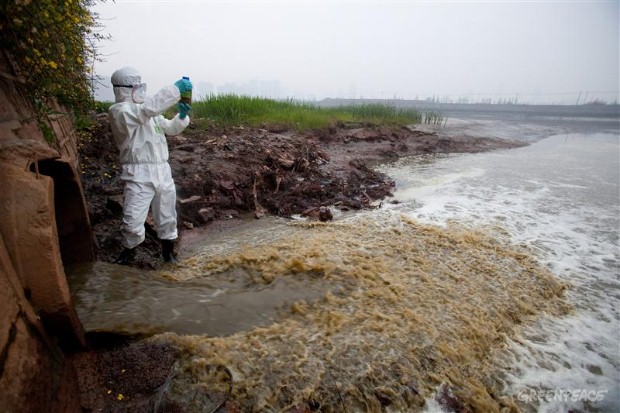
environmental activism, Greenpeace, Dirty Laundry, Zara, Fast Fashion, pollution, ChinaSpanish fast fashion company Zara has come under intense fire recently for failing to address a Greenpeace report released last year outlining the textile industry’s deleterious impact on China’s waterways. Called Dirty Laundry, the report unveiled that persistent and bio-accumulative hazardous chemicals with hormone-disrupting properties are released into the same water that residents rely on for their livelihoods.

Several other clothing manufacturers rose to the environmental advocacy group’s challenge to clean up their act. Zara’s failure to do the same has resulted in a massive global campaign to besmirch the firm and pressure its leadership to re-evaluate their environmental policies.

environmental activism, Greenpeace, Dirty Laundry, Zara, Fast Fashion, pollution, China

This sign outside a Zara store in Israel reads “Fashion is not Pollution”

Zara = Poison?

Last week Greenpeace initiated an international campaign to pressure Zara to incorporate a more responsible approach to its production and activists everywhere are spreading the message – even on the company’s Facebook page, where slogans such as ZARA = POISON have proliferated in the last few days.

Greenpeace sent Zara clothing to be tested in independent laboratories and discovered that many of the chemicals found in China’s polluted waterways are present in the world’s largest clothing companies products.

Children’s jeans, for example, are made with dyes that release a carcinogenic amine under certain conditions, as well as nonylphenol ethoxylates that break down in the environment as toxic hormone-disrupting chemicals.

Given that the they develop a new line every two weeks and produces 850 million garment pieces every year, Zara has a profound environmental impact. But if the textile giant commits to reducing their impact, their influence could have a positive overall impact on the industry.

Zara under fire

“That is why we singled out Zara as the next brand to lead us on the road toward a toxic-free future,” Greenpeace said in a recent press release.

“Its sheer size and scale mean Zara is ideally positioned to be a catalyst for wider change within the clothing industry. Suppliers listen to brands like Zara because they provide them with such huge amounts of business, and as an industry leader it is clear that where Zara go, others will soon follow.”

When the initial Dirty Laundry report was released, Greenpeace named a host of other companies in the industry that are also guilty of having few to no substantial chemical control protocols designed to mitigate their environmental impact.

Of those, a small handful have stepped up and provided Greenpeace with firm dates by which time they plan to switch out harmful chemical processes for something that is less toxic – both environmentally and socially.

Marks & Spencer, for example, have committed to release pollution data from several of its suppliers by February 2013,” Greenpeace reports.

“Another close competitor, H&M, has given a concrete date for when it will phase out PFCs – one of the most hazardous chemical groups used by the sector. H&M says this is possible by 1st January 2013, so what’s to stop Zara from doing the same for this and other chemicals of concern currently being used to make its clothes?”

Tafline Laylin
Tafline Laylinhttp://www.greenprophet.com
As a tour leader who led “eco-friendly” camping trips throughout North America, Tafline soon realized that she was instead leaving behind a trail of gas fumes, plastic bottles and Pringles. In fact, wherever she traveled – whether it was Viet Nam or South Africa or England – it became clear how inefficiently the mandate to re-think our consumer culture is reaching the general public. Born in Iran, raised in South Africa and the United States, she currently splits her time between Africa and the Middle East. Tafline can be reached at tafline (at) greenprophet (dot) com.

Read More

TRENDING

Dior’s Summer 2027 show promises sustainability. Do we believe them?

Dior highlights recycled materials, regenerative agriculture, circularity initiatives, and digital traceability, but the luxury fashion business model still depends on constant consumption, global supply chains, fashion shows, and high-carbon production.

Zentera drops “ethical wool” claim after PETA exposé into ZQ-certified farms

The New Zealand Merino Company, now rebranded as Zentera, has quietly removed the phrase “world’s leading ethical wool brand” from its website, a notable change that comes after a disturbing investigation by PETA Asia-Pacific into the company’s ZQ-certified wool supply chain, PETA reports to Green Prophet.

PETA pressures H&M to ban mohair again after new farm abuse investigation

Remember PETA? The group of animal activists that threw...

What Makes Artificial Turf Like AstroTurf Safe? University Research and Independent Testing Reveal Key Factors

A comprehensive analysis published by AstroTurf experts on turf field safety identifies several critical factors that separate premium synthetic surfaces from standard installations.

Endangered sperm whale washes ashore in southern Israel

A large sperm whale has washed ashore on Zikim Beach in southern Israel, marking only the eighth documented case of its kind along the country’s Mediterranean coast since monitoring began.

Yerukim Forms a New Green Economy Where the Money is Really Green

The Yerukim members who pick up the recyclables get to keep the monetary reward, the public earns "green" bills that can be used in shops, and business owners get to be associated with environmentalism.

Choosing Riyadh over Dubai? What Investors Should Know

Saudi Arabia is deploying capital at unmatched scale to catalyze tourism and advanced industry while rewiring its power-and-water backbone. The investable frontier is widening—especially in renewables, grid storage, water efficiency/desal retrofits, and hospitality operating platforms. Prudent investors will insist on phased delivery, enforceable KPIs (energy, water, biodiversity), and RHQ/zone compliance—while pricing political-economy and reputational risks alongside growth upside.

Sell your cooking oil for biodiesel money

Want to make money on old french fry oil? Sell it.

Qatar Alternative Energy Summit Pairs Investors And Innovators

Alternative energy investors and innovators can meet n' greet in Doha, Qatar March 16 and 17.

Here’s How To Implement The Four Pillars Of Employee Engagement

If you throw a party for your work team and they are vegans, don't make it a barbecue. Know the sustainability values of your team to boost moral and retain good people.

Locals From Rishon Fight IKEA

Big Box stores are a pretty new concept in Israel, and thank God that not every Israeli city wants them in their backyard. A word from someone who has see the beautiful farmland around her hometown Newmarket, Ontario stripped and converted into vulgar strip malls of big box shops: they have no place in a healthy and sustainable town or city.

The Jewish National Fund Meets An Inconvenient Truth

According to the JNF, it has transformed thousands of acres of barren land into green forests in Israel. They state that each person emits about 23 tons of carbon per year, estimating that each tree planted can absorb one ton of carbon in its lifetime. That's a whole lot of trees you'd need to be planting. Could so many fit in Israel?

How to quiet noise from construction in your office

Streets need to be resurfaced in New York but the humming and grinding noise is unsettling. Noise is environmental pollution. 

Popular Categories