“In the midst of uncertain time, renewable energy remains consistent and steadfast in its expansion,” said Francesco La Camera, IRENA’s Director-General. “A more decentralised energy system, with a growing share of renewables and more market players, is structurally more resilient.”
Health insurance is a regulated financial product. Insurers operate under binding contracts, overseen by state insurance commissioners, that legally obligate them to pay claims meeting policy terms. Policyholders who believe a covered claim was wrongfully denied have legal recourse through state regulatory channels.
The New Zealand Merino Company, now rebranded as Zentera, has quietly removed the phrase “world’s leading ethical wool brand” from its website, a notable change that comes after a disturbing investigation by PETA Asia-Pacific into the company’s ZQ-certified wool supply chain, PETA reports to Green Prophet.
Somehow vegetables with short seasons excite the imagination and appetite more sharply than produce that’s available all year around. Good Middle Eastern cooks have many recipes for delicate fava beans, and this turmeric-fragrant soup is one.
“In the midst of uncertain time, renewable energy remains consistent and steadfast in its expansion,” said Francesco La Camera, IRENA’s Director-General. “A more decentralised energy system, with a growing share of renewables and more market players, is structurally more resilient.”
Health insurance is a regulated financial product. Insurers operate under binding contracts, overseen by state insurance commissioners, that legally obligate them to pay claims meeting policy terms. Policyholders who believe a covered claim was wrongfully denied have legal recourse through state regulatory channels.
The New Zealand Merino Company, now rebranded as Zentera, has quietly removed the phrase “world’s leading ethical wool brand” from its website, a notable change that comes after a disturbing investigation by PETA Asia-Pacific into the company’s ZQ-certified wool supply chain, PETA reports to Green Prophet.
Somehow vegetables with short seasons excite the imagination and appetite more sharply than produce that’s available all year around. Good Middle Eastern cooks have many recipes for delicate fava beans, and this turmeric-fragrant soup is one.
“In the midst of uncertain time, renewable energy remains consistent and steadfast in its expansion,” said Francesco La Camera, IRENA’s Director-General. “A more decentralised energy system, with a growing share of renewables and more market players, is structurally more resilient.”
Health insurance is a regulated financial product. Insurers operate under binding contracts, overseen by state insurance commissioners, that legally obligate them to pay claims meeting policy terms. Policyholders who believe a covered claim was wrongfully denied have legal recourse through state regulatory channels.
The New Zealand Merino Company, now rebranded as Zentera, has quietly removed the phrase “world’s leading ethical wool brand” from its website, a notable change that comes after a disturbing investigation by PETA Asia-Pacific into the company’s ZQ-certified wool supply chain, PETA reports to Green Prophet.
Somehow vegetables with short seasons excite the imagination and appetite more sharply than produce that’s available all year around. Good Middle Eastern cooks have many recipes for delicate fava beans, and this turmeric-fragrant soup is one.
“In the midst of uncertain time, renewable energy remains consistent and steadfast in its expansion,” said Francesco La Camera, IRENA’s Director-General. “A more decentralised energy system, with a growing share of renewables and more market players, is structurally more resilient.”
Health insurance is a regulated financial product. Insurers operate under binding contracts, overseen by state insurance commissioners, that legally obligate them to pay claims meeting policy terms. Policyholders who believe a covered claim was wrongfully denied have legal recourse through state regulatory channels.
The New Zealand Merino Company, now rebranded as Zentera, has quietly removed the phrase “world’s leading ethical wool brand” from its website, a notable change that comes after a disturbing investigation by PETA Asia-Pacific into the company’s ZQ-certified wool supply chain, PETA reports to Green Prophet.
Somehow vegetables with short seasons excite the imagination and appetite more sharply than produce that’s available all year around. Good Middle Eastern cooks have many recipes for delicate fava beans, and this turmeric-fragrant soup is one.
“In the midst of uncertain time, renewable energy remains consistent and steadfast in its expansion,” said Francesco La Camera, IRENA’s Director-General. “A more decentralised energy system, with a growing share of renewables and more market players, is structurally more resilient.”
Health insurance is a regulated financial product. Insurers operate under binding contracts, overseen by state insurance commissioners, that legally obligate them to pay claims meeting policy terms. Policyholders who believe a covered claim was wrongfully denied have legal recourse through state regulatory channels.
The New Zealand Merino Company, now rebranded as Zentera, has quietly removed the phrase “world’s leading ethical wool brand” from its website, a notable change that comes after a disturbing investigation by PETA Asia-Pacific into the company’s ZQ-certified wool supply chain, PETA reports to Green Prophet.
Somehow vegetables with short seasons excite the imagination and appetite more sharply than produce that’s available all year around. Good Middle Eastern cooks have many recipes for delicate fava beans, and this turmeric-fragrant soup is one.
“In the midst of uncertain time, renewable energy remains consistent and steadfast in its expansion,” said Francesco La Camera, IRENA’s Director-General. “A more decentralised energy system, with a growing share of renewables and more market players, is structurally more resilient.”
Health insurance is a regulated financial product. Insurers operate under binding contracts, overseen by state insurance commissioners, that legally obligate them to pay claims meeting policy terms. Policyholders who believe a covered claim was wrongfully denied have legal recourse through state regulatory channels.
The New Zealand Merino Company, now rebranded as Zentera, has quietly removed the phrase “world’s leading ethical wool brand” from its website, a notable change that comes after a disturbing investigation by PETA Asia-Pacific into the company’s ZQ-certified wool supply chain, PETA reports to Green Prophet.
Somehow vegetables with short seasons excite the imagination and appetite more sharply than produce that’s available all year around. Good Middle Eastern cooks have many recipes for delicate fava beans, and this turmeric-fragrant soup is one.
“In the midst of uncertain time, renewable energy remains consistent and steadfast in its expansion,” said Francesco La Camera, IRENA’s Director-General. “A more decentralised energy system, with a growing share of renewables and more market players, is structurally more resilient.”
Health insurance is a regulated financial product. Insurers operate under binding contracts, overseen by state insurance commissioners, that legally obligate them to pay claims meeting policy terms. Policyholders who believe a covered claim was wrongfully denied have legal recourse through state regulatory channels.
The New Zealand Merino Company, now rebranded as Zentera, has quietly removed the phrase “world’s leading ethical wool brand” from its website, a notable change that comes after a disturbing investigation by PETA Asia-Pacific into the company’s ZQ-certified wool supply chain, PETA reports to Green Prophet.
Somehow vegetables with short seasons excite the imagination and appetite more sharply than produce that’s available all year around. Good Middle Eastern cooks have many recipes for delicate fava beans, and this turmeric-fragrant soup is one.
“In the midst of uncertain time, renewable energy remains consistent and steadfast in its expansion,” said Francesco La Camera, IRENA’s Director-General. “A more decentralised energy system, with a growing share of renewables and more market players, is structurally more resilient.”
Health insurance is a regulated financial product. Insurers operate under binding contracts, overseen by state insurance commissioners, that legally obligate them to pay claims meeting policy terms. Policyholders who believe a covered claim was wrongfully denied have legal recourse through state regulatory channels.
The New Zealand Merino Company, now rebranded as Zentera, has quietly removed the phrase “world’s leading ethical wool brand” from its website, a notable change that comes after a disturbing investigation by PETA Asia-Pacific into the company’s ZQ-certified wool supply chain, PETA reports to Green Prophet.
Somehow vegetables with short seasons excite the imagination and appetite more sharply than produce that’s available all year around. Good Middle Eastern cooks have many recipes for delicate fava beans, and this turmeric-fragrant soup is one.
It was once a subject that some employers would have never breached. Now, it has become the new normal and for many of us, our homes feel as though they have become our permanent office space. And, well, they have. New backyard or basement offices. Tiny homes as offices. The whole idea sounds ideal but what if you have to hear your space or keep it cool? There are energy costs to consider.
Of course, while it has the obvious (pajama) benefits, there are some practical considerations that are starting to become more prominent. Many of us have gone from spending a few awake hours in a home, to the whole day. Ultimately, our energy bills are only going one way.
Bearing this in mind, today’s post is all about how you can send the costs of your energy plummeting if you are one of the many who are now working at home.
Easy infrastructure hacks
Firstly, don’t underestimate the ‘classic’ fixes. By these, we’re talking about the likes of insulation, double glazing and even draught stoppers.
All of the above has been contained in energy-saving guides for years, but if you are suddenly based at home all day, every day, the difference over the course of a year can be considerable.
About your boiler
For years, we have been told to consider energy efficient boilers – and for good reason.
However, this is only the tip of the iceberg when it comes to making the most of your boiler whilst working from home. These hydrogen boiler options might be new but can make a considerable dent in your energy bills (and are great for the planet as well).
Sure, an energy efficient boiler (or an A++ model, depending on where you are based) is an ideal solution in a lot of cases, but there are alternatives.
For example, what about ground or air source heat pumps? Or, if you really want to push technology, what about a hydrogen-fired boiler which have started to emerge?
These options might be new but can make a considerable dent in your energy bills (and are great for the planet as well).
It sometimes comes to opening the blind
OK, this subheading might have been a little understated. However, for many of us, working at home is quickly turning into rolling out of bed and grabbing the laptop. The result? Most of us don’t open the blinds or curtains until mid-morning at best.
Well, this is hurting us from an energy efficiency perspective. Quite often, the flurry of natural light in a morning is enough to gently nudge the temperature higher. Not only that, but particularly now we are in winter, you don’t have to rely on light switches as much.
Review what electrical devices you are using
Printer, monitor, desktop computer – the list of home working equipment could go on.
Quite often, we don’t use all of this at once though. Some of us will just sit with the laptop on our knee for a morning, while for others the printer only comes out once a week (or less).
As such, don’t leave these devices plugged in. It sounds small, but some sources believe that you could save up to 10% per year from your energy bill by unplugging or turning off switches for devices you are not using.
Remember the tale of Goldilocks? She tried out a few different options until the porridge, the chair and bed fit her just right. Berkey Filters offers several different water filter system sizes for just the right fit in any situation, but there’s no need to be a modern day Goldilocks. Find all of the information you need right here!
For When You’re On the Road
The smallest size is the Travel Berkey, and it lives up to its name. This one is ideal for those on the road. At a holding capacity of 1.5 gallons, it’s the perfect size for RV’s or camping. It best serves households that have one to three people. It sits at 19 inches tall and 7.5 inches wide. When the upper chamber is nested in the lower chamber it’s a compact 11 inches by 7.5 inches. The Travel Berkey holds a maximum of two black Berkey Filters and can accommodate two fluoride filters.
The Best Seller
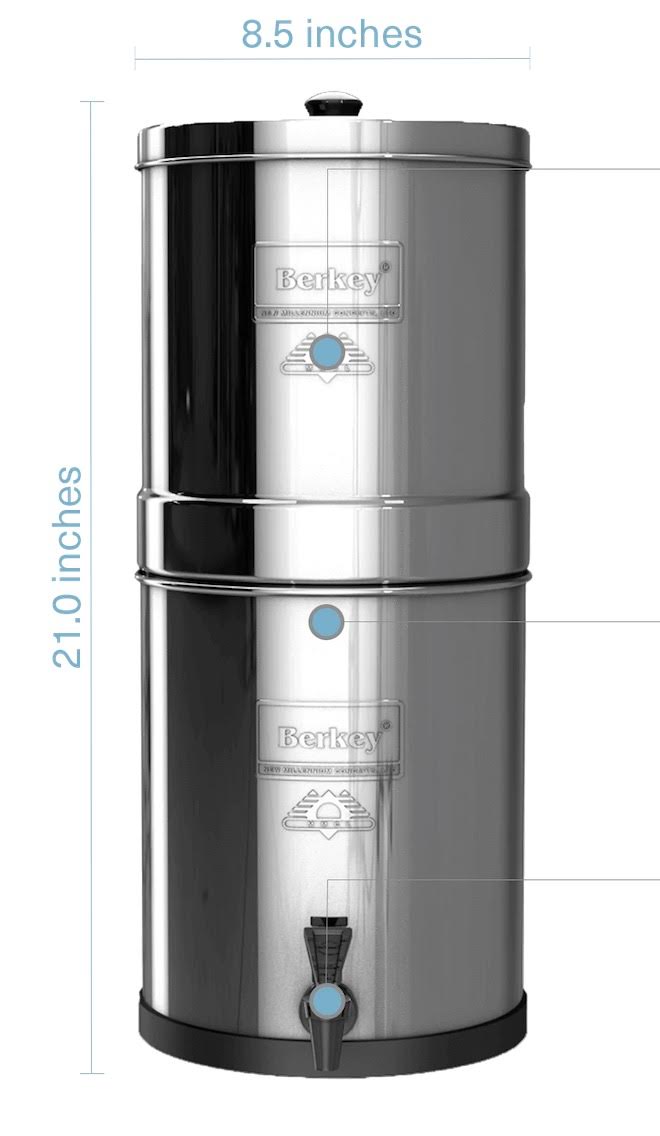
Everyone’s favorite is the Big Berkey. Perfect for couples and small families, it’s versatile and accommodates just about any situation. The Big Berkey holds 2.25 gallons and is 21 inches tall by 8.5 inches wide. It comes with two Black Berkey filters, but can hold up to four. Couples or families are easily served by the Big Berkey. It’s also great for active individuals who drink a lot of water or frequently have guests over. For storage or transport, the upper chamber fits into the lower chamber to make it 13 inches by 8.5 inches. First-time buyers usually purchase a Big Berkey because it’s suitable for many living situations.It’s no surprise to see Big Berkey top the list of best countertop filters on the market, according to Waterfilterspot.
The Light (Plastic) Option
The Berkey Light holds 2.75 gallons. It’s called the Berkey Light because it weighs less than its counterparts at seven pounds when empty. It is made of high quality, BPA free, food-grade, co-polyester plastic. It sits at a height of 28 inches and 9 inches wide. It is the only system that comes with a base, elevating it six inches. The Berkey Light is for those who hate surprises. The ability to see through the chambers removes any guessing of how much water is in the Berkey and when it’s time for a refill. It can hold up to four black Berkey filters. The Berkey Light works well for households of two people up to six people.
For Large Families & Offices
A step up in water filtering capacity is the Imperial Berkey. It holds 4.5 gallons and is the first model to allow up to six black Berkey Filters, which also means it can hold up to six fluoride filters. The Imperial Berkey is 10 inches wide and 27 inches tall. When needed it can collapse to 10 inches by 19 inches. Large families or families with high water consumption are easily supplied with plenty of water. This is also a great option for small offices. Offer employees and patrons the purest water for a great experience.
The Biggest Berkey of All
Sitting at a tall 31 inches and 11 inches across the Crown Berkey is the largest option. It holds a massive six gallons and eight black Berkey Filters. The Crown Berkey serves eight or more people like it’s nothing. That’s a lot of water! In an emergency situation, the Crown Berkey could provide enough drinking water for up to 150 people. This is for those who are extra thirsty or use Berkey water for everything–drinking, cooking, pets, watering plants, washing produce, canning, filling humidifiers, and whatever else. It would also be a great option for offices to keep employees hydrated or for yoga studios to offer participants.
For Hikers and Backpackers
Don’t forget about the smaller, mobile options like the Go Berkey Kit holding one quart of water and the Berkey Sport bottle which holds 22 ounces. The Go Berkey Kit is 14 inches tall by 4 inches wide. The Sport Berkey dimensions are 11 inches by 2.5 inches.
BerkeyFilters.com offers several options for the right-sized system. Between the six different systems there are options for one person, all the way up to a dozen people.
Photomicrograph of shell structures. The mechanism that controls the creation of shells is still a mystery. Pali Nalu / Flickr
Princeton grad Prof. Sigal Abramovich has a mission. She wants to convince global regulators to include regular monitoring of the geochemistry of a certain type of teeny tiny shell of marine organisms (called forams) as an indicator of pollution in the ocean. She is in Israel studying the effects of desalination pollution, like heavy metals on the marine environment. And quantifying it from shells a the seashore near where effluent is produced.
Looking at the tiny shells or foraminifera, “We have been able to quantify the amounts of heavy metals pollution injected by the brine discharge from desalination plants across the Mediterranean coast of Israel,” explains Prof. Abramovich.
“Our research demonstrates the potential of using heavy metals anomalies in foraminiferal shells as a tool for detecting the industrial footprint of coastal facilities including areas that were considered clean nature reserves.”
What are forams?
Foraminifera (forams for short) are single-celled organisms (protists) with shells or tests (a technical term for internal shells). They are abundant as fossils for the last 540 million years.
In a series of studies over the past three years, Abramovich and her team from Ben Gurion University, The Israel Oceanographic and Limnological Research Institute and the Geological Survey of Israel have found that foraminifera found on the ocean floor store evidence of the pollution around them within their shell formation.
Coastal infrastructure makes the marine ecosystem susceptible to incidental industrial metal introduction that, even if relatively short-term, could stress local ecosystems or affect the water quality. Traditional monitoring methods are insensitive to these events, and thus better and more comprehensive monitoring methods are required.
Sigal Abramovich
Foraminifera are unicellular organisms that produce calcite shells directly from seawater. They are among the most ancient and abundant fossils and their calcite shells accumulate in mass quantities in oceanic sediments and thus become one of the most important components of sedimentary (carbonate) rocks.
Their shells record the chemical and physical properties of their seawater, providing the basis for most climate research. This is the reason why foraminifera are considered one of the most important archives of ancient and modern oceans.
Foraminifera build their shells by sequential addition of chambers and each shell thus represents a natural monitoring sequence recording heavy metals in the ambient seawater over months. This chronological documentation of heavy metals in the seawater allows the recognition and quantification of short-term pollution events, and, since foraminifera are abundant, small and their shells are preserved after death, the monitoring can be carried out retroactively and at high spatial resolution.
She is working with an international network of oceanographers to encourage countries around the world to adopt regular foraminifera monitoring based on the methods developed in her lab.
Her research has been supported by the Israeli Ministry of Science through the BMBF-MOST program, by a GIF (German-Israeli Foundation for Scientific Research and Development) grant and the Israel Science Foundation.
Like rings on a tree, telling pollution story
An environmental record from the sea
As the animal grows, its home—the protective shell that surrounds it—must get bigger, and so they grow their shells layer upon layer, creating ‘growth-bands’, or growth increments, within the shell, according to Science. Some of these growth increments are visible on the external surface of the shell, while others are only visible in the internal structure.
But the interesting thing about the growth increments is that their width, or thickness, is affected by environmental conditions, like temperature. Some growth increments are a reflection of tidal cycles, some show annual periodicity. So the series of growth increments within a shell are essentially a record of the animal’s lifetime and, similar to the study of tree-rings, some scientists study them to make interpretations about the environment where that animal lived and grew.
The chemical characteristics are significant too—other metals, like magnesium (Mg2+) or strontium (Sr2+) can substitute for the calcium in the calcium carbonate, and this often depends on environmental conditions like temperature or salinity. Heavy metals incorporated into the shell can provide a record of environmental contamination or pollution.
New research from the University of Oxford predicts that total electricity generation across the African continent will double by 2030, with fossil fuels continuing to dominate the energy mix – posing potential risk to global climate change commitments.
The study, published in Nature Energy, uses a state-of-the art machine-learning technique to analyse the pipeline of more than 2,500 currently-planned power plants and their chances of being successfully commissioned. It shows the share of non-hydro renewables in African electricity generation is likely to remain below 10% in 2030, although this varies by region.
‘Africa’s electricity demand is set to increase significantly as the continent strives to industrialise and improve the wellbeing of its people, which offers an opportunity to power this economic development through renewables’ says Galina Alova, study lead author and researcher at the Oxford Smith School of Enterprise and the Environment.
‘There is a prominent narrative in the energy planning community that the continent will be able to take advantage of its vast renewable energy resources and rapidly decreasing clean technology prices to leapfrog to renewables by 2030 – but our analysis shows that overall it is not currently positioned to do so.’
The study predicts that in 2030, fossil fuels will account for two-thirds of all generated electricity across Africa. While an additional 18% of generation is set to come from hydro-energy projects. These have their own challenges, such as being vulnerable to an increasing number of droughts caused by climate change.
The research also highlights regional differences in the pace of the transition to renewables, with southern Africa leading the way. South Africa alone is forecast to add almost 40% of Africa’s total predicted new solar capacity by 2030.
‘Namibia is committed to generate 70% of its electricity needs from renewable sources, including all the major alternative sources such as hydropower, wind and solar generation, by 2030, as specified in the National Energy Policy and in Intended Nationally Determined Contributions under Paris Climate Change Accord,’ says Calle Schlettwein, Namibia Minister of Water (former Minister of Finance and Minister of Industrialisation). ‘We welcome this study and believe that it will support the refinement of strategies for increasing generation capacity from renewable sources in Africa and facilitate both successful and more effective public and private sector investments in the renewable energy sector.’
Minister Schlettwein adds: ‘The more data-driven and advanced analytics-based research is available for understanding the risks associated with power generation projects, the better. Some of the risks that could be useful to explore in the future are the uncertainties in hydrological conditions and wind regimes linked to climate change, and economic downturns such as that caused by the COVID-19 pandemic.’
The study further suggests that a decisive move towards renewable energy in Africa would require a significant shock to the current system. This includes large-scale cancellation of fossil fuel plants currently being planned. In addition, the study identifies ways in which planned renewable energy projects can be designed to improve their success chances – for example, smaller size, fitting ownership structure, and availability of development finance.
‘The development community and African decision makers need to act quickly if the continent wants to avoid being locked into a carbon-intense energy future’ says Philipp Trotter, study author and researcher at the Smith School. ‘Immediate re-directions of development finance from fossil fuels to renewables are an important lever to increase experience with solar and wind energy projects across the continent in the short term, creating critical learning curve effects.’
We all want to do our bit for the environment and the first place you can start is with your home. A few changes here and there can lower your carbon footprint, reduce your emissions and make your living space a little greener for all.
Here are just a few tips to consider to give your home an eco-friendly makeover this year – some are quick changes you can make and some require a little thought and investment on your part.
Swap your white goods for eco-friendly models
While we know this is a pretty steep investment, you’ll save money in the long run and you won’t be consuming as much energy or damaging the environment. Plus, you can also store your old washing machine or fridge in a storage unit until you can sell it – these come in all shapes and sizes, with even locker sized units available to keep a single white good safe for sale.
It’s time to ditch the halogens in the kitchen and bathroom! These light bulbs gobble up energy, increasing your carbon footprint. Instead, look for LED light bulbs that are energy efficient while still providing a bright glow in the room.
Turn down the thermostat
It’s time to dig out the blankets and those oversized jumpers in favour of cranking the heating up. The recommended temperature for a home to keep it eco friendly is 18°C, which should keep things toasty when paired with snuggly knitwear.
Skip the tumble dryer
When you just want to get those towels dry or the bedding washed and ready to go back on the bed, it’s sorely tempting to throw everything in the tumble dryer. But these devices are not great for the environment. If you can hang your washing outside, that’s preferred – or put them near a radiator or window where they can dry quicker.
Look into solar panels
These are more of an investment – but there are schemes out there that can help the cost of solar panels. Plus, once installed, you can sign up for the Smart Export Guarantee which means energy companies buy spare power from you – so you could even make some money back over time! Solar energy is renewable, green and panels can increase the value of your home – so it’s definitely an eco-friendly option to consider.
Trap the heat
In the midst of winter, we want to keep our homes as warm as possible – especially if we’ve turned the thermostat down. This means taking it upon ourselves to block any draughts that may be getting in. Blackout curtains, insulating blinds and draught excluders along the bottom of doorways are just three easy ways to trap heat and make your home a little more energy efficient.
It’s also worth looking into loft insulation if yours doesn’t have much. Heat rises and can escape through the roof, which means all that energy you’re using to keep your home warm doesn’t count for much. You can buy loft insulation in rolls from a DIY store that can be simply rolled out across the space to trap heat and keep the lower floors cosier.
Try out these tips for an eco-friendly makeover this year and enjoy a greener home for you and your family.
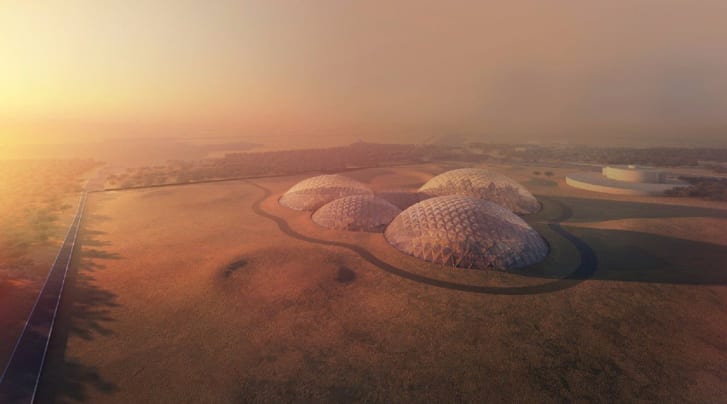
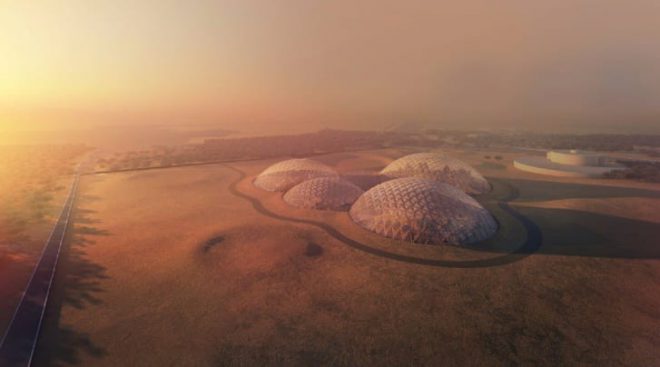
Projected Mars Science City village, United Arab Emirates
Desertification has, according to the United Nations Convention to Combat Desertification (UNCCD), affected the lives of as many as 1.5 billion people, and in the next half-century, will displace around 135 million. Desertification, inarguably, is one of the most challenging environmental problems to overcome.
In this article, we will hope to explain what desertification is, and why you should fight against it. If we all work together, we can fight desertification and save the lives and homes of millions of people.
Desertification Explained
According to the UNCCD, desertification is when land degradation occurs in arid and semiarid areas. It can be caused by a number of factors, including but not restricted to, climatic variations and human activities. If that sounds like jargon to you, then we’ll simplify: desertification, which occurs on every continent in the world (excluding Antarctica), is when the land loses its biological or economic productivity, turning it into, as the name suggests, a desert. Desertification can be devastating for those unfortunate enough to live in regions affected by it. Over time, crops can no longer be sustained, animals have nowhere to graze, and villages and towns become inhospitable to their population.
Areas Affected by Desertification
We must fight back against desertification and reverse its effects while we still can. Libya is a country that is greatly affected by desertification as the environment is 95% desert or semi desert. Libya’s desertification problems have been exacerbated by human activities such as poor land planning and insufficient water resources. Fortunately, efforts to limit the negative effects of desertification have been put in place. These include endeavours to maintain soil fertility, curbing of sand dunes and preservation of rainwater on farm lands with sloping terrains.
For us to fight desertification, we must understand that it is not a third world problem, and rather, one that can affect all of us. You are not safe simply by virtue of living in a developed western nation, and in fact, at least thirteen EU member states have declared that they too have been affected by desertification. The problem even stretches as far as Australia.
How are Australians affected?
Australia has 10 deserts and is extremely prone to long-lasting droughts, particularly in the south of Western Australia. The primary concern for Australians will actually be from the wind. The extra soil created by desertification will be displaced and could cause respiratory diseases from the dust and other air pollutants in the air. We used this website comparing health insurance in Australia to check the terms of a few Aussie health funds. It looks like Aussies will be covered against these types of things if they have private cover, but more than 50% don’t have private insurance, so their treatment options on the public system may not be as fast which puts them at higher risk. The best solution for those concerned in Australia would be to plant trees in reasonable places as the trees help with the reduction of wind and soil erosion, keeping the dirt on the ground.
Why Should We Fight Desertification?
If we do not all come together and begin fighting desertification, millions will be displaced, and the problem will gradually spread across the world. Desertification is indiscriminate and nowhere other than Antarctica is safe from it. Together, we can fight this environmental threat, but only together. If you are reluctant to help, simply look to China’s Taklamakan Desert. Over the next few centuries, the homes of hundreds of millions will look almost indistinguishable from it, potentially even yours.
In this article, we hope to have explained the severity of desertification, what it is, and why we should fight back against it. It is up to us to save the lives of millions and to reverse the damage done by desertification.
In 2017, the Emirates revealed plans to build cities on Mars. It may take four or five generations of scientists to achieve it, each one improving the previous generation’s blueprints as research continues and plans evolve. And I guess Emiratis will be giving the world’s richest man Elon Musk a run for his money as he plans to send a mission to Mars in the next decade. In 2014 we reported that the Emirates wanted to send a spaceship to Mars by 2021, one of their ambitious goals about to be achieved.
Like California City, envisioned as home to a Mars research station and Mars City basecamp by Vera Mulyani, The desert surrounding Dubai provides an ideal testing ground. Barren and dry as Mars itself, there’s plenty of room there for the Mohammed Bin Rashid Space Centre (MBRSC) to establish a project that covers 176,000 square meters. It’s called Mars Science City, and its current budget is estimated at $135 million.
How Mars can look in 100 years.
The architects Bjarke Ingels Group have submitted plans for a prototype Mars Science City to be tested in the Emirati desert. To achieve this first stage, they analyzed the challenges that the hostile Martian environment presents to humans, and conceived solutions for overcoming them.
The first challenges are avoiding the powerful radiation that pierces Mar’s thin atmosphere, the low gravity, and creating an artificial temperature that permits human life. The normal Martian temperature is -63°C (-81°F); a tad chilly for sustaining life. Given the scant air pressure due to the thin atmosphere and low gravity, fluids transform to gas quickly, such that an unprotected person’s blood would boil away.
Other challenges will doubtless arise to be dealt with, but the architect Bjarke Ingels Group has already proposed detailed plans for living on Mars.
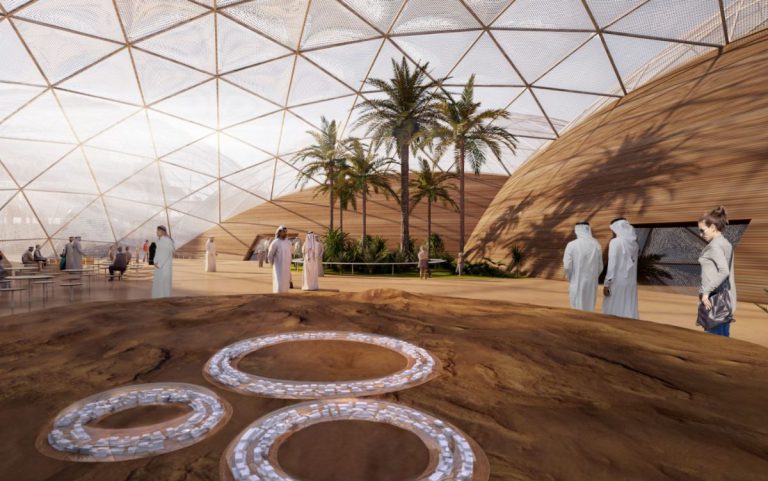
A projected building inside a Martian biodome.
In an interview with CNN, Jakob Lange, partner at Bjarke Ingels Group, gave a picture of how the artificial city would be made habitable. People would live inside of pressurised, oxygen-filled biodomes covered by transparent polyethylene. The oxygen would be made by passing electricity through ice stored underground.
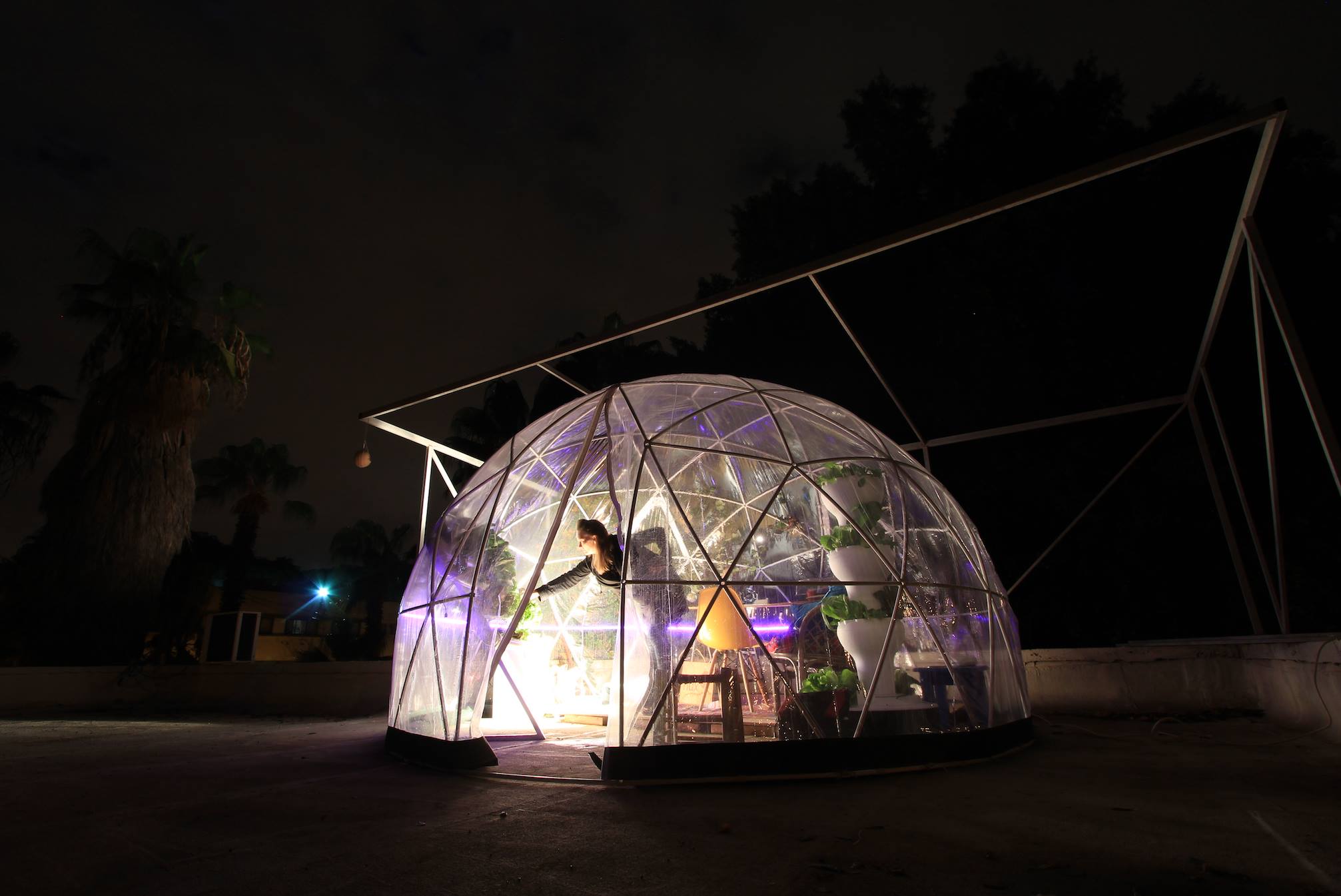
Karin Kloosterman, Green Prophet founder inside a farming biodome she created in Jaffa, Israel on her roof.
Solar energy would power and heat the city, taking advantage of the thin atmosphere to maintain a comfortable warm temperature.
Lange explained, “Since there is very little atmosphere on Mars, the heat transfer will be very low, meaning that the air inside the domes will not cool down as fast as it would on Earth.”
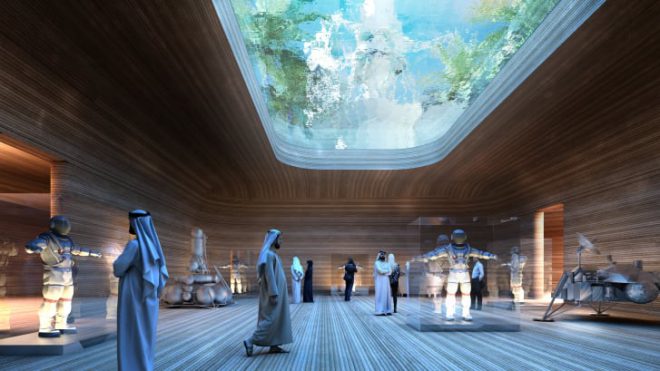
Buildings would be constructed of red Martian soil and 3D-printed. Rooms 20 feet long would be built underground as insurance against radiation, dust storms, and meteor crashes. Light would filter in from water-filled skylights with living fish swimming inside them.
Watery skylight in Mars Science City. The water protects inhabitants from radiation.
“In the future on Mars, you would have skylights in your underground cave that would be like aquariums,” said Lange.
Our great-grandchildren, can expect to see other fantastic forms of buildings on Mars, which has only one third of Earth’s gravity.
“… which means that you can suddenly make columns that are … slimmer and longer,” Lange said. “It creates almost like a completely new rule set that you have to follow when designing architecture in space.”
This brings to mind the covers of sci-fi magazines from the 1960s showing spacecraft hovering over tall, many-turreted buildings, and a huge pockmarked planet glimmering in the background.
Looking even longer into the future, it’s hoped that as the Martian population grows, biodome villages will be built and eventually join to become cities.
Projected Mars Science City village.
The earthly model for the Mars Science Center will be 3D-printed from desert sand and its domes will not be artificially filled with oxygen. But there will be water skylights and solar energy will power it, as projected for the building on Mars. It will contain rooms for a school, a museum, and office spaces, as per the Martian plans. Israelis show us a prototype of a 3D printed home they created for living on Mars.
Vera Mulyani in California is also building a Mars City. Our friend Vera features in this video below:
https://www.youtube.com/watch?v=dtq9Sby-AzU
Past testing grounds for space missions include Antarctica’s Concordia Station, California’s Mojave Desert, where NASA tested Mars rovers, and the Moroccan Sahara, where the European Space Agency created a Mars analog. But the MBRSC hopes that in the future, Mars Science City will be the foremost facility for testing conditions on Mars.
“This is going to be our platform where we can develop the science [and] the technology that will help us in our future missions to Mars,” said Adnan AlRais, Mars 2117 Program Manager at MBRSC. “We want to come up with a totally new facility that will help the international community.”
MBRSC hasn’t given final approval to a design for the Mars Science Centre, nor settled on an architect. They are developing a budget for the project and determining how much desert space it would need.
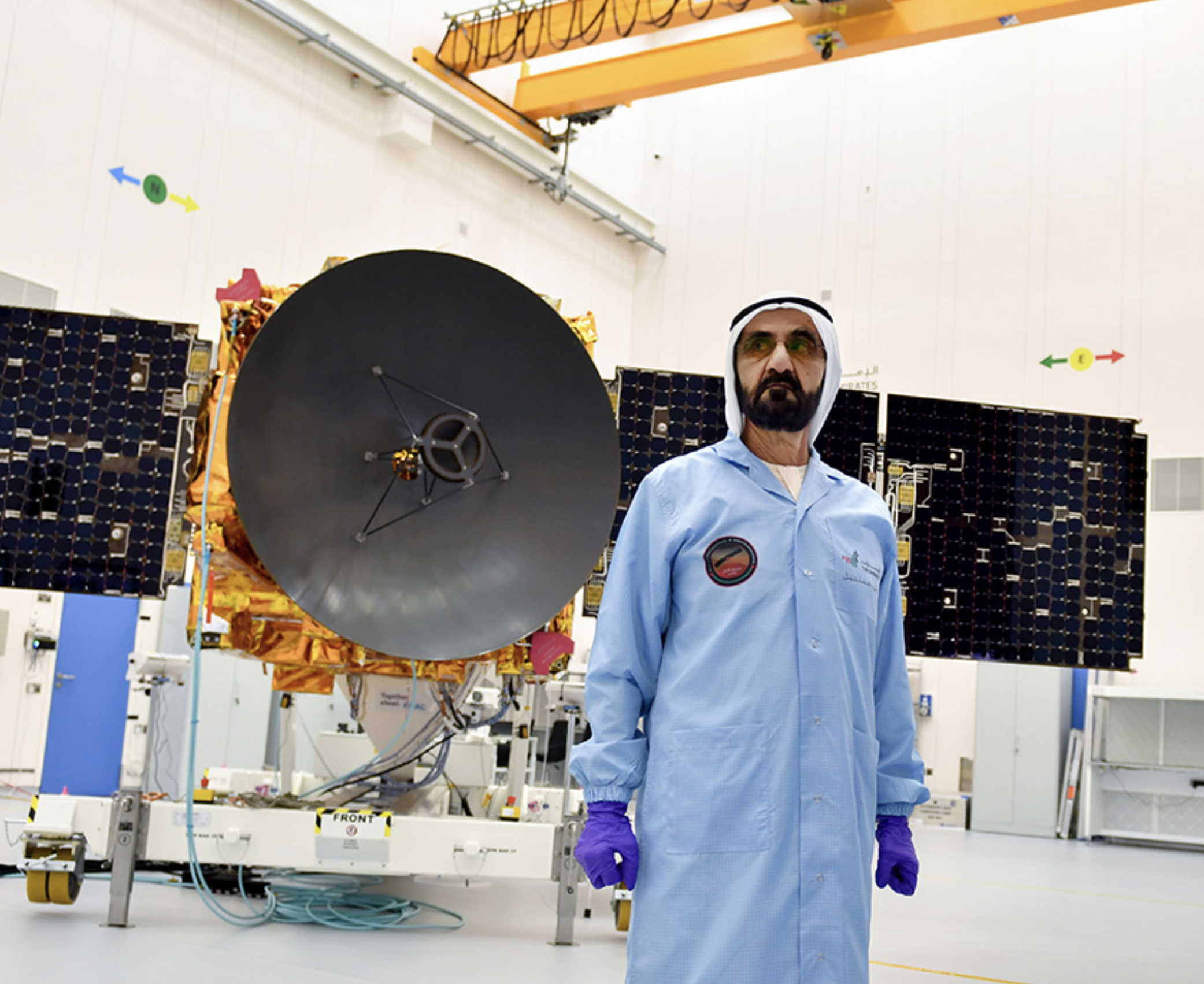
The MBRSC’s space program has been active since 2014. They have sent an astronaut into outer space (September of 2019) and launched a probe to Mars in July 2020. The probe is named Hope and is expected to return in February of this year, loaded with data on Martian conditions.
More plans are to send an Emirati crew member to the international analog mission in Russia that’s to test the effect of isolation and confinement on mental and physical health. The project will take place in November of this year, and will last eight months.
Arab men get their own fashion week. Can they be a brave green voice in an overly polluting industry?
The Dubai-based Arab Fashion Council has pioneered the first men’s fashion week in the Middle East. But will it be eco?
Presented by Arab Fashion Week in partnership with Facebook, Arab Fashion Week- Men’s will run from January 28 to 30. Thereafter, it will take place twice a year each January and June in line with the menswear fashion week calendar.
Reinforcing the Arab Fashion Council’s goal to establish a sustainable platform through which to champion fashion design talent from across the region, both established and emerging menswear designers from the UAE, Lebanon, Qatar, and Iran, have confirmed their participation in Arab Fashion Week- Men’s. A sustainable platform, but will the wear actually be sustainably? Made ethically, to last, with materials that are ecologically sourced?
Furthermore, as part of a strategic partnership between The Arab Fashion Council and The Fédération de la Haute Couture et de la Mode, four emerging menswear designers from Paris Fashion Week Men’s, have been selected to participate in the first Arab Fashion Week- Men’s.
“Emerging brands express a fashion forward view on the world. We are pleased to present some of these talented designers from the Paris Fashion Week calendar in Dubai at Arab Fashion Week-Men’s, to allow them to increase their global reach,” said Serge Carreira, Head of Emerging Brands Initiative, The Fédération de la Haute Couture et de la Mode.
Arab Fashion Week– Men’s will commence on January 28 with designers premiering their collections through their individual expressions of digital creativity on Facebook Live and Instagram Live, allowing 2 billion users all around the world to view and pre-order the designer’s collections direct through Instagram Shopping and the ByTribute luxury marketplace.
Karin Kloosterman, editor and founder of the Middle East sustainable news site Green Prophet says that “finally a recognition that Arab men are fashionable and want to see runway fashion. But how can we weave local traditions into Arab fashion, along with an eco-ethos? Leading American brands ready-to-wear brands like Reformation use sustainable fabrics and deadstock.
“The word sustainable is thrown out too lightly now. Everyone is using it. But what is sustainable? What can menswear creators do to change the polluting face of men’s fashion? Usher in a new reality. We are waiting.”
Arab Fashion Week- Men’s is powered by the Arab Fashion Council’s commitment to the principles of equality and progress across the region.
“Facebook, Inc is pleased to partner with the Arab Fashion Council to present the first Arab Fashion Week- Men’s on Facebook Live and Instagram Live, as part of our combined mission to empower the creative community in the Middle East,” said Joana Jamil, Strategic Partner Manager, MENA, Public Figures & Social Influencers at Facebook.
“As the only official fashion week established within the region, The Arab Fashion Council is thrilled to launch Arab Fashion Week- Men’s and to begin a new journey to shape the future of the emerging menswear market across the Arab world both by nurturing the creativity of regional designers and, through our continued support to international designers wishing to explore opportunities within the region,” said Jacob Abrian, Founder & CEO, The Arab Fashion Council.
Ancient Greek burial stone discovered while clearing paths for nature park in Israel’s Negev Desert reveals period of time in transition
A stone bearing an inscription in Greek from the end of the Byzantine period – around 1400 years ago – was discovered last weekend in the confines of the Nitzana National Park in the Negev Desert in Israel. The flat, round stone, about a foot in diameter, was used as a tombstone in one of the cemeteries surrounding the ancient settlement.
The stone was found by a “Project 500” worker from the Israel Parks and Nature Authority while cleaning and preparing nature paths in the Nitzana National Park. The stone was left at the head of the path when it was noticed by David Palmach, the director of the Nitzana Educational Village, who realized that it bore an inscription. Palmach photographed and collected it to prevent its being looted. He also contacted the Israel Nature and Parks Authority and the Israel Antiquities Authority, and the inscription is being transferred to the National Treasuries Dept.
The inscription was deciphered by Leah Di Segni of the Hebrew University in Jerusalem and it refers to “Blessed Maria, who lived an immaculate life” and died on February 9th.
A time of Islam conquering the region
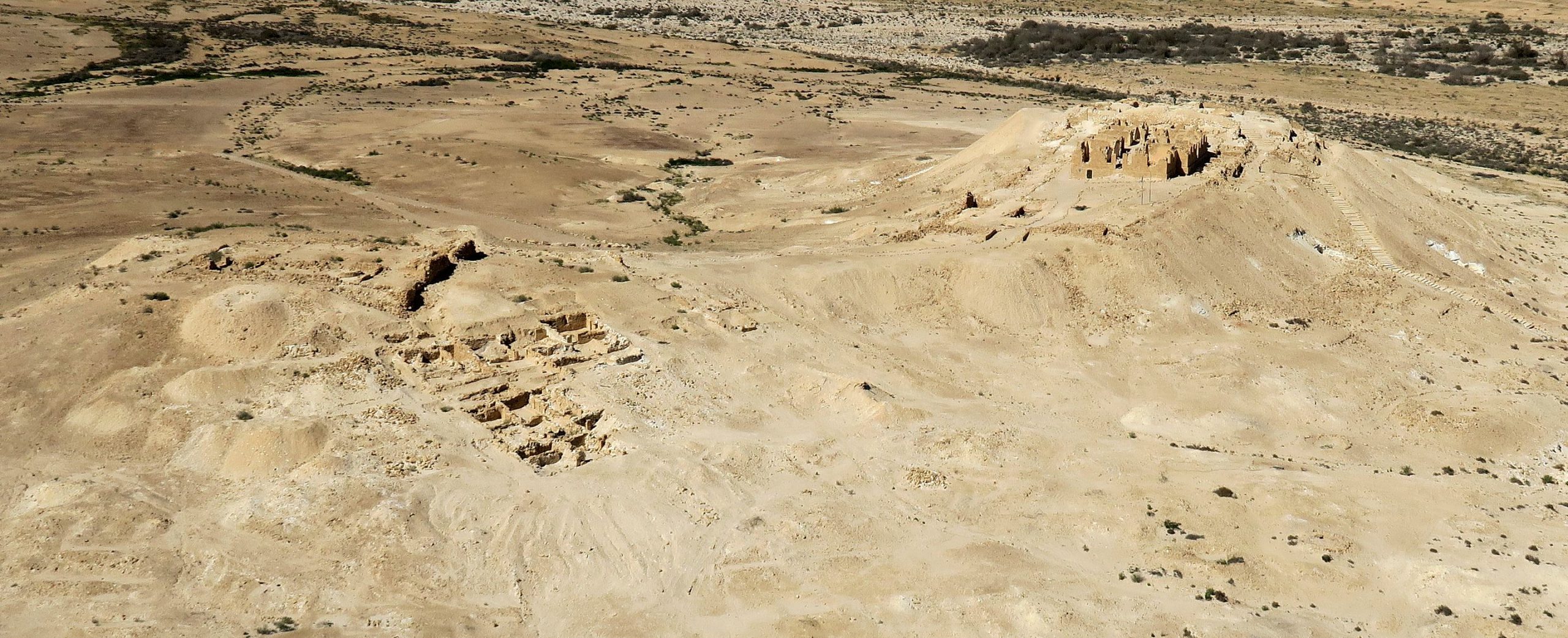
According to Tali Erickson-Gini of the Israel Antiquities Authority, “Nitzana is renowned as a key site in research into the transition between the Byzantine and the Early Islamic periods. During the fifth and sixth centuries CE, Nitzana acted as a center for the villages and settlements in the vicinity. Among other things, it had a military fortress as well as churches, a monastery and a road station that served Christian pilgrims traveling to Santa Katarina, which believers regarded as the site of Mount Sinai.”
Mount Sinai is where Jewish believers say Moses received the 10 Commandments. Nitzana in an aerial photograph below.
According to Dr Erickson-Gini, Nitzana was founded in as early as the third century BCE as a Nabatean road station on a major trade route and the place was inhabited intermittently for about 1300 years, until it was abandoned in the tenth century CE and its name was forgotten.
Archaeological excavations at the site in the 1930s unearthed a papyrus archive, and the name ‘Nessana’ was rediscovered. The burial-stone find, naming the deceased as Maria, joins other stones commemorating Christians buried in the churches and cemeteries around Nizzana that have been unearthed in excavations by the Ben Gurion University of the Negev, among others.
Israel Antiquities Authority Southern District archaeologist Pablo Betzer says, “Unlike other ancient towns in the Negev, very little is known about the burial grounds around Nitzana. The find of any inscription such as this may improve our definition of the cemeteries’ boundaries, thus helping to reconstruct the boundaries of the settlement itself, which have not yet been ascertained.”
It’s common for archeology remnants to be uncovered by civilians in Israel. Especially in the winter time as heavy rains disturb old sands. Remember last year when a boy in Israel found the Bel Air of tombstones while out hiking?
Nitzana was Nabatean too
Nitzana (Hebrew: ניצנה; transliterated at the site as “Nizana”, Byzantine Greek Νιζάνα) is an ancient Nabataean city located in the southwest Negev desert in Israel close to the Egyptian border. It may have been a camel caravan station on the eastern branch of the ancient Incense Route, serving pilgrims and merchants travelling to Sinai or central Egypt.
Gaza built from the ruins of Nitzana
The Nabataean towns of the Negev were typically founded around the first century BC, conquered by Romans two centuries later, who garrisoned the site, and inhabited by Byzantine Christians from at latest the fourth century until the invasion and the Muslim conquest of Syria in the seventh century. Relatively few stones remain on the site because most were recycled into buildings in Gaza in the early 20th century.
We love the Nabateans because they had excellent systems for water capture and reverence for nature. And they built beautiful things like Petra.
The first people to green the desert? Nabateans who built Petra were like the Mayans of the Middle East. The ancient people were developed in agriculture, spirituality and architecture. Archaeologists dig into how they dealt with drought in Jordan, one of the driest countries on earth.
Will you reduce your carbon footprint this year? Meet your eco-match? Maybe it is written in the stars.
Time marches on as it always does. Once again, an old year ends and a new one begins. This time last year, we were all filled with excitement and anticipation over what 2020 would bring. It certainly turned out to be an unusual year, to say the least. Unexpected changes and unprecedented challenges came into play. While some astrological readings foreshadowed upcoming hurdles, extra time for looking inward, and life taking major turns for 2020, no one fully understood the magnitude to which those predictions would come true.
Looking Ahead
This brings us to 2021, and many people are wondering what developments will come to pass for them during the next few months. Quite a few are turning to their Horoscope for the answers they seek. As always, the stars are providing answers as long as we’re willing to look for them. Understanding the finer points of your sign may be the key that unlocks all 2021 holds in store for you.
Aries
First off, Aries are typically brazen and adventurous. By some accounts, 2021 will be the year to use those characteristics to your advantage and pursue some of your greatest aspirations. Maybe a desert trek? Reigning in the standard Aries impertinence and recklessness may be the best approach in some situations, though.
Taurus
Next on the list is Taurus. Those born in this constellation tend to value their peace and quiet and enjoy the calmer sides of life. Good things are sure to come during the new year. Like reading a good book.
Gemini
Busy and ambitious Gemini are known for their mental clarity and fast-paced thought patterns as well as forcing their bodies to keep tempo. This may be a good time to slow down a bit and give yourself a little break.
Cancer
Those born under Cancer are generally balanced and intuitive of other people’s feelings. Considering the past year, your unique (eco) gifts could be extremely helpful to others who need a little grounding and understanding.
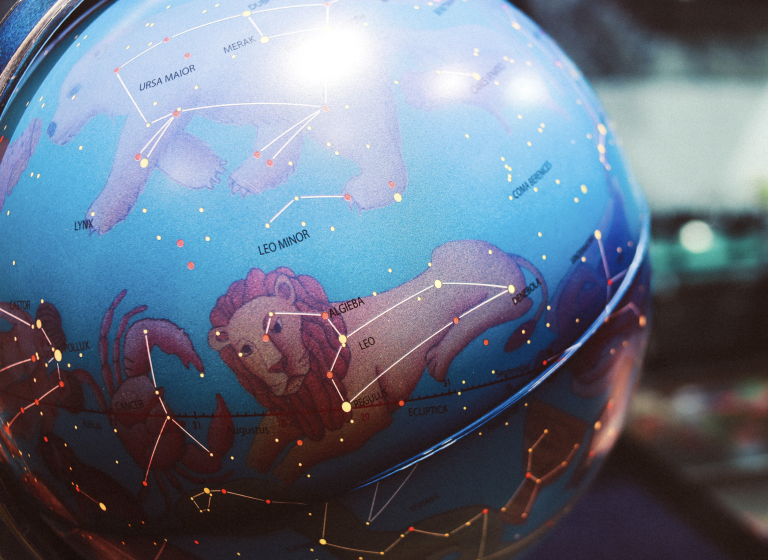
Leo
If you’re a Leo, you’re most likely a cheerful, confident soul filled with passion and drive. No doubt, those traits will propel you to new heights as you stride through the new year with your head held high.
Virgo
As a Virgo, you’re incredibly practical and analytical. Those are important traits to have in most situations. That said, they could lead you to overthink things and cause yourself unnecessary stress as 2021 unfolds.
Libra
Being born under the sign of the scales, Libras are naturally balanced in virtually all aspects of life. While your drive for equilibrium and consistency is almost always a good thing, don’t obsess over those elements too much as you settle into the new normal.
Scorpio
Steeped in the emotional world and usually trying to keep a certain distance from cold reality, Scorpios tend to be viewed as mysterious. This may be a good time to close the gap you often try to create between yourself and others.
Sagittarius
Always apt to try new things and enjoy unusual experiences, those born in Sagittarius are particularly equipped for whatever 2021 may have planned. Embrace your openness, and it will take you far.
Capricorn
For the most part, Capricorns are grounded and realistic. Still, they’re perfectly capable of losing themselves in emotion and fantasy when their practical sides will let them. Don’t let your pessimism get the best of you during the coming months.
Aquarius
Members of the Aquarius sign are independent and generally have unique ways of looking at the world. You’re a giving person and willing to help where you can. Drawing a line between being charitable and being taken advantage of isn’t always easy, though.
Pisces
Pisces are often torn between the solidity of the real world and the beauty of the fantasy realm. This could certainly work out in your favor. Unlike most people, you can allow yourself an effective emotional escape while still keeping one foot planted in reality.
Rushing Headlong into the New Year
As we say goodbye to what was perhaps the strangest year any of us has ever experienced, we can’t help but wonder what is yet to come. Those in each sign of the zodiac are uniquely equipped with traits and characteristics that will be essential to them as well as their loved ones moving forward. Whether you’re a ram, a scorpion, a crab, or anything in between, have no fear, and let yourself live for new experiences during the coming year.
American consumers are more concerned about the planet than steady economic growth, new report. Your company wants to be a part of this. What steps do you take?
Each company should create detailed reports that evaluate the environmental impact of the business, numerous social responsibilities and factors that can improve corporate governance. Once the investors review these reports, the shareholders may provide additional investments, request more information, examine the value of the company and study relevant trends.
Evaluating Corporate Policies That Can Affect the Environment
If a report examines environmental sustainability, the report could describe climate change, the benefits of recycling, numerous types of emissions and the company’s policies. While the experts customize the report, the specialists can also evaluate renewable sources of energy, and many companies have installed cutting-edge equipment that could utilize solar energy, hydroelectric power, windmills and geothermal energy.
According to multiple surveys, more than 82 percent of respondents would like to invest in companies that use renewable energy. Once a business reduces emissions, the company’s policies could significantly improve the reputation of the business, enhance efficiency and decrease long-term expenses. Moreover, several reports have indicated that approximately 73 percent of customers frequently search for companies that utilize renewable resources.
Studying Socioeconomic Factors and Providing Comprehensive Solutions
Generally, the report could examine numerous policies that may affect thousands of employees, and when a business customizes the report, the company’s experts could describe the salaries, the working conditions, the available vacations and the opinions of many employees. While the investors review the report, the shareholders may ensure that the work environment is safe. The investors can also examine equipment that could enhance automation, optimize communication, reduce downtime and improve the cohesiveness of each team.
The report may describe various types of retirement plans, and if a company provides retirement plans, the business could improve the satisfaction of employees, retain many workers and optimize the company’s reputation. Additionally, the company may offer a substantial bonus that could motivate many employees. According to numerous reports, incentives can significantly increase the productivity of the workers, augment the company’s revenue and improve the morale of employees.
Numerous studies have suggested that more than 57 percent of businesses regularly import multiple types of products, and typically, this strategy could considerably reduce each company’s costs. The detailed report should describe international suppliers that provide necessary resources, high-quality products, advanced technology or helpful advice.
Examining Corporate Governance and Reviewing Helpful Guidelines
If a report evaluates corporate governance, the report could describe the corporation’s structure, various types of policies, the company’s directors and numerous regulations. Once the business improvesESG reporting, in the esg framework chosen the experts may also examine guidelines that could protect each customer’s information, and the company could create policies that may prevent the employees from sharing personal data.
After an enterprise provides numerous guidelines, the business could substantially improve transparency, accountability and the company’s efficiency. The business can also increase security, and usually, these strategies may prevent data beaches, improve the company’s reputation and increase the confidence of investors.
Creating Multiple Types of Reports
Once a company gathers important data, the business can hire experts who specialize in ESG reporting, and the specialists could evaluate the interests of investors. These experts may examine the accuracy of the information, compare several types of reports and study detailed statistics. The specialists could also interview many employees, the managers, the directors and the owner of the company, and during several meetings, the experts can discuss the reports, provide informative presentations and answer numerous questions.
Improving the Availability of Each Report
When a business designs a website, the company should create multiple pages that contain the informative reports. Subsequently, the investors can easily find the reports, contact the company and verify many facts. Usually, this strategy could significantly improve transparency, increase the trustworthiness of a business and optimize the company’s reputation.
Neder Khalili (1936 to 2008) was an Iranian-born architect whose vision of sustainable building for the relief of the poor has been realized in communities around the world.
Like the Egyptian architect Hassan Fathy before him, Khalili built homes of earth with thick walls, curves instead of straight lines, and consideration for the needs imposed on residents by their climate. But where Fathy’s system proved unsustainable over the decades, Khalili’s technology seems likely to endure.
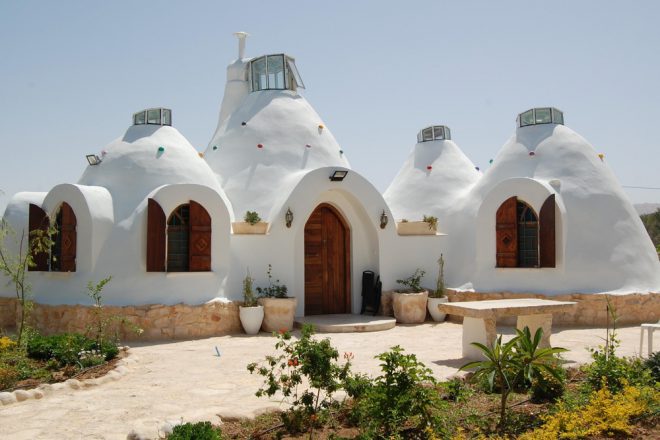
SuperAdobe structures in Colombia.
Khalili escaped Iran as a young man and established his office in California, where he was licensed as an architect in 1970. He taught his theories around the world, reaping recognition and awards for his work.
At the request of NASA in 1984, Khalili developed a technology that could be used to build on Mars and the moon. Eventually it became known as SuperAdobe, a form of architecture using dirt-filled sandbags, barbed wire, plaster, and very little else. Although it first remained a theory, NASA published the plans, which were awarded the Aga Khan Award for Architecture in 2004. We reported more on Khalili’s works and awards, here.
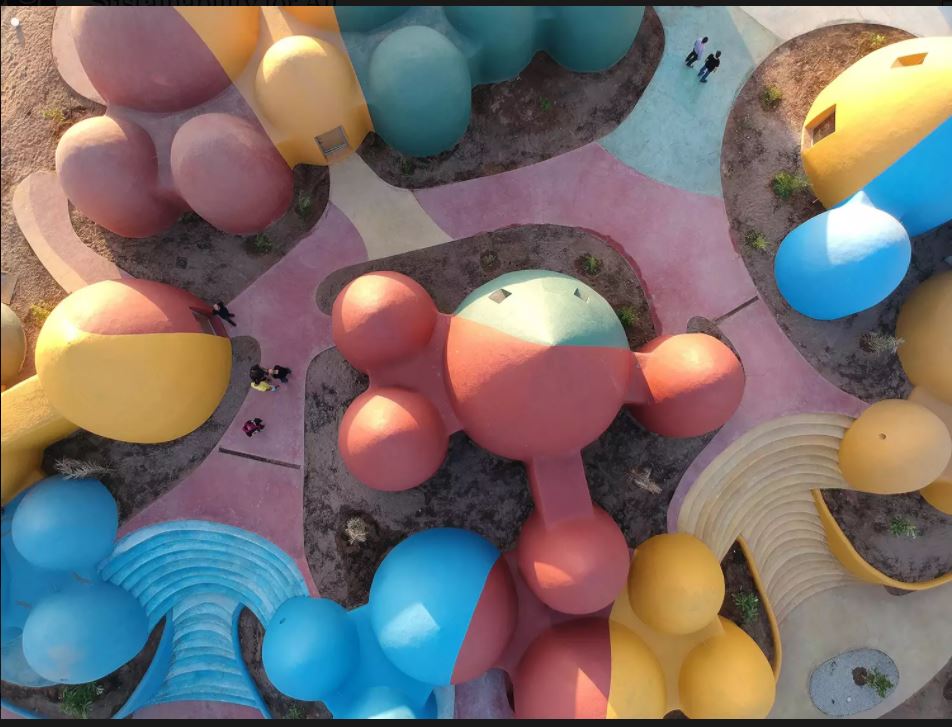
Aerial view superadobe village in Iran.
In practice, SuperAdobe has been used to create homes, community centers, playgrounds and more, in 49 countries and counting. The projects built in the States pass global safety requirements and earthquake code tests in California.
A SuperAdobe community in Jericho.
The Los Angeles Times reported, ““The city (of Hesperia) conducted tests, under the supervision of the International conference of Building Officials, and found that SuperAdobe stood up to twice the amount of weight that would crush a pitched-roof house.”
In 1991 Khalili founded the California Institute of Earth Art and Architecture (Cal-Earth), a non-profit school where he taught the SuperAdobe building technique with the aim of showing ordinary people – not only students of architecture – how to build their own homes from filled sandbags. His daughter and son now run the organization and train teams in theory and practice.
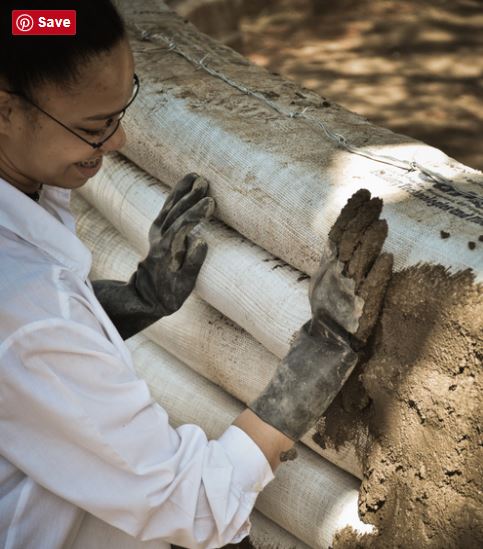
Plastering a SuperAdobe wall.
How SuperAdobe works is explained on the Cal-Earth site:
“Long or short sandbags are filled with moistened earth and arranged in layers or long coils. Strands of barbed wire are placed between each layer of sandbag to act as both mortar and reinforcement. Stabilizers such as cement, lime, or asphalt emulsion may be added. Similar to how a potter stacks coils of clay to make a vessel, builders stack coils of earth to make a structure.
The structural design uses modern engineering concepts like base-isolation and post-tensioning. The long coils of sandbag provide compression (vertical) strength. While the barbed wire adds tensile (horizontal) strength. In addition, the sandbags add flood resistance. The earth itself provides insulation and fire-proofing.”
Supplies needed to build SuperAdobe structures are synthetic, UV resistant degradable sand bags, four-point, two strand, galvanized barbed wire, shovels, tampers, dirt and water.
SuperAdobe village in Iran
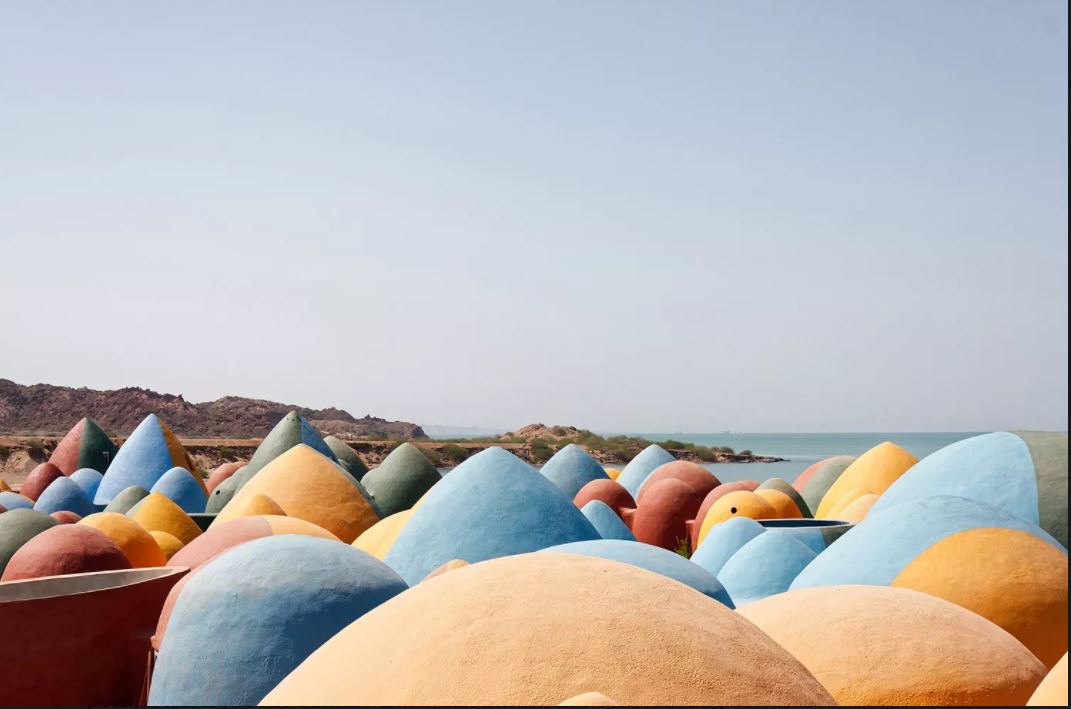
This beautiful domed village was created on the island of Hormuz, in Iran, by the architectural firm Zav Architects, based in Teheran. The residents have traditionally been involved in illegal activities, but the hope is that, having been trained in SuperAdobe construction, they will turn to more acceptable ways of making a living. This is similar to the vision of Hassan Fathy, whose New Gourna village was created to house residents of the original Gourna and guide them to farming and construction trades.
Until the Covid pandemic appeared, Cal-Earth offered courses, hands-on workshops, youth programs, field trips and lectures. All possible classes have been moved online and are available as videos or Zoom sessions now. Visit Caltech for details.
What does Pablo say?
Green Prophet’s friend and advisor, environmental artist Pablo Solomon says:
“People in our part of Texas have made adobe bricks from caliche clay for centuries. It is a naturally occurring mixture of clay and limestone gravel (often small fossils). When it dries in the sun it is incredibly hard. Like all adobe, you must plaster over it to keep the moisture out.
“Also, you might find this interesting–a guy out in Marfa, Texas (near Big Bend National Park) mixes cement, shredded paper and sand to make a light weight concrete for construction by blocks or pouring. The really unique aspect is the way he mixes the composition. He pulls a mixer behind his pick up truck as he drives around and gears attached to the trailer wheels cause the mixer to turn.”
Aura Air signs $30 million deal to supply Japanese market with air purifying system, which has proven to be 99.99% effective in killing COVID-19
An air filtration and disinfection system developed in Israel that kills viruses could bring Japan’s ailing karaoke industry back to life.
Tel Aviv-based startup Aura Air has signed a $30 million deal with Japanese distributor J-TEC to supply the Japanese market with its advanced technology, which is specially designed to purify air in closed spaces. The company’s system has proven to be 99.99% effective at eliminating COVID-19 particles, among other pathogens.
Oren Eliyasov, business development director at Aura Air, told The Media Line that the agreement with J-TEC includes the Japan Karaoke Box Association and other major clients in Japan, such as SMBC Trust Bank and JTB Corporation, one of the largest travel agencies in the country.
“The karaoke association says that there are 100,000 [karaoke] rooms all over Japan,” Eliyasov said. “Currently, most of them are closed due to the coronavirus pandemic.”
Karaoke, which means “empty orchestra” in Japanese, was developed in the Land of the Rising Sun in the 1970s and quickly spread around the world as a popular form of entertainment. In Japan, it has long been a favorite outing for groups of friends and families.
Since the COVID-19 pandemic, however, many karaoke bars in the country have reduced operations or shut down entirely as the industry struggles to stay alive. Karaoke nights generally take place in small crowded rooms, an ideal setting for spreading the novel coronavirus.
Aura Air’s device monitors air quality 24/7 and constantly purifies it, Eliyasov said.
“Basically, we found out that we’re capable of reducing the coronavirus by 99.99%, which gives a lot of confidence to clients and those who would come and sing in the karaoke rooms,” he explained.
Aura Air uses a combination of four filters to completely change the air in a standard-sized room every 2.5 hours. It has a pre-filter to catch large particles and dust, a patented multilayered HEPA filter that includes a carbon-infused fabric, UVC LED lighting to neutralize bacteria and viruses, and a Sterionizer device that produces positive and negative ions to purify air.
Piloted to clean Covid-19 air in hospitals
Founded more than three years ago, the startup recently completed a month-long pilot of its system in Sheba Medical Center at Tel Hashomer in Israel, and also installed its technology in the reception halls of the King of Spain’s Zarzuela Pala.
According to Aviad Shnaiderman, co-founder and CEO of Aura Air, the system is already in use in more than 50 countries, in their hospitals, clinics, educational institutions and public transportation.
“We conducted several clinical tests in hospitals, labs and in universities in Israel,” Shnaiderman told The Media Line. “We proved that we are able to destroy a lot of viruses, bacteria and fungi.”
The COVID-19 pandemic has helped to accelerate Aura Air’s sales worldwide.
“The coronavirus helped us to educate and raise awareness of indoor air quality,” he said. “It did a fast-forward for everything that we believe in and that we claim.”
Measures pollutants real time
What distinguishes the company’s system from others on the market, Shnaiderman added, is that it provides a measurement of pollutants in real-time and that it uses a unique process to filter and disinfect the air.
“It’s an IoT (internet of things) product for smart homes and smart buildings,” he said, explaining: “It connects to the internet, mobile phones and other smart devices and applications.”
The startup’s recent entry into the Japanese market also has a personal story behind it.
“I was traveling in Japan two years ago and had a girlfriend there, which led me to learn Japanese so that I could communicate with her parents,” Eliyasov said. “This led to me falling in love with the culture, people and language over there.”
While the relationship did not last, it did lead Eliyasov to joining Aura Air as a business developer for Japan, which the company hopes will become one of its major markets.
____
This story was first published on the Middle East News Source, The Media Line
A government decision breaks the norms by allowing women to work as cabin crew
Despite Saudi activists going to prison for women’s rights, Saudi Arabian Airlines (Saudia) over the weekend opened the door for Saudi women to work as flight attendants for the first time.
The kingdom’s flag carrier clarified in a statement on Friday that Saudi female applicants must be high school graduates between the ages of 20 and 30, with the “required level of the English language,” that their weight be “proportional to the height in accordance with the standards of Saudi Airlines” and that they pass a medical examination.
Saudia is the third-largest carrier in the Middle East in terms of revenue, behind Emirates and Qatar Airways.
Karema Bokhary, an analyst and academic who was a candidate in Riyadh’s 2015 municipal council elections, suggested to The Media Line that in five years or so, Saudi women might have equal rights, as the society would overcome major obstacles in terms of their rights.
“Allowing Saudi women to work as flight attendants forms a very interesting topic. … I’m going to monitor who’s going to apply and their numbers as well,” Bokhary said.
She explained that historically, Saudi society had forbidden females to work in trades such as saleswomen, much less as flight attendants who were somehow considered servants. “They [Saudis] might consider it a further humiliation for Saudi women as they will have to serve, clean and deal with any requests as it will be their job.”
The decision was a good tipping point in the kingdom, as it normalized the job and made it available for all, women and men, Bokhary said. “Also, the payoff for the job is very high, especially since it opens the way for women who are not university graduates to work. At the same time, the decision will enable them to travel.”
There was great interest within the country regarding women working in new fields and their conditions and pay, “as it’s very important to enable women to support themselves and be productive members of society, rather than burdens,” she continued.
Nevertheless, it was important for Saudi Arabia to preserve its identity amid these major changes, and for Saudi women to protect their identities as well, Bokhary said.
“We don’t want to be like the Western world. I think there’s confusion now, especially since the door was opened all of a sudden and some women are using it to become famous, but eventually this bubble will burst,” she said.
She indicated that the movement to support women’s rights started during the reign of King Abdullah bin Abdulaziz (2005-2015) and made great strides under the current monarch, King Salman bin Abdulaziz. “And Crown Prince Mohammed bin Salman has completely opened the way for women and fully supporting Saudi women, and he’s not pulling back. The sky’s the limit for them,” Bokhary said.
A central part of the prince’s Saudi Vision 2030 program to make the kingdom less dependent on oil is for Saudi women to work across a broad spectrum of industries, whereas in the past they were limited to such sectors as education.
Riyadh has publicly committed to increasing the rate of female employment by reforming both the economy and the legal system, Bokhary said.
Hanaa’ Khayari, 20, a student at Riyadh’s King Saud University who works part-time as a hostess in a restaurant, told The Media Line she was grateful to her country and the changes that have been made for women, and that Saudi Vision played a major role in opening opportunities for females.
“I hear that a large number of Saudi women want to work as flight attendants, within certain comfort criteria drawn up by the airline company itself to help women work in a healthy environment,” Khayari said.
For Saudi women to achieve their goals and to be independent within society, they must prove themselves, she said. “It’s a huge opportunity, as women will be able to visit many countries and meet new people, in addition learning new languages and cultures.”
It was important to encourage Saudi women to apply to join the airline’s cabin crews, by focusing on the benefits and the advantages the job would provide females. “For instance, by explaining how women can evolve and grow in the field, she said.
“I thank King Salman and the Crown Prince Mohammed bin Salman for the number of girls who will benefit from this great opportunity,” Khayari said.
Prof. Widad al-Jarwan, who specializes in political sociology at King Saud University, told The Media Line people should bear in mind that Saudi women were living normal lives, just like everyone else in the kingdom, as they joined the educational system more than 70 years ago and many had graduated as teachers and physicians.
“And the door was opened for them more than 15 years ago in terms of studying abroad …, the same as for men in all fields,” she said.
The whole world was undergoing many changes and passing new laws, as even in the most developed countries some obstacles stood before women in some matters, and not only in Saudi Arabia, Jarwan explained.
“Now there are new changes and transformations that include radical reform of legal, social and civil affairs in terms of women, under Riyadh Vision,” she continued. “Women are half of society, and the options for empowering women are increasing regarding their type of work and specialization, and obtaining all of their family, social and legal rights.
Women formed the most important part of society, as mothers, wives and the ones raising the next generation, she said. “They protect the country and produce for it.
“Saudi women have exceptional talents and mentality that enable them to combine education, work and their families. Saudi women are strong, capable and productive women for their country,” Jarwan said.
If one compared the Saudi woman to other women around the world with transparency, pragmatism and sincerity, the results would show that females in the kingdom were better off in terms of living conditions, she said. “Education is available to her in all specializations. Work is available for her in all fields. Financial social support is available for her and in exceptional cases as well, such as disability and widowhood.”
Saudi society in general, by virtue of the religious, societal and governmental norms, respected, valued and sympathized with women, Jarwan emphasized. “We have a very, very high percentage of women in education and work and in senior positions. In our country, we are keen to contain all aspects that would put women in the best condition.”
Major steps have been taken in the past three years toward granting equal rights to Saudi women, including lifting the ban on female drivers, and granting them the freedom to leave the home without a male guardian and to attend public events such as soccer matches.
Saudi women also now have the right to, without male guardian permission, register births, marriage or divorce, live apart from their husbands, travel overseas and obtain family records. Moreover, they can register as a co-head of household, along with their husbands.
____
This article was first published by the Middle East News Service, The Media Line
Some spoon the flesh out to eat, some peel the fruit. It’s also known as the pineapple guava.
Sweet, musky feijoa fruit (Latin name: Acca sellowiana) is native to the southern highlands of Brazil, Argentina, and Uruguay. The French botanist and traveler Edouard Andre introduced it to Europe in 1890.
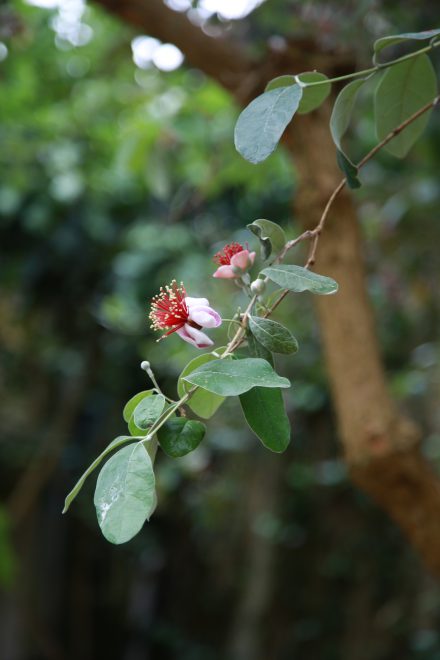
The feijoa (said fey-joya) tree was first grown as an ornamental hedge for its beautiful red flowers, but people soon learned to enjoy the flavor of the exotic fruit.
The feijoa tree’s beautiful flowers.
Botanists improved the species. Eventually the tree made its way to other European countries, all the way to Russia and to the Far East. New Zealand leads the cultivation and export of feijoa, but now Israel and Turkey also boast of feijoa harvests.
It’s a hardy sub-tropical plant that yet needs a cold winter to fruit. The season is short, but in the right conditions, feijoa offers an abundant crop. Around this time of the year, magazines in Australia and New Zealand offer recipes for people who don’t know what to do with all the feijoa in their gardens.
In Israel, November and December are the months where it appears in markets. It has an oval, egg shape and a juicy inside with tiny seeds. Its fragrance reminds you of pineapple – feijoa is also known as “pineapple guava,” with a little strawberry or pear aroma in there somewhere.
A feijoa tree in France
The flesh should be white when ripe. Any sign of brown in the flesh means that it’s over-ripe. Feijoa doesn’t have a long shelf life; it only lasts two or three days after ripening. You have to be alert to get the best out of feijoa. Best if you forage it so you know it’s ripe and organic.
It’s tricky to pick it off the tree because you can’t be sure it’s ripe, but the tree lets you know when to harvest. When feijoa fruit is ripe, it falls. Gardeners must get up early and inspect the ground to see what fruit fell overnight. Once you collect a small pile, you can eat them, put them in the fridge or freeze with the skins off for shakes and freezes.
A little-known fact: the petals of the feijoa flower are edible and sweet. But you can’t pick off too many flowers, or your fruit crop will be disappointingly small.
Feijoa Muffin Recipe
Ingredients: 3 cups all-purpose flour 4 tablespoons baking powder 1 cup granulated sugar 3 large eggs 1 ¼ cups milk 1/2 cup peeled, finely diced feijoas 125 g – ½ cup unsalted butter, melted and cooled A few spoonfuls of coarse sugar
Sift the flour into a large bowl. Whisk in baking powder and granulated sugar.
In a medium bowl, whisk the eggs and milk together. Gently fold the diced feijoas into the egg mixture.
Gently stir the egg mixture into the dry ingredients. Gently stir in the butter.
Divide the batter evenly between 12 cups of a well-greased or lined muffin pan. Sprinkle the tops with a little coarse sugar before baking.
Bake muffins at 220°C – 425°F for 15-20 minutes, until evenly baked. To test for doneness, poke a toothpick in the center of a muffin in the middle of the pan. When the muffins are fully baked, the toothpick will come out clean of crumbs.
Let muffins cool in pan for 5 minutes. Remove muffins from pan and transfer to cooling rack. Allow muffins to cool on rack for about 5 more minutes before serving.
5 pounds (2kg) feijoas 6 slices fresh ginger Zest from ½ orange and lemon 1 cup sugar per 1 cup juice
Peel the feijoas and chop roughly into a large pot. Add the sliced ginger, orange and lemon zest. Fill with water to ½” – 1cm above the feijoas. Bring to a simmer for 10-12 minutes or until the feijoas are completely soft. If the feijoas are hard it may take a little longer.
Place a bowl under a strainer and line it with muslin. Carefully pour in the feijoas and juice. Gather up the sides and tie with string. Hang the muslin over the bowl, tying it high enough for the juice to drip slowly through. Do not be tempted to squeeze the muslin. Leave overnight to drain.
Next day, measure the juice into a clean pot. For each cup of juice add 1 cup of sugar. Slowly bring to a simmer, then boil gently for 15 minutes. Remove the scum from the top as it boils — it is ready when a little is tested on a saucer and it will almost set.