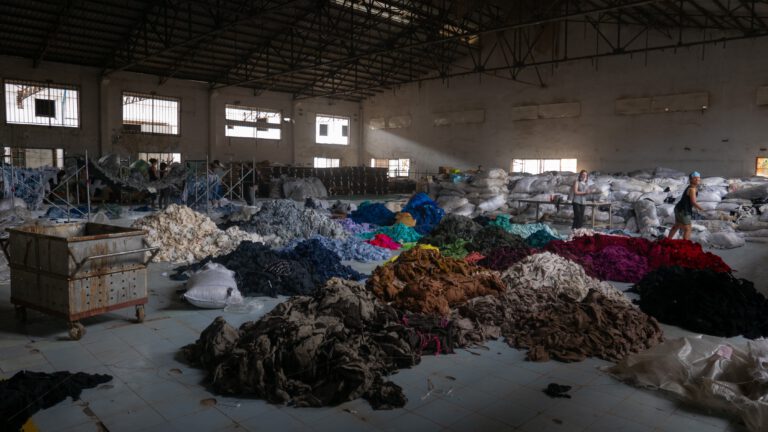
A Sonovia machine dying fabric in a more sustainable way. Via the use of physics, Sonovia is harnessing the power of ultrasonic cavitation jet-streams to impregnate textiles with color.
Sonovia is taking the textile industry into the future as we speak, developing the newest way of production in fashion. I spoke with Shay Hershcovich, the co-founder of Sonovia: “It takes eleven-thousand liters of water to produce one pair of jeans,” Shay says. Another problem: the enormous amounts of wastewater dumped due to unsustainable textile production has turned the Jian River in China red from dye.
Shay and the rest of his team at Sonovia are working long and hard to revolutionize the textile industry. By breaking away from outdated methods of dyeing and finishing manufacturing practices, Sonovia aims to create a sustainable future for textile production. According to Sonovia, they claim to “leave the most significant mark on the textile industry since its inception and to enable humanity to enjoy the textiles that surround our lives with a clearer conscience.”
The Jian River in China contaminated with red dye via ecohubmap.com
Developed originally at Bar Ilan University outside of Tel Aviv, Sonovia is expanding the new technology of using ultrasound soundwaves to cut down emissions in the textile industry. Via the use of physics, Sonovia is harnessing the power of ultrasonic cavitation jet-streams to impregnate textiles with color. Like “chemistry guns”, they call it, the technology works to generate cavitation bubbles that implode and generate 1,000 meter/sec jet-streams.
The machine is called Sonofix, manufactured and supplied by their partners at Bruckner Trockentechnik GmbH. Sonovia affirms this machinery to have breakthrough durability and performance, non-toxic chemistry, and 100% agnostic to fiber type, as well as being cost competitive.
Leading European textile machinery maker Bruckner partners with Sonovia to cut carbon footprint of clothing production ahead of new European rules. From left, Sonovia CEO Igal Zeitun, Sonovia owner Shuki Herschkovitz, Brückner Textile Technologies owner Axel Pieper. Photo courtesy of Sonovia
In addition, Sonovia has other partners all over the world, including companies all over Asia, and in Germany and Italy. The French Luxury group, Kering, which owns big brands such as Gucci and Saint Laurent even decided to integrate Sonovia’s technology into their production methods for the withseen future.
Sonovia can dye jeans with 90% less wastePictures of Sonovia’s technology
According to a study produced by Made2flow, a company that specializes in testing the environmental impacts the textile industry has, Sonovia’s technology reduces greenhouse gas emissions by 60%, 85% in water use, 99% in polluting wastewater, and 90% in land utilization, compared to the traditional industrial dyeing process of jeans.
Their technology has been tested in labs around the world, including Hohenstein, VisMederi Textyle, Microbe Investigations Switzerland (MIS), and Bureau Veritas.
Sonovia’s products include an innovative and sustainable means of indigo dyeing and odor-controlling technology. The current project D(y)enim, is the indigo dyeing system that uses indigo pigment dispersion to save water and be more eco-friendly.
Unlike the traditional method, D(y)enim only includes 2 dye baths, no redox/oxidation dyeing mechanism, and results in no hydrosulfite waste. There is no need for merceization/scouring prep process before dyeing or need for multiple wash baths after the dyeing baths passage. In their recent study, the production of 1 pair of jeans using their technology saved 9.8% of water, equivalent to 160 days of drinking water per person on average.
In addition, the study concluded that 4% of GHG was saved, equivalent to 12 Km driven by an average private car. And lastly, it saved 1.4% of land use, equivalent to 249 grams of flour produced from equal land use.
Sonovia has created a process for using less dye and water for sustainable fashion. These are jeans dyed with the Sonovia process
As Sonovia continues to expand internationally, its mission is to serve as the face of sustainable textile production is not bleak. The Future of Sonovia looks propitious, especially as the climate crisis continues to demand change in our society. With the immense research proving Sonovia’s technology massively saves enormous amounts of water, CO2, and land-use, as well as being more cost-effective, companies around the world continue to be inspired to adopt Sonovia’s technology. The company has even been listed in the Tel Aviv stock exchange (TASE: SONO).
Ittai Ben Zeev, Joshua Herchcovich, Aaron Garzon, Yaron Yaacobi, Liat Goldhammer, Shay Hershcovich, and Yana Chernyak at TASE’s Listings Unit
To learn more about Sonovia, check out their website.
Environmental activist, green deen, Green Prophet, urban strategist and Islamic author Ibrahim Abdul-Matin passed away in California on June 21, 2023. He was only 46 and leaves behind a wife and children. Abdul-Matin interviewed several times on Green Prophet leaves legacy of deepening democracy and environmental advocacy.
Abdul-Matin wrote the book Green Deen: What Islam Teaches About Protecting the Planet, worked as a Senior Fellow with Interfaith America and New Yorkers for Clean Power, and with the NYS Advisory Board member of the Trust for Public Land.
He was a proud eco-Muslim and loved sharing his love for the planet. As an intro to his popular book, he writes: “Muslims are compelled by their religion to praise the Creator and to care for their community. But what is not widely known is that there are deep and long-standing connections between Islamic teachings and environmentalism.
“Green Deen draws on research, scripture, and interviews with Muslim Americans to trace Islam’s preoccupation with humankind’s collective role as stewards of the Earth.
“The Earth is a mosque.”
Deen means “path” or “way” in Arabic. And in his exploration Abdul-Matin offers dozens of examples of how Muslims can follow, and already are following, a Green Deen in four areas: waste, watts (energy), water, and food.
At last, people of all beliefs can appreciate the gifts and contributions that Islam and Muslims bring to the environmental movement. Proceeds from the sales of his book will go toward supporting his family.
Why do you believe that Muslims have an important role to play in combating climate change? Because it’s our God given duty. Allah has entrusted human beings with the planet and all that’s in it. Creation is not ours – it’s Allah’s and He has made us responsible, as the best of Creation, to take care of it. Allah has generously given us these things and that we cannot forget to be grateful. We also must serve with justice and not destroy, pillage, or hurt any of the things He has provided.
What one person or group or way of thought has inspired your Green Deen? Definitely my father. He grew up on a farm in southern Virginia and has deep connections to the land. He’s spent the last 15 years in upstate New York and frequently takes trips into the woods, the mountains, to simply exist among Allah’s creations and praise Him. My father prays outside a lot – he says that it’s good to be reminded of what we’re a part of and who to be thankful to.
What do you think is holding back Muslims from doing more for the planet (particularly in the Muslim world)? And what can be done to tackle these constraints? I think it’s the same reason as the old woman in Memphis. Muslims need to feel compelled spiritually to make dramatic changes in their lives. They need to feel like Allah has commanded them to do something – that’s what “Green Deen” is about. I argue that Allah has told us that protecting the planet is a major priority in our practice of Islam.
If you could get Muslims to do one thing for the environment, what would it be? Become advocates for worldwide clean water. Muslims need to pay attention to and get involved in issues that don’t just affect them – but affect everyone. We are stewards of the Earth. Not just stewards of Muslims. Water is every creature’s most basic need for survival. Our Prophet taught us to not waste water while making wudu, even if we live next to a flowing river. Our Holy City of Mecca exists because of the Well of Zamzam.
Jaffa, Tel Aviv’s historic sister city, is famous for its rich biblical tales and unmatched sightseeing. With its unique combination of history and modernity, Jaffa offers countless opportunities for environmentally sustainable and unique day and nighttime activities.
Green Spaces of Jaffa
Fairuz Festival Jaffa at the Pisgah Park. Have you ever seen a view of Tel Aviv quite like this?
Jaffa Port
Make sure to check out Jaffa Port, one of the oldest ports in the world. Jaffa Port is a historical landmark well known for being the biblical location of Jonah and the Whale. In addition to its historical roots, the port serves as an active fishing port, allowing visitors to peek into the daily lives of fishermen. Visitors can rent kayaks for paddling around in and some local boat owners sublet their yachts for a night or a week for those who want to sleep on the water. Jaffa, Tel Aviv’s historic sister city, is famous for its rich biblical tales and unmatched sightseeing. With its unique combination of history and modernity, Jaffa offers countless opportunities for environmentally sustainable and unique day and nighttime activities.
Jaffa Slope Park
Along the seaside is the Jaffa Slope Park. Embrace the awesome scenery and spice up your day by packing a picnic and taking a nature walk to enjoy natural beauty. Slope Park is an excellent escape from the “hustle and bustle” of city life. This park was a construction waste site, later transformed into a park on the insistence and lobbying of environmental activists. If you walk from the port to the Slope Park look into the sea and find Eco Wave’s pilot project collecting energy from the sea.
The Slope Park is a great location for flying a kite. There are no electricity wires and few trees to get stuck on.
It’s a great stretch of park for runners who start in Tel Aviv. Run all the way to the end of the boardwalk around Aliya Beach near the Shimon Peres Center and return back along the sea.
Givat Aliya Beach
Givat Aliya Tel Aviv-Jaffa’s Southernmost beach is the perfect location for beachgoers. Have a picture-perfect day and enjoy the palm trees, limestone, and stunning arches. After soaking up sun rays, Givat Aliya conveniently offers nearby trendy bars and restaurants.
HaPisgah Park
Another beachside park worth exploring is Gan HaPisga. Named after the Hebrew word for the summit, this park has an eye-popping view of the coastline in addition to a well-known amphitheater used for outdoor concerts and summer events.
Local and Sustainable Dining in Jaffa
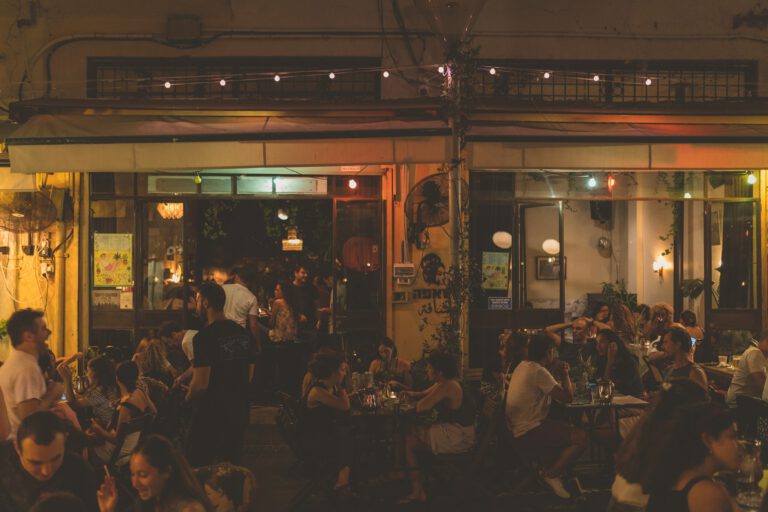
Shaffa bar and restaurant in Jaffa
Hummus
Jaffa is about the hummus. It’s simple and vegan. Abu Haasan serves what consider the best hummus in Jaffa. They are a family-owned local spot that serves both traditional and spicy hummus, which are excellent vegan and sustainable options. The best idea- try the triple plate and taste all three vegan dishes.
Israelis are pretty picky when it comes to hummus. Some locals suggest these ones might be just as good. Some say better:
Alkalha “is a deluxe experience” says one resident of Jaffa. They are located on Salame. Eliyahu Hummus in the flea market is a nice place to hang out. Asli on the corner of hatkuma and yerushalayim across from the hotel. Dani Ful in the same area of Asli.
Jaffa Coffee Shops
Tomer, the mastermind behind Ada Hanina Cafe. He travels to Ethiopia and meets the farmers who grows his coffee beans.
We have tried them all. The only two coffee shops we can recommend in Jaffa are Ada Hanina Cafe, in the Flea Market area run by Tomer Lenziger, who picks hand-selected beans from countries like Africa where he pays farmers direct and roasts locally, and the other is Cafelix in the Noga area.
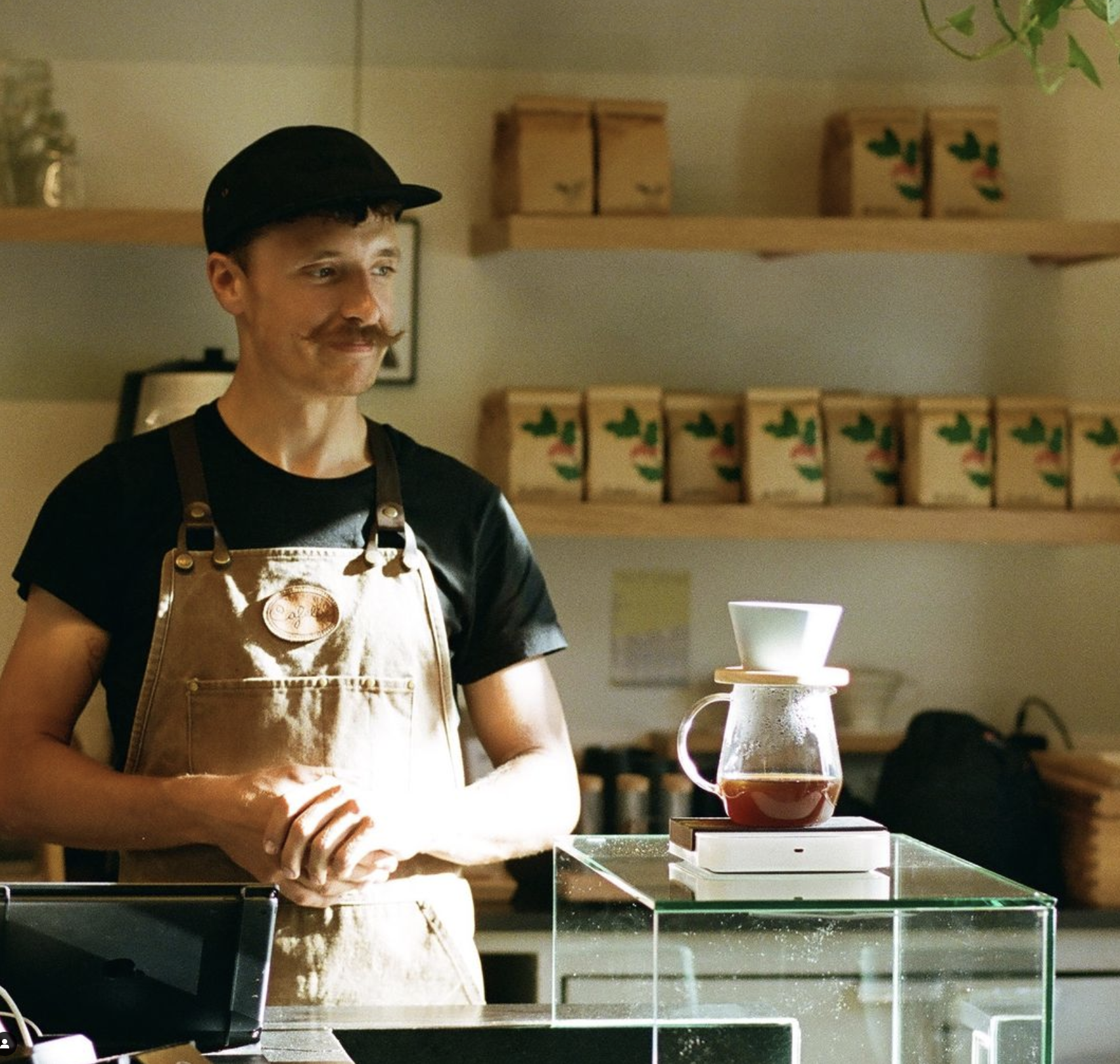
Ada Hanina Cafe, barrista pouring coffee at the free trade, organic coffee shop in the Flea market of JaffaCafelix in the Noga neighborhood of Jaffa
Alhambra Deli and cafe offers a unique Farm to Table experience. They have much more than coffee, and offer culinary experiences of Slow Food sourced from all over the Land of Israel.
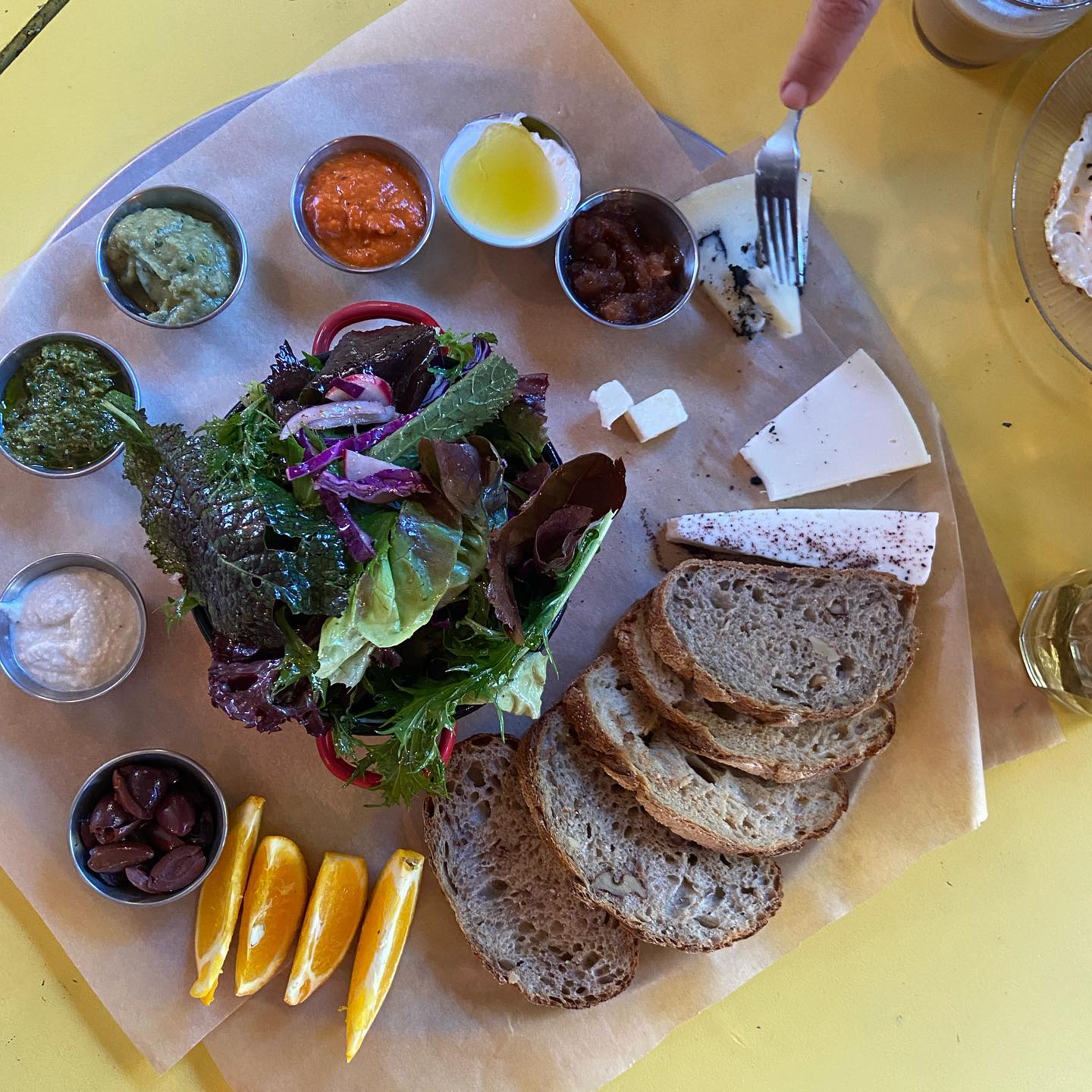
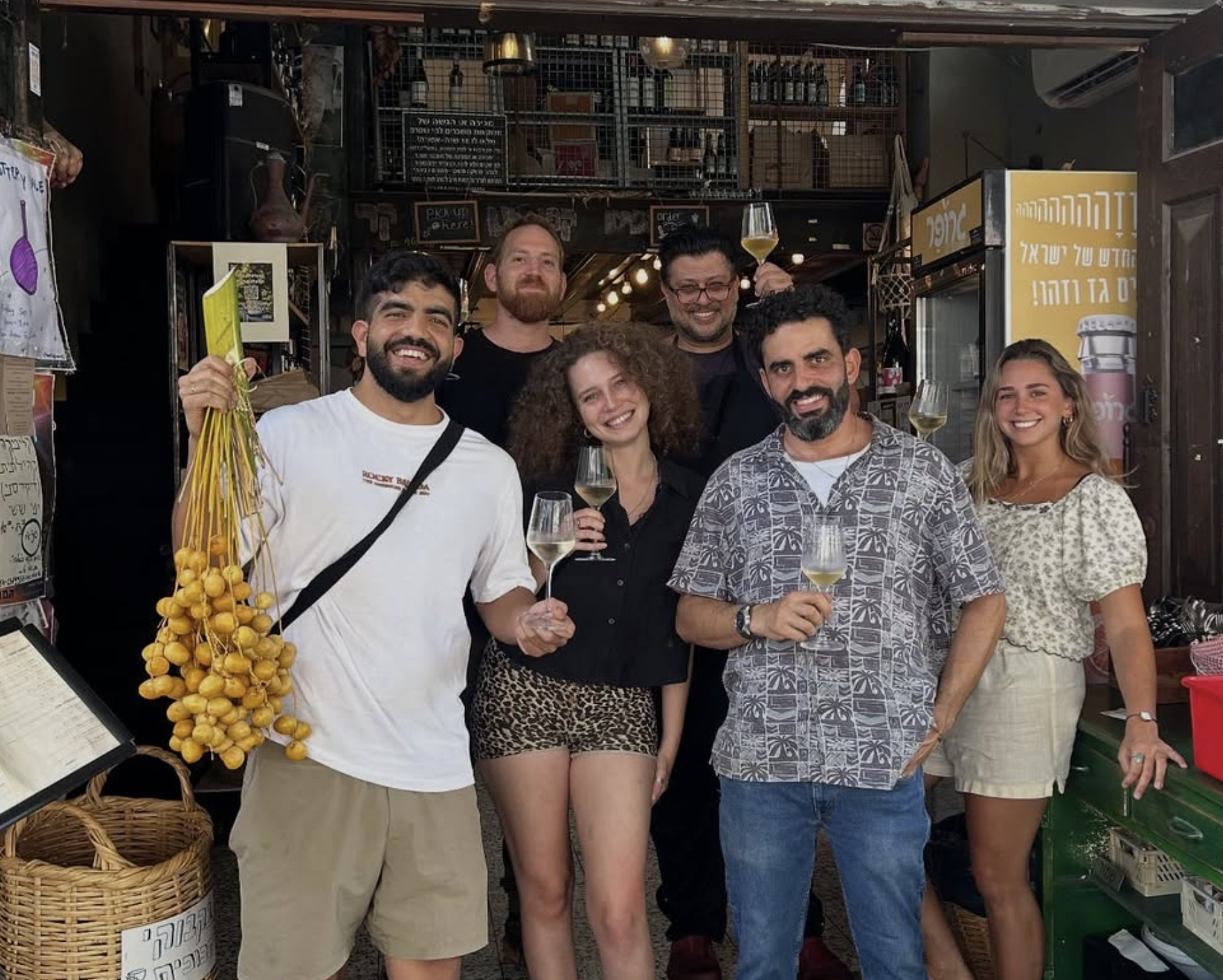
A plate of local delicaciesYakir Knafo, center right, with his crew from the deli Alhmabra in Jaffa
Jaffa Fishery
Visiting Jaffa port by 7:00 in the morning is a treat for the early birds as you witness fishermen unloading their fresh daily catches and displaying them along the harbor. Take advantage of this opportunity to purchase high-quality doral, snapper, and seafood directly from the fishermen, all at a more affordable price than restaurants.
Pizza
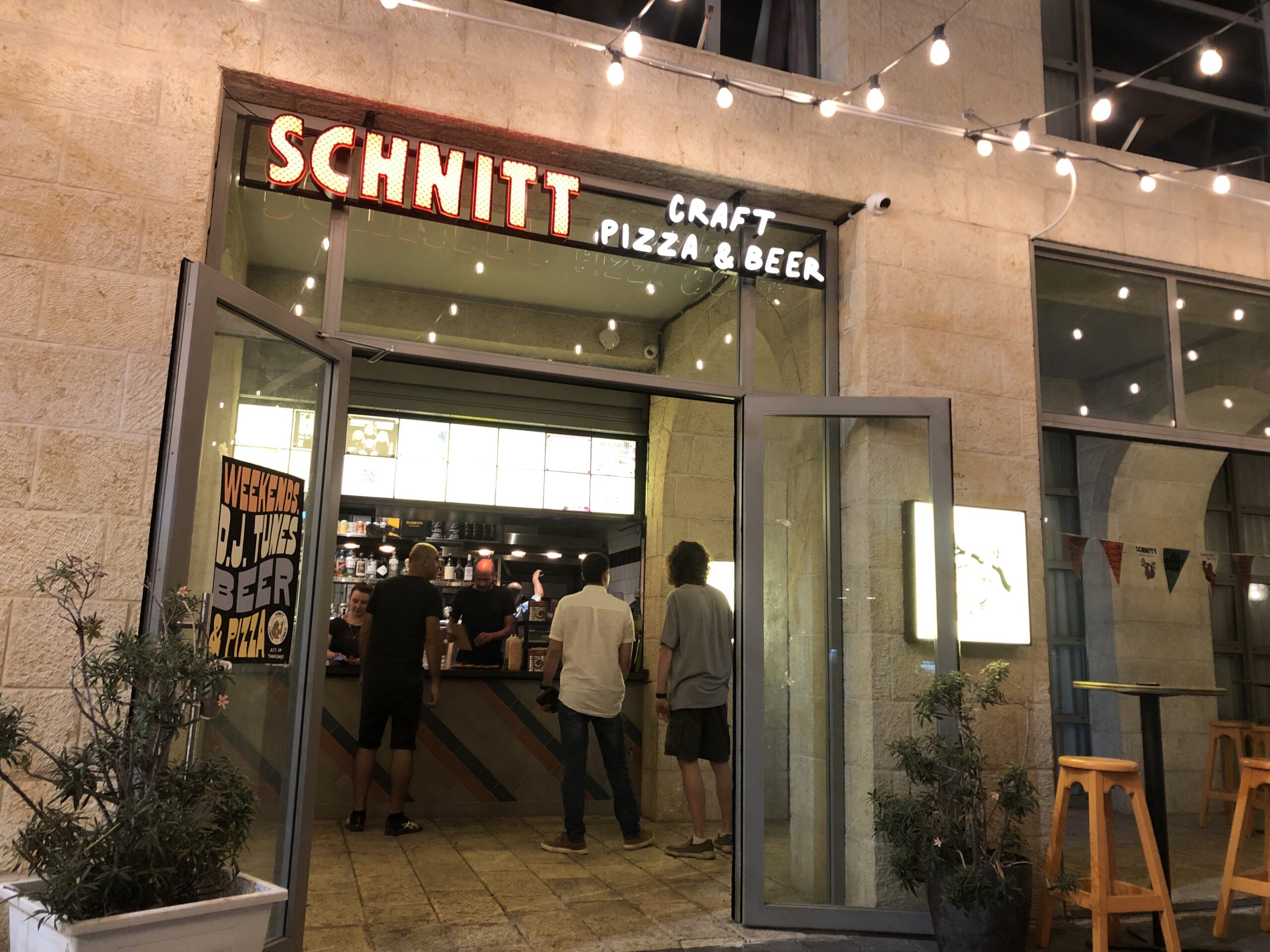
Schnitt Pizza and craft beer in Jaffa
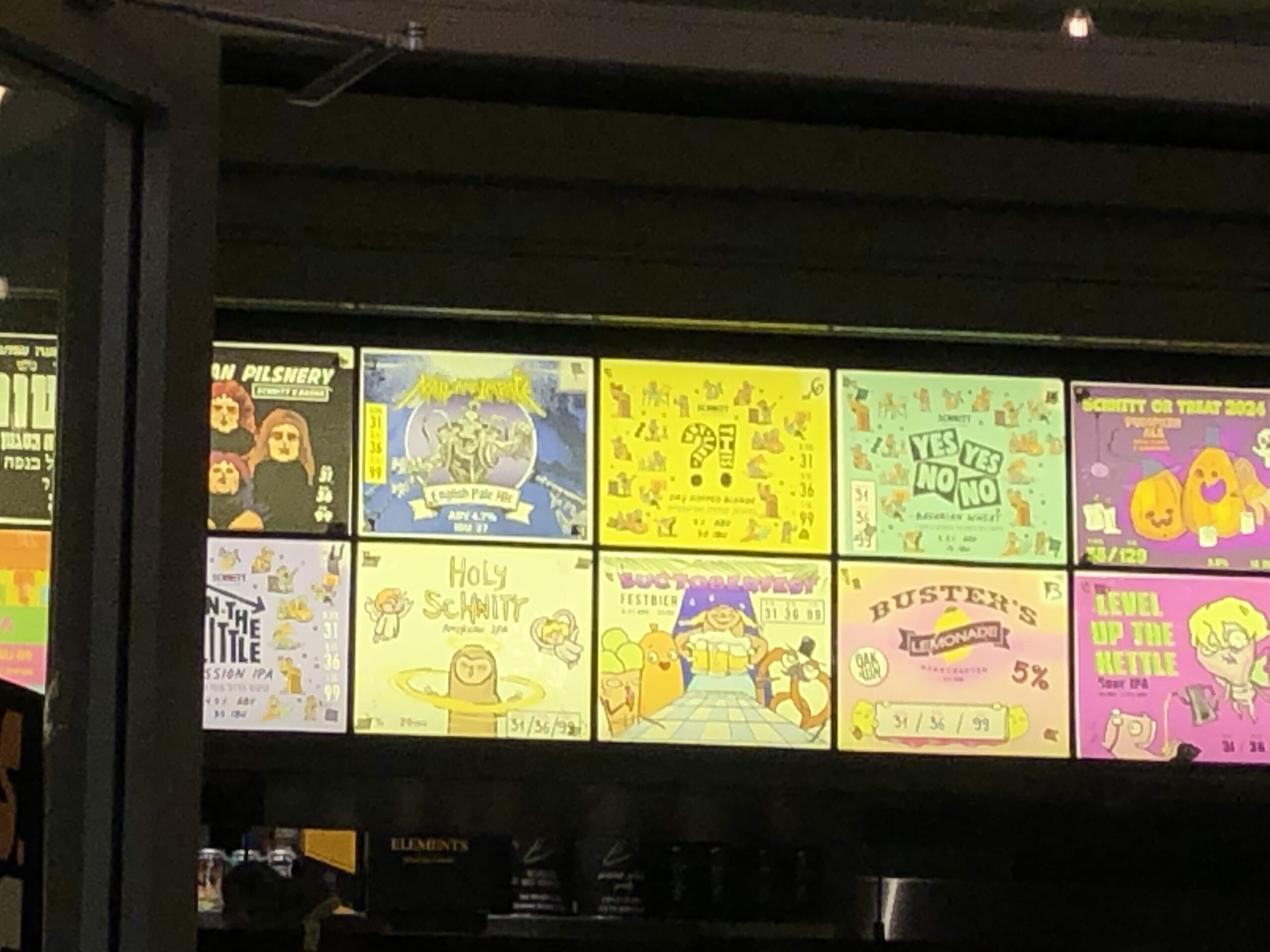
Eat pizza and drink local craft beer from Schnitt. You might feel that you are in a Swiss or German beer garden. The beer and pizza are our favorite
Shaffa Bar
Immerse yourself in 70s vibes and enjoy locally sourced ingredients at Shaffa Bar. Known for its vibrant ambiance, this bar offers a range of cocktails during happy hour with the bonus of eating sustainably. Indulge in great company and feel good about your environmentally positive choices.
Eco-Friendly Transportation
Electric Scooter
If you love an adventure like me, I’d like to introduce you to Tel Aviv-Yafo’s electric scooter takeover. Many scooter-sharing companies operate in the city, allowing people to rent electric scooters for short-distance travel. They produce zero emissions and make a greener and more fun alternative to driving in a car. Watch out for reckless drivers.
Biking
Get active by biking around Jaffa’s bike-friendly city and using the dedicated bike lanes and bike-sharing programs. Renting a bike to explore the city while minimizing your carbon footprint is encouraged. Several bike rental stations throughout Jaffa make it easy for locals and visitors alike to help the environment.
Walking
Jaffa is certainly a walkable and pedestrian-friendly city. Enjoy the city’s charm and discover new places only seen on foot. Walking does not only reduce pollution but also allows a fully immersive experience of the culture and overall vibe of the city.
Public Transportation
The old city is conveniently well-connected to the Tel Aviv metropolitan area through public transportation networks. The choices are abundant between the easily accessible bus system and light rail trains, providing convenient and eco-friendly options for traveling within Jaffa and nearby destinations.
Sustainable Cultural Experiences
The East West House in Jaffa
Flea Market
The Jaffa flea market, known as the Shuk Hapishpeshim, is where creativity thrives. Endless treasures, including antiques, crafts, and locally made products, are yours to find. Supporting local artists and small businesses as well as sustainable entrepreneurship. A few boutique hotels have opened in recent years.
Galleries
You aren’t doing Jaffa’s correctly if you do not explore its renowned art scene and visit its many galleries of local visionaries. Admire or even purchase unique pieces from the local art community. Try Beit Kandinof which is an art gallery and happening space combined with a high-end restaurant.
Live Music
The East West House offers weekly shows featuring local music with ethnic roots from the Arab and Jewish world. There is also a more taverna-style showing of a similar vibe at Shaffa Bar many days of the week.
Artisanal Shops and Workshops
Making work trousers at Havie in Jaffa
And finally, from pottery and ceramics to jewelry-making and textile weaving, Jaffa’s artisans combine their gorgeous work with the city’s rich cultural heritage. Gain insight into their creative processes and learn about the importance of their craft. Make sure to check out hands-on workshops, mainly concentrated in the area called Noga.
There is Beit Hamelacha which offers print-making and textile-dying workshops in Noga.
Ilanit Neutra maker of upcycled tire bags has her studio in Noga.
Enjoy a free co-working space for the 18-25 year-old crowd on 83 Yefet Street. It is supported by the Tel Aviv-Jaffa Municipality.
Streets need to be resurfaced in New York but the humming and grinding noise is unsettling. Noise is environmental pollution.
A construction site near your office can be a source of constant annoyance. The noise can be unbearable. From hammering and drilling to the buzzing of saws, particularly if you work in a creative or knowledge-based profession that requires a quiet workspace.
Noise pollution can increase stress, decrease productivity, and impact overall satisfaction and well-being in the workplace.
Creating a quiet workspace should be a top priority for both employers and employees. Here are 10 solutions for employers to reduce construction noise in the office.
Sound Barrier Fence
Sound barrier fences aim to reduce noise pollution by absorbing or reflecting sound waves using materials like wood, concrete, or metal. They are commonly employed in residential areas to alleviate noise from highways, airports, or other sources.
Double-Glazing Windows
Double-glazing windows can reduce noise pollution from outside sources. The double-pane application serves as an extra layer of insulation that helps absorb sound and keep it out of your workspace.
Acoustic Wall Panels & Ceiling Tiles
Unwanted sound is a form of pollution with real health effects
Acoustic wall panels and ceiling tiles effectively reduce sound in your office. The absorbent material helps absorb noise and reflects it away from your workspace.
Rugs & Carpeting
Rugs and carpeting muffle noise in the workplace. By adding a layer of material between you and the floor, you can help reduce overall sound levels.
Soundproofing Curtains & Blinds
Soundproofing curtains reduce noise pollution in the office. These heavy-duty curtains provide an extra layer of insulation that helps block out unwanted noise. Noise-reducing blinds are another excellent way to help keep sound from entering or leaving the office space. They provide an additional layer of protection against outside noise, allowing for more comfortable conversations in the office. The curtains and blinds also help reduce the amount of light entering the office, providing a comfortable working environment.
White Noise Machines
This is how white noise feels
White noise machines generate soothing ambient sound to cover up distracting noises. While often used to sleep better in a noisy bedroom, they can be used in cacophonous offices, too. With these machines, you can customize your sound preferences so that it is easier to focus on work instead of being distracted by outside noise. These machines help create a more peaceful atmosphere and a more focused work environment where it is easier to concentrate and be productive.
Soundproof Paint & Acoustic Foam Panels
Soundproof paint, which uses silica aerogel, is yet one more way to reduce noise pollution in the workplace. By applying a layer of soundproof paint, sound waves can be blocked.
Foam Panels
Foam panels placed on walls and ceilings are another way of blocking sound waves more effectively. This solution will allow you to talk without distractions from outside noise.
Noise-Cancelling Headphones
Noise cancelling headphones can reduce the stress of city noise
Noise-cancelling headphones are great for blocking out distracting noises in the office. They also provide a great way to listen to music without disrupting your colleagues or fellow office workers. With them, you can do more than just cancel outside noises. You can also enjoy your music without having to worry about bothering anyone.
Soundproofing Materials
Soundproofing materials such as dampening panels can be used to reduce the amount of sound that travels through walls in office spaces. This will provide a quieter environment for everyone in the office.
Currently, Eco-Friendly Construction Does Not Address Noise Pollution
Although many green construction building projects have adopted a wide range of eco-friendly products, these focus on energy and resource conservation or eliminating toxic products. Since reducing noise pollution in surrounding offices is necessary, employers must invest in soundproofing materials, install acoustic insulation, use noise-canceling headphones, encourage employees to use headsets, or try other noise-reducing options.
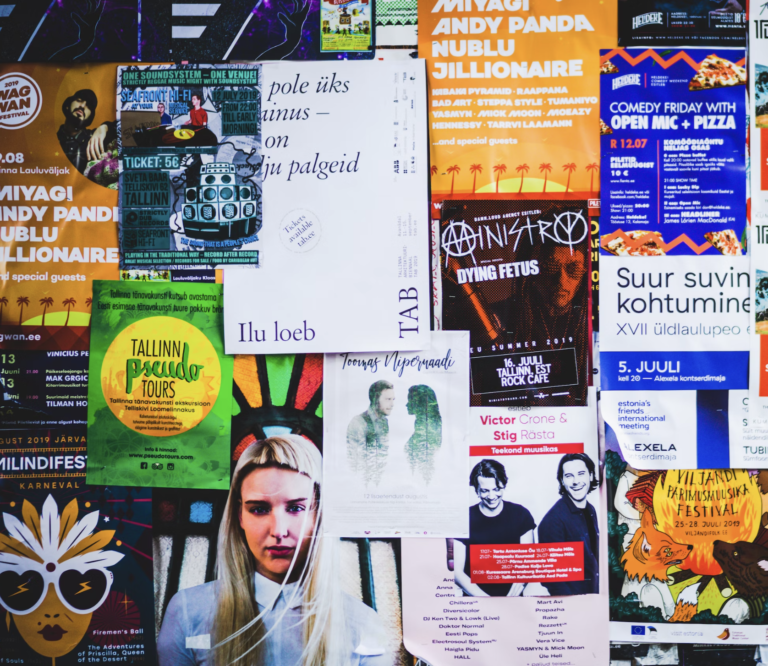
Colorful posters in Europe printed with algae and sustainable eco-dyes
In today’s digital age, various design tools have revolutionized how we make and promote various materials. An online flyer creator is one of them that has gained significant popularity. And that’s for a reason.
With a wide range of customizable templates and a user-friendly interface, this tool simplifies the process of creating eye-catching flyers for occasions, businesses, and more. This post will look at the top five benefits of using this great thing for your next event.
1: Easy-to-Use Templates
Creating a visually appealing flyer from scratch may be daunting, especially if you don’t have a design background. Dedicated online creators come equipped with a diverse range of pre-designed templates, allowing you to choose a layout that suits your event’s theme. They often incorporate professionally developed elements, ensuring your creation looks polished and attractive even if you’re not a design expert.
Using a web flyer creator, you can browse various templates categorized by types or styles. Whether organizing a music concert or a bake sale, you’ll find great options tailored to your needs. Templates provide a solid foundation for your small creative project, making it easier to compose a flyer that captures the essence of your event.
2: Time and Cost Savings
Printing and distributing physical flyers may be time-consuming and expensive. Using online tools for designing them offers a cost-effective solution by eliminating the need for printing and allowing you to share your creation digitally. With just a few clicks, you can make it, download it in popular shareable formats (PDF, PNG, etc.), and distribute it on the web via email, social media platforms, or your website.
3: Customization Options
Biodegradable poster paper and sustainable ink. Ask for these.
One of the key advantages of using an online flyer creator is the ability to customize your work. These tools often provide a wide range of options for tweaking things like:
colors;
fonts;
images;
layouts.
You may add branding elements like logos and slogans to make a flyer that aligns with your event or business. By tailoring the whole design to your precise demands, you can effectively convey your message and capture the attention of your target audience.
These dedicated design tools typically present intuitive editing interfaces that allow you to make real-time changes to your project. You can experiment with different color palettes, fonts, and image placements until you achieve the desired look. Some even provide advanced features, such as layering and effects, meaning you can add depth and uniqueness to your designs.
4: Flexibility and Versatility
Add seeds for the garden or picks made from recycled paper and plastic to show off your handmade guitar business. Be creative
Online flyer creators offer flexibility in terms of design changes and revisions. If you need to update the details of your event or make any modifications, you can just open and edit your saved project without starting from scratch. It means eliminating unnecessary repetitive work.
If you’re organizing multiple events or running several campaigns, you can easily modify and repurpose existing projects, saving valuable time and effort. This feature is particularly useful when dealing with time-sensitive promotions or when you need to make last-minute shifts.
Overall, it’s possible to re-design your creations effortlessly. Suppose you initially developed a flyer for online promotion but later decided to print physical copies for a similar occasion. In that case, you can simply adjust the needed points and ensure that your work retains its visual appeal in the new look. This versatility saves you from the hassle of composing the entire new project and guarantees consistent branding across different mediums.
5: Analytics and Insights
Unlike traditional printed resources, some online creators deliver valuable insights and analytics about your campaign’s performance. Many web tools offer tracking features that enable you to monitor the number of views, clicks, and conversions generated by your creation. This data helps you evaluate the effectiveness of your design and promotional strategies, allowing you to make data-driven decisions for future marketing efforts.
You may also gain insights into your target audience’s preferences and behaviors by analyzing the analytics provided by dedicated tools. You can determine which design elements, headlines, or calls to action perform better and optimize your future project designs accordingly. This iterative process lets you continually improve your marketing collateral and maximize the impact of your promotional campaigns.
Conclusion
Using a special online design tool streamlines the process of developing and distributing stunning event flyers. Whether you’re promoting a concert, a charity fundraiser, or a local business, harnessing the power of web flyer creators can help you make visually attractive materials that captivate your audience and drive engagement.
Founder of the Animal Environment Association (AEA), Diana Babish works overtime to support not just her own life, but also the lives of thousands of animals.
While Diana works overtime at the animal shelter, she is also the manager of the tourist bus station for the municipality in Bethlehem. Before she took on this job, she worked as a bank manager for many years and got her master’s degree in Bethlehem in corporations and development. Still, as Diana works her full-time job, she never gives up on making a large commitment to working in and running the shelter.
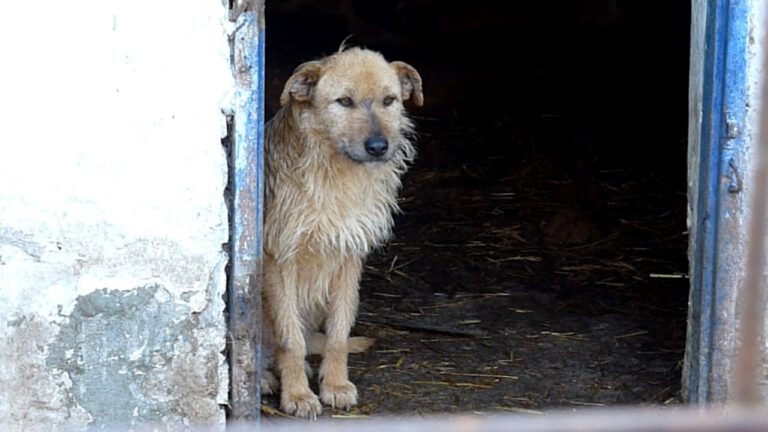
Located in the West Bank in Bethlehem, the AEA Bethlehem Shelter strives each and every day to treat, care, and rehome dogs, cats, and even donkeys. However, the AEA struggles to keep up with the continuous transport of animals, as the AEA is a non-profit and does not receive any support from the government. The AEA is the first and only shelter located in the West Bank, so it is especially hard to take care of all of these animals. In addition, the AEA is looking for more recognition, more financial support, and more volunteers.
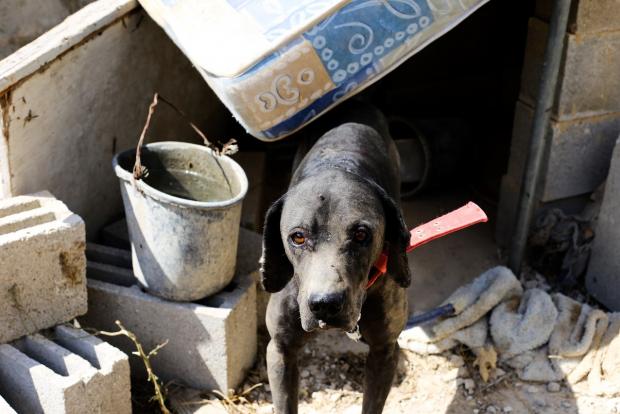
In the past year, 4,000 dogs were brought into the shelter and over 600 cats. Unfortunately, when the animals are brought in, they are typically in bad shape. Commonly with severe problems that need immediate medical attention. Diana sees animals daily with ticks, skin problems, dehydration, broken limbs, and diseases of all kinds.
“It’s difficult work,” Diana tells Green Prophet: “so many cases that tear you apart: abused animals, maggots eating their flesh, poisoned and shot”. For Diana personally, she took home a dog from the shelter that was shot 8 years ago. Still to this day, Diana periodically needs to buy her dog medicine because its lungs were permanently damaged and therefore cannot stop coughing.
Sometimes, when an animal is struggling to find a home, Diana adopts it as her own. Today, Diana has 7 dogs, two of which recently came from the shelter. “They deserve a better life,” Diana said. “Any number they need I take them.”
Shelters in Israel are over capacity, and the AEA is only 200 meters. So it’s not only a struggle to take care of the sick pets, but to also have room for them. Not having enough room for them also means not having enough resources to take care of them. Even so, the shelter struggles to have the necessary technology to diagnose pets with whatever disease they are struggling with.
Ryder: a dog available for adoption at the AEA Shelter in Bethlehem
The AEA relies on donations in order to keep up with their best work, but even that is not enough. Sometimes the shelter receives sponsors from organizations but is in desperate need of more help. Diana would like to see more funds coming in to help rehome, afford materials, and pay vets. She also wants more support both locally and abroad.
Diana strives to spread her good work beyond the realm of animals. She actively goes to schools and teaches children how to be better for the environment. For example, Diana teaches children to close the tap, not to throw things out the car window, etc. She also gives lectures to adults on how to better treat the environment. She lectures to adults via PowerPoint, teaching preservations measures and disease prevention and treatment.
In order to help preserve of the environment, Diana and her other volunteers created tenets for the animals with recycled tires. They collected tires, wooden pallets, and iron pallets and were able to make a tent so the shelter could home more animals.
I strongly encourage everyone to check out the AEA Shelter in Bethlehem and give recognition to Diana and all her hard work. I also strongly advise people all over the world to adopt their pets from shelters. The AEA Shelter in Bethlehem does abroad adoptions to countries such as the U.S., Canada, and many countries in Europe. To find out more information on animals available for adoption, check out the AEA’s Facebook Page.
Please make a donation to the AEA Shelter in Bethlehem, as every donation makes a difference. Even if its 1 shekel a month, this can add up to help save lives of animals in desperate need of attention. And if you are in the area, I encourage you to check out the shelter. The shelter is in desperate need of more volunteers, resources, food, and love and attention from the public.
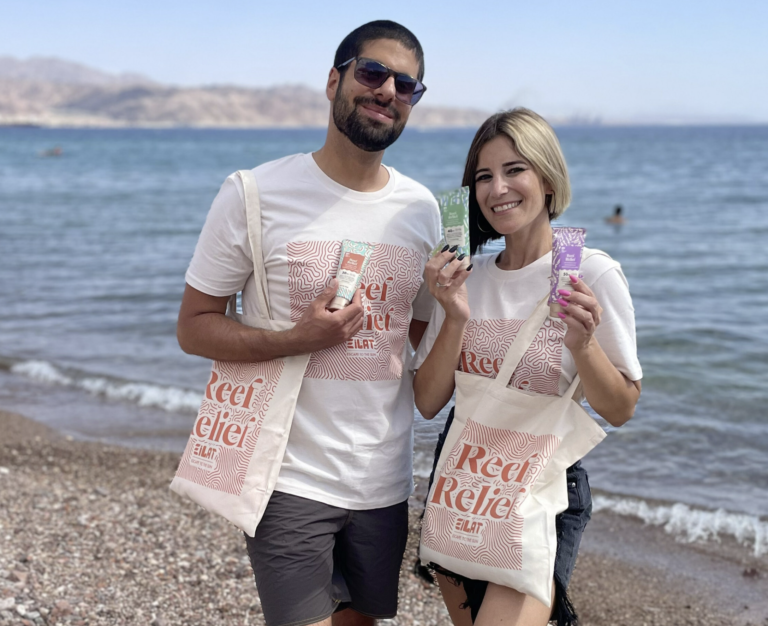
Reef Relief produces a sunscreen with an RFP – for reef protection factor
Jump into a lake or sea covered in Neutrogena or Coppertone sunscreen and you feel a film of sunscreen wash into your eyes. That same sunscreen that’s meant to protect you is very damaging to lakes and ocean life, and especially life that’s sensitive to environmental disturbances. Of course you can make your own sunscreen – here’s our sunscreen DIY recipe here – and while this might be less harmful to your body the elements may still harm sea life. But a company from Israel says that they have created a sunscreen that protects you from the sun and the reefs from harm. It’s called Reef Relief.
The sunscreen was formulated in the Red Sea city of Eilat, home to dying coral reefs. The company announces developing the world’s first sunscreen that is scientifically formulated not only to protect the skin from UV rays but to feed and nourish endangered coral reefs.
Eilat is home to the world’s most northernmost shallow-water reef and locals are passionate about protecting it and other coral reefs.
‘Reef Relief’ sunscreen to help turn the tide on coral bleaching. Courtesy.
Coral is facing serious threats from climate change, pollution, and other human activities, with an estimated 14,000 tons of sunscreen ending up in the world’s oceans every year. As many as 80% of ordinary sunscreens contain chemicals that contribute to coral bleaching and dying reefs.
While some manufacturers have begun to remove harmful chemicals like oxybenzone, Reef Relief goes further than any other sunscreen on the planet to protect coral reefs and help them thrive, the company says.
Marine and skincare specialists have developed a new formulation based on a non-nano, titanium-dioxide-based, mineral sunscreen. The base formula is Ecocert compliant and has undergone extensive aquatic safety testing, to include safety for freshwater fish, saltwater fish and coral larvae. The added reef nourishing formula is a bespoke blend of FDA-compliant trace minerals used by coral farmers to feed and support healthy growth in coral.
Giovanni Giallongo, a marine biologist from Ben Gurion University of the Negev said, “The development of a sunscreen that not only doesn’t harm coral, but has the potential to feed and nourish our reefs, is an important step towards protecting and preserving our oceans.
“Reef Relief could feed into the health of communities underwater and on land.”
Reef Relief sunscreen also presents to the world another first, a brand-new certification – not just against SPF, but also now RPF for Reef Protection Factor.
An increasing number of products claim to be ‘reef-friendly’ or ‘reef-safe’, but there is a lack of regulation in this area which means that consumers are easily being misled. It’s hoped that the new RPF marque will become an industry standard and spread beyond Israel, worldwide, helping consumers make responsible choices.
Giallongo added, “This is a way of identifying sunscreen that truly cares for coral. An RPF marque as an industry standard.”
How can you know if your sunscreen is reef safe?
Unfortunately the term “reef friendly” is not regulated, so you can’t always trust products with this description. It’s important to actually check the active ingredients label on the back of your sunscreen or personal care product to ensure that reef-harming chemicals are not included, says Save the Reef, an NGO set up to educate us about saving coral reefs. The size of minerals used in the sunscreen can also have an impact.
They say, be sure to use micro-sized (or non-nano) mineral sunscreens to avoid nanoparticles, as these smaller particles can be toxic in high concentrations. It’s also advised to stick with lotions and avoid spray or misting sunscreens, especially those that contain titanium dioxide as it can be harmful to your health if inhaled.
It’s always good to use products that cut back on single use plastic packaging, either by using containers that are reusable, have high recycled content or are made out of biodegradable plant-based materials like cardboard.
Make sure your sunscreen does not contain the following harmful substances:
Oxybenzone
Octinoxate
Octocrylene
Homosalate
4-methylbenzylidene camphor
PABA
Parabens
Triclosan
Any nanoparticles or “nano-sized” zinc or titanium (if it doesn’t explicitly say “micro-sized” or “non-nano” and it can rub in, it’s probably nano-sized)
Any form of microplastic, such as “exfoliating beads”
Holding her ears from the noise in Beirut, Lebanon
Noise is toxic and damaging to your peace of mind. An unsettled mind can lead to immune system malfunctions and chronic problems related to stress. A loud industrial saw is working on construction of the building next door to me in Tel Aviv, as I type. Music blasting in nature sites, bus speakers announcing stops, criminal level shouting and incessant honking and screaming – on the streets, and in classrooms, are the norm in an overly loud Israeli city.
Israel, by law, has natural quiet hours –– between the hours of 2PM and 4PM when European Jews like to nap and it’s called schlafstunde –– Yiddish for afternoon sleep. The law is still intact, but it’s easy to get around it if you own a construction business and need to get the job done.
Chronic, including humming and droning noise by large machinery during waking and sleeping hours is not just annoying, it’s a health threat that goes largely unrecognized. The relentless din of cars, trucks, trains and planes increases the risk of hypertension, stroke and heart attacks according to research studies.
Even people who live in generally quiet areas are affected: those sudden jarring sounds coming from fire crackers are also particularly detrimental. Cities like New York enacted honking bans in some of the more populous areas of Manhattan already in the early 90s and now cities like Paris have installed noise cameras to monitor vehicles’ sound levels. Thanks to the lovely Swiss, they are introducing national quiet hours.
Noise pollution is a global concern
According to the European Environment Agency, more than one in every five EU citizens is exposed to chronic harmful levels of road traffic noise. This percentage is much higher in many urban areas. The number of people ‘highly annoyed’ and ‘highly sleep disturbed’ must be reduced by 5.4 million and 1.5 million, respectively, in order to meet the 2030 zero pollution targets for noise pollution. They say that “based on levels and measures currently in place, the prospect of meeting these targets is low.”
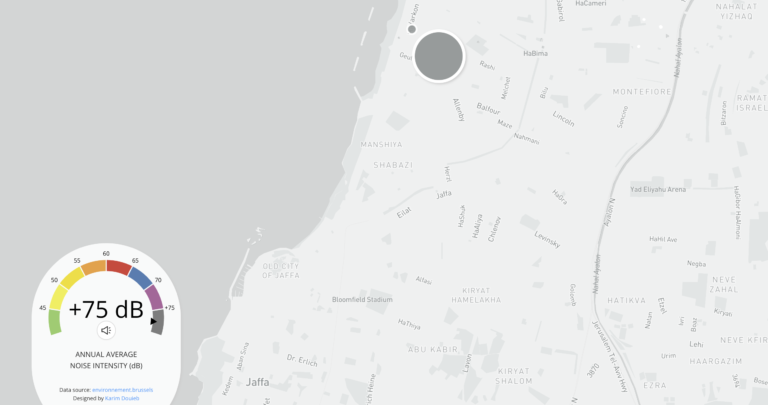
Check out Noisy City to see how cities of the world differ in sound pollution
Try this interactive map of noise pollution from Noisy City to see how your city and region fares. I rolled over Tel Aviv and experienced what more than 75 dB of sound can feel like all day, every day.
Israel fortunately, does care about noise pollution but really doesn’t do much to enforce that the laws or guidelines are met. First step to complaining about noise is finding which ministry will deal with it. The Ministry of Environmental Protection, the weakest ministry in the Israeli Government, oversees noise pollution. But on a local level the police and city authorities may also handle complaints. If it’s construction noise ongoing, a hum of an air conditioner rattling your brain or the sounds of a garbage truck picking up a bin at 4am. All are different units. Consult this complainer’s noise guide if this is what you are looking for.
If you want to change policy and law, contact Adam Teva V’Din, an Israeli organization that creates policies and the foundations for environmental law in Israel.
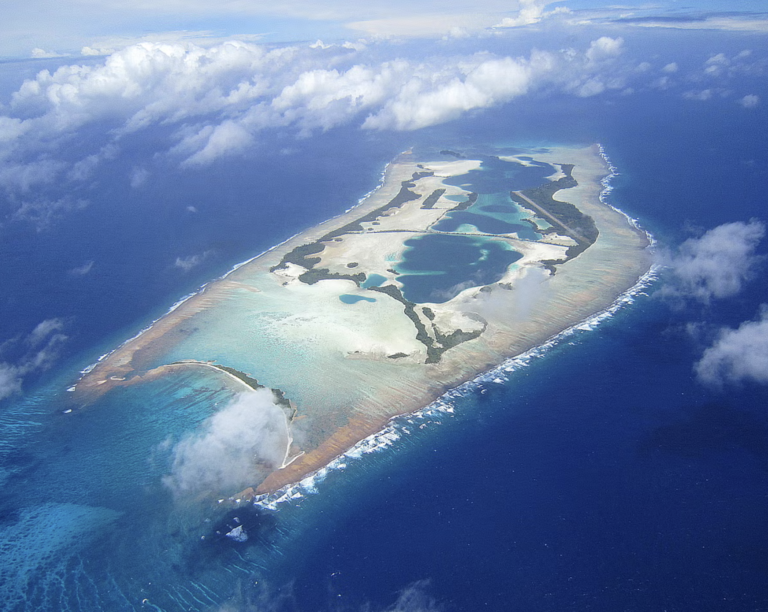
Palmyra is a habitat destroyed by a US army base. Can fungi restore it? Photo via Nature Conservancy
This lushly photographed island is in an isolated patch of the North Pacific. The atoll of Palmyra is actually home to some of the most pristine coral reefs in the world but the land around it has been ravaged by invasive coconut-palm trees and wrecked by a former US military base.
Now a nature preserve, Palmyra has become a natural laboratory for studying whether networks of fungi below ground can help to revive damaged habitats: “If we can get restoration right on islands, we have this great capacity to have an outsized impact on reversing the world’s biodiversity crisis,” says ecologist Holly Jones.
The project is run by Toby Kiers from Holland and she is also the director of the Society for the Protection of Underground Networks.
Toby Kiers investigating soil and the fungi inside it
Researchers believe that mycorrhizal networks of fungi may have evolved a unique ability to cycle nutrients between seabirds, rainforest trees, and coral reefs in the atoll. Led by Kiers, the Society for the Protection of Underground Networks (SPUN) travelled to this remote atoll – a place so untouched that researchers had to freeze their clothes each night to prevent the introduction of non-native species to the protected islands – for a recent research expedition.
In partnership with The Nature Conservancy Climate Adaptation Lab, SPUN is mapping the diversity of mycorrhizal fungi across Palmyra Atoll, 1,000 miles south of Hawai’i. This atoll, the Earth’s most remote, is the site of much lore, including a double murder, sunken treasure, and disappearing aircrafts. It is also home to a million seabirds, untouched coral reefs, and a fish population that is 44% sharks.
“Never could I have imaged sampling fungi while small sharks swam around my feet. As we hiked in the ocean between forested islands, we could hardly hear ourselves talk because the birds were so loud,” says Kiers. “Visiting Palmyra allows you to go back in time when other organisms – not humans – dominated the landscape.”
The scientists sampling Palmyra hope to understand how mycorrhizal fungi facilitate nutrient movement between the sea and the rainforest – and how remote island ecosystems are coping with climate change, invasive species, and rising sea levels.
During the course of a recent expedition, SPUN scientists collected samples from across 27 islands. These have been sent off for DNA sequencing so that the fungal players can be identified.
Strange trees that eat birds
Among the island’s species is the towering Pisonia tree. Pisonia is a native rainforest species that has been reported to digest seabirds that get trapped by the sticky substance secreted by its seeds. Kiers and her team conducted extensive sampling of the symbiotic fungi that colonize Pisonia roots to test how nutrients from birds and their guano (the bird poo) are captured and fed back to the rainforest trees.
Scientists believe that these mycorrhizal fungi create nutrient feedback loops that not only support the island’s rainforests, but also the plankton communities and coral reefs offshore: “On these remote islands – out of reach of human interference – we see an extreme form of interdependence among organisms on land and sea,” says Kiers. Lose any of these organisms – fungi, crab, birds, tree, corals – and we may witness a devastating cascade effect.
Giant crabs at Palmyra
The waters surrounding the atoll host some of the most pristine coral populations in the world. The Palmyra Atoll is also home to the largest crab species in the world. Coconut crabs grow up to a meter wide and are prolific hunters and tree climbers. The science team has hypothesised that these land crabs are helping to distribute the symbiotic fungi to new roots through their digging, re-enforcing the cycling of nutrient among birds, crabs, coral reefs and native rainforest.
Until now, the fungal communities of the atoll had never been studied, and researchers anticipate the discovery of new species able to withstand extreme heat, salinity and low nutrient conditions. Despite being so remote, the islands have been threatened by invasive species. The Nature Conservancy has removed over 1 million non-native coconut palms and eradicated large populations of introduced brown rats. And, as sea levels around the islands rise, erosion is beginning to eat away at Palmyra. So researching here can be a lab for climate change and rolling back human influence, if it is at all possible.
It’s definitely a site worth watching as Middle East capitalists for Neom in Saudi Arabia start building billions of dollars worth of so-called eco-hotels on islands in the Red Sea never inhabited by humans.
A landmark treaty set by the UN for conservation and sustainable use of marine biodiversity on high seas
The Food and Agriculture Organization of the United Nations has welcomed the approval by UN member states of a landmark legally binding agreement, under the UN Convention on the Law of the Sea, for the conservation and sustainable use of marine biological diversity in international waters, covering nearly two-thirds of world’s ocean. The world’s oceans are in trouble from over-fishing, pollution, plastic, climate change.
The FAO is set to support its members in implementing the accord, often referred to as the “High Seas Treaty”, on safeguarding Marine Biodiversity of Areas Beyond National Jurisdiction (BBNJ), which has been under discussion for nearly two decades and was approved at an intergovernmental conference in New York on 19 June after 5 negotiating sessions.
Treaty marks new heights for marine protection
The BBNJ Agreement “is of great importance to our efforts to tackle environmental challenges and promote the conservation and sustainable use of marine biological diversity on the high seas,” said Manuel Barange, director of FAO’s Fisheries and Aquaculture Division.
The agreement “enables us to complete the legal and institutional framework for global ocean governance and as a result manage and conserve our precious marine living resources more effectively,” Barange said.
The FAO has consistently advocated for sustainable and effective fisheries management as the best way to replenish stocks, conserving biodiversity and ensuring people continue to benefit from the ocean’s resources, including the high seas.
In tackling biodiversity challenges, including those in areas beyond national jurisdiction, the Organization argues that lasting progress can only be achieved through sustainable practices that enable humans to restore the health of marine ecosystems as part of effective management solutions.
As the only intergovernmental organization mandated to undertake the collection, compilation, analysis and distribution of global fisheries and aquaculture data, the FAO has played a crucial role in informing the treaty process and will assist in the implementation of this new legally binding instrument.
Groundwork already laid
Working with its partners through the Common Oceans Program, FAO has already laid the groundwork for change in the ocean governance of shared marine waters. Between 2014-2019, the program helped to establish 18 new areas to protect vulnerable marine ecosystems, contributed to the reduction of marine pollution and rebuilt tuna stocks to more sustainable levels. It has also helped to lower the bycatch, or discarding by fishers of such species as dolphins and porpoises in the Indian Ocean and the threat to marine turtles in the Pacific Ocean, as well as to build capacity on the BBNJ process and foster public-private partnerships.
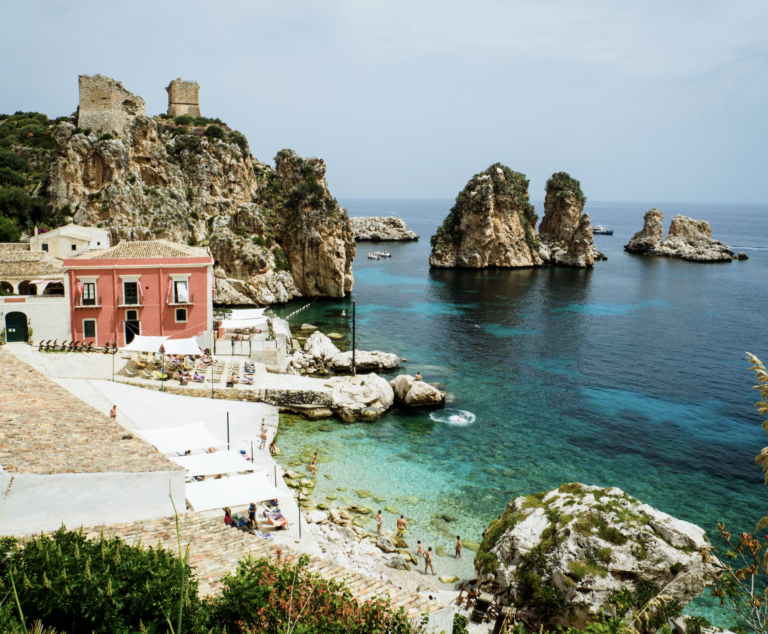
Tonnara di Scopello, Scopello, Sicily, Italy: the Mediterranean Sea looks healthy, but the damage is below the surface.
The underwater world is in danger, and the culprit is overfishing. It is a problem fueled by multiple factors, each wreaking havoc on our marine ecosystems. First, the appetite for commercial and recreational fishing puts immense pressure on important fish species, disrupting the delicate balance of life beneath the waves. But that’s not all—illegal practices, unreported catches, and forbidden gear silently destroying fish populations.
As if that weren’t enough, destructive fishing techniques like bottom trawling leave a path of destruction, harming their intended targets, unintended creatures, and fragile habitats. To make matters worse, fisheries management is drowning in a sea of challenges, from weak enforcement to limited monitoring, making it nearly impossible to accurately assess fish stocks and implement effective conservation measures. It is a dire situation, threatening the very sustainability of our oceans and the long-term health of marine ecosystems.
The Mediterranean, including Israel, may never fully recover, and the same is true for the rest of the world if we don’t take urgent action to safeguard the surviving fish populations.
Why should I care about over-fishing?
Fish dead in fish nets
Diminishing fish stocks, caused by the reduction in species diversity through over-harvesting, jeopardizes the livelihoods of the 800 million individuals working in the fishing industry. According to fishforward.edu, a staggering 93% of Mediterranean stocks are threatened by over-capturing. This decline in fish populations leads to diminished catches, financial losses, and a devastating impact on coastal communities.
The consequences of over-capturing extend beyond economics. Overfishing harms marine ecosystems’ delicate food webs and ecological relationships. The extinction of a fish species due to overfishing has far-reaching consequences, negatively impacting predators, prey, and their habitats. Disturbingly, Scientists have made a startling discovery: the Red Sea floor is leaking vast amounts of gas, further highlighting the ecological disruptions caused by overfishing. Sharks, vital to the balance of underwater ecosystems, are facing extinction in 20% of the world’s reefs and are dying off in the Mediterranean Sea.
Despite regulations, illegal fishing (IUU) poses one of the most significant challenges in combating over-exploitation. In fact, illegal fishing contributes a substantial percentage to the overall problem. Insufficient surveillance on the water hinders the enforcement of fishing regulations, allowing illegal fishermen to thrive. Their indiscriminate drag nets capture non-target species, further exacerbating the ecological imbalance caused by overfishing.
What are Israeli efforts against over-fishing?
Slow Food chef prepares Slow Fish, caught sustainably with a rod by one fisher
The Israeli government is taking decisive action to protect endangered species during their crucial reproductive periods. They have implemented fishing restrictions and season closures, incorporating measures like minimum size limits and regulating the quantity of fish that can be caught.
But that’s not all. Enter Marine Protected Areas (MPAs) – designated zones that act as safe havens for marine life. These areas restrict or even prohibit fishing activities, allowing fish populations to rebound and marine ecosystems to flourish again. The magic happens when these MPAs revive their protected spaces and help fish numbers grow beyond their boundaries.
To ensure the effectiveness of these conservation efforts, strict monitoring and enforcement are essential. Imagine increased patrols, cutting-edge monitoring systems, and even tougher penalties for those who dare to defy the regulations. It is a united front against overfishing, and these surveillance mechanisms play a crucial role in safeguarding our precious marine resources.
But protecting our oceans is not a solo mission. It requires the active involvement of fishermen, buyers, and the wider public. That’s why public awareness and education are essential to spreading the word about the value of sustainable fishing methods and shedding light on the consequences of overfishing, creating a sense of responsibility in everyone. Together, we can make informed choices and become stewards of our marine ecosystems, ensuring their long-term survival and prosperity.
What can I do to stop over-fishing?
A family hauling in a large fishing net
Educate yourself on fish sustainability policies and support the European Mediterranean nations as efforts are there to ensure that stocks are managed sustainably and work to combat IUU fishing. As an individual, you can still eat sustainably and mindfully on the Mediterranean coast.
Try different fish species – these are 7 safe fish to eat. As consumers, we tend to eat the fish we are used to, and the fishers work to meet the demand for more “common” fish. European Mediterranean fish buyers are being encouraged to help buyers try new and more sustainable local species that are not overfished and are widely available in the consumers’ respective regions. Consider eating farmed fish like tilapia.
Support small-scale fishing businesses and Slow Fish protocols. Collaboration with stakeholders, regulated sales to local restaurants, finding new markets, and establishing distribution agreements ensure a steady seafood supply.
Fishing communities like the one at the Port in Jaffa can also explore opportunities like fishing tourism, wildlife observation, cultural heritage preservation, and sustainable aquaculture. These efforts boost regional economies and emphasize the significance of fish. Making informed choices to support these initiatives is essential.
Through these collective efforts and informed choices, we can strive for a future where our oceans thrive, and the underwater world is preserved for generations.
If there’s one person to thank for the phrase “urban forager,” it’s Leda Meredith. The words encompass her passion for the wild edible plants that grow in natural settings like parks and forests, but also between cracks in the sidewalk, in empty lots, and unrecognized, in your own garden. Leda dedicated years to teaching how to identify and eat these plants, with the goal of helping people to reduce their carbon footprint by consuming locally grown foods.
Leda’s first career was as a brilliant professional dancer, a teacher of dance, and choreographer. She chose ethnobotany, the science of plants’ uses, as her second career, and earned certification in the field from the New York Botanical Garden. She had an honorary doctorate in fine arts for writing from La Universidad Leonardo da Vinci in El Salvador, and was granted Adelphi University’s Teaching Excellence Award.
She led foraging tours and held food preservation workshops all over the world. Owing to her influence, thousands of people now consciously choose to protect the environment by buying and preserving locally sourced foods, or growing them.
Leda Meredith, urban forager pioneer
Then there was Leda’s personal beauty and charm; her engaging enthusiasm for life and life’s good things; her wide-ranging intelligence and curiosity; her courage and sense of adventure.
She identified as a pagan. This is the grace she said over food:
“The energy you give me, I will turn into the actions of an honorable life. You will have no cause to be ashamed of being part of my bones. May your spirit travel in joy.”
Leda fought colonic cancer for a year. She died at home in San Juanillo, Costa Rica, where she and her husband, Richard Orbach, built a house. She is survived by Richard, and her mother, Penelope Colby. And by those many who deeply mourn her loss as a teacher and friend. I am one.
A Tesla Cybertruck is the easiest way to save money on gas, if you can find one
As gas prices rise to all-time highs around the nation, many people find themselves stressed about their finances. Rising gas prices can strain anyone’s budget. Whether you are looking to save some cash on leisurely road trips or just need help surviving the daily grind while commuting to work at votacall.com, there are some simple ways to lessen your spending at the pump. If you’re tired of rising fuel costs and ever-increasing bills, these tips can help lower your expenses without compromising safety or taking unnecessary risks with your car. Read on for a comprehensive guide to saving money on gas!
1. Drive less and more efficiently
Consider taking public transportation or carpooling for your daily commute to save money on gas. When you do drive, take advantage of your car’s fuel efficiency features like cruise control and engine start-stop technology. You can also try coasting to red lights and keeping tires properly inflated. These small changes can help you save money on the cost of gas over time.
2. Shop around for the best prices
Not all gas stations are created equal. You can easily compare fuel prices online or use a smartphone app to find the cheapest prices in your area. Look for gas stations that offer discounts or rewards programs to get even more savings.
3. Choose the right car
If you’re in the market for a new vehicle, consider one with better fuel economy so you can save money on gas each month. Electric, hybrid, and diesel cars tend to have the best fuel economy ratings.
4. Buy in bulk
You can save money on gas by buying in bulk from wholesale suppliers or large chains. Many places offer discounts when you purchase a larger quantity of fuel, so be sure to shop around for the best deals.
5. Consider alternative fuel sources
A hydrogen truck at a gas station
Alternative fuels like biodiesel, natural gas, and propane can be much cheaper than traditional gasoline. Investigate fueling options in your area to see if any of these alternatives could be the right choice for you.
These tips can help you save money on the cost of gas without sacrificing your safety or comfort. With a few simple changes, you can stop worrying about sky-high fuel prices and start enjoying the freedom of the open road.
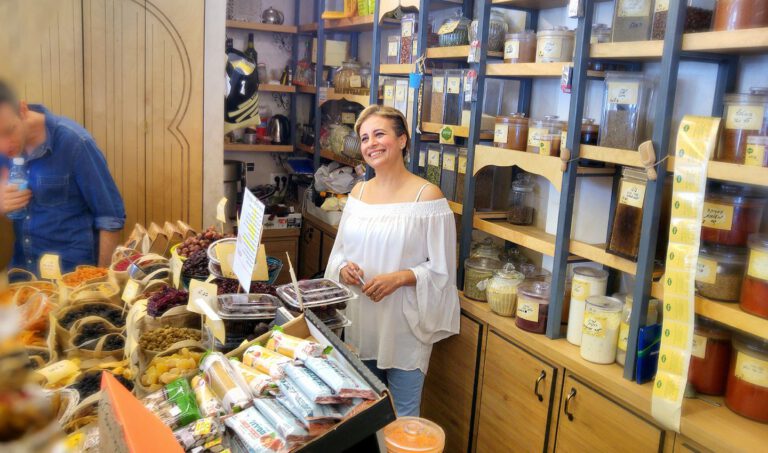
It’s rare for a Middle East spice market to be women-owned and run. But this Persian-Israeli woman Iris Tevlinksy defies market logic in Tel Aviv’s famous Levinsky Market.
Located on the corner of Hahalutsim St and Levinsky St in the famous Levinsky Market (close to Cafe Levinsky) is Tavlinsky, a unique market that has organic products that range from soaps and candles to spices and sauces. The array of products caught my eye as I was walking from a nearby coffee shop and had to stop inside to check it out.
When I went inside I met Hila Gadidi, who now owns the shop alongside her mother, Iris Gadidi for the past 10 years. Iris opened the shop because she wanted people to be consuming organic products. Iris was inspired by her mother to open the store. When Iris was a child, her mother gave her a Persian Havang, a type of pot used to grind many things, such as spices. One of which is saffron, Hila said, but you can grind any type of spice with it efficiently.
Hila preaches for her mother, who she claims was an independent woman for opening this shop all by herself. It’s difficult to open a shop here in this market, Hila said, but she is proud of her mother for being able to do so.
Tavlinksy grinds and produces all of its spices on-site, without the use of any preservatives or additives. At Tavlinsky, their mission is to serve the people the best, most organic spices. When you go to any other grocery store and buy spices, you are most likely not getting quality products. “The species you buy in-store are cheap, but they are not real spices,” Hila noted. I left the store with the Tuscany spice for 35 shekels, which I plan to make to make so many recipes with.
A Tuscan spice blend from Tavlinsky
Hila let me smell and even try some of the spices. One spice that I smelled was the “Iranian cumin”, which had a delicious strong smell that can be used to cook many different things. She also let me try the cinnamon, which they grind directly from the stick.
Cumin from Tavlinksy. Cumin is a very common spice in Israel and the Arab world.
“Not a lot of people like cinnamon. This is because the cinnamon is bitter, if it’s bitter, it’s not real cinnamon,” Hila told me. However, when I tried her cinnamon, it was almost spicy, exactly how you would like cinnamon to be. According to Hila, if the cinnamon is bitter, that means it has been mixed with coffee bean shells.
When I asked Hila how her business helps preserve of the planet, she told me “it’s not for the environment, it’s for the people.”
According to Hila, when you take real, natural medicine, and not unnatural, chemical-based medicine, it is so much better for you. The spices in the shop are for healing, “when you are stressed you drink the tea, when you have a headache, you drink the tea”.
Her best seller is the Organic Moringa, which is a superfood like spirulina. According to Hila is one of the healthiest superfoods in the world. Hila’s personal favorite is the Tuscany blend (which I had to buy for myself), which can use to make almost anything. Some of which can be schnitzel, chicken, pasta, salmon, potatoes, cauliflower and so much more.
If you are into rocks, Tavlinksy has a wide assortment to choose from. Each rock that Tavlinsky has available has a description associated with it so her customers can understand the meaning behind each one. For example, the green agate is supposed to help with self-confidence by cleansing the aura. Another example is the strawberry quartz, which stimulates the energy center in the heart and encourages universal love.
Tavlinksy is also all over social media, including Instagram, Facebook, and even Tiktok, which they have gone viral on. They can be found as “Tavlinksy” on TikTok and one of their videos got 273.4K views.
If you find yourself in the Levinksy market, I highly suggest you check out Tavlinksy. Whether you speak with Iris or Hila, you are ensured to get amazing customer service and the best, most organic products around. Especially if you are into cooking, you will find so many interesting spices and products here in the Levinsky Market.
Growing up in America, recycling has always been a well-known concept that everyone knows to do. Whether Americans participate in it or not, it can be found everywhere. Back home, we have two trash cans: garbage and recycling.
At my university, you will always find garbage and recycling. We are given lectures about recycling; the importance, the concept, and where to find them. However, now that I am in Israel (my first time), I rarely see recycling cans. Where are they? Do Israelis recycle?
Trash room in a dining common at the University of Massachusetts Amherst
In America, industries print numbers onto their materials to indicate the kind of plastic it is and this designates whether it can be recycled and in what bins. For example, in my hometown in New Jersey, we have designated days on which we can recycle, where we place them, and what rules to follow.
Each number inside the triangles indicates the type of material the item is made of. For example, number 2 indicates the material is made of high-density polyethylene. This material, which is commonly used in everyday household products is one of the easiest and safest recyclable materials. However, it is important to recognize that just because the object has a numbered indicator, does not mean it is recyclable. A number 7, classified as other, may or may not be recyclable. In the States, it is crucial to read up on your town’s recycling rules and regulations in order to educate yourself on correct trash disposal.
However, is recycling the only answer? According to the EPA (Environmental Protection Agency in the US), only 32 percent of Americans recycle. But grimmer numbers from Greenpeace suggest that the recycling rates are only about 5%. This shows that when the option is available to Americans to recycle, not all of them do it. In fact, most Americans do not take the time to educate themselves on the proper disposal of recyclable materials and therefore recycle incorrectly.
Recycling incorrectly can lead to even further problems, such as damage to the recycling equipment, and cause major delays and inconveniences in the recycling centers. (Do note however the problems with recycled plastics.)
Recycling labels
The question is how can we gives incentives for people to recycle in the proper way? As an American traveling to Israel who has decent knowledge in the area of recycling, I want to express my concern on the topic. First off, we cannot simply throw recycling cans all over Tel Aviv and expect everyone to cooperate. We need to educate Israelis and show them how to recycle, why it’s important, and then make them feel rewarded for recycling.
In order to educate, we need to put up flyers, posters, and advertisements around Tel Aviv so that the people will see them everywhere to the point where they can reiterate it in their sleep. For example, flyers hung around Tel Aviv can proclaim the importance of recycling. Or, show a sad image of a landfill. Then, provide resources so that the people can properly educate themselves in a manner that is quick and efficient for everyone’s busy lives.
Secondly, there need to be resources on recycling cans that easily show people what can and cannot be recycled. Another way to encourage recycling (an effective way that is widely seen in America) is by shaping the tops of recycling cans to only fit what can be recycled. This limits people from recycling materials that physically cannot be recycled and therefore helps the recycling centers do their job.
Lastly, it is noble to show the people that their actions toward creating a cleaner community pay off. One of the best ways is by creating economic incentives. For example, creating a program where if one recycles a certain amount of garbage, they can be given rebates and compensation. In addition, just expressing to people that their sustainable acts are worthwhile is moral.
Made eco chic shop in Jaffa for sustainable fashion
Recycling does not have to be boring. Similarly to items sold at Madeo eco-chic, a sustainable shop located in Jaffa, we can open more stores that sell items made from recycled material. There are so many ways we can reuse objects and create them into something new and fascinating.
For example, we can use recycled glass to create extraordinary art pieces:
Igreenspot.com made by Reborn Glass, Cape Coral, Florida USA
Overall, recycling not only creates a greener community, but it is also a way to bring us all together to find solutions to our disposal. Recycling does not need to be a tedious subject; we can use the subject of recycling to create new and improved concepts such as creating art and clothing.
Recycling is not a topic to shy away from. It is an innovative, expressive, and fun way to create a greener community.