EcoBasalt’s Volcanic Rock Fabric to Clean Oil Spills

lizard on volcanic rock
Volcanic basalt is a rock which can be turned into oil-absorbent fibers.

A company named EcoBasalt was founded in Israel in February of 2012.  Its founders are leveraging Russian space technology to create a new product for cleaning up oil spills.  Their product is named SB-1 and is based on the absorbent properties of basalt.  Basalt is a common kind of dark volcanic rock which has been used in everything from the floors of Egyptian pyramids to the insulation of Soyuz spacecraft and now it might help us clean up oil spills.
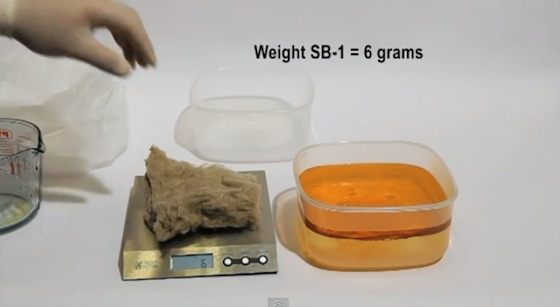
ecobasalt fabric before sucking up oilEcobasalt fabric before sucking up oil

More than 70,000 barrels of oil are produced every day and all of it must be transported to the consumers.  We hear about the spectacularly large oil spills which occur at the well-head or aboard supertankers, but given the amount of oil produced and consumed every day, spills along the entire supply chain are inevitable.  Therefore, oil spill containment is an important problem to solve.
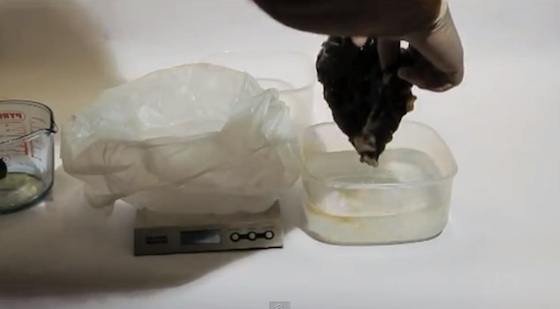
ecobasalt fabric
Ecobasalt after sucking up oil 

In the case of BP’s Deepwater Horizon oil spill and Egypt’s Jebel al-Zayt oil spill, chemical dispersants worked quickly to sweep some of the long-term problems beneath the waves where they won’t effect this quarter’s stock prices, but the cosmetic application of millions of gallons of toxic dispersants may cause more long-term damage than the oil-spill they were intended to cure.

[youtube]http://www.youtube.com/watch?v=eGGkWIIreCA[/youtube]

Clay, sand, oil-based synthetics and even human hair can be used to absorb oil spills, but EcoBasalt’s SB-1 basalt fibers have some advantages.  EcoBasalt’s tests show that one gram of SB-1 can absorb up to 72 grams of oil, at least twice as much as typical carbon-based absorbants and it can do it faster.

SB-1 is a non-toxic, natural, fire, alkali and acid-resistant substance, so it is possible to burn absorbed oil without extracting it from the basalt.  Extraction is also possible by simply compressing the SB-1 and as a third alternative, SB-1 can be mixed with asphalt and used in road construction

Robert Barzelay, the CEO of EcoBasalt tells Green Prophet that the product has not yet been tested on oil spills.

He says: “We have developed an oil sorbent made of basalt fibers. It has been a result of decades of R&D, and years of testing. It has been tested and proven (by independent labs in the USA and Israel) to perform far better than anything else on the market. Plus it is non-toxic, constitutes no health hazards, is ecofriendly, and the removed oil, can be recuperated from the sorbent, whereafter the sorbent can be recycled in asphalt for roads.

“There is nothing like it on the market.”

“At the moment we are at the stage to design oil sorbent booms with our basalt fiber sorbent material. In addition, we are in the process of setting up our own production lines. Once the end-product (oil boom) has been developed and produced, it will be tested by OHMSETT in the USA, and by (at least) ten oil and gas companies and so-called oil spill responders, companies and organizations that contain oil spills and do the cleanup.”

::EcoBasalt

Image of lizard on volcanic rock from Shutterstock

Brian Nitz
Brian Nitzhttp://www.greenprophet.com
Brian remembers when a single tear dredged up a nation's guilt. The tear belonged to an Italian-American actor known as Iron-Eyes Cody, the guilt was displaced from centuries of Native American mistreatment and redirected into a new environmental awareness. A 10-year-old Brian wondered, 'What are they... No, what are we doing to this country?' From a family of engineers, farmers and tinkerers Brian's father was a physics teacher. He remembers the day his father drove up to watch a coal power plant's new scrubbers turn smoke from dirty grey-back to steamy white. Surely technology would solve every problem. But then he noticed that breathing was difficult when the wind blew a certain way. While sailing, he often saw a yellow-brown line on the horizon. The stars were beginning to disappear. Gas mileage peaked when Reagan was still president. Solar panels installed in the 1970s were torn from roofs as they were no longer cost-effective to maintain. Racism, public policy and low oil prices transformed suburban life and cities began to sprawl out and absorb farmland. Brian only began to understand the root causes of "doughnut cities" when he moved to Ireland in 2001 and watched history repeat itself. Brian doesn't think environmentalism is 'rocket science', but understanding how to apply it within a society requires wisdom and education. In his travels through Europe, North America, Asia and the Middle East, Brian has learned that great ideas come from everywhere and that sharing mistakes is just as important as sharing ideas.

TRENDING

Eco organization offices destroyed by Iran missile

Tel Aviv's eco organization, the Heschel Center, was impacted by an Iranian missile.

What are AWG air-water generators, and why they aren’t a golden-bullet solution (yet)

Atmospheric water generators (AWGs) sound like magic: machines that can pull drinking water out of air. The idea is mentioned in the Bible, where the elders would pray for water collected as dew on plants and the catch on turning this into a machine is in the physics. To turn invisible vapor into liquid, you must remove heat, especially the latent heat of condensation.

Jordan’s $6 Billion Aqaba–Amman Desalination Project from the Red Sea Moves Forward

In 2025, the Jordanian government signed agreements with a consortium led by Meridiam and SUEZ, alongside VINCI Construction and Orascom Construction. Under a 30-year concession agreement, the consortium will design, build, finance, operate, and maintain the system before transferring it back to the Jordanian government. The total investment is estimated at approximately $6 billion USD.

The Saudi Startup Turning Desalination’s Toxic Waste Into Its Own Disinfectant

For millennia, the Middle East's water crisis seemed an immutable fact of geography — a region defined as much by what it lacked as by what lay beneath its sands. Today, a convergence of plummeting solar costs, advancing membrane technology, and hard-won engineering expertise is rewriting that story.

Earth building with Dead Sea salt bricks

Researchers develop a brick made largely from recycled Dead Sea salt—offering a potential alternative to carbon-intensive cement.

Should You Invest in the Private Market?

startustartup Unlike public stock exchanges, which offer daily trading, strict...

How to build a 100-year-company

Kongō Gumi is a Japanese construction company, purportedly founded in 578 A.D., making it the world's oldest documented company. What can we learn about building sustainable businesses from them?

From Pilot Plant to Global Stage: How Aduro Clean Technologies’ 2026 Expansion Signals a Turning Point for Chemical Recycling Investors Like Yazan Al Homsi

The company's Next Generation Process (NGP) Pilot Plant in London, Ontario, has officially moved into initial operating campaigns, generating the kind of structured, repeatable data that separates laboratory promise from commercial viability.

How AI Helps SaaS Companies Reduce Repetitive Customer Support Work

SaaS products are designed for large numbers of users with different levels of experience, and also in renewable energy.

Pulling Water from the Air

Faced with water shortage in Amman, Laurie digs up...

Turning Your Energy Consultancy into an LLC: 4 Legal Steps for Founders in Texas

If you are starting a renewable energy business in Texas, learn how to start an LLC by the books.

Tracking the Impacts of a Hydroelectric Dam Along the Tigris River

For the next two months, I'll be taking a break from my usual Green Prophet posts to report on a transnational environmental issue: the Ilısu Dam currently under construction in Turkey, and the ways it will transform life along the Tigris River.

6 Payment Processors With the Fastest Onboarding for SMBs

Get your SMB up and running fast with these 6 payment processors. Compare the quickest onboarding options to start accepting customer payments without delay.

Related Articles

Popular Categories