

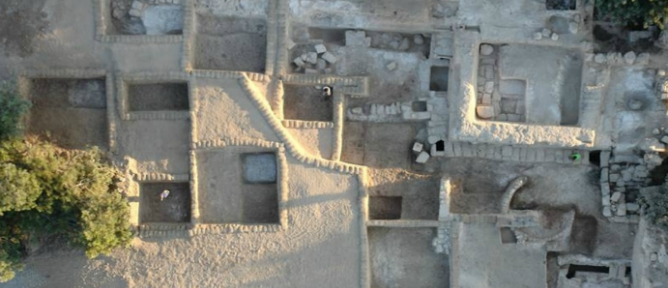
Ramat Rachel is an ongoing archeological dig on the southern outskirts of Jerusalem. A 2,500-year-old garden at the site, probably built by local Judeans, holds many secrets about the past waiting to be uncovered. An elaborate network of irrigation channels made it clear that this was a garden, but what was planted in it has been a big mystery.
New research by Tel Aviv University into ancient pollen found embedded in plaster suggests something very exciting for Jewish and natural historians of the region. Among the imported species of trees and plants determined by pollen analysis to have grown in the garden is the citron tree, known also as the etrog. According to the researchers, this pollen is evidence for the first cultivation of the citron tree, which is not native to Israel.
What makes it interesting for traditional Jews is that the citron, or etrog in Hebrew, is a powerful and mystical symbol used during the Jewish holiday of Succoth. An unusually fragrant citrus fruit, the etrog accompanies a bundle of three other plant species – willow, palm frond and myrtle — used in the weeklong festive fall holiday.
Could it be that the trees imported to Ramat Rachel thousands of years ago by foreigners have made such a lasting impact on the land of Israel and the traditions that the people abide by today?
Researchers at the site of Ramat Rachel –– Prof. Oded Lipschits, Dr. Yuval Gadot and Dafna Langgut –– think so. That’s why they are investing much energy into understanding the pollen deposits located at the ancient garden. The hope is one day to reconstruct it in all its glory.
Langgut is a palynologist, meaning she studies pollen and spores, and she specializes in ancient pollen from the Levant region. She was approached by the curious archeologists. “We didn’t have any clue about what was growing in this garden,” she recalls. “So they asked me to analyze fossil pollen embedded within the ground. I told them that I didn’t think it would be preserved.”
Chasing pollen in the wind?
Then one day she heard a talk about Ramat Rachel and learned that there were inscriptions found at the garden written in plaster. This gave Langgut some fresh ideas on how to find and study what could be ancient pollen trapped in the old plaster.
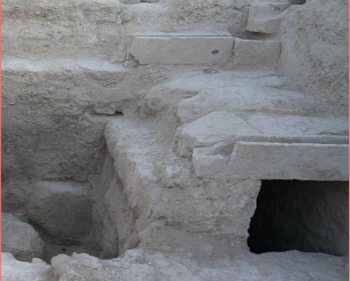
- Unique water gutters at the Ramat Rachel garden.
“If one of the layers of plaster was prepared in the spring while the garden was blooming, if we will be lucky we can analyze what was growing in this garden then, because the pollen would be preserved in this plaster,” she says.
After analyzing the layers of plaster in the lab, she was thrilled to find that all the layers of plaster contained fossilized pollen and one layer was particularly intriguing because it contained pollen assemblages of plants not at all typical to the Judean Mountains, she tells ISRAEL21c.
Finding the trace of etrog pollen was the biggest news for the researchers and a highlight of Langgut’s career. “I can tell you that I was astonished to find the citron pollen because I knew it is not a typical plant in the area so I realized it was imported. And I saw other [non-native trees] like the cedar of Lebanon,” she says, noting that from the pollen records and physical archeological evidence it is clear that a lot of work was put into this elaborate garden. It was built to impress.
From the Garden of Eden to the Hanging Gardens of Babylon, the thought of ancient gardens conjures up the stories from legends. What more can the ancient garden of Ramat Rachel reveal?
Reviving an ancient garden
The site was originally uncovered by Tel Aviv University researchers and their partners from Heidelberg University in Germany a few years ago. According to them, this is first full-scale excavation of this type of archaeological site anywhere in the pre-Hellenistic Levant, an interesting fact for archeology buffs.
Lipschits says he thinks that what is revealed at Ramat Rachel can give important archeological information about ancient gardens in the whole Middle East. Only two miles from the Old City of Jerusalem, Ramat Rachel likely has a lot more secrets to tell.
For now, a basic layout of the garden has been constructed. The researchers know that indigenous trees such as figs and grapevines were planted there. New evidence also points to myrtle and citron, the Persian walnut tree, birch trees and the cedar of Lebanon.
The grandiosity of the garden, the researchers speculate, was for the ruling class at the time to flaunt their wealth. Now that information on the garden is pouring in, in the form of ancient pollen, the archeologists will be able to reconstruct ancient times so modern people can enjoy the opulence that once was.
This article was first published on ISRAEL21c – www.israel21c.org




Fascinating.
Thank you.