
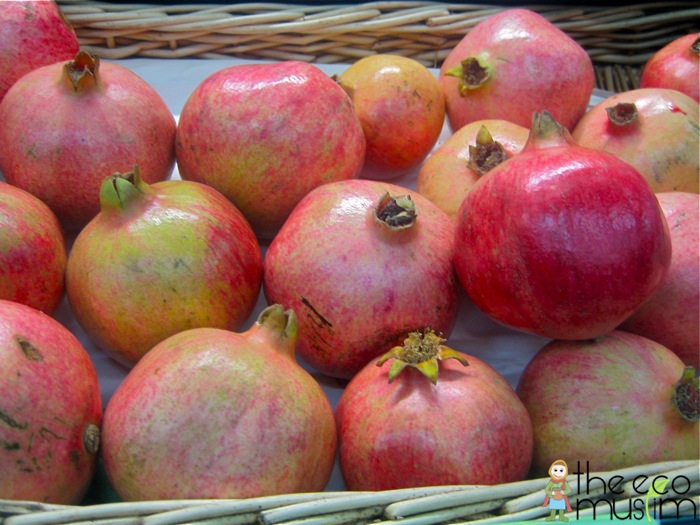

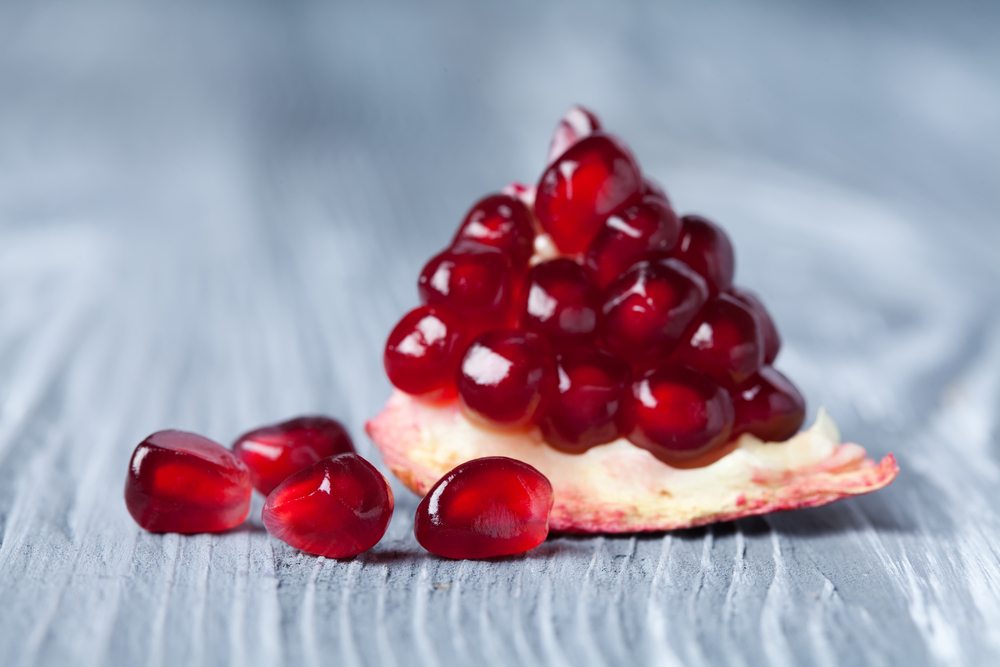
The princely pomeganate, ar-Rumm in Arabic, is mentioned in the Koran as one of the many delicious rewards awaiting in Paradise. Its numerous uses in cooking and medicine, as well as its beautiful structure, make the fruit a wonder for Muslims who believe that each pomegranate seed is a sign of the sustainer.
Pomegranates are mentioned three times in the Koran or Qur’an: As one of the fruits that will be found in paradise:
“In both of them [gardens] are two springs, spouting […]In both of them are fruit and palm trees and pomegranates. So which of the favors of your Lord would you deny?” (Quran, 55:66-69)
As a reminder of God’s sustenance on earth,
“And He it is who produces gardens (of vine), trellised and untrellised, and palms and seed-produce of which the fruits are of various sorts, and olives and pomegranates, like and unlike; eat of its fruit when it bears fruit, and pay the due of it on the day of its reaping, and do not act extravagantly; surely He does not love the extravagant.” (Quran, 6:141)
And as a sign of his artistry,
“And it is He who sends down rain from the sky, and We produce thereby the growth of all things. We produce from it greenery from which We produce grains arranged in layers. And from the palm trees – of its emerging fruit are clusters hanging low. And [We produce] gardens of grapevines and olives and pomegranates, similar yet varied. Look at [each of] its fruit when it yields and [at] its ripening. Indeed in that are signs for a people who believe.” (Quran, 6:99)
The frequent mentions of this fruit owe to its gem-like beauty, a glistening core of seeds compacted in a layer resembling honeycomb.
Equally astounding are the colours of both the fruit and flowers which are an attestation to the Qur’anic verse:
“And whatsoever He has created for you on the earth of varying colors [and qualities from vegetation and fruits] and from animals. Verily! In this is a sign for people who remember.” (Qur’an, 16:13)
In Arabic a pomegranate is known as the royal word ‘rumaan‘, in Urdu ‘anaar‘ and interestingly, because of its resemblance to many fragments resulting from detonating a grenade, in Hebrew the word ‘rimon‘ may mean both pomegranate and shell.
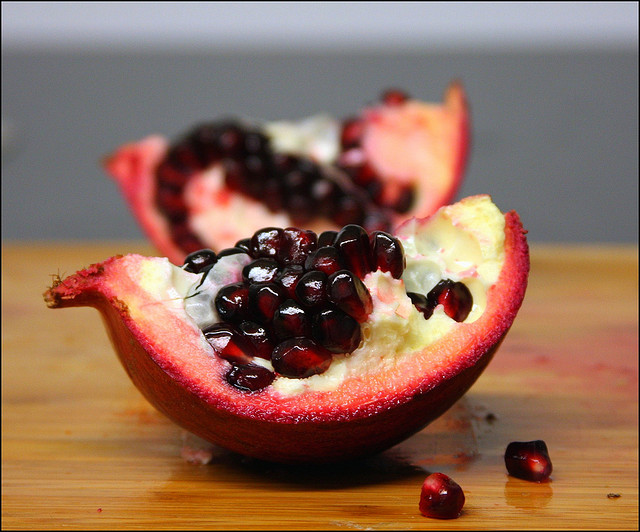
A split-open pomegranate fruit reveals red gems resting between protective papery skins
Inside a pomegranate are the edible succulent grains of pulp-like tissue, pink-red in colour. Once the leathery skin is removed, these “seeds” can be plucked loose for on-the-go eating or a sharp tap of a wooden spoon will scatter them into a bowl.
Tasting Those Seeds
Pomegranate grains have a “fresh, sweet-sour”, very juicy taste (Gernot Katzer), while other forms of the fruit may be acidic. Here in Britain one rarely finds a very acidic pomegranate although many fruit varieties very popular throughout the Middle East are used to sweeten meat dishes and salads.
Where Pomegranate Shrubs Grow
Pomegranates originate from the Middle Eastern region and are cultivated in central Asia, Mediterranean countries and northern India. They often resemble a shrub more than a tree. In Turkey you can find them adorning outdoor swimming pools in hotels; in Israel people plant them as one of the Seven Species of the Bible.
In India, pomegranates have a culinary reverence. The grains of more sour fruits are dried and used as a flavouring and substituted for raisins in baking. The juice of the pomegranate is a favourite in many Middle Eastern countries and Asia.
I remember, as a child, my family would buy the cool red juice from street vendors in Pakistan and just before a rice dish had finished cooking, handfuls of pomegranate grains would be stirred in, bursting with red colour and bite. Pomegranate fruit juice is also used to make sauces and jellies.
Nutritional Value of Pomegranates
Nutritionally, pomegranate fruit is rich in Vitamin C and contain 65 calories and it is a good source of sodium, riboflavin and calcium. A handful of grains for suhoor (pre-dawn meal) are ideal for balanced health over the Ramadan fasting period.
Prophet Muhammad of Islam told his companions that each pomegranate potentially held a heavenly grain, “There is not a pomegranate which does not have a pip from one of the pomegranate of the Garden (Jannah) in it.” (Abu Nu’aim)
And these pips, along with the outer skin, are rich with antioxidant and antibacterial properties, testimony to its benefits for cleansing the palate. The prophet therefore also said, “Pomegranate and its rind strengthen digestion (stomach).” (Abu Nuaim, narrated by `Ali)
Uses Of Pomegranate
Among its various uses in the culinary world, the scarlet flowers of the pomegranate plant produce a vibrant red dye for textiles, which has been used for centuries in Central Asia.
Pomegranate plants also provide herbal medicines for diarrhoea, fevers, gum disorders and earaches. Resourceful explorers have found the bark of the pomegranate shrub to have medicinal use while the fragrant flowers of the tree can be used to relieve sore eyes.
We have a wonderful recipe here for the adventurous on how to make pomegranate molasses.
Find more fruity goodness:
Go Green this Ramadan! (6 Steps)
June Seasonal Produce, Melons, Cherries, and Apricots
4 Unique Aloe Vera Juice Recipes for Summer and Health




see plants of holy quran
Why did you mention the ancient love a fair the Jewish people have with the pomegranate and how many times we have wrote about it . This is a good place to make conextions we need .