
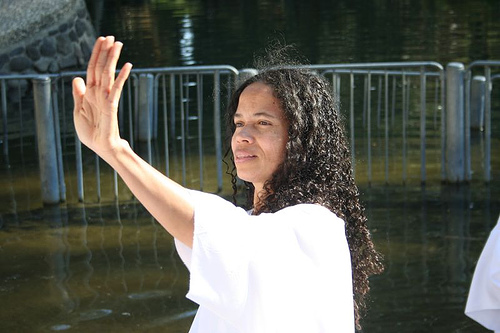


(A Christian woman about to be baptised in Israel’s Jordan River.)
Sunday was World Water Day, and lately with all the adverse publicity regarding the cleanliness of Israel’s streams and rivers, I’ve often wondered if there are any that might be considered as safe to drink out of, even if one were in dire straits and suffering from severe thirst.
While some appear to be running clear and clean, especially those on the Golan Heights such as Nahal Hermon and Nahal Yahudiya, what one would find in the waters of these placid streams, if samples were sent to a laboratory, would be a bit disturbing, to say the least.
Even Nahal David and Ein Gedi, those streams in the Ein Gedi Nature Preserve, where the biblical David drank form when hiding in the wilderness from King Saul, are considered as too polluted to drink from, unless treated.
And as far as the Jordan River, one of Israel’s major suppliers of water to the, Kinneret, it’s waters are also substantially polluted after receiving a good portion of Lebanon’s raw sewage and other pollutants from the Lithani River, one of the Jordan’s major sources.
I suppose this might also be said for most of European waterways, even those in mountainous countries like Switzerland and Austria, for that matter. This is unfortunately a fact of life, and a result of Mankind’s ruination of the world’s fresh water supplies, by dumping all kinds of chemical and biological wastes into them. About a year ago, a small stream in Israel’s Galilee region, Nahal Meiron, was discovered to be contaminated by detergents and other pollutants.
It’s interesting to note that some of worst polluted streams in the country, such as Nahal Alexander, Kishon, Yarkon, and Sorek were once clean enough to swim and fish in. And one stream, Nahal Tenenim (Crocodile River) was once said to have those very reptiles living happily in it. I myself recall that Nahal Tenanim had giant African catfish that were up to a meter or more in length as recently as the mid 1980’s. No more, however.
While there are some efforts being made to clean up some of Israel’s streams, including (believe it or not) those like the Kishon, Alexander and Hadera streams, they will never be clean enough to be suitable for major outdoor recreation.
And the Yarmuk, one of the Kingdom of Jordan’s major water sources, has been polluted by Israel sources, requiring The Israeli government to compensate the Jordanians with fresh water from the already polluted Kinneret. What would happen to streams on the Golan Heights, especially Nahal Hermon which flows by the Banias nature site, if given back to Syria would be far-gone conclusion, as the Syrians literally trashed the area in the period before the June 1967 Six Day War.
Clean water is a very scarce commodity in this region, and all that can be done now is to try to keep the situation from getting worse.
More on water resources:
Israel Compensates Jordan With Sea of Galilee Water
High Radioactivity Found in Jordanian Groundwater
From Solar Air Conditioning to Squeezing Water From Thin Air
[image via nickolette]



Yes Maurice, I’ve lived here in Jerusalem for 4 years, and have toured the Golan.
I agree that the Syrians may have caused environmental damage there, and the Lebanese on the border there, and with Jordan, Egypt, etc etc, and the British, and the Turks….but what matters now is who does what now, and how we here at GP try to channel environmental awareness and media to find solutions, co-operatively, not to point fingers & cast the blame.
Lets hope all the rivers & streams of the Holy Land will soon be full of fish & swimmable (& be clean enough to be baptised in, or whatever….), B’srat Hashem!
Hi James,
Regarding your comment about Syria, do you live here in Israel; or if not, have you ever visited here – especially touring the Golan Heights? If not, you should. Then you would see what is going on there.
Regarding the Thames, I agree that more efforts need to be done in Israel to clean up out small streams like the Jordan and the others I mentioned in the article. I’m not going ot get into what has made many of them so polluted, but I can say that its a combination of factors, including wholesale dumping of both industrial wastes and raw sewage into them. I would also like to see many of these streams full of fish again.
Maurice – there’s not much to be gained from just bashing the Syrian’s in a ‘what if’ scenario…..
also, London’s famous River Thames has now been cleaned up after a hundred years of Industrial (& non-Industrial) pollution, that while I wouldn’t fancy swimming in it (though people do), it is now full of fish again. Next time you’re in the Smoke, stand on any of London’s bridges and marvel at what we can do, when we put our minds to it, to reverse environmental damage……
Surprisingly, or maybe not because they are Swiss after all, most if not all the streams in Swizterland are swimmable. Even the large ones running through cities like Zurich and Basel; Fountains in villages taking water from springs and wells very drinkable.
Searching For A Clean Stream In Israel, Or Anywhere http://tinyurl.com/cqnt93