Hidden Costs of Constructing Wind Farms in Turkey Include Many New Roads

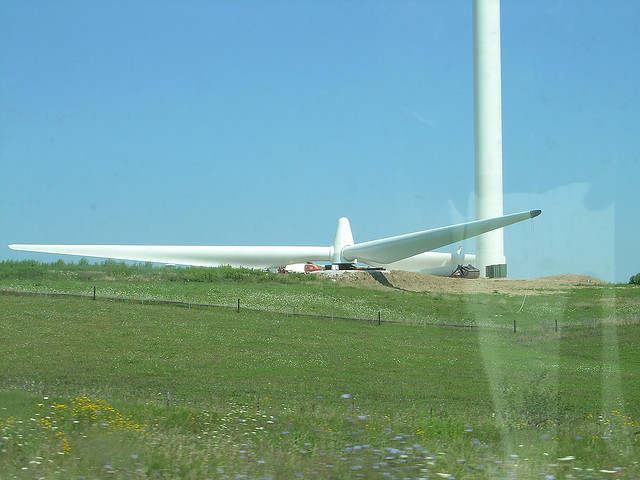
turkey wind farmsThe new roads required to transport wind turbines to installation sites in Turkey can delay projects and add to their costs, but also create hundreds of new construction jobs.

An anonymous representative from one of Turkey’s largest wind energy companies says that every new wind project requires new access roads, because the best wind is found in relatively remote, inaccessible terrain, according to the Hurriyet Daily News. Even main roads sometimes need to be rebuilt, because the trucks bringing the wind turbine equipment cannot maneuver sharp curves.

As a result, the extra costs of road construction are often figured into the projected costs of wind energy companies. Local authorities, the Ministry of Environment and various NGOs must also be consulted when planning any wind project, to ensure that local communities and ecosystems won’t be too disrupted by the new roads.

But so far, these roads’ biggest effect on local communities seems to be the new construction jobs they create.

Certainly, wind companies have not imitated the heavy-handed way in which hydropower plants or thermal power plants are built in Turkey, often without regard for the local environment or local residents’ concerns. Unlike thermal power companies, wind energy companies typically employ local construction outfits, and take pains to inform local residents about the project in detail, according to Mustafa Ataseven, chairman of the Turkish Wind Energy Association.

These procedures can delay a wind project by several months, Ataseven told the Daily News. But they are small hurdles compared to the major forces that have held back the wind industry in Turkey: a lack of government funding and an inefficient licensing system.

Wind power in Turkey took a big hit in the early 2000s, when the country suffered a financial crisis and requested help from the International Monetary Fund. To encourage market privatization, the IMF aid forced the Turkish government to cancel guaranteed funds to seventeen already-approved wind power projects, according to a report by Richard Lynch of the U.S. Department of Energy.

In 2007, the Turkish government passed a renewable energy law with small incentives for wind energy, which boosted the sector. An amendment to that law, passed at the end of 2010, increased feed-in tariffs for wind to $0.073 per kilowatt-hour, which, though small, should further promote investment in wind projects.

When Turkey’s Energy Market Regulatory Authority (EMRA) invited power companies to apply for wind project licenses in 2008, it received applications for almost 80 GW of projects. Unfortunately, most of these applications overlapped at a handful of grid connection points. As a result, no construction on the projects can begin until new tenders are held for each separate connection area, which will begin to happen later this year.

Currently, the country has an installed wind power capacity of 1.3 GW, which is still a fraction of its estimated potential of 90 GW. But the capacity is increasing quickly. In 2010 alone, 343 MW were added to the grid, and by 2015, Turkey’s wind power capacity is projected to reach 5 GW. The government wants to increase that figure to 20 GW by 2023.

If these exciting numbers come true, Turkey may well become a major player in the Middle Eastern wind energy industry — more so than countries like Egypt, which just announced a tender for 2.7 gigawatts of wind projects, and Jordan, where the government aims to install 1.6 GW of wind power by 2020.

Compared to its neighbors, and to the depressing incentives for other renewable energies in Turkey, wind energy has a bright future in the country. If wind projects can be responsibly planned while also creating employment opportunities for local construction workers, so much the better.

:: Hurriyet Daily News

Read more about wind energy in Turkey and the region:

Turkey Blowing and Going on Wind Energy

Egypt Requests Bids to Get 2.7 Gigawatts of Wind Power by 2016

Syria’s Master Plan for Renewable Energy

Image via royalgeekg

Julia Harte
Julia Hartehttp://www.greenprophet.com
Julia spent her childhood summers in a remote research station in the Rocky Mountains of Colorado, helping her father with a 25-year-old experiment in which he simulated global warming over a patch of alpine meadow. When not measuring plant species diversity or carbon flux in the soil, she could be found scampering around the forests and finding snowbanks to slide down. Now she is a freelance journalist living in Istanbul, where her passion for the environment intersects with her interest in Turkish politics and grassroots culture. She also writes about Turkish climate and energy policy for Solve Climate News.

Read More

1 COMMENT

LEAVE A REPLY

Please enter your comment!
Please enter your name here

TRENDING

AI data centers are triggering panic, instead of cleantech opportunities

AI may unintentionally become the economic engine that finally modernizes America’s aging grid. California is experiencing a massive AI data center boom, ranking 3rd in the U.S. with 227 operating centers and 54 more in development as of April 2026, according to Stanford.

24 7 renewable energy: how solar, wind, batteries and AI SaaS replace fossil fuels

A new report from the International Renewable Energy Agency based in Abu Dhabi makes something clear that many in the industry already suspected. When solar and wind are paired with battery storage, they can deliver reliable, round the clock electricity at costs that compete with, and often beat, fossil fuels.

Abortion Pills, Plan B and Mifepristone and what the new US mail ban means

Abortion pills, often confused with Plan B (the morning-after pill), and historically referred to as RU486 (mifepristone), are part of a broader category of reproductive health medications that women have been using for decades. But they are not the same thing.

Korean researchers create battery from greenhouse gases

Professor Ji-Soo Jang, in collaboration with Professor Taekwang Yoon of Ajou University and Professor Hansel Kim of Chungbuk National University, has developed a novel energy device that generates electricity during the process of capturing greenhouse gases.

SunZia comes online and America’s 11B, and largest renewable project begins wind power

The impact is already being felt. California has broken its wind generation record multiple times in recent weeks as SunZia begins feeding electricity into the grid. It’s a glimpse of what a renewable-powered future could look like when large-scale infrastructure finally comes online. Can we start saying goodbye to Saudi Aramco and Arabian Gulf oil? 

How to quiet noise from construction in your office

Streets need to be resurfaced in New York but the humming and grinding noise is unsettling. Noise is environmental pollution. 

EarthX and a blueprint for sustainable investing

Trammell S. Crow, a Dallas-based businessman and father of four, is focusing his efforts on impact investing, and media that focuses on saving the planet through EarthX.

Mining Afghanistan’s Mineral Discoveries Similar to Avatar

Now that American forces in Afghanistan are commemorating the longest period of any war that America has been involved in, including the 1965-73 Vietnam War, the recent discoveries of large and extremely valuable mineral and metal deposits may finally bring to light a reason to continue the presence of US fighting forces in this war torn and backward country.

From Pilot Plant to Global Stage: How Aduro Clean Technologies’ 2026 Expansion Signals a Turning Point for Chemical Recycling Investors Like Yazan Al Homsi

The company's Next Generation Process (NGP) Pilot Plant in London, Ontario, has officially moved into initial operating campaigns, generating the kind of structured, repeatable data that separates laboratory promise from commercial viability.

Nobul’s Regan McGee on Shareholder Value: “Complacency Is the Silent Killer” 

Why the governance framework designed to protect shareholders so...

Should You Invest in the Private Market?

startustartup Unlike public stock exchanges, which offer daily trading, strict...

How to build a 100-year-company

Kongō Gumi is a Japanese construction company, purportedly founded in 578 A.D., making it the world's oldest documented company. What can we learn about building sustainable businesses from them?

How AI Helps SaaS Companies Reduce Repetitive Customer Support Work

SaaS products are designed for large numbers of users with different levels of experience, and also in renewable energy.

Popular Categories