
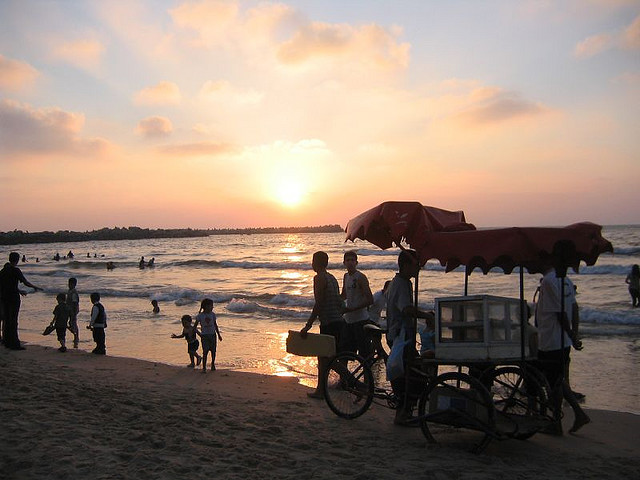

 Environmentalists condemn Israeli plans to build an artificial island off the coast of Gaza to house a port, an airport and to encourage tourism
It seems that it is not only Dubai that harbours ridiculous dreams of artificial islands– Israel does too. Israeli minister for transport Yisreal Katz recently revealed that plans to construct an artificial island off the coast of Gaza had been encouraged by the PM Benjamin Netanyahu and may be getting the green light soon.
It is believed that the island project will cost an estimated $10 billion and take up to 10 years to finish. Gideon Bromberg, director of Friends of the Earth Middle East told the Guardian that the project is “complete madness”.
Katz said the plans had been under consideration for some time and had already attracted investors. The three square mile Island would be linked to Gaza via a three-mile long bridge and will also include a marina and hotels to attract tourists.
Israeli director of Friend of the Earth Middle East Bromberg spoke to the Guardian:
“This sort of thing makes no sense whatsoever. The environmental implications would be felt along the coast of Gaza and Israel.
Even the building of a marina caused a two-mile scar of beach erosion in Israel which the developer’s planning had not predicted. The public should be very sceptical.”
It was also reported that the Israeli Ministry of Environmental Protection had not been consulted on the project.
The Gaza Strip’s own airport was destroyed by the Israeli army back in 2002 and the enclave has been under a tight naval blockade since 2007. Gaza has a small fishing port but it doesn’t have anything to deal with commerical shipping. Israel has only allowed limited goods to enter and leave Gaza since 2007 although Gazans have taken to smuggling goods from Egypt through tunnels.
Although Israeli spokesmen have insisted that the artificial island will also benefit Palestinians, commentators have remarked that simpler steps could be taken. I can think one myself which that wouldn’t’ decimate the already devastated ecosystems around Gaza– end the blockade.
:: Image via Olly L via flickr.
For more news in Israel see:
Travellers Want Trains- What is the Middle East Doing?



@tinamarie – allowing spare parts for the water treatment facilities already in gaza would be a far more sustainable and environmentally sound response to the lifethreatening daily shortage of clean water.
Allowing raw materials for the companies already existing in gaza, but currently opperating at massively reduced capacity, and allowing these companies to export their products, would me a much more sustainable and empowering way of providing employment to palestinians in gaza
why such a convoluted expensive environmentally damaging plan, while ignoring all the simple sensible steps towards solutions?
check http://www.gazagateway.org/ to flush out details
In what possible sense would this “get supplies to Gaza without jeapordising Israeli security”? In what way is it any more ‘secure’ than the simple proposals of using the secure gates already in place (but seldom opened) with their extensive existing infrastructure of checkpoints, observation towers and x-ray equipment?? or sending a boat around the coast from teh security conscious israeli ports to the ports of gaza?
and why is the gaza coast israel’s to build on?
or is it all about securing access to the oil fields just off the gaza coast?
It doesn’t have to be. We could simply focus on the green aspects of such an Island, nu? With that said, thanks Tafline for clarifying a bit on the environmental drawbacks of this construction. How would this compare to a harbor?
It’s almost impossible to write a story about Israel and Gaza without the political scenario popping up, but let’s be clear: artificial islands are environmentally destructive no matter where they are built or by whom.
How does the impact compare to that palm tree shaped thing in Dubai, or the creation of the peninsula for the Rafik Hariri Memorial park in Beirut? Do those projects muck up the local coastline and coastal environment the same way, or is there something about the “islandishness” of this project or the Israeliness of this that makes it especially egregious? Is the protest environmental/sustainability or is it political?
What I read elsewhere Karin is that one reason was for security purposes. It would give Gaza an transport corridor via the island/bridge, rather than depending on its borders with Israel and Egypt. I didn’t read anything about why not rebuild it on land. But off the top of my head, I’m just thinking that the land area is so small, and an airport takes up a lot of space. Maybe for the same reason that other small countries (Japan) have turned to the seas for such a facility?
Understood that there is a “security” issue; still I think it’s very short term planning and a very bad idea in general. Beaches will erode, ecosystems destroyed.
The United Arab Emirates have a love affair with artificial islands – to the serious detriment of the marine ecosystem. They cause erosion, they disrupt currents, they displace marine life, and – as evidenced by The World islands in the UAE – they aren’t even guaranteed to stick around for very long! (The World islands are sinking). It’s great that Israel is trying to think of a way to get supplies to Gaza without jeopardizing their own security, but I’m not sure this is the right response. Gideon from Friends of the Earth Middle East said of this project that it is sheer madness because even a small marine development project creates environmental scars. Also note that the environmental ministry wasn’t consulted… there’s probably a reason for that.
Because I was interested in flushing out the details of this story, I found may other sources reporting that the Island airport will benefit Palestinians as well as Israelis. They will be able to use it to ship goods in and out of their region (via a bridge to Gaza), secure employment for those living in Gaza (who definitely need jobs!), and that investment from Palestinian sources is also being offered (besides Israeli and International). In addition to providing a more secure means of transport for goods in and out of the region (thereby making the borders of Gaza with Egypt and Israel more secure, less restrictive?) the island would also include a desalination plant (this is good given the scarcity of water issue that knows no boundaries), and that an international agency, such as NATO, would manage security for up to 100 years. 17 such projects around the world exist/are underway, probably less political than this one. Environmental impact concerns notwithstanding, I think it’s important that if we are to mention the very real political pains of those living in the region (Palestinians and Israels), we include a more complete picture. Is there potential benefits such a project might bring? If people from both sides can collaborate – again, taking the issue of whether or not this island is a sound choice to make on environmental merits alone – than it is my hope that we can find the common good.
With that said, I really want to learn more about how this Island may or may not harm/benefit the environment. I do hope these studies are conducted and considered before any such Island is built.
I am sure the idea was meant to benefit the Palestinians, but the real question is why an island? Why can’t the Gazans have an airport on land?
Doesn’t Japan have such an airport? I wish there was more on the environmental concerns mentioned here. I’m not sure this is a bad idea based on the information presented.