
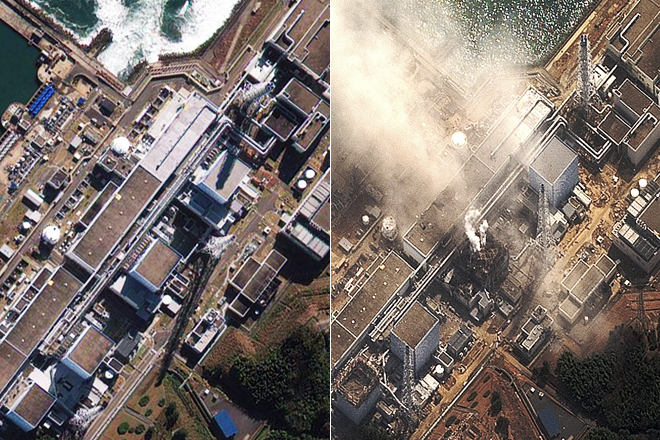

 Fukushima Daiichi reactors in Japan before and after the tsunami. Is this worthwhile for Israel or other Middle East countries?
Japan’s damaged nuclear facilities are reaching even more critical radiation leakage levels, and the country’s population is becoming more concerned about the effect of radiation their own environment as well as that outside Japan. Despite this reality, energy spokespersons in other parts of the world still talk in favor of nuclear energy as a “clean and safe” fuel, as compared to fossil fuels like oil and coal.
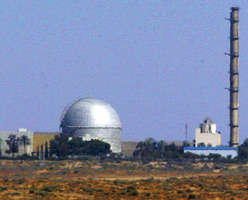 Dimona nuclear reactor
One of these voices is coming from a very unlikely place, Israel, where its nuclear energy program has been described as being “in a state of ambiguity” for years due to ongoing rumors of it possessing a number of nuclear weapons.
During the recent Negev Conference in Israel’s southernmost city of Eilat, Mr. Yiftach Ron-Tal, Chairman of the Israel Electric Company, told conference attendees that “Israel should build a nuclear power station, and it must be made to be safe. Hasty decisions should not be made because of what is happening in Japan.”
Ron-Tals remarks, as reported in Globes financial news site, emphasized that Israel should “move forward and learn”. He added that in a decade “we’ll have an advanced nuclear reactor in the northern Negev.”
Learn indeed: recent news coming from Japan now indicates that the radiation levels are becoming so high in the Fukishima Daiichi plant that all that can be done to try to cool down the exposed reactor fuel rods is to drop sea water from helicopters on the reactors from above.
This seems to be about as effective as when airplanes dropped water and chemicals on the disastrous wildfires in the Carmel forests that were only brought under full control when the winds shifted and it finally rained enough to help extinguish the fires. In Japan, both winds and rain will cause the radiation leaking out of the damaged reactors to spread further and also be absorbed quicker into the ground.
Israel’s nuclear program has been ongoing since the early 1950’s, and became accelerated when the French, under the leadership of President Charles De Gaulle agreed to help Israel with its nuclear program, with the idea that a nuclear Israel could be a control factor over Egypt during Frances war in Algeria.
During this period, which lasted until the 1967 Six Day War, France helped Israel construct the nuclear facility in Dimona, and also was said to be aiding Israel to import uranium for use in its nuclear reactor.
Shhh… Israel has nuclear reactors
Israel now has two nuclear reactors in operation: the one in Dimona, and a second one at Sorek, between Tel Aviv and Ashdod.
We might now say “so much for nuclear ambiguity”. During the Negev Conference, which was organized to encourage tourism and other industries to Israel’s largest – and driest region, economic models were presented that would turn Eilat into a “gateway” city to Africa and Europe, with a population of around 150,000.
Nuclear energy, in a plant that would be built in Israel’s northern Negev region, would only be part of a wide ranging energy plan which will include natural gas and renewable energy – especially solar energy.
Regarding other area nuclear plant plans, especially those by Jordan, Ron-Tal said that these plans are being monitored, especially the one by Jordan to construct a nuclear power station next to its Red Sea port of Aqaba.
Ron-Tal told the conference group:
“As for the Jordanian power station, we’re monitoring it. This is a matter for the government. Appropriate geo-seismological studies are being conducted to find the best location for such a power station, especially with regard to the Syria-Africa Rift Valley. Israel is monitoring the issue, but there is no partnership by Israel. Current reactors are much safer than the reactors in Japan, which are very old.”
With plans to make renewable energy provide 10% of Israel’s total power needs within 20 years, and with the availability of natural gas – Ron-Tal added that “Israel has become a natural gas power” – why would the use of nuclear energy be such a viable option in light what is happening in Japan? That’s obviously an answer that only Israel’s leadership can make forthcoming, in light of its nuclear history to date.
Photo: Fox News
Read more on Israel’s other Mid East area nuclear energy programs:
As Japan Nuclear Plants Approach “Meltdown” What Can the Middle East Learn
Japanese Nuclear Meltdown Will Seriously Affect World Environment
Is Israel Planning to Come out of the Nuclear Closet by Planning Power Station?
Israel Seeks to Build Nuclear Power Plants in Cooperation with Arab Neighbors
Jordan Explores the Nuclear Option Despite Alternative Plans for “Clean” Fuel


It’s amazing how an event such as that which is happening in Japan can change everything. America, for example, has 104 nuclear power plants. And many can still remember the Three Mile Island and Silkwood incidents. There is also a lighter side in regards to The Simpsons comic series, when the father, Homer Simpson, often came home from his job in the nuclear power plant with a piece of glowing nuke material in his pocket.
I guess people are not laughing so much now.
http://www.jpost.com/NationalNews/Article.aspx?id=212599
Things change fast in Middle East. Israeli PM just said that there will be no Nuclear civilian energy in near future.
Humans are terminally stupid.