

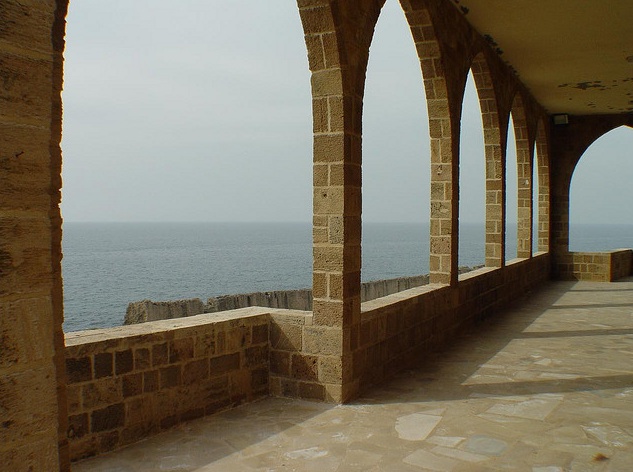
 Lebanon looks to lay claim to natural gas find off Israel’s coast. Image of Mediterranean Sea from Beirut.
Lebanon’s Hezbollah leader Hassan Nasrallah is not only trying to pose a threat to Israel’s security, but to its pocketbook as well. Israel has announced striking gas – natural gas– and now the Hezbollah (Arabic: حزب الله, literally “Party of God”) based in Lebanon are attempting to lay claim to the underwater natural gas fields that Israel discovered, and is now developing off Israel’s northern coast. A Washington Times article penned by Gal Luft suggest that that the Hezbollah, a Shi’ a Islamist political and paramilitary organisation, are looking for ways to continue its “armed struggle” against Israel, with its claims that the gas fields are actually in Lebanese national waters, and therefor belong to Lebanon. Can the Hezbollah justify its actions? And will it be using the “Free Gaza” flotilla-style operations to monitor Israel’s seas?
The gas fields, currently being developed by the Texas-based Noble Energy company, together with Yitzhak Tshuva’s Delek Energy subsidiary can go towards making Israel an energy exporter, as well as taking care of a good portion of its energy needs for a period of time of as long as 10 years. The gas fields are located about 100 km off the coast, and in an area that both Israel and Lebanon are claiming as their own territorial waters.
With Hezbollah’s infrastructure rebuilt following the 2006 war, Sheikh Nasrallah is now boasting of his ability to “wipe out Israel’s navy” with rockets supplied by both Iran and Syria. Such an attempt on Hezbollah’s part would result in very unpleasant results for the Iran-backed organization, which has now become so entrenched in Lebanon that even former adversaries like the Druze community there accept them.
The Washington Times article does note that the Hizbollah are watching how the Israeli Navy deals with aid ships being sent to Gaza in order to determine any weaknesses in the Israeli naval forces.
Luft argues:
Upcoming flotillas under the “Free Gaza” banner would enable Hezbollah fighters to observe closely the Israeli navy at work and identify its weak spots. Later, as the eastern Mediterranean becomes home to drilling rigs, pipelines and other infrastructure related to Israel’s gas operation,Hezbollah could find multiple soft targets to attack. Such attacks could easily escalate into a regional war involving neighboring countries such as Syria, Turkey and Iran.
Getting back to the claim by Lebanon of oil and natural gas reserves in the Mediterranean Sea belongs solely to Lebanon (and hence to Hizbollah as well), the amount of corruption in Lebanon is such that the Lebanese government is powerless to be able reach any kind of agreement in regards to rights for energy exploration in Lebanon’s legal offshore section of the Eastern Mediterranean. And Lebanon’s continuing state of belligerency towards Israel prevents the reaching of any kind of energy exploration agreement with Israel.
This also holds true regarding any agreements regarding protecting the environment, from a country that still dumps raw sewage and solid waste materials into the sea.
The solution to curtailing Lebanon’s and Hezbollah’s virtually baseless claims to energy reserves in Israeli territorial waters can only come from international assistance from both the USA and world legal councils, according to the Washington Times article.
More articles on Lebanon’s environment and the Hezbollah:
Garbage Trucks Dump Straight into the Sea as Hizbollah Takes Hold
Green Prophet Flies to Mazen Aboud’s Environmental Blog in Lebanon
Lebanon’s Sidon Garbage Dump More Serious Than Just the Smell
Image via sergemelki



I think the potential problem with Israel’s claim is how they angle upward from the point where Israel and lebanon’s border meet for no apparent reason like the sea borders between Israel and Egypt.
That works when nations are situated at some sort of angle to each other, but Lebanon and Israel are directly on top of each other requiring no angling on their sea borders.
The border should be drawn then horizontally from the point where their borders meet, not angled upward.
NOW I’ve read that at the specific point of conjunction takes a turn upward justifying in Israel’s eyes the continuation of that angle out to sea.
If this is so, Israel would be smart to show this demarcation. I’ve not had any luck finding a map to show that detail.
In any case if the border only angles up say a few hundred yards from the beach I imagine it wouldn’t be held up regardless, and some sort of compromise would be in order.
Featuring worthless biased articles like this are a sure way to completely destroy The Green Prophet’s image.
Only the most extreme right winger could think this was a balanced or factually accurate article.
It’s extremist, one sided view is so outrageous it’s FUNNY.
I mean indicting Lebanon’s motivations by mentioning it “still pures raw sewage into the ocean”.
I guess that as soon as Israel cut back on doing the same thing, it became evidence of moral turpitude.
The Leviathon gas field lies in BOTH Israel and Lebanon’s coastal economic zone. These two countries are technically in a state of war. Hezbullah is a TERRORIST organization which is part of the Lebanese government.
Lebanon does not have the right to all of the gas in the Leviathon field, nor does Israel. (Nor do the other countries mentioned.) However, Israel and its commercial partners discovered the field and will be able to extract gas first. Good going, Israel!!
Stop promoting the raping of nations.
This article is oozing with bias. Any educated person can see the gaps in the manipulative writing style.
Lebanon certainly has its internal issues. But that does not change the fact that the gas found by Lebanon’s neighbor runs into Lebanese territory. How the Lebanese manage this does not change the validity of their claim that it is indeed in their waters and exploitation of this resource must be done with Lebanese partnership at worst.
When lies are continuously repeated, even the liars themselves start to believe. Get a grip.