

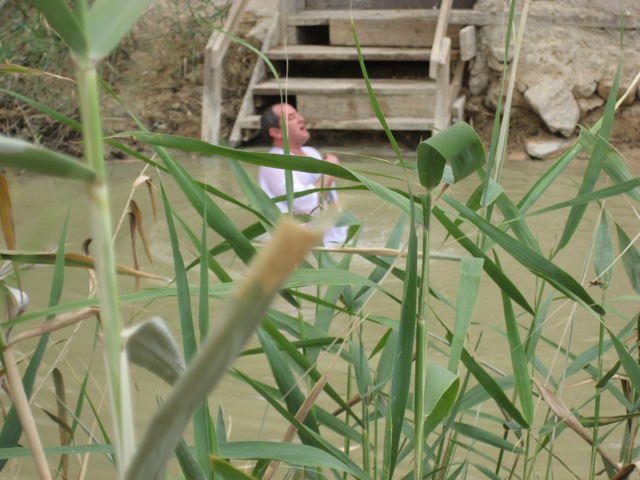
 The Jordan River’s source is a sewage pipe, and it ends in a whimper. Predicted to run dry by 2011, Karin goes on a media tour with FoEME to see firsthand the damage done. Here a Russian tourist dips into Kaser El Yehud, believed to be Jesus’ baptismal site on the Jordan.
The bus full of foreign journalists (including Green Prophet’s Maurice) wobbles down a barely graded side-road flanked by an untamed overgrowth of weeds and reeds. “I am going to show you something they don’t want you to see,” says Gidon Bromberg, water activist and director of the Israeli chapter of Friends of the Earth Middle East.
Bromberg has made it his life mission to protect Israel’s precious and limited water supply, the same waters shared by his neighbors and partners in Jordan, and the Palestinian Authority. There is a water crisis in the region; some like Bromberg cite mismanagement as one of the major reasons. Noses are held on approach as the bus reaches the site that some in Israel’s government would rather hide — not for religious or political reasons, but environmental ones.
About one and a half miles down the river from Yardenit where African, American and European Christian tourists drape themselves in white cotton robes and dip themselves into holy baptismal waters is a dam, and no longer a river.
The dam, which holds water from the Sea of Galilee to be pumped back to the land for agricultural use on water-intensive crops like citrus and bananas never actually makes it to the River Jordan site about 80 miles downstream where Jesus was baptized more than 2,000 years ago at Kaser El Yehud.
The lowest river on earth is spiritually and chemically low
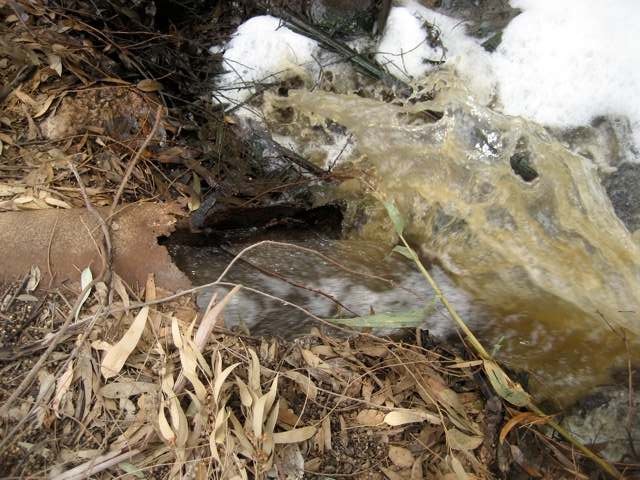
Up at the source of the lower Jordan River below the Sea of Galilee, the journalists hold their noses and wince. The source of the river is raw sewage funneling into the open mouth of the riverbed (see image below). The brown water comes from the toilets of nearby Israeli villages, and the sight and smell of it is visceral and shocking.
But it’s not just Israel that’s to blame. Just as many and even more Jordanians and Palestinians, for lack of a better solution, also let raw sewage pollute the river. The mix becomes more toxic as agricultural wastewater, saline water from the Sea of Galilee and fish farm effluent makes its way to the river, once majestic with currents and rapids — and now pitiful. Life sustaining invertebrates have left, the otters are gone and dense non-native and salt loving reeds crowd the rivers edge, replacing shady willows.
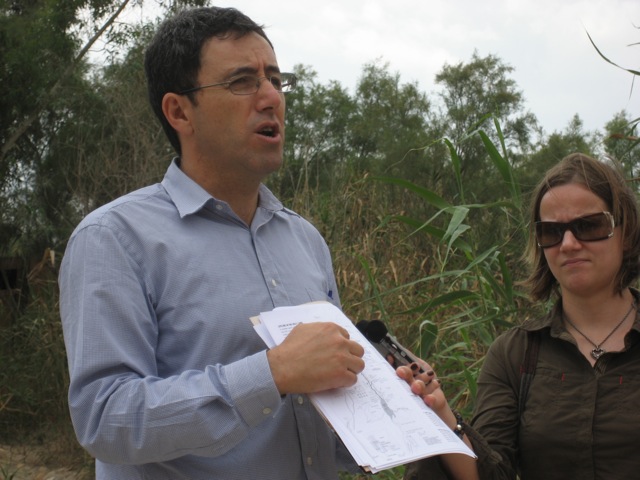
But Bromberg (pictured below) and his Palestinian and Jordanian colleagues at FoEME, with offices in Jordan, Bethlehem and Israel, the only true trilateral organization in the region, don’t see the desperate state of the Jordan River as a lost cause, even though a recent report they’ve released says the river will probably run dry by 2011. They see opportunities: opportunities for collaboration, environmental rehabilitation, tourism and peace making. They see that clean fresh water for all of the region’s inhabitants is not just good for the earth, it’s an imperative for peace.
This week the organization launched a report, the first of its kind, giving sound scientific justification and reason why all three entities, Jordan, Israel and the Palestinians, should clean up and return fresh water to the banks of the Jordan River. It was presented at a conference in Jordan, with about 200 specialists in water from the region and beyond in attendance.
Boating, baptism and barbecues
They hope it will become an influential report, convincing governments and funding bodies like the World Bank, as to how regional cooperation, and proper water management, and not necessarily major technological advancements like building more desalination plants and a Red Dead canal, can rehabilitate rivers, aquifers and the region’s coveted Dead Sea.
As part of their proposal they call on Jordan, Israel and the PA to replace water taken from the River Jordan, the water that was once there and to replace it with 75 percent freshwater, and 25% well treated sewage.
Providing economical reasons and suggestions to improve water efficiency and to reduce water demand, Bromberg hopes this report will have a knock on effect on other water problems, including that found at the “dying” Dead Sea where lack of freshwater from the Jordan, in conjunction with harvesting minerals, is causing an alarming recession of the water’s edge every year.
If water were to return to the Jordan River and feed the Dead Sea it is likely that the costly and controversial Red-Dead canal, which has massive environmental implications, will never have to be built. The Jordan River after all once fed into the Dead Sea. Meanwhile today, the only water that reaches the Dead Sea today is sewage from Jericho.
Bromberg says the alternatives proposed by FoEME will benefit many in the region, many “smaller” people who can take advantage of sustainable tourism, and agriculture — and not just a few big stakeholders who are set to make a lot of money from a Red-Dead canal.
Toxic to bathe in
“We are asking for one-third of the Jordan River water to come back,” Bromberg who tells ISRAEL21c implores. And if environmental and social reasons aren’t cause enough to help save the Jordan River, maybe religious ones will help: Kaser Al Yehud, just outside of Jericho and a few miles north of the Dead Sea is now toxic to bathe in.
It’s not only holy to Christians, but to about 50 percent of the world: Jews believe it to be the place where the Israelites crossed over to the Promised Land with Joshua, leaving Moses over in Jordan. While Muslims recognize that holy people are buried along its shores — the Four Companions to Mohammed.
Dunking in the water at the true baptismal site of Jesus is today quite dangerous; and people can get sick from bacterial infections they are likely to pick up says Bromberg. Despite the warnings, the journalists see a Russian tourist enshroud himself in the cloth and slide into the water from the Jordan site. Currently access is restricted from the Israeli-controlled side in the West Bank.
How can we tell people who have come so far for this spiritual experience not to enter the Jordan River? Bromberg asks. Even though the signs clearly say do not enter, they jump in. “He’ll likely get sick; develop a rash.”
Meanwhile FoEME celebrates small steps of achievements, such as influencing public opinion to push the governments to make change. It looks like there will be a sewage treatment plant at the source of the lower Jordan River in Israel, thanks to the work of FoEME, whose staff and volunteers know now that so much more needs to be done to save the River Jordan.
Boating, baptism and barbecues
They hope it will become an influential report, convincing governments and funding bodies like the World Bank, as to how regional cooperation, and proper water management, and not necessarily major technological advancements like building more desalination plants and a Red Dead canal, can rehabilitate rivers, aquifers and the region’s coveted Dead Sea.
As part of their proposal they call on Jordan, Israel and the PA to replace water taken from the River Jordan, the water that was once there and to replace it with 75 percent freshwater, and 25% well treated sewage.
Providing economical reasons and suggestions to improve water efficiency and to reduce water demand, Bromberg hopes this report will have a knock on effect on other water problems, including that found at the “dying” Dead Sea where lack of freshwater from the Jordan, in conjunction with harvesting minerals, is causing an alarming recession of the water’s edge every year.
If water were to return to the Jordan River and feed the Dead Sea it is likely that the costly and controversial Red-Dead canal, which has massive environmental implications, will never have to be built. The Jordan River after all once fed into the Dead Sea. Meanwhile today, the only water that reaches the Dead Sea today is sewage from Jericho.
Bromberg says the alternatives proposed by FoEME will benefit many in the region, many “smaller” people who can take advantage of sustainable tourism, and agriculture — and not just a few big stakeholders who are set to make a lot of money from a Red-Dead canal.
Toxic to bathe in
“We are asking for one-third of the Jordan River water to come back,” Bromberg implores. And if environmental and social reasons aren’t cause enough to help save the Jordan River, maybe religious ones will help: Kaser Al Yehud, just outside of Jericho and a few miles north of the Dead Sea is now toxic to bathe in.
It’s not only holy to Christians, but to about 50 percent of the world: Jews believe it to be the place where the Israelites crossed over to the Promised Land with Joshua, leaving Moses over in Jordan. While Muslims recognize that holy people are buried along its shores — the Four Companions to Mohammed.
Dunking in the water at the true baptismal site of Jesus is today quite dangerous; and people can get sick from bacterial infections they are likely to pick up says Bromberg. Despite the warnings, the journalists see a Russian tourist enshroud himself in the cloth and slide into the water from the Jordan site. Currently access is restricted from the Israeli-controlled side in the West Bank.
How can we tell people who have come so far for this spiritual experience not to enter the Jordan River? Bromberg asks. Even though the signs clearly say do not enter, they jump in. “He’ll likely get sick; develop a rash.”
Meanwhile FoEME celebrates small steps of achievements, such as influencing public opinion to push the governments to make change. It looks like there will be a sewage treatment plant at the source of the lower Jordan River in Israel, thanks to the work of FoEME, whose staff and volunteers know now that so much more needs to be done to save the River Jordan.
More on the Jordan River:
Read Maurice’s account of the historical problems and solutions proposed for the Jordan
Jordanian Students Work to Save the Jordan River
Pope Calls on People to Clean the Jordan River
(This story was first published on ISRAEL21c – www.israel21c.org. Images by Green Prophet)



Y’know our American Christians place their faith in the Lord to keep them healthy and safe while baptizing each other at the real location where Jesus was baptized, and I personally feel this should be encouraged.
In fact we should find some way to give them free airfare to that location and encourage them to lounge lazily in the Jordon River there so that they can then emerge as healthy as they were when they went in to prove to everyone that Jesus kept them safe.
(sarcasm)