

SolCold wants to cool buildings using sunlight

Dolat Abad windcatcher in Yazd

For centuries people living in hot climates have tried to cool buildings without electricity. Long before air conditioning, architecture itself acted as the cooling system. It’s called using passive energy. In Iran, for example, traditional homes used wind catchers, known as badgirs, tall towers that captured breezes and funneled cooler air down into homes. These passive ventilation systems have been used for thousands of years across the Middle East and can naturally cool buildings by directing airflow and expelling hot air.

In hot climates like the Middle East and North Africa, homes were also designed around inner courtyards with pools and shaded gardens, allowing for privacy, but also for cool air to circulate through thick mud-brick walls and shaded spaces during the day. In some cases, underground spaces connected to aqueducts or water channels were used to further cool incoming air before it entered the building.

white reflective paint, researchers look at samples
Purdue researchers Xiulin Ruan (left) and Joseph Peoples use an infrared camera to compare the cooling performance of white paint samples on a rooftop. (Purdue University photo/Jared Pike)

Modern sustainable architecture has tried to rediscover these ancient ideas. Over the years we have covered everything from white roof paint that reflects sunlight to experimental passive cooling materials designed to reduce air-conditioning demand.

Afghan car cooler, DIY car air conditioner, evaporative cooling system, windcatcher technology, Persian windcatcher, sustainable car cooling, off-grid AC, homemade car AC, eco-friendly air conditioner, Kandahar taxi innovation, low-tech air cooling, passive cooling system, DIY swamp cooler, solar car cooler, ancient Persian technology, car cooling without electricity, desert cooling hack, traditional air conditioning, Afghan taxi cooler, budget car air conditioning
Afghan windcatchers on taxis, via the AFP

Now an Israeli startup says it may have taken the idea a step further: cooling surfaces using sunlight itself.

SolCold, a climate-tech company based in Ness Ziona, Israel, has developed a nanotechnology coating that actively cools surfaces when exposed to sunlight. The company was founded in 2016 by Yaron Shenhav and Dr. Yaron Shenhav (co-founder and CEO), based on research originating at the Hebrew University of Jerusalem.

The coating can be applied to buildings, vehicles, shipping containers and even fabrics. When sunlight hits the material, it triggers a physical process that reflects most solar radiation, converts absorbed heat energy into light, and releases heat through radiative cooling. Sort of the way you cool down after you pop into the water and then stand in the air.

Unlike traditional reflective coatings or “cool roof” paints, which simply bounce sunlight away, SolCold’s technology actively removes heat from the surface. In direct sunlight, coated objects can become cooler than the surrounding air.

The hotter the environment and the stronger the sun, the stronger the cooling effect. In laboratory tests the coating has demonstrated temperature reductions of up to about 20°C below ambient conditions.

The company says the technology could significantly reduce air-conditioning demand in buildings, cut energy use in refrigerated shipping containers, and help lower the urban heat island effect that traps heat in cities.

SolCold has raised several million dollars in venture funding, with investors including the Israel Innovation Authority and private climate-tech investors, and has conducted dozens of pilot projects with global automotive and industrial companies, testing the coating on vehicles and equipment exposed to intense sunlight. Major global manufacturers have reportedly tested the technology for use on vehicles and industrial equipment exposed to heat.

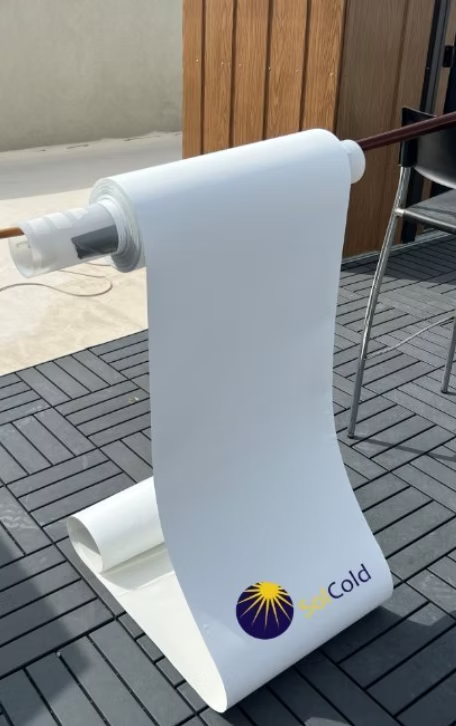
The company is entering a growing field of passive cooling and reflective materials, competing with technologies such as cool roof coatings from companies like Cool Roof Rating Council partners, radiative cooling materials developed at Stanford and MIT, and reflective paints such as those commercialized by PPG and other building-materials manufacturers.

Its first product named “Glacier 110,” is an opaque, white solid film with a thickness of 350 µm, an area density of 0.3 kg/m2, and is highly durable, lasting for ten years in high-performance applications. The material’s optimal cooling power is 70W/m2 – 170 W/m2 at noon in summertime. It can be used on buses to keep occupants cool, for instance.

Glacier 110 has four layers: a smart filter that lets 1% of heat pass through it, an anti-stokes layer, a radiative cooling layer, and a mirror layer. The coating maintains a low ambient temperature throughout its entire architecture.

The main benefits of the company’s innovative products include zero electricity and fuel consumption and zero carbon emissions. Used in clothing, it protects the health of the wearer.

If the technology scales commercially, coatings that turn sunlight into cooling power could offer a modern, high-tech counterpart to the ancient passive cooling systems that shaped desert architecture for centuries.


Karin Kloosterman
Karin Kloostermanhttp://www.greenprophet.com
Karin Kloosterman is an award-winning journalist, innovation strategist, and founder of Green Prophet, one of the Middle East’s pioneering sustainability platforms. She has ranked in the Top 10 of Verizon innovation competitions, participated in NASA-linked challenges, and spoken worldwide on climate, food security, and future resilience. With an IoT technology patent, features in Canada’s National Post, and leadership inside teams building next-generation agricultural and planetary systems — including Mars-farming concepts — Karin operates at the intersection of storytelling, science, and systems change. She doesn’t report on the future – she helps design it. Reach out directly to [email protected]

LEAVE A REPLY

Please enter your comment!
Please enter your name here

TRENDING

EU Ports Still Power Russia’s Arctic Gas Exports Despite Phase-Out Pledge

The findings suggest that rather than declining, Europe’s reliance on Yamal LNG intensified in 2025. Yamal cargoes accounted for 14.3% of the EU’s total LNG imports, equivalent to roughly one in every seven LNG ships arriving at European terminals.The findings suggest that rather than declining, Europe’s reliance on Yamal LNG intensified in 2025. Yamal cargoes accounted for 14.3% of the EU’s total LNG imports, equivalent to roughly one in every seven LNG ships arriving at European terminals.

Ecomondo 2025: Italy’s Green Expo Powers Global Circular Innovation

Each November, a quiet city on Italy’s Adriatic coast becomes the epicenter of the world’s circular economy conversation. What began in 1997 as a local waste management trade show has grown into Ecomondo, a global forum for environmental innovation, resource regeneration, and ecological transition.

Helion Energy, AI, and the New Cold Fusion War With China

Helion’s model plays to America's old strength: innovation through agility, not top-down megaprojects. Instead of waiting for 2050, Helion’s compact reactors aim to deliver electricity in a matter of years—and not just for cities, but for data centers, isolated industries, military bases, even disaster zones. Their current prototype, Polaris, is scheduled to fire in 2025. If Helion succeeds, it won’t just disrupt global energy. It could redraw the world map.

Trump’s “Shower Liberation” Proposal: A Disastrous Step Back or a New Path to Efficiency?

New findings revealed that at any given flow rate, higher-pressure showers were associated with lower water consumption. While low-flow showers delivered less water than high-flow-rate showers, high-pressure showers used less water overall because they were turned off sooner.

The UN builds an AI coalition to save the planet

Over 100 partners, including 37 tech companies, 11 countries and 5 international organizations, have joined forces with the UN under the Coalition for Environmentally Sustainable Artificial Intelligence, aiming to ramp up global momentum to place AI on a more environmentally sustainable path. 

From Pilot Plant to Global Stage: How Aduro Clean Technologies’ 2026 Expansion Signals a Turning Point for Chemical Recycling Investors Like Yazan Al Homsi

The company's Next Generation Process (NGP) Pilot Plant in London, Ontario, has officially moved into initial operating campaigns, generating the kind of structured, repeatable data that separates laboratory promise from commercial viability.

How AI Helps SaaS Companies Reduce Repetitive Customer Support Work

SaaS products are designed for large numbers of users with different levels of experience, and also in renewable energy.

Pulling Water from the Air

Faced with water shortage in Amman, Laurie digs up...

Turning Your Energy Consultancy into an LLC: 4 Legal Steps for Founders in Texas

If you are starting a renewable energy business in Texas, learn how to start an LLC by the books.

Tracking the Impacts of a Hydroelectric Dam Along the Tigris River

For the next two months, I'll be taking a break from my usual Green Prophet posts to report on a transnational environmental issue: the Ilısu Dam currently under construction in Turkey, and the ways it will transform life along the Tigris River.

6 Payment Processors With the Fastest Onboarding for SMBs

Get your SMB up and running fast with these 6 payment processors. Compare the quickest onboarding options to start accepting customer payments without delay.

Qatar’s climate hypocrisy rides the London Underground

Qatar remains a master of doublethink—burning gas by the megaton while selling “sustainability” to a world desperate for clean air. Wake up from your slumber people.

How Quality of Hire Shapes Modern Recruitment

A 2024 survey by Deloitte found that 76% of talent leaders now consider long-term retention and workforce contribution among their most important hiring success metrics—far surpassing time-to-fill or cost-per-hire. As the expectations for new hires deepen, companies must also confront the inherent challenges in redefining and accurately measuring hiring quality.

Related Articles

Popular Categories